Things You're Just Supposed to Know

Most of the time, Long-Forgotten assumes that readers are already familiar with basic facts
about the Haunted Mansion. If you wanna keep up with the big boys, I suggest you check out
first of all the website, Doombuggies.com. After that, the best place to go is Jason Surrell's book,
The Haunted Mansion: Imagineering a Disney Classic (NY: Disney Editions; 2015). That's the
re-named third edition of The Haunted Mansion: From the Magic Kingdom to the Movies (NY:
Disney Editions, 2003; 2nd ed. 2009). Also essential reading is Jeff Baham's The Unauthorized
Story of Walt Disney's Haunted Mansion (USA: Theme Park Press, 2014; 2nd ed. 2016).

This site is not affiliated in any way with any Walt Disney company. It is an independent
fan site dedicated to critical examination and historical review of the Haunted Mansions.
All images that are © Disney are posted under commonly understood guidelines of Fair Use.

________
.
Showing posts with label The New Twilight Zone. Show all posts

Thursday, August 1, 2013

The Shadow Man

.
We've explored the cultural/mythical backgrounds of so many supernatural manifestations encountered in the Haunted Mansion that you'd think by now we must have covered them all, but not so.  Here's one we have not discussed at all:
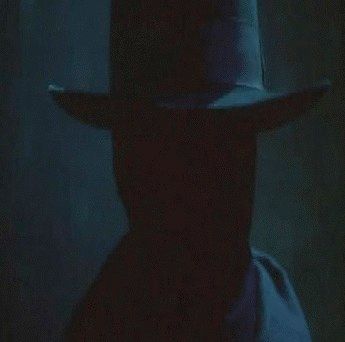

What we have here is not a ghost so much as a paranormal being, variously classified. If you Google "Shadow People," you'll be inundated with sites discussing this phenomenon. You'll read of demons, or you'll read of aliens, and nowadays "interdimensional beings" is a pretty popular explanation too.  Belief in Shadow People seems to run independently of belief in ghosts. There are people who have never seen a ghost and even have doubts about their existence who swear that they have had creepy encounters with Shadow People.

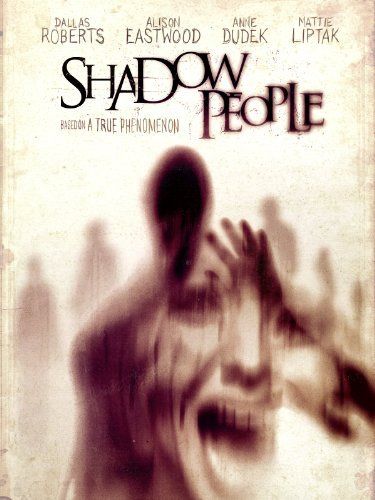
These beings are no strangers to popular entertainment culture.  A recent example is the 2012 horror film Shadow People, which claims to be "based on a true phenomenon."  Gosh.  (I'm sitting here trying to think what it would take to falsify the claim, "based on a true phenomenon.")

The Hat Man

The "Hat Man" is one particular variety of Shadow folk who shows up over and over, and I have to say that I find the hatted figure at least ten times scarier than the hatless types, and I don't even know why.
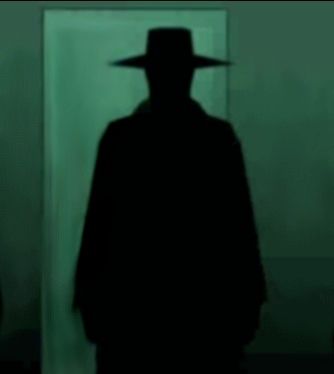

People rarely get a good look at him.  It's usually an "out of the corner
of your eye" manifestation, which only makes him that much scarier.
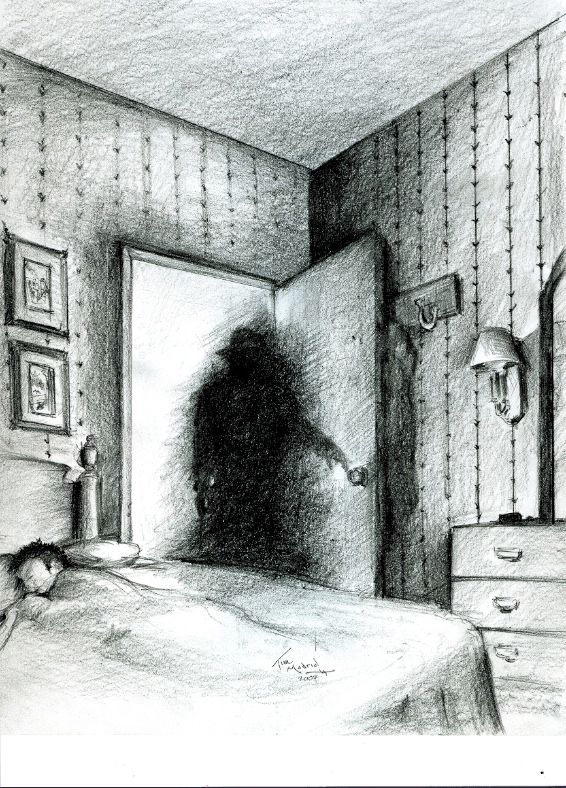

Merchandizers of horror haven't let this opportunity slide by, of course.
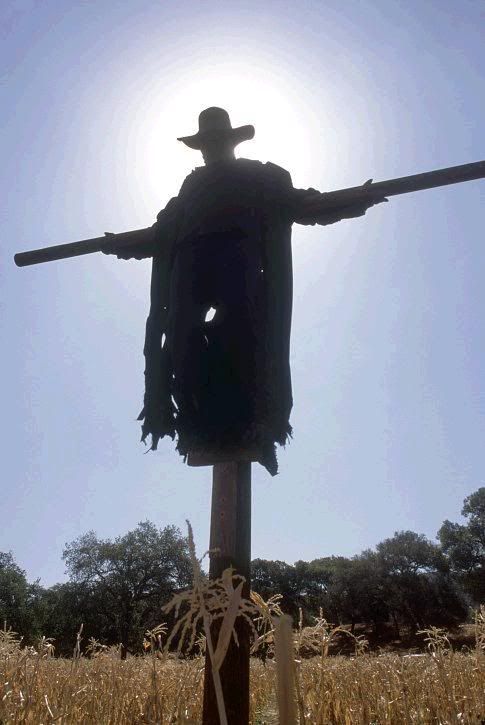
The Jeepers Creepers film series cashes in on it with their villain:

One of the better episodes of the new Twilight Zone series in the 80's was a Joe Dante directed piece called "The Shadow Man," about one of these dark fellows who lived under a 13-year-old boy's bed and was definitely up to no good.  I remember that when I first saw it back in '85, it was just about the scariest thing I had ever seen on a regular TV program.  It's up on youtube as of this writing, and if you haven't seen it, you should. Terrible music and utterly unconvincing performances by the young actors, but forget all that.  It's got one of the best twist endings evah.


I am the Shadow Man...


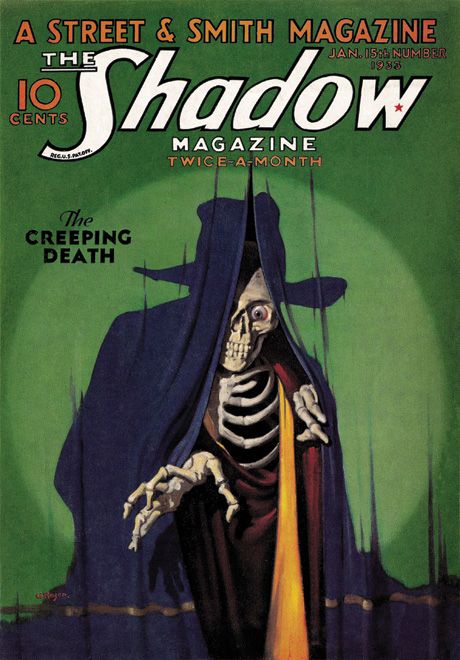
In pop culture, the basic Hat Man image goes back at least to the early 1930's and the creepy anti-hero, "The Shadow," famous from pulp novels, comics, and an immortal radio program, where he was sometimes portrayed by Orson Welles.  (That seems right; in later years Welles did indeed cast quite a shadow, as I recall.)  The Shadow bears a remarkable resemblance to our Hat Man.

The Shadow Knows
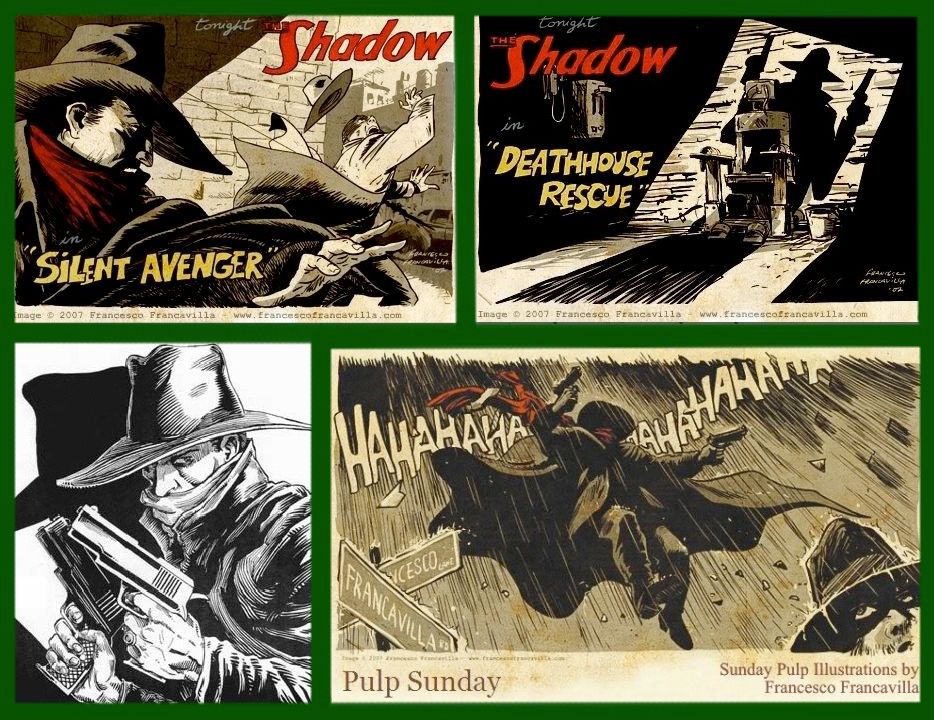


As the first "dark knight" avenger and anti-hero, The Shadow may have served
as a prototype for Batman, although in this one he looks more like Bela Legosi:


We could chase this guy around all day. People continue to report sightings in the Santa Lucia mountains along the central California coast of what have come to be known as "Dark Watchers," black robed and broad-rimmed hatted specters.  They're always in the distance, either staring at the visitors or off into nowhere in particular.  If you approach them they vanish.  They say.  No one knows how long they've been reported, but they're mentioned in a John Steinbeck short story, so they've been around since the 1930's at least.  There are supposed to be old stories about them among the local Native Americans, taking us back into the mists of antiquity, but *yawn* that's de rigueur with these kinds of things.  It seems like any time any weird thing like this is reported anywhere in North America, it isn't long before someone makes confident claims about old Indian traditions in connection with said Weird Thing. (For the record, in this case, responsible anthropologists who have learned everything they can about Native Americans in the Santa Lucia area—those would be the Chumash Indians—haven't found anything there about the Dark Watchers.)
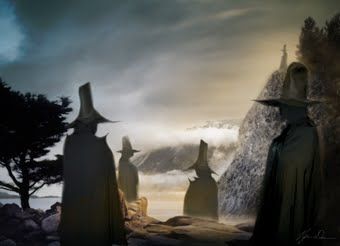

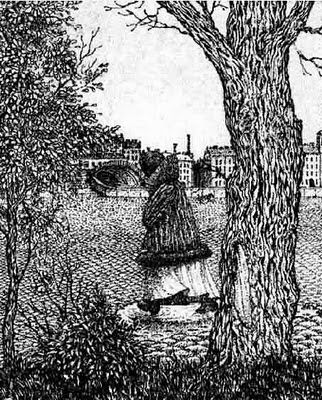
Nevertheless, I do suspect that the essential image here goes back a lot further than the 1930's.  No doubt you've heard of the artist Edvard Munch? You know, the guy who did "The Scream"?  Yeah, him. Well, here's an equally cheerful Munch piece from 1890, innocently called "Night in St. Cloud."  Would you sit next to this guy?  Hey . . . where's his shadow, anyway?


Yeesh.  I'm tellin' ya, it's that damn hat.
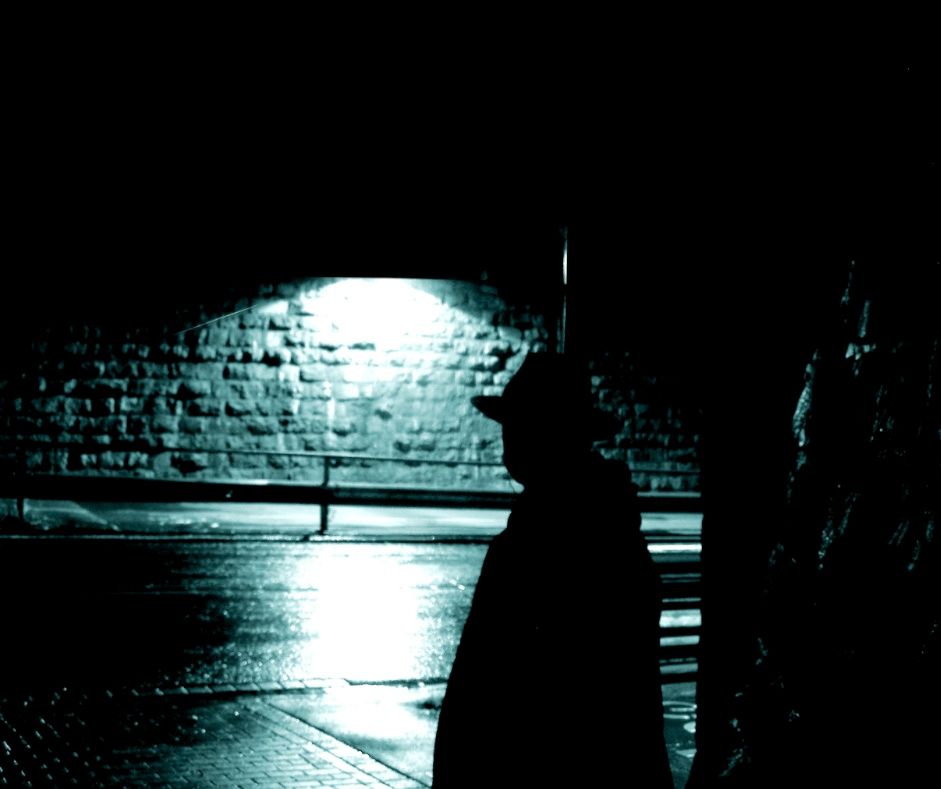
(pic by erix!)

Shadow People in the Mansion

So now that we're a little more familiar with the territory, we may ask whether the Haunted Mansion Imagineers put any Shadow People into the house.  And of course the answer is yes. Some of the early concept art definitely tries to tap into those vague, amorphous, SP atmospherics. Here are two sketches, most likely by Ken Anderson.  Feast your eyes; they're extremely rare.

This first one was on display in the Disney Gallery for awhile in 2003, but I don't think it's ever been published.
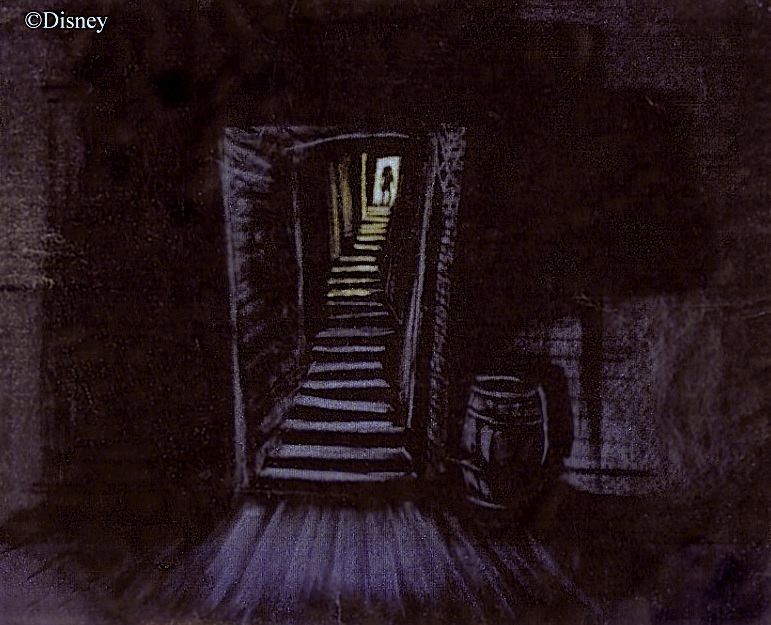

And I don't think this second one has ever been officially displayed or published anywhere.
[Edit: It was displayed at the 50th HM Anny exhibit in the Opera House]
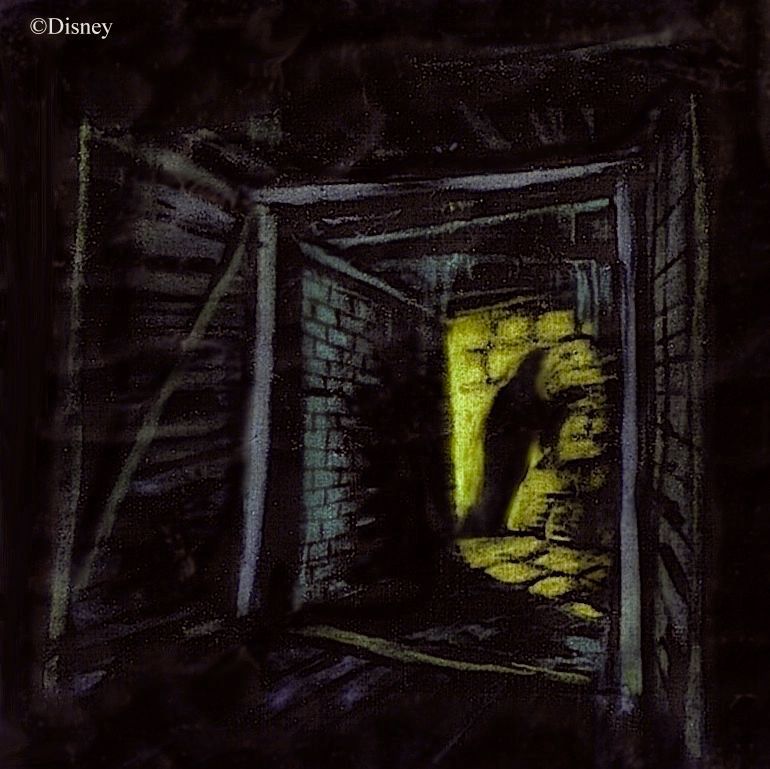

Incidentally, that second one is a superb example of Mansion cross-pollination with other Disney attractions.  It's obviously
inspired by a piece of Eyvand Earle concept art for the Sleeping Beauty walk-thru, especially if you reverse it like I do here:
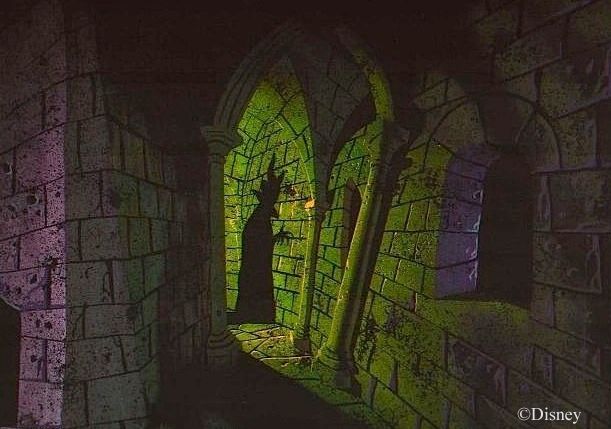

Anderson was working on the Sleeping Beauty attraction at about the same time that he was also working on the Ghost House project.  We really don't need evidence in order to suppose that Anderson knew this particular piece—he must have—but as a matter of fact we happen to have such evidence anyway, in this photo which we've run before showing Ken and Claude Coats working on the Sleeping Beauty project:
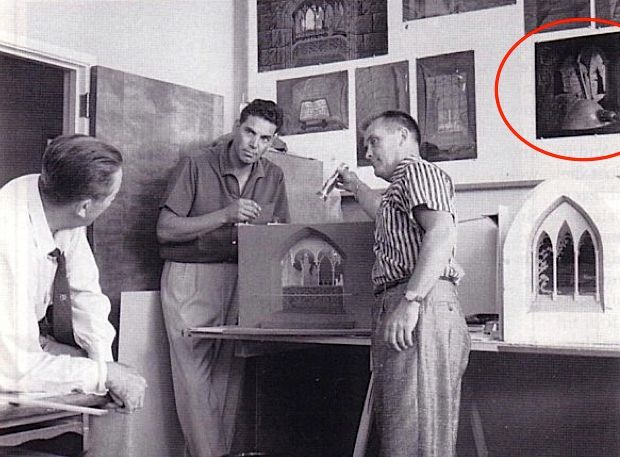

Speaking of Coats...
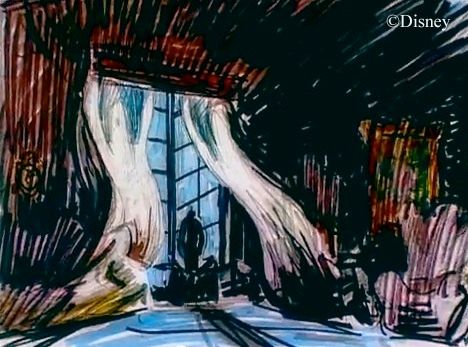

These ominous figures recall the more amorphous, unhatted variety of Shadow People, but in the
80's and 90's the Imagineers went full-on Hat Man, starting with Phantom Manor concept artwork...
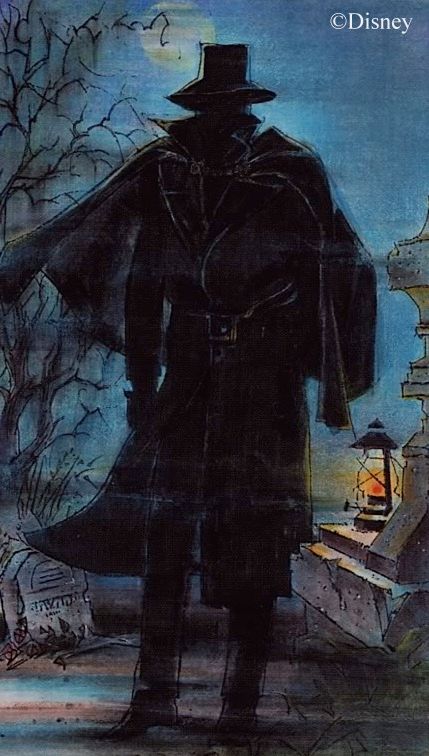

(Hat tip DHI)

...and ending with the introduction of a new character at Disneyland, the attic pianist of 1995.
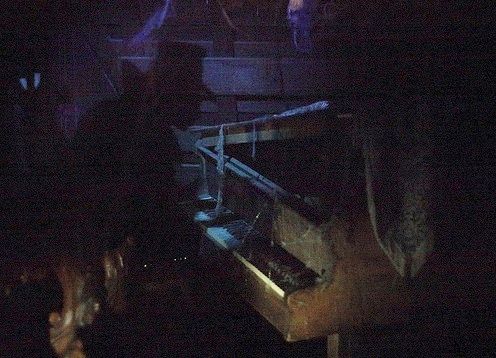
(pic by K447)

Some people think the pianist is supposed to be the Hatbox Ghost, or at least a tribute
to the Hatbox Ghost.  It's possible, but I doubt it.  The style of hat isn't quite right.
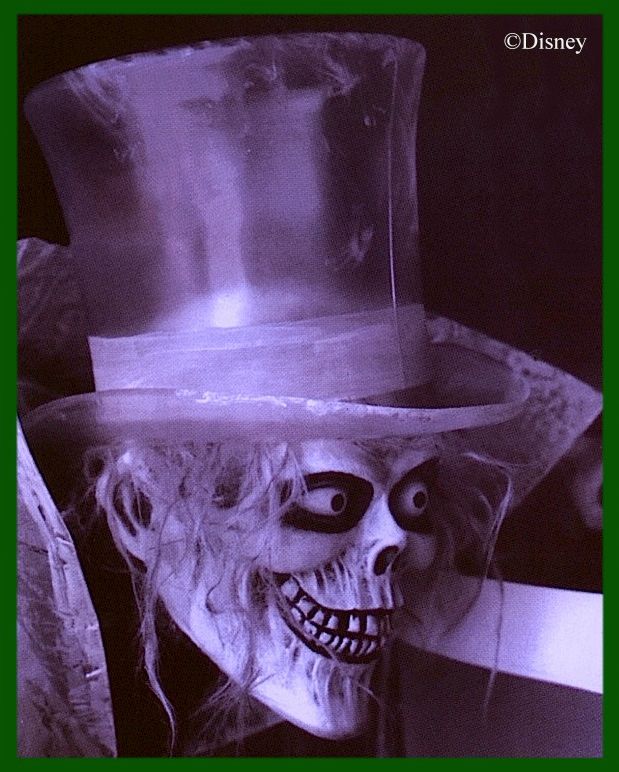

But if it's wrong for him, it's right for the Hat Man, with its slightly droopy, downward-sloping brim, quite noticeable in this crisp Daveland shot:


According to some interpretations of the Shadow People, the shadow is all there is. These aren't shadows OF someone or something; the shadow is itself the being. The attic piano player seems to be precisely this kind of apparition.  The shadow demons in The Princess and the Frog are also good examples of this type of manifestion.
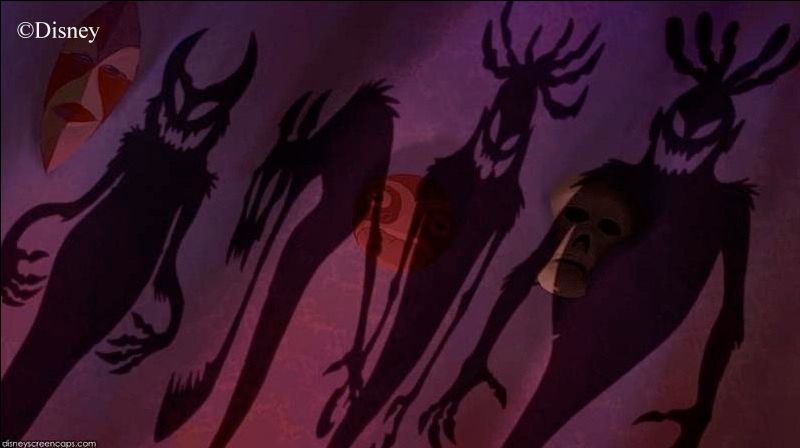

This makes me wonder whether there are other specters in the Mansion that could or should be regarded
as Shadow People rather than the cast shadow of some sort of unidentified spook.  How about this one?
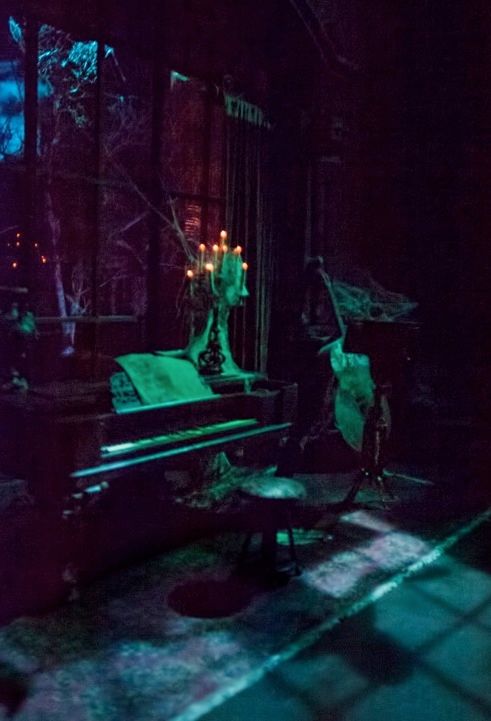
(pic by Jeff Filmore -LifebytheDrop)

Probably not.  Notice that unlike the attic pianist at Disneyland, the shadow is not itself in the position of the player.  We're supposed to
take this as the cast shadow of a not-quite-yet materialized spirit, similar to what you find in this gag from Mickey's Christmas Carol:
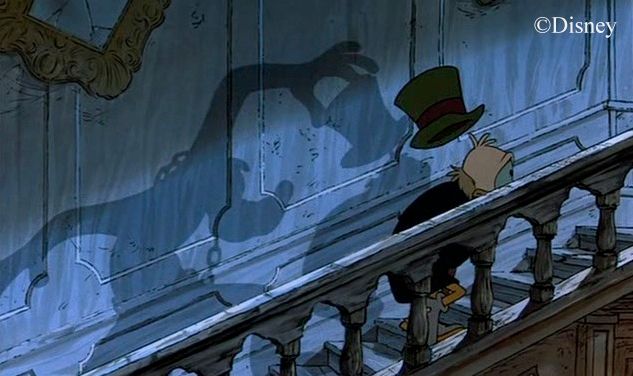

By the way, that gag isn't new:

Okay, well, how about this one?
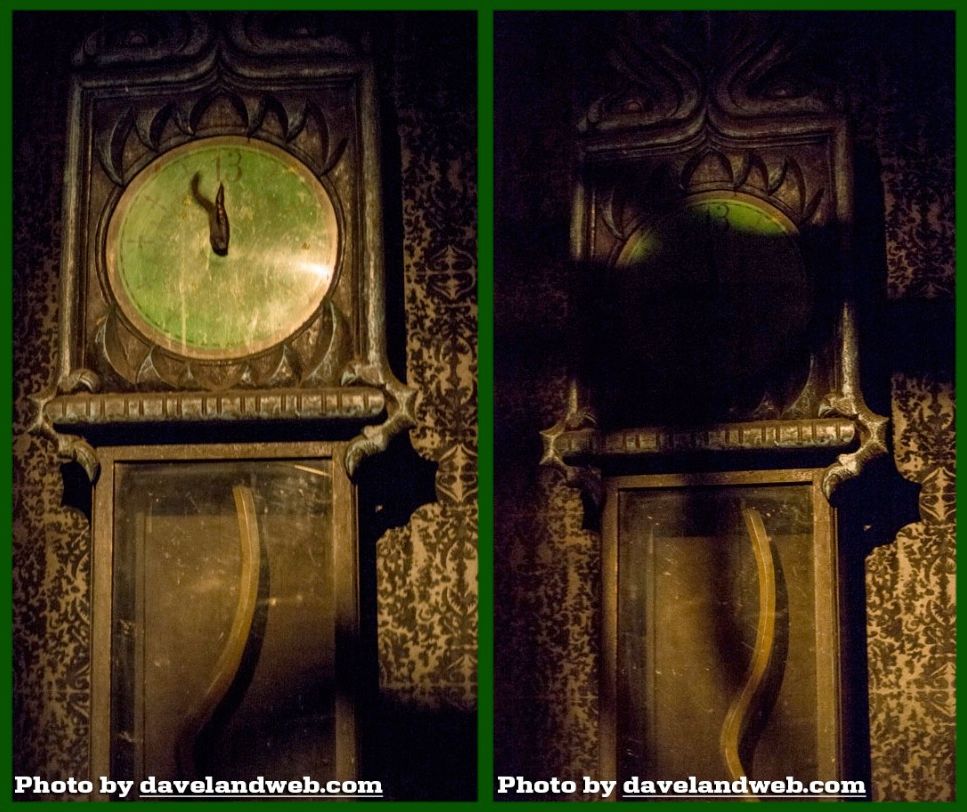

This is a better candidate.  Have you ever considered the possibility that there may not be anyone behind you at all, casting that shadow?

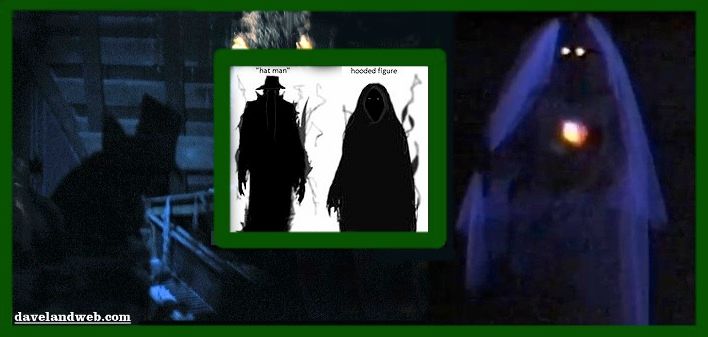
As it happens, one of the most celebrated ghosts in the Mansion may be drawing inspiration from these same murky wells.  Besides the Hat Man,
a few other "species" of Shadow People have been identified, including a hooded figure with glowing eyes.  Kind of a tall, dark Jawa, I guess.


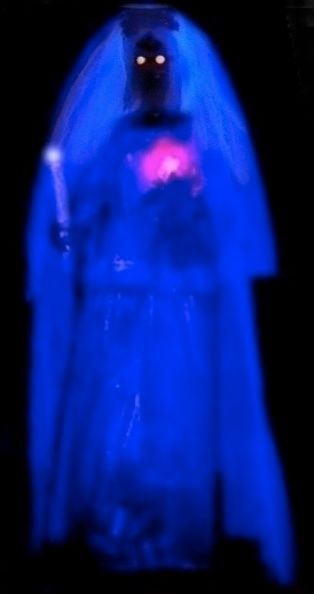
Look familiar?  Lots of people, including myself, think that the creepiest, scariest attic bride was the dark-faced, round-eyed, Beating Heart
version.  Could that be because she seems vaguely like something more or other than your garden variety ghost?  I don't know, but I wonder.

Come to think of it, that illustration of the two most often reported varieties of shadow people is eerily reminiscent of the attic occupants in general.  I don't know if this a matter of sheer coincidence or another example of well-tuned artistic instinct. On the other hand, this particular incarnation of the bride was taken out at the same time that the pianist went in, so they've never been seen there together. Perhaps I'm making something out of nothing (again).  I don't know what's going on here, if anything, but I wonder.

I don't know, but I  wonder.
Sometimes I think that's my life motto right there.
And sometimes it doesn't bother me if it is.

It's a Joke...

It would probably be a huge mistake to assume that the Imagineers thought they were dealing with a wholly other type of critter when they threw Shadow People into the mix.  One of the ground rules in the world of the Haunted Mansion is that no real lines are drawn between one netherworldish being and another.  "Ghosts" includes not only spirits of the dead, but banshees, wraiths, demons, phantoms, poltergeists, goblins——you name it. Shadow men are just another part of the ghoulish goulash presented under the catch-all rubric of "ghosts" or "spirits."  You are further given to understand that almost all of them are "happy haunts" and "silly spooks," and since no one actually believes in fun-loving ghosts, the attraction disclaims any and all attempts to tell you anything serious about what populates The Unknown.  There's wisdom in that.  Marc Davis ain't no theologian and he ain't no paranormal investigator.

But for sure Davis does know what he's doing.  He's going after Disney's biggest target audience: the Average Joe.  To be sure, you and I know exactly what a banshee is. ("She's not quite a ghost, but a spirit of the fairy folk," says one source.)  Demons are quite another thing, and poltergeists yet another. But we Forgottenistas are a little peculiar in our intellectual pursuits.  Average Joe just sort of smiles and says, "Whatever.  A spook's a spook." He's skeptical about whether they exist at all, but even if they do, he's still skeptical that we can know anything about them with certainty.

That seems to be the premise of the Haunted Mansion as well, but curiously enough, this ghostly homogenization for purely comic purposes is agreeable to not one but two decidedly uncomical schools of thought on the subject.


...And Therefore It Should Be Taken Seriously


First of all, on the Christian side, the Church has always held that undisciplined curiosity about the occult world is unhealthy, for the simple reason that you don't know who or what it is you're pursuing.  Yes, there are beings over there, says the Church.  No, you have no way of judging which are good and which are bad, especially since the bad are going to try to look like they're good, and they seem to have such skills as are necessary to do it convincingly. Between their shape-shifting abilities and their suspect motives, how are you supposed to know who or what you're dealing with?  Spiritually speaking, it just isn't safe to travel through that forest alone at night.

Second, some of the most respected secular paranormal investigators have come to much the same conclusion.  I'm thinking in particular of Jacques Vallée and John Keel.  Many sane and serious people believe that there is sufficient evidence to conclude that there are non-human intelligences cohabiting the planet with us who are normally imperceptible by us.  Beyond that general observation, you've got your angels, demons, gods, fairies, ghosts, sprites, kelpies, gnomes, aliens, extra/intra-terrestrials, reptilians, elves, Care Bears, Men in Black, Shadow People——there's simply no way to know how many of these are actually separate "species" or even if they're all the same thing, wearing different masks for God knows what reasons.  The Care Bears, at least, have been revealed for what they really are (*shudder*).

(right: Vallée; left: Keel)

Vallée and Keel do think these critters are generally untrustworthy, whatever they are.  When they choose to communicate with us, they frequently turn out to be liars, and sometimes malicious ones.  Hence, Vallée and Keel, neither of them religious, end up giving you advice similar to that of the Pope or your local Baptist pastor: You don't know and can't know what you're pursuing, and it is probably not wise to actively seek such contact.  Even if you're skeptical and regard this whole mess as a human psychological phenomenon, it's still the case that that way lies madness.

Of course, we don't get anything posing as an ET from Venus at the Mansion.  Here, the only interest is in the sort of "goblins and ghoulies" that can reasonably be said to have come "from last Halloween." Still, when the show jumbles these all together and presents them to us in a comic venue, it may, if we let it, have the healthy effect of reminding us that Average Joe has a point: We know a lot less than perhaps we like to think we do when it comes to sorting out what lies in regions beyond, and that's the kind of attitude that can keep you out of trouble.  There's a reason it's called The Unknown.


Saturday, May 26, 2012

Walls and Stares

.
We've done a lot of posts exploring the historical, literary, cinematic, and even musical roots of things that go bump in the night at the Haunted Mansion.  There are some phantoms, however, that originate not in events or figures from the past but in universal psychological experiences.  There is still a history to look at, but in these cases history is used to show that those experiences are indeed common to most or all of us and have been around for a long time.  Today we're all about resurrecting and exploiting childhood fears. Hey, why not?  That's as good a way as any to give folks the willies.  Specifically, we're going to look at scary faces seen in abstract or semi-abstract patterns, the sorts of patterns used to decorate walls and furniture.
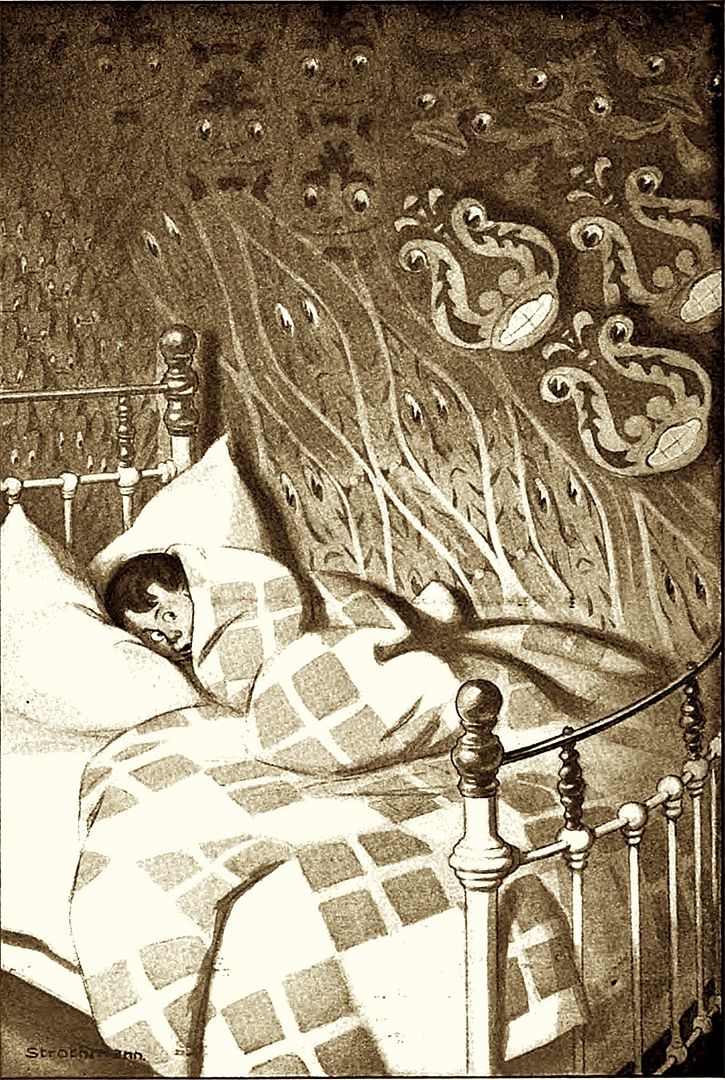
I wasn't going to devote a whole post to what seems like an extremely narrow topic, but Craig Conley, bless 'im, discovered this gem and brought it to my attention.  It's from the November 1904 edition of Good Housekeeping magazine.  It proves that exactly this sort of childhood terror is nothing new.


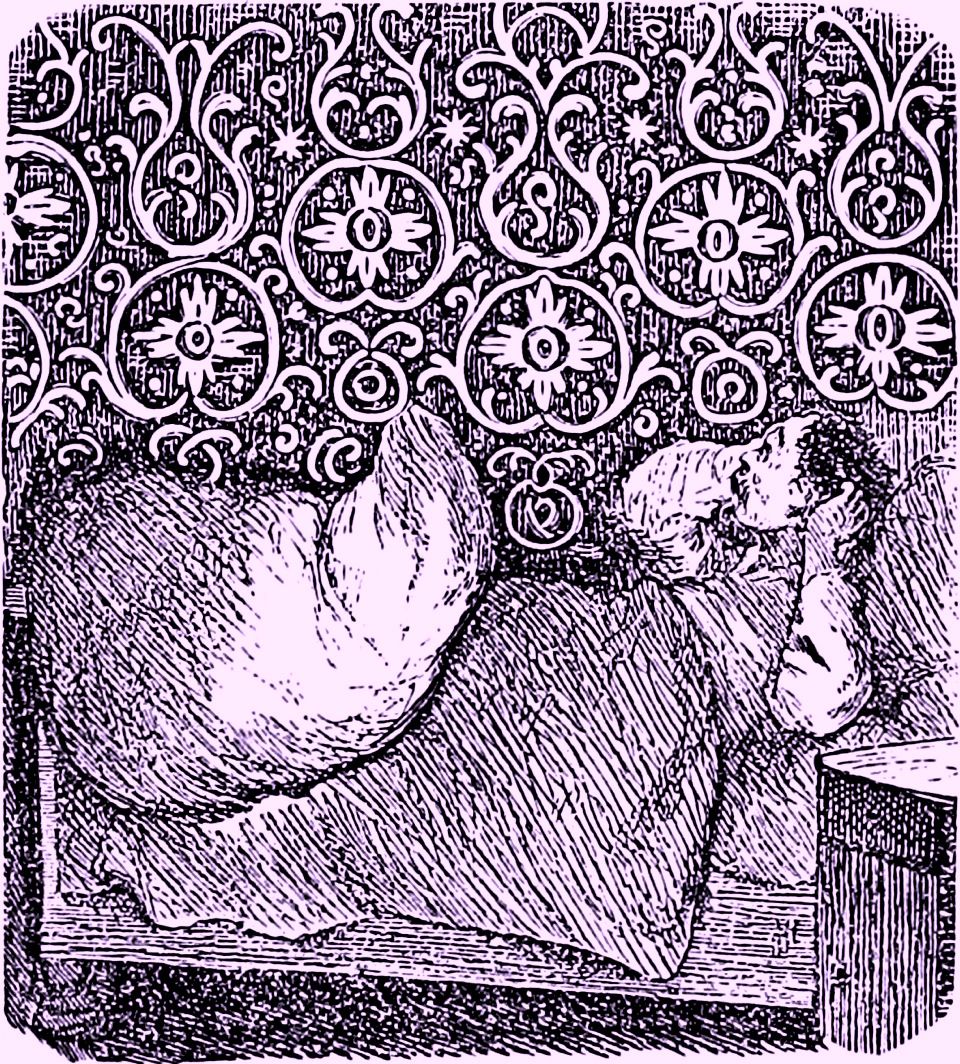
It's not just a kid thing, either. For an adult perspective, let's go back another quarter century to page 123 of Berlin Under the New
Empire (1879), by Henry Vizetelly. It seems Mr. V. doesn't care much for German wallpaper. (This is another Conley find.)


"The wall-papers in many private houses and hotels are remarkable for their hideous patterns, which, in the case of nervous individuals are sufficient to induce an attack of nightmare.  These papers are bad enough in the daytime, but at night—lighted perhaps by a trembling moonray—they assume a ghastly aspect.  Great ogres' heads, with eyes as large as saucers, and mouths which seem to open wider and wider every minute, appear to stare down upon one; serpents twist and twirl in endless arabesques, as though about to spring; while little demons perch themselves here and there round the room with hideous grins stereotyped upon their features.  No wonder that a stranger, with the indigestible Berlin cuisine lying heavily on his chest, should imagine himself encompassed by all manner of horrors, and engage in a more or less desperate struggle with the spirits of the air, in the course of which the hateful bag of feathers is certain to overbalance itself and topple to the ground, leaving him shivering in a half-sleeping, half-waking state during the remainer of the night."

It's hard to know how far back we can trace this particular bogey.  I suppose that when the fires burned low and the shadows of night took over, cavekids used to shiver at the sight of knarly old trees turning into monsters, but if we want to stay indoors and talk about childhood terror triggered specifically by patterns in walls and furniture, I suppose we have to wait until the emergence of cheap, mass produced, decorative detailing.  Before that, wall devils would have been a luxury known only to the lucky few, the children of the rich and powerful.  If only he had been born a few generations further back, that unlucky kid in our cartoon would have been sleeping soundly.

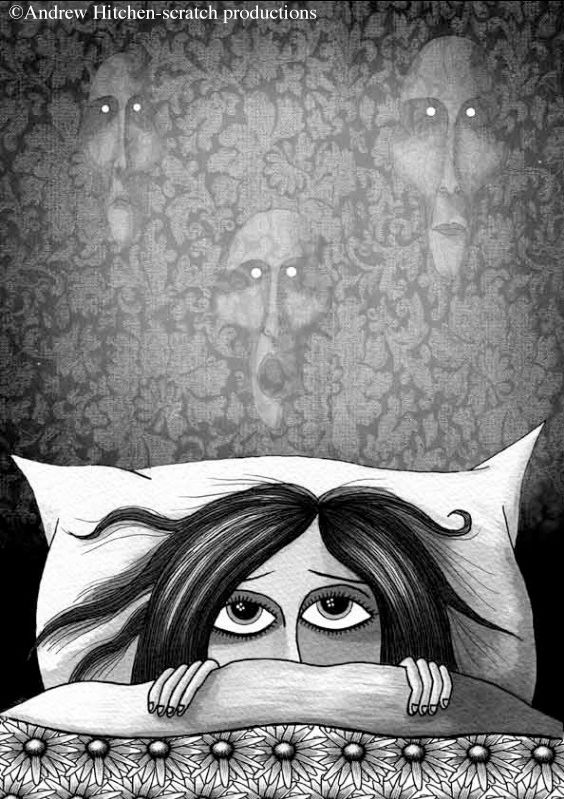
Flash forward a century and we see that nothing has changed.

(illustration © Andrew Hitchen - scratch productions)

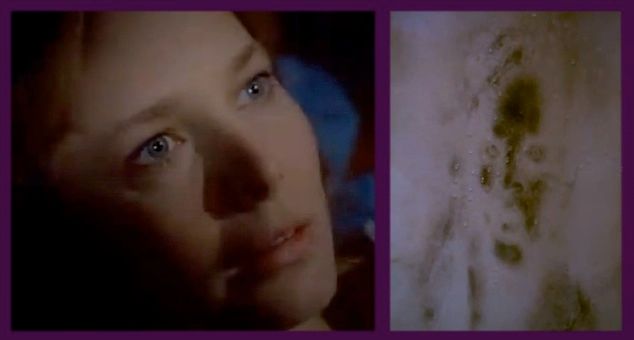
For a 1989 exploration of this theme, there's a dandy episode of the New Twilight Zone, "Something in the Walls."  It's yet another version of that hoary old horror cliché: a supposedly crazy person's hallucinations turn out to be real.  But it's well written and refers to precisely the type of childhood fear we see above.


Here's a crucial sound bite:

Something in the Walls


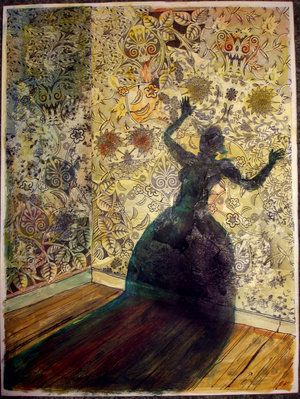
Eerie faces that show up in wallpaper show up in highbrow literature as well.  In 1892, Charlotte Perkins Gilman published "The Yellow Wallpaper", a novella now considered something of a classic.  In it, an intelligent Victorian-era woman suffering from what looks like a pretty normal case of postpartum depression is confined to a room and deprived of any stimulation like books or artwork, deprived even of her child, so that she may "calm down" and recover from "temporary nervous depression—a slight hysterical tendency."  Rather than improve, she goes from bad to worse.  She becomes obsessed with the yellow wallpaper and begins to hallucinate, eventually descending into full psychosis.


"The Yellow Wallpaper" has often been interpreted as an angry feminist protest against Victorian attitudes toward women, as it most certainly is in the excellent 1986 BBC production for Masterpiece Theatre.  The creepy atmosphere of growing madness is palpable, and there is one particularly horrific moment.


Gilman's own interpretation, however, was more prosaic:  She had undergone a similar treatment for her own depression and had averted a mental breakdown by violating the two-hours-per-day restriction on her writing and drawing.  She hoped her story would convince her physician of the folly of his asinine "rest cure."  It is also the case that "The Yellow Wallpaper" has been classified and anthologized as first and foremost a crackin' good tale of terror, almost a ghost story.  None of these interpretations excludes any of the others, of course.

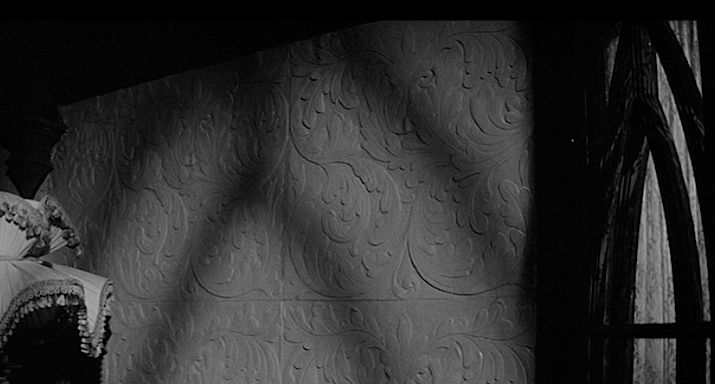
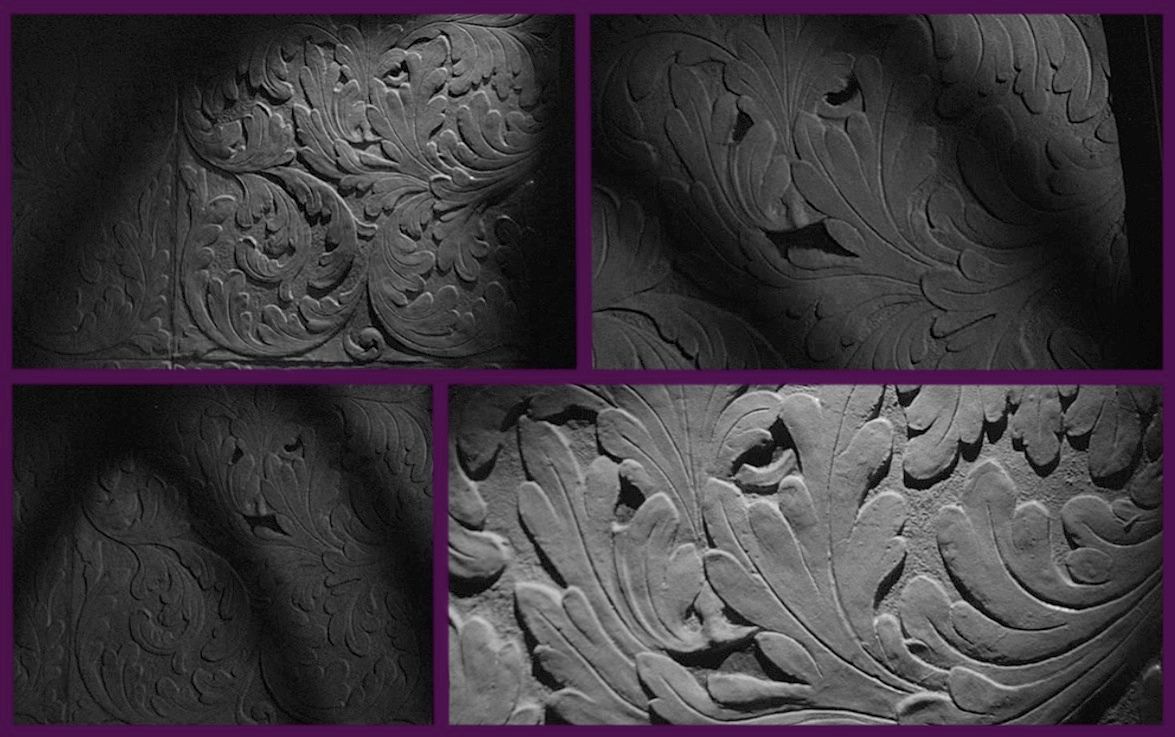
The best-known use of creepy wallpaper as a horror device, however, may well be Robert Wise's 1963 film, The Haunting.  We've discussed this one before.  The scene in question features clever shifts in lighting on the wallpaper (and maybe a dab of black paint).  This is combined with an eerie audio track of muffled voices, and that's all there is to it.  It's one of the scariest scenes in the movie.  (Don't turn up your volume too much or you'll have Julie Harris yelling at you.  It's supposed to be quiet.  Relax, there's nothing to be afraid of.  Let it build up on its own.)

From The Haunting


So there you have six pop cultural treatments of the scary wallpaper motif,
going back to the 19th century, and no doubt more examples could be found.

Where Do They Come From?

Yoo hoo, readers. *waves*  I've got a question.  Is there anyone out there who did not find faces in the dining room wallpaper (or wherever it was) when they were little?  It wasn't always scary stuff, of course.  When you were at somebody's house as company and you were put on your Best Behavior and had to sit there silent and fidgetless while the grownups droned on and on about the most boring stuff in the world, what else could you do but find odd creatures in their wallpaper or upholstery?  And the ones you had at home, well, those were as familiar as the family pets.  Am I right?

If we want to understand the actual phenomenon, the psychologist in the New Twilight Zone episode is correct, of course.  The brain does try to find meaningful things in abstract patterns.  The woman in that episode marvels that faces are what most show up, but that's not really a mystery.  The brain always seems to be looking for faces, perhaps going back to infancy's very first search-and-identify mission: recognizing Mom.

Our predisposition to finding faces is so universal that it is exploited in the
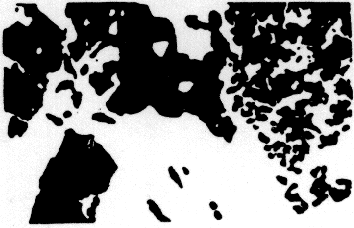
visual arts.  You see it not only in dozens of ain't-it-cool optical illusions...


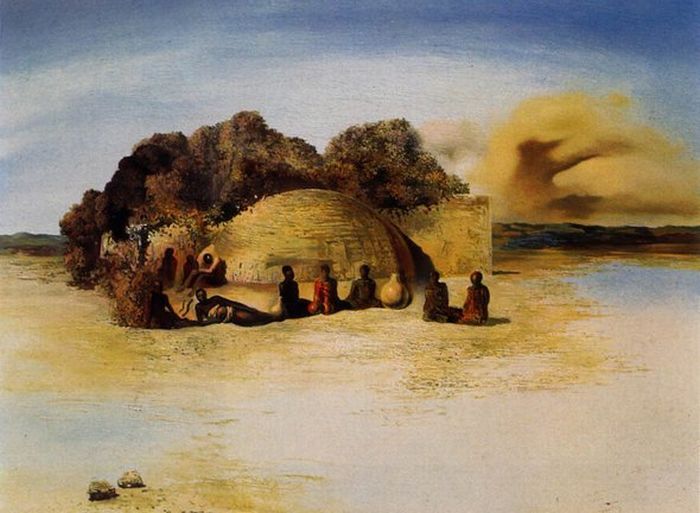
... but also in "serious" art, often of the surrealist type, as in this Dali:


Here's another curious thing.  It seems that a face once discovered can scarcely ever be undiscovered.  Once you see Jesus in this popular optical illusion, for example, you'll see him immediately every time you look at it again and wonder how you ever could have missed it.  As we shall see, this occasionally makes a difference when we look at certain things in the HM.


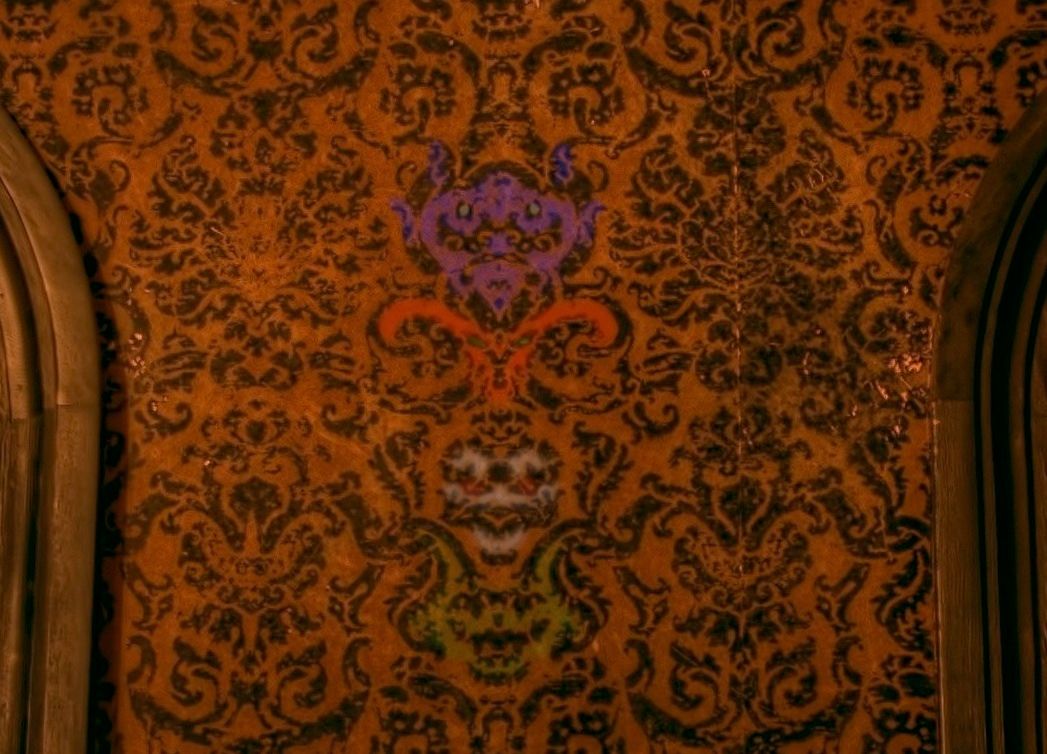
The Demon-Eye Wallpaper

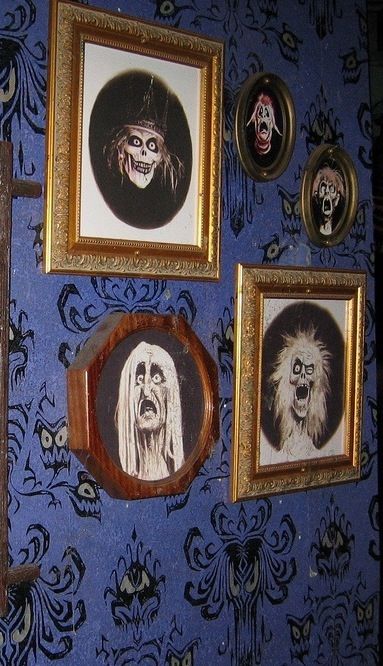
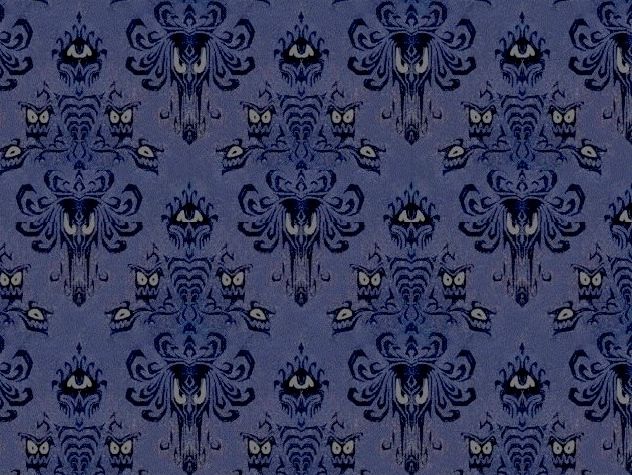
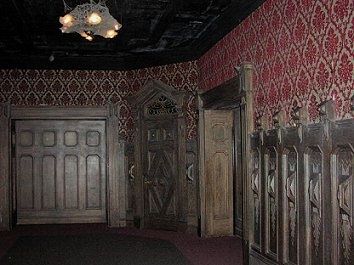
With all of that background, let's go back to the Mansion and to its famous example of the phenomenon we have been discussing.  As that older post pointed out, The Haunting was a direct influence on the Haunted Mansion, and the possibility that the wallpaper scene may have served as an inspiration for the demon-eye wallpaper we find in the Corridor of Doors has been suggested more than once.  That's still very likely, but as we have now seen, the concept itself is older and part of a broader human experience than The Haunting.


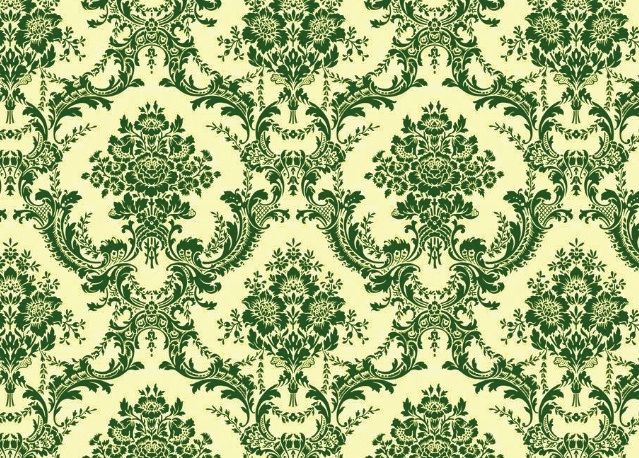
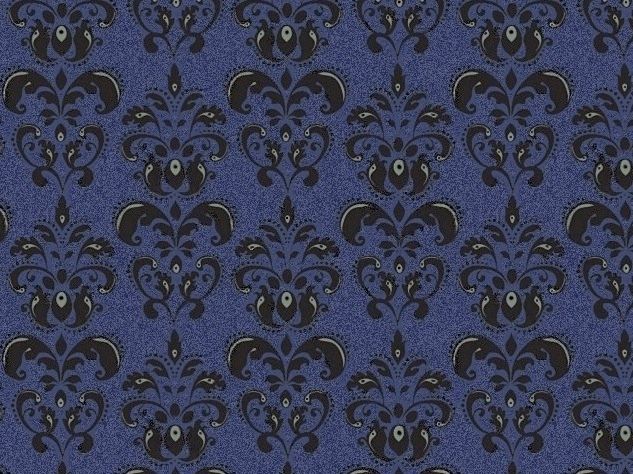
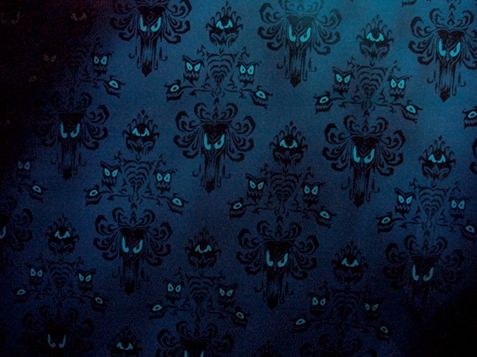
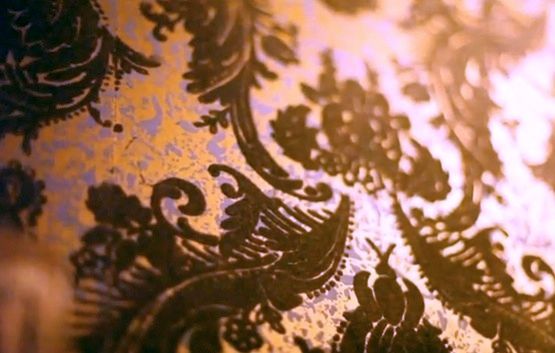
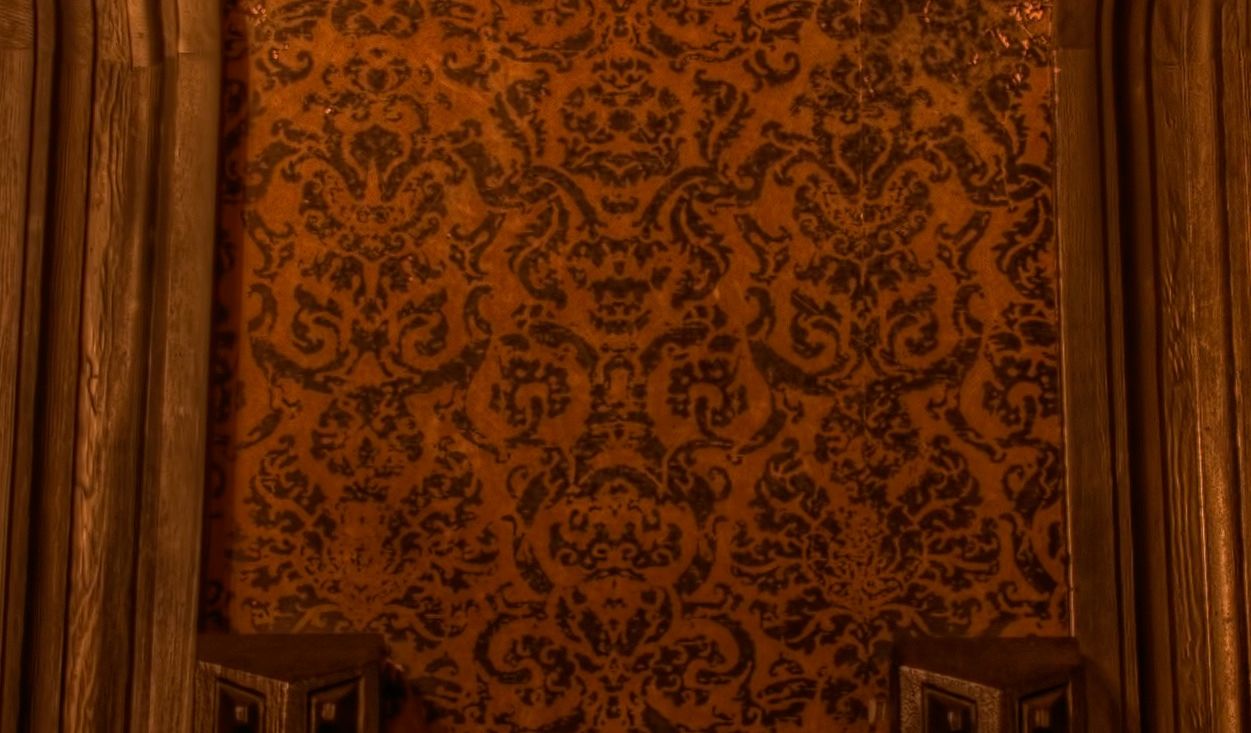
Seems like just about everybody likes that wallpaper, and because it has become so familiar, it is easy to forget that it is in fact a sinister parody of something else, of damask wallpaper, which features endlessly repeated clusters of abstract or botanical designs.


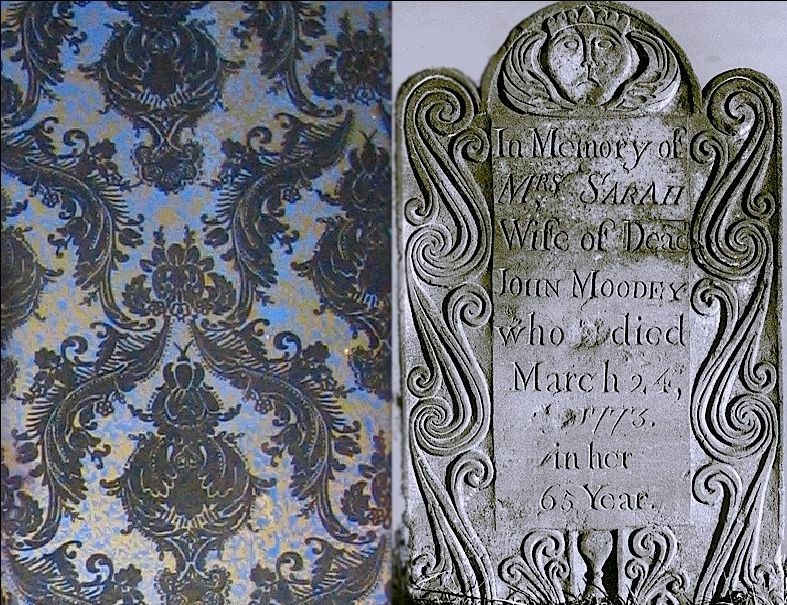
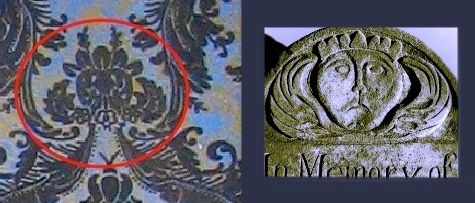
It is in symmetrical and intricate patterns like these that we are apt to find faces, especially as children.  The whole idea of the demon-eye design is to suggest that those faces really were there, and they really were malevolent (or are there and are malevolent).  It resurrects and confirms those long-forgotten childhood fears.  In short, it plays off of precisely the thing you see in that 1904 cartoon.

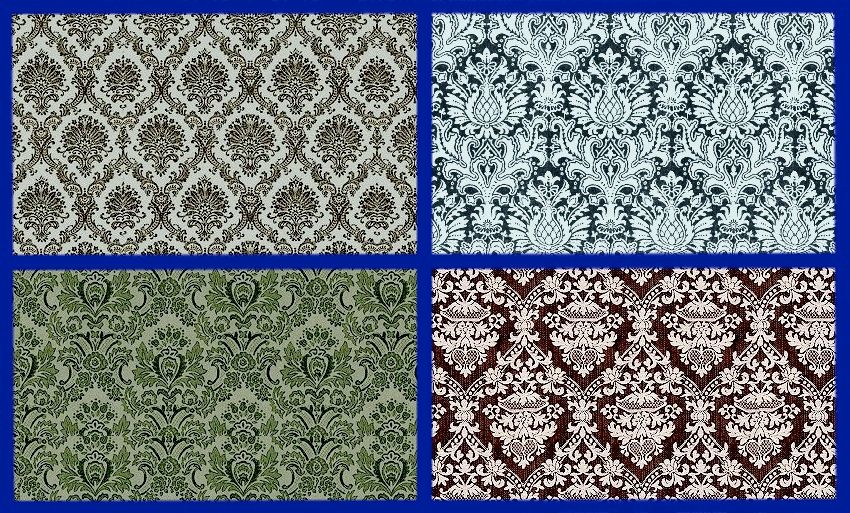
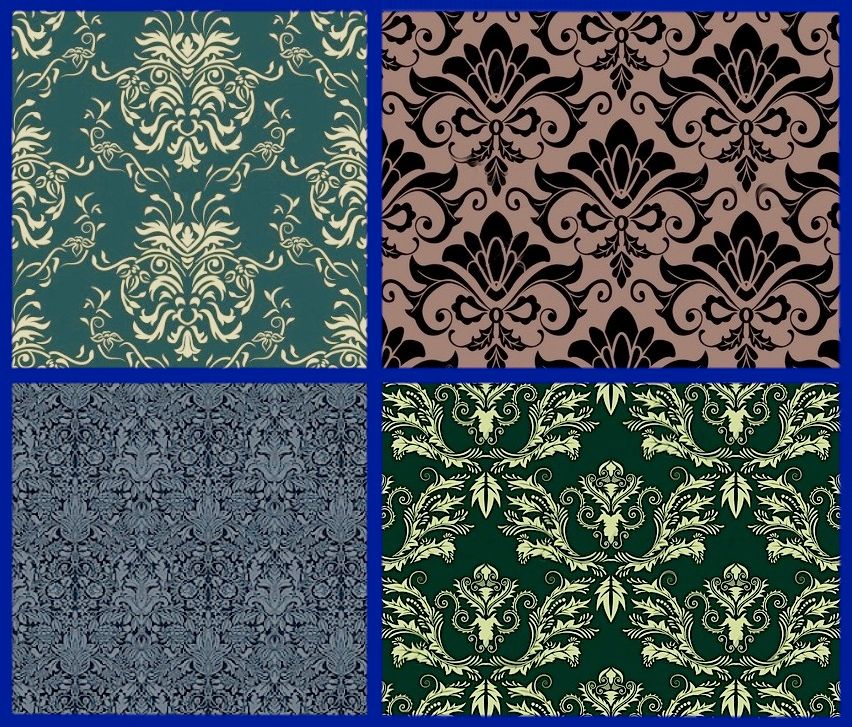
One thing I have noticed in going through scores of damask designs is that they are not all equally amenable to the discovery of hidden faces.  Oh, I have no doubt that with perseverance and an active imagination (and boring enough grownup conversation around you) you can find some strange countenances in just about any design; nevertheless, there are some designs that look pretty benign to me, that seem relatively resistant to the paranoid imagination.  If you insist on a damask design in the nursery, then these, I think, might be acceptable choices.


Then there are others in a more middle position.  You can find ominous faces in these— 
at least I had no trouble—but I imagine that some people may require a little time and effort.


Then there is a third kind.  With these, it is hard to understand how the
artists themselves could have missed the monsters they were creating.


Yes, those are all real, commercially available damask patterns.  At least with the blue one, if you look closely, you'll notice that the lion is actually a vegetarian, so that's a relief.  I don't know about you, but in the bottom right I see a mad bird of prey.

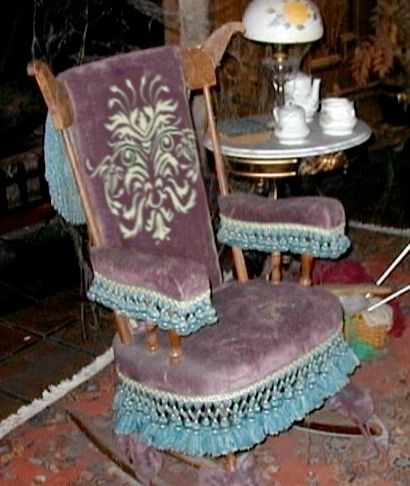
So it isn't entirely subjective.  Some designs do seem to generate scary faces more readily than others, and with some you can hardly avoid seeing them.  Seriously, you could import that upper left design into the Haunted Mansion exactly as it is, and no one would doubt for a moment that it was a creepy face:

(psst...the real chair is below)

But there's another factor involved.  By the time we reach the COD we have learned that the ghosts can manipulate the very fabric of the building, so it is possible that they have distorted the actual designs in their ongoing attempts to frighten and intimidate us, just as the "family portraits" may be hideous distortions of normal portraits.  Perhaps the damask was demonized only moments ago, or it may be an illusion, a trick they're playing on you.  It's the stretching gallery's "real or imagined?" dilemma, once again.


The portraits are not unlike the hideous transformations that flash in the normal paintings downstairs, but unlike those, these never change back to normal.  The ghosts are no longer concerned to conceal their presence and are clearly turning up the pressure as we go along.  If that is indeed what is happening, storywise, then inquiring minds may wonder if there is a normal, undistorted design on the walls when the ghosts aren't using it to make faces at us.  It's sheer fantasy, of course, but all the same it's fun to speculate what the undemonized design would look like.  Just for kicks and giggles, I fooled around a little to see if I could imagineer something.


Too subtle, perhaps?  How about this one:


And then, *shazzam*


Is it a wallpaper mask of damask wallpaper?  It is.

In defense of such idle musings, I would point to the WDW Mansion, where since 2007 there is a more direct
suggestion that the watching ghosts infiltrate the wallpaper design as the walls gradually become visible.

(pic by Joe Penniston Express Monorail)


The effect is helped along by the fact that the wallpaper eyes glow.
(They also glow in Paris and Tokyo; only at Anaheim do they not.)

(pic by GRD)

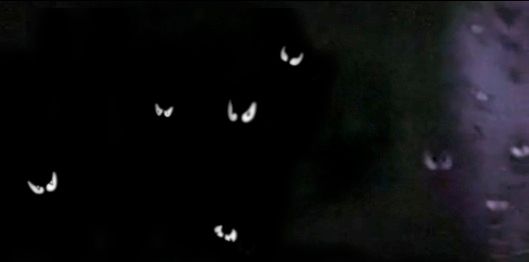
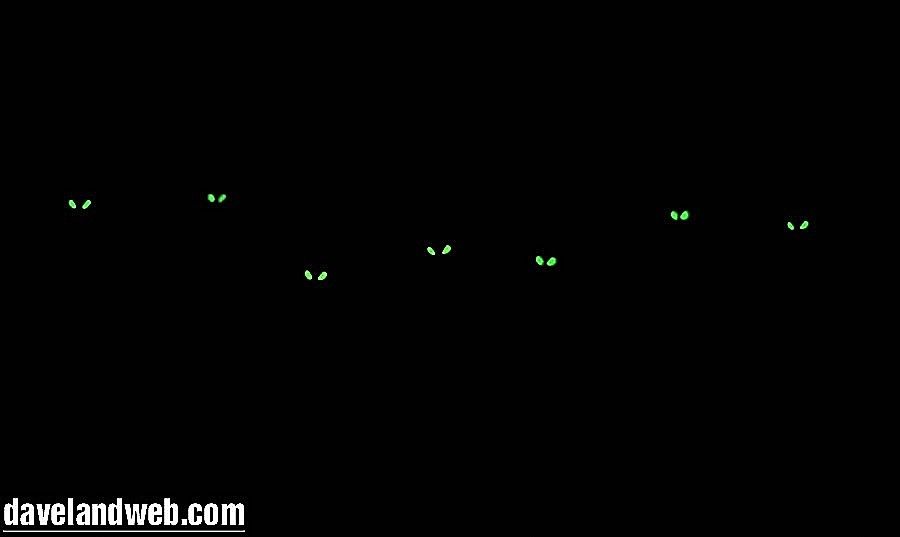
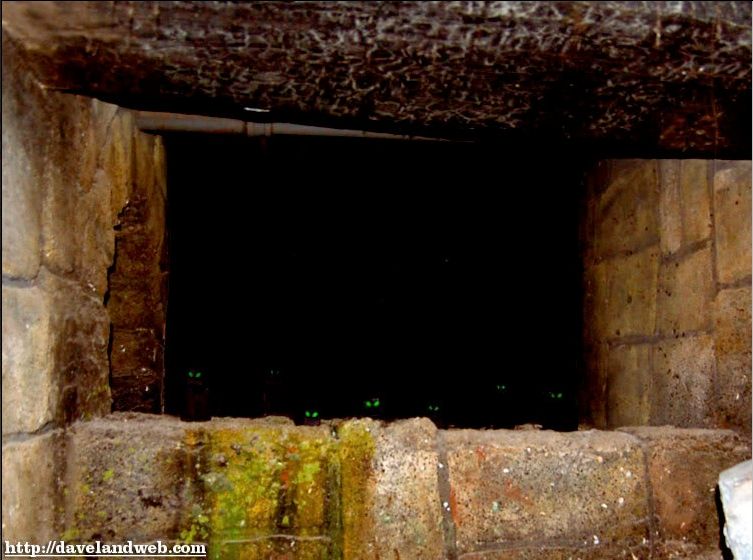
I haven't seen the effect in person, but I imagine that when it's operating properly and light levels are correct, it's an impressive illusion.  I have to admit that I'm also positively disposed toward it because those eyes in the darkness are a new implementation of an old Yale Gracey effect from 1967.  Some of you Eastern folks may not be aware of that fact.  At DL, as the boats ascend the waterfall at the end of Pirates of the Caribbean, there are green rats' eyes winking at you in the darkness on your left.  They've always been there.


But we're straying off topic here.  Let's get back to walls and stares.

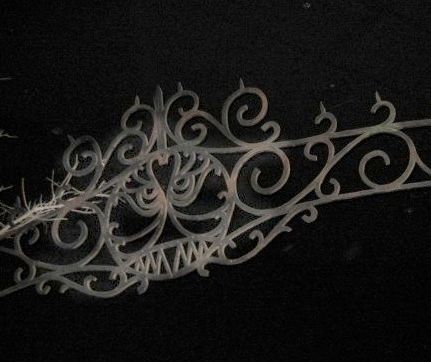
As every HM fan knows, the Imagineers put faces everywhere, in the woodwork, in metalwork, and in upholstery.
Like the demon-eye wallpaper, some of these are obviously intentional and hard to miss if you look at them.

(left and right pix by Maggot Prince)


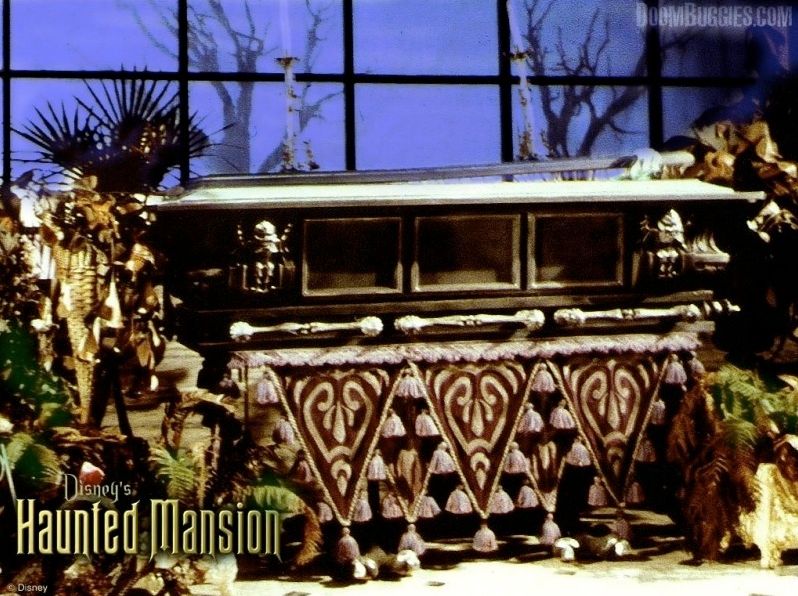
But there are other faces that are so stylized that the Imagineers seem to be deliberately steering you into a fogbank, a place where you're not quite sure if the face you see is "really there" or if your imagination is starting to detect ghostly manifestations in perfectly innocent patterns.  I think that's exactly the sort of paranoia they hope to inspire, as part of the overall experience.  Are those sad faces on the triangular tapestries below the coffin really there, or are you imagining them?  Hmm.  They're probably "real," but ask me again tomorrow.  The point is, they're that much creepier for the ambiguity.


This is the other "real or imagined" game in the Haunted Mansion.  There are two.

Are some of the things you see the result of ghostly
manipulation of the building or are they mental delusions?

Are some of the things you see intentional effects created
by the Imagineers or are they ... um ... mental delusions?

Hmm.  Better make that three games.

Are the two dilemmas two dilemmas or are they really only one?

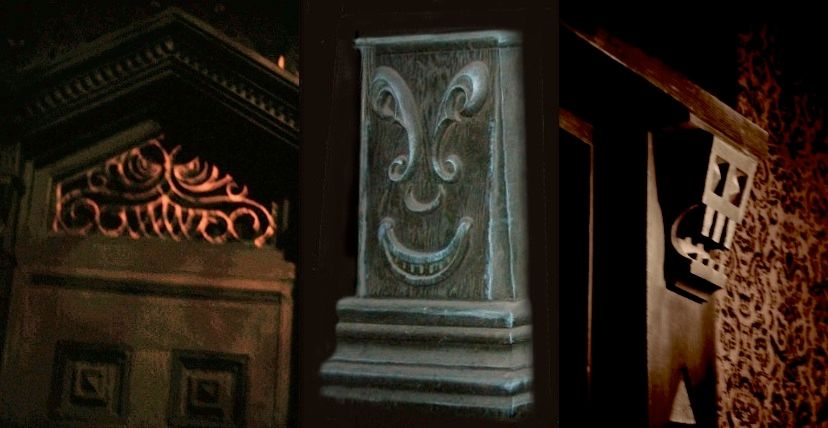
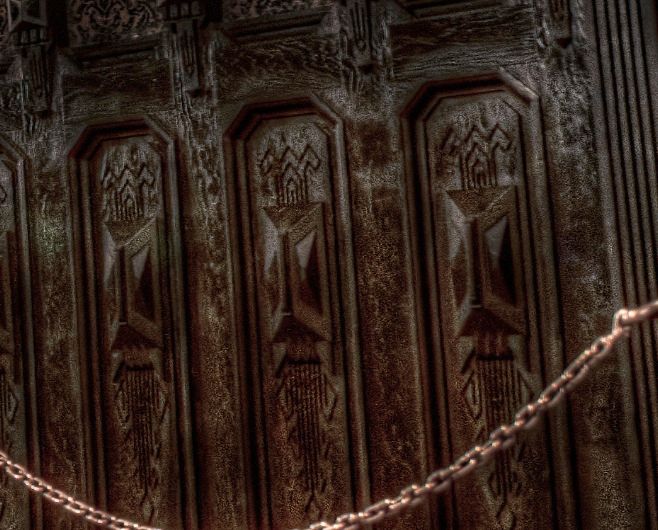
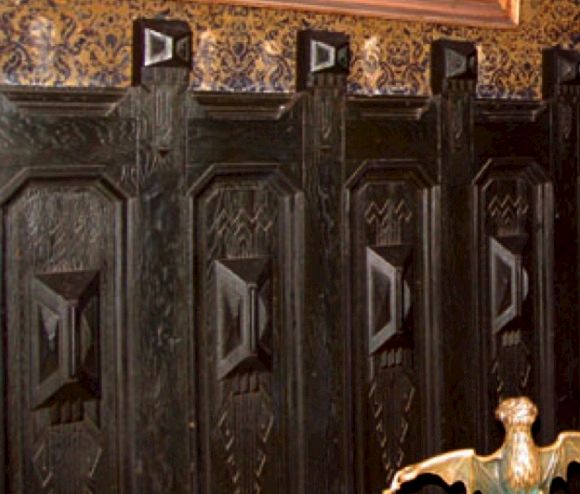
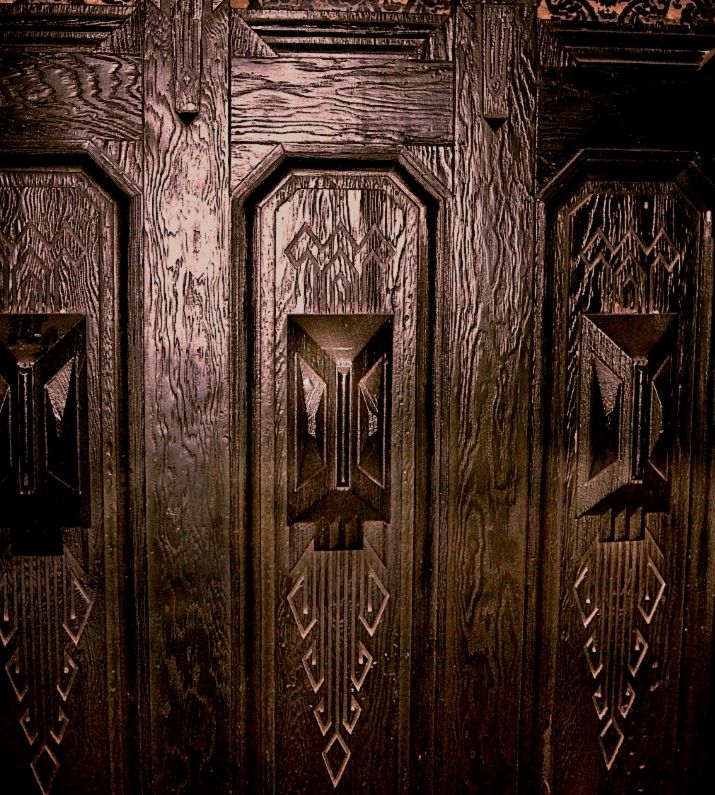
The heavily stylized "skulls" all over the wainscoting in the portrait hall (load area at WDW) are also denizens of this twilight zone.  Once it occurs to you that they're skulls, they're forever skulls to you, but I'll bet a lot of guests look right at them and don't see anything other than abstract geometric designs in the woodwork.  (We'll pick up this topic again below.)

(pic by Kevin Crone Tours Departing Daily)


(pic by Loren Javier)

(pic by Michael Hansen Tours Departing Daily)

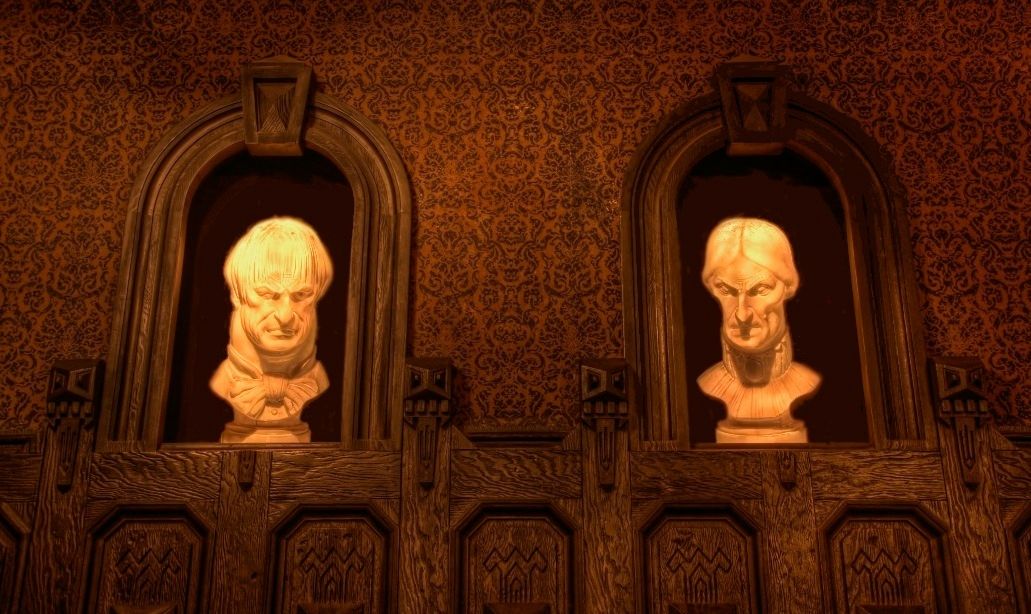
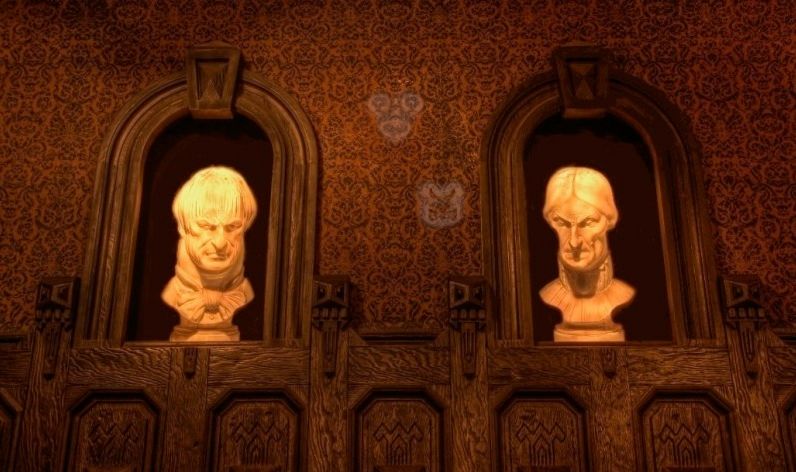
In their own weird way, they're like the changing portraits: normal one second but ghostly the next, in this case depending not on electronic illusions but on your mindset and perhaps the angle you look at them.  Come to think of it, the staring busts oscillate too.  They're normal when you're standing still but ghostly when you move.  It's all so beautifully consistent, but what about the wallpaper?

[Be sure to see the July 2021 update below the original discussion, which follows, and let's all stay together, pleeeeze.]

When the Imagineers were flipping through samples, don't you think they would have been drawn consciously or unconsciously to designs of the third kind discussed above, the kind that practically plop their hidden faces into your lap?  If you saw one of those designs in the Mansion, wouldn't you suspect that the choice was made precisely because that kind of design is starting to do what the COD paper already does?  Like the wainscot "skulls" and the coffin tapestry, "found" designs of that nature would go into that murky, "real or imagined" category.

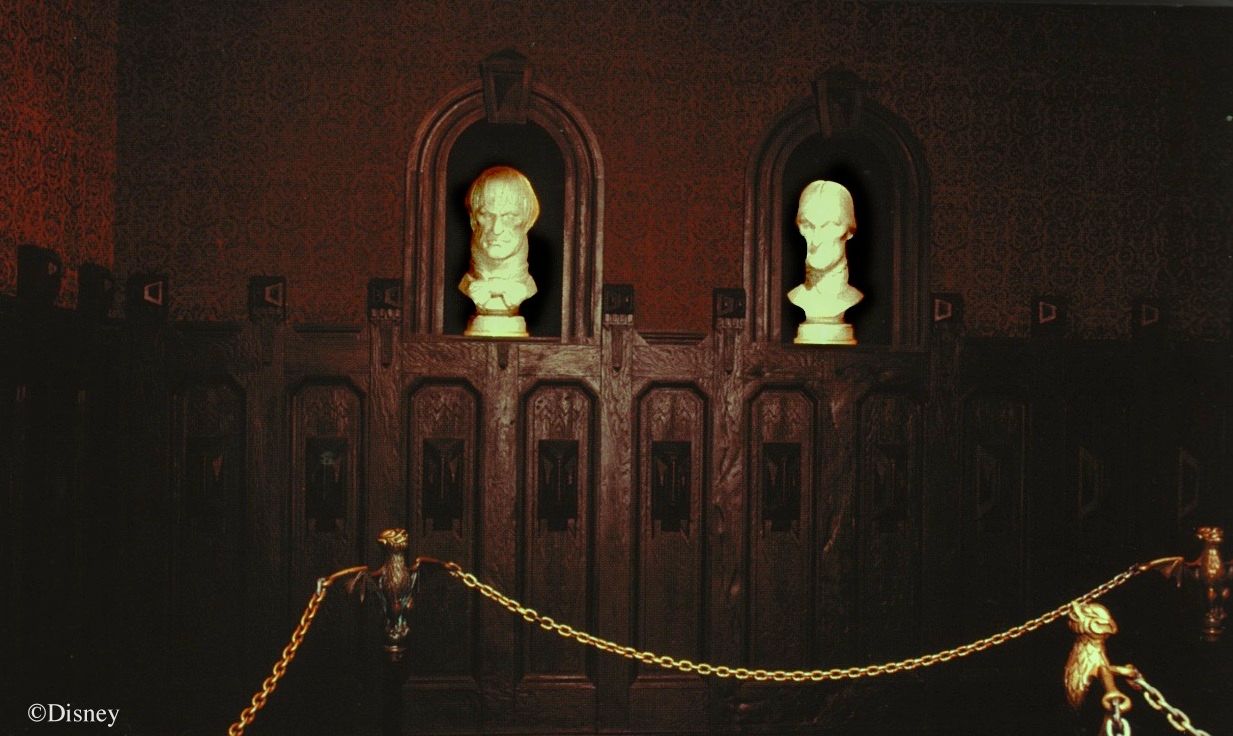
When you enter the portrait hall, you begin to really feel like you're being watched.  You look down at one end and you see the two busts staring back at you.  Most of the flashing paintings have figures looking out at you.  Besides all that, there are the bat stantions grinning up at you, and a step below them on the subtlety meter are the "skulls" in the woodwork.  Can we go even further?  Do we dare?


(pic by Michael Hansen Tours Departing Daily)

Should it occur to you to look at the walls for faces, they fairly pop right out at you.
 And heed this warning!  Once you see these little devils, you may never be able to unsee them.


But that's nothing.  Go in a little closer.

(pic by Michael Hansen Tours Departing Daily)

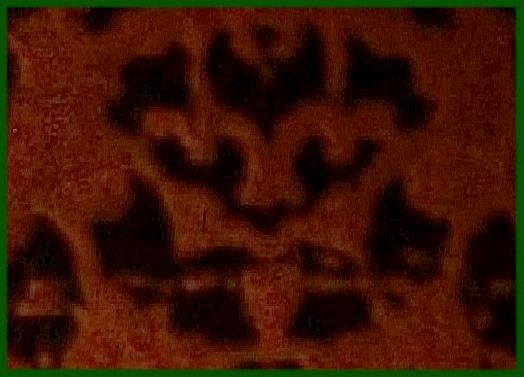
You know, it's ridiculously easy to see faces in this wallpaper pattern, once it occurs to you to look at all.
They're almost as obvious as the ones you could see in the third kind of designs we were looking at earlier.

(pic by Michael Hansen Tours Departing Daily)

The bat is particularly hard to erase, once you've seen it.  Get used to him, Disneyland
Forgottenistas; you're going to see him from now on, like it or not.  (I warned you. I did!)

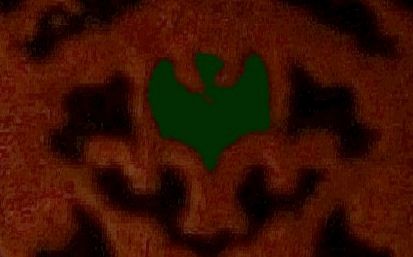
And we're not done yet.  Right in the center of this particular totem pole (and you can find
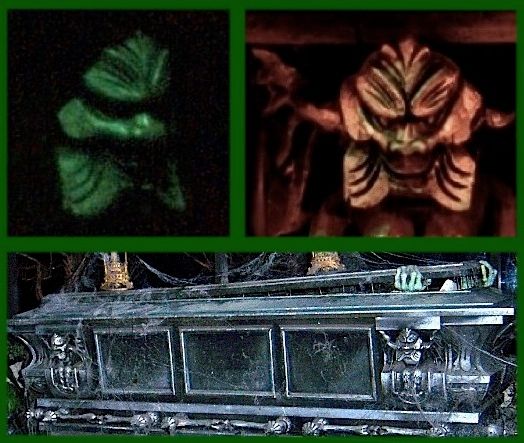
others if you try), there's a smaller face, parked right there on the Sith/Skull's forehead.


This doesn't mean a thing, I know, but I must say he reminds
me of the gargoyles carved on the ends of the coffin upstairs.


Well, we'd better pull back, because now we're surely
"seeing things" rather than seeing things, and I ...

... wait a sec ...

What's that parked on HIS forehead?


Ummmm....nope.  Nothing on the bat's forehead.  Further than this we cannot go.

Somewhere between the busts and the bat, we obviously passed over a line, and I think I know where that line is, but ... I'm not absolutely sure.  Just as the paintings down here certainly flash back and forth between normal and ghostly, and just as the busts are natural when you're still and supernatural when you're moving, and just as the "skulls" in the woodwork down here may oscillate in your perception between abstract designs and death's heads, so also this paper design may have been chosen (consciously or unconsciously) because it lends itself so easily to the same sort of oscillation at an even more subtle level, playing off of a near-universal psychological experience often associated with childhood fears.  Hey, we have the demon-eye wallpaper upstairs as proof that they were aware of and exploited exactly that psychological tendency, so who knows?
 
UPDATE July 28, 2021: As part of the "enhauntsments" of 2021, which included the return of April-December, there came a completely new wallpapering of the Portrait Hall in order to match what they put behind April in her newly-constructed hallway. Alas, the new paper is not the target-rich environment that the old one was. The new stuff does have a face or two if you look hard, so we'll just have to be content with that and with our memories. Look for it only in blogs, my children, a wallpaper gone with the wind.


Upstairs Downstairs

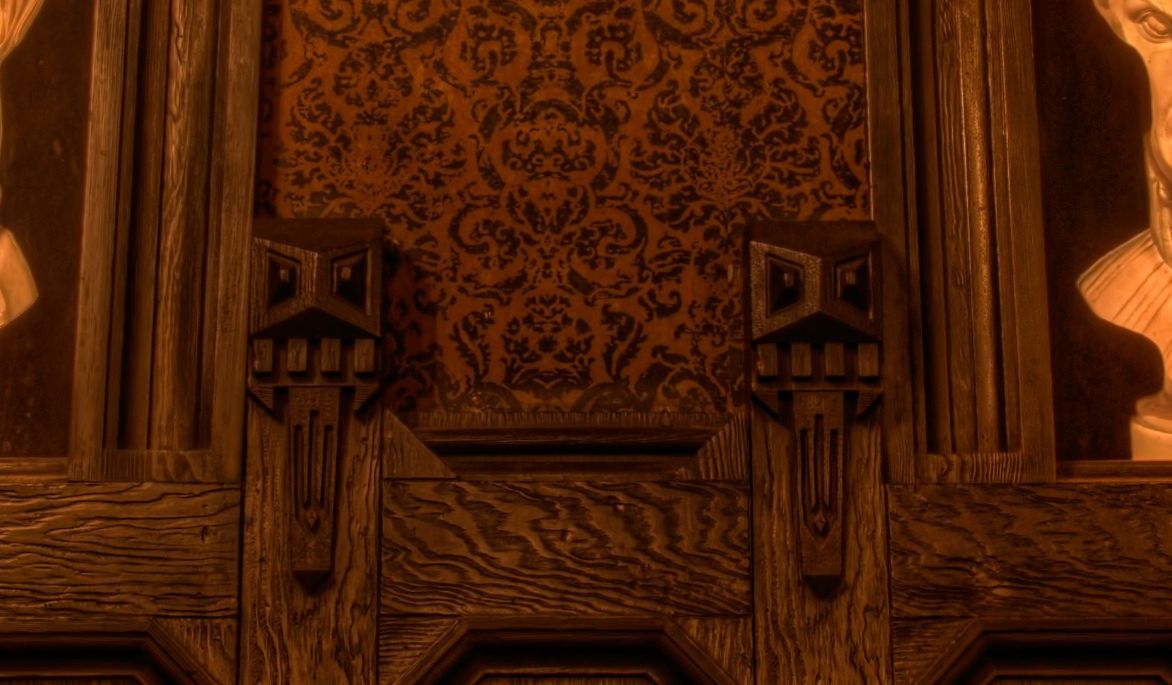
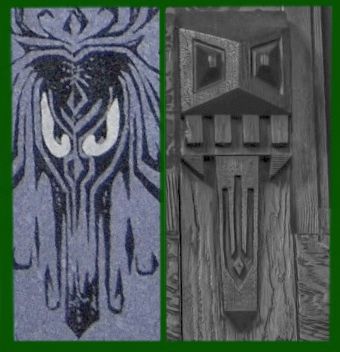
Here I am doing a major update, practically before the ink is dry . . . no, wait, practically before the electrons have settled down on the original post.  First off, I want you to try to unthink and then rethink the wooden figures along the top of the wainscoting.  Do they bear a stronger resemblance to skulls, or to something else?


Hmm.  Notice how well the teeth and eyes line up.  "Skulls" indeed.


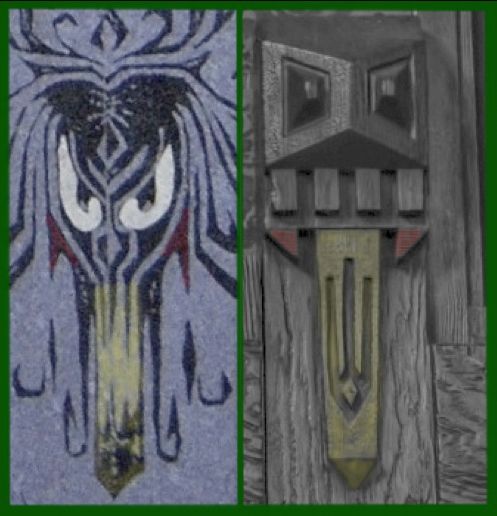
The larger "skull" also features an intriguing similarity to one of the demon-eye characters.
Note the "fishhook" designs in the "beard," and the diamond-shaped tip at the bottom.


It may even be that the carvings are a composite of features from
more than one wall imp, rather than corresponding one-to-one:


It would not be surprising to find a stylistic consistency linking this woodwork with the demon-eye wallpaper, for
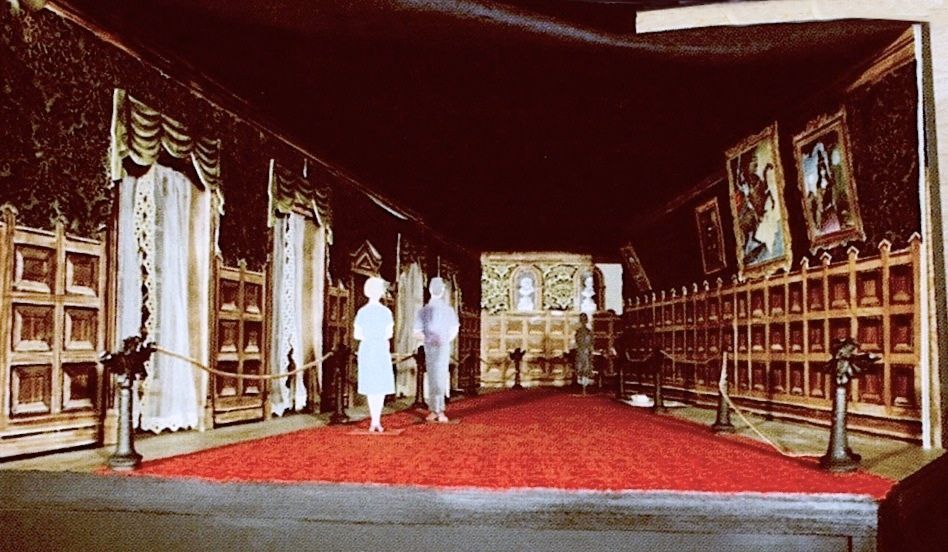
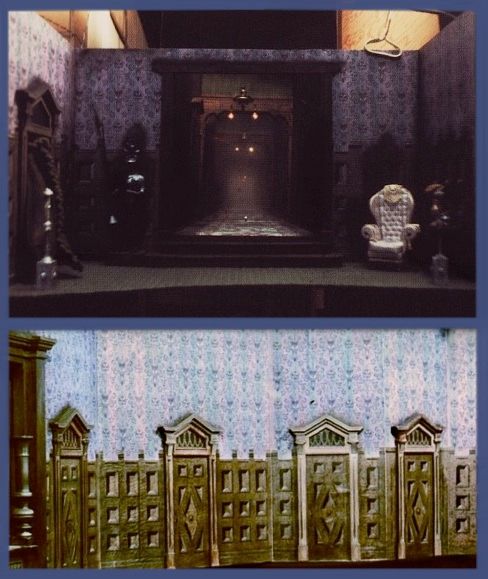
the simple reason that they were going to go together.  Originally, the Corridor of Doors, beginning already at the
Endless Hallway, was going to have the same wainscoting as the Changing Portrait Hall.  Look at the scale models:


In the models, the woodwork has no facial features.  It would be interesting to know if they decided to carve figures into it before or after it was decided not to use it upstairs.  I suspect it was before, since the decision not to use it sounds like a pragmatic decision, driven by a shortage of time and/or money.  In that case, the "skulls" would have been designed with the expectation that the demon-eye wallpaper would be right above them.

Think about the subtle head games involved.  In the Portrait Hall you see these stylized figures in the woodwork, and they're a little creepy, because they look like faces of some sort.  The wallpaper above them will give you faces too if you take a moment to look for them.  But you know that those are imaginary, your mind playing the old spontaneous tricks it always does with suggestive patterns of that type.  Maybe the geometric designs in the woodwork are nothing more than that?  Then when you get upstairs you are shown the same carvings in juxtaposition to impish faces undeniably present in the wallpaper, and those faces are stylistically similar enough to the carvings to confirm absolutely what you may have only suspected downstairs.

DIsquieting metamorphosai at every turn.

I don't think this was necessarily thought out consciously and discussed.  I think it could have been imagineered by artistic instinct alone.  Whatever the truth is, "skulls" shall forevermore be in skeptical quotation marks around here when those carved features are mentioned.


The Other Yellow Wallpaper

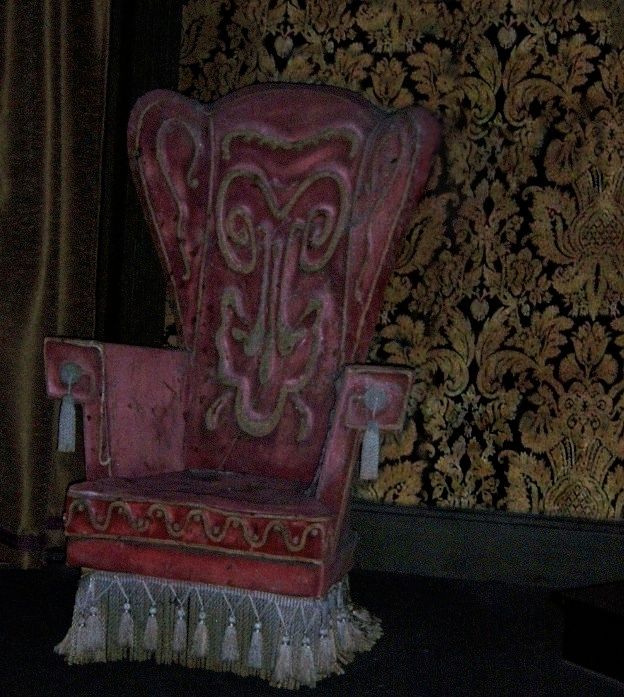
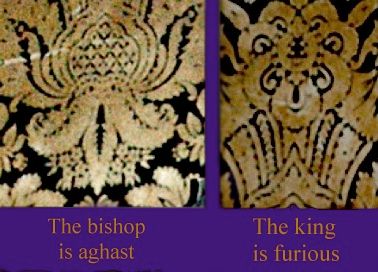
If we're going to go mad and start seeing things in ordinary wallpaper, like the protagonist in Gilman's novella, then it may as well be yellow, like hers.  We've discussed before the wallpaper upstairs, around the Endless Hallway (formerly there in WDW, still there in DL and Tokyo).  I'm wondering now whether the face in the chair upholstery may serve as an open invitation to the viewer to look at the walls behind it for hidden faces as well.


That hypothesis looks better when we remember how this area was originally scripted.  You will recall from that earlier post that the Imagineers presumed a movement of guests past all of it at a much slower rate, a presumption made obsolete by the doombuggy, resulting in a last minute rewrite of the entire scene.

So again, who knows?  Even if the Imagineers did not see precisely them, it could
be that my king and bishop are not quite so random and subjective as I thought.


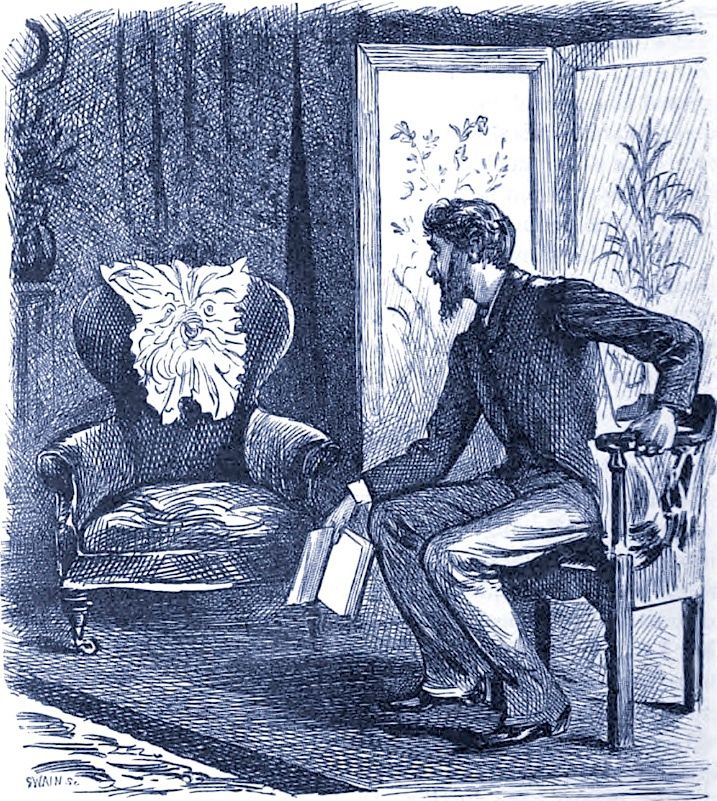
[Edit: Aug 2, 2013]  Incidentally, we once again have warrant from the Victorian
era for the phenomenon of finding strange faces, in this case in antimacassars:

(Cornhill magazine, 1885.  Hat tip to Craig Conley)


.                  Meanwhile, in Orlando

Before we wind it up, I want to take a quick look over at the WDW Mansion.
We now know (as of Sept '13) that the load area there originally had yellow wallpaper.

Hat tip to Foxxy; the pic is from Mike Lee at WidenYourWorld


It was a damask pattern, but not the same as the yellow wallpaper upstairs at DL, nor
was it the same as the face-filled wallpaper in the DL portrait hall. Wish we knew more.


 Anyway, early on this was replaced with a red and white paper that lasted a very long time.


It's not the target-rich environment you find in the portrait hall at Disneyland, but still, it takes little imagination to see a face right there.  I like it for two reasons.  First, the "chin" is an uncharacteristically angry Tigger.  I guess a Tigger is not always such a wonderful thing.  Second, whether by design or by accident (probably the latter), it reminds me of more sinister wallpaper yet to come.


During the 2007 refurb the red paper was replaced. The
new paper is rich and beautiful, no question about it.


Too bad there are no macabre faces to be fou—

...wait a sec...


Enough.  Enough!  This is getting out of hand.  Maybe I've been staring at these wallpaper designs too long.  A year from now I may look back here at the silliest post I've yet written.  One thing I am sure of is that the Imagineers made selections and drew up designs that were purposely intended to lead our imaginations into a limbo where you have difficulty separating the real from the imagined, the deliberate from the accidental.  I'm afraid the Ghost Host may not be the only one taunting us.  Now if you all will excuse me, I'm going back under my blankets, where it's safe.