What is it about uncovering a source of inspiration behind something that we love that gives us (some of us, anyway) so much pleasure? We do a lot of that around here, in case you haven't noticed, so it's a pertinent question. My guess is that finding a hitherto-unknown influence behind the thing we so admire does a couple of things.
First, it connects the isolated thing with the rest of the world, making it a point of human expression bigger than itself. You pull on what seems superficially to be a trivial thread and find the rest of the universe attached. It's one of the reasons I defend something as silly as doing a blog on the Haunted Mansion. Thanks to the artistry of the dozens of contributing talents, this particular work is complex enough to open little windows right and left into the larger world of human experience. It's an entry point, a conversation starter, and it requires no PhD to get into it.
Second, this kind of sleuthing can shed further light on the creative process that produced the thing we love. What did the artists simply take from what went before, and what did they contribute out of their own genius? The ability to create something new out of something old is a fascinating thing, and we love to watch.
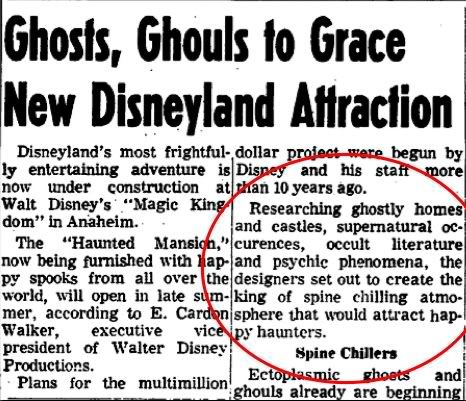
Of course, there are occupational hazards with this sort of thing. One pitfall is that it's easy after awhile to start acting like these artists were empty shells, unable to generate anything original. Without thinking, you begin to assume that behind every item in the HM there must be a movie or a book or a painting, as if guys like Ken Anderson and Marc Davis couldn't come up with any entirely original ideas! Another pitfall is that most of the time you are dealing with possibilities and probabilities rather than smoking-gun certainties, and sometimes you're just getting all jazzed up about a coincidence. Notwithstanding the first pitfall, we must remember that the Imagineers have explicitly stated that they combed through material looking for ideas, and after all, in order for their ghostly conjurations to connect instantly with audiences there would have to be some cultural connections already in place, something that gives rise to recognition.
Notwithstanding the second pitfall, so long as one is modest in one's claims and makes liberal use of "possible," "plausible," and "probable," there is no harm in putting things out there for others to puzzle over and enjoy, even if some discussions properly end in question marks.
In this post I present some one-offs, some isolated Mansionalia and possible influences, for your consideration.
One inspiration that we have previously pointed out is "The Old Witch," an EC comics "host" character who graced the covers of Tales from the Crypt, Vault of Horror, and Haunt of Fear comics in the early 1950's. "The Old Witch" obviously served as the model for Marc Davis's Hatchet Man:
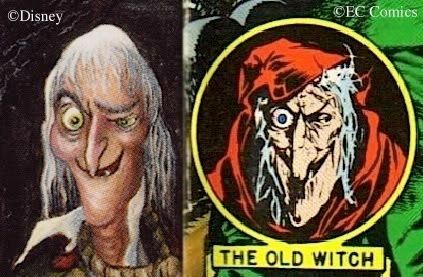
But once we know that Davis was flipping through these old comics, one can't help wondering about other items that come up...

Long-Forgottenista and blogger "Brother Bill" has suggested that the table in the Grand Ballroom owes something to Miss Havisham's cobweb-shrouded table in David Lean's classic 1946 film adaptation of Great Expectations. You will recall that Miss H was a jilted bride who sorta went round the bend and kept her wedding table untouched all her life. Quite a sad old sicko, was Miss H. You have to wonder if the character contributed a little something to the Mansion's bride character (and also Melanie at Phantom Manor). As for the table, take a look, and compare concept art from Davis and also Claude Coats.


I have to admit I wasn't bowled over when I first read the suggestion, but when the pix are put side-by-side, it looks mighty good. Not a smoking gun, but definitely a possibility.
In the same comment, Brother Bill also pointed out another example of possible inspiration that others have noticed, especially the all-seeing eye of Brandon at Ghost Relations Department. Joan Crawford was originally supposed to star in the 1964 thriller, Hush Hush Sweet Charlotte, but she dropped out and was replaced by Olivia de Havilland. Some early publicity shots were released with Crawford in them, including this one:

It doesn't take an overactive imagination to see that this could well have been an inspiration for another
famous Marc Davis piece, produced not long after the above photo appeared in Life magazine.

Left to right, that's Davis's initial sketch, his own concept painting, and the basic form the painting takes today in the actual attraction (artist: Clem Hall). As GRD points out, the plot of the movie includes an axe-murdered fiancé, a mad widow, and an antebellum Louisiana mansion, among other suggestive elements. I think this one rates rather high on the probability meter.
The credit goes to Triana (aka The Dark Lady, at Micechat) for the following one. For some reason we seem to be trapped in the stretching portrait gallery. This time we turn our gaze toward the Tightrope Gal...

Hall on the left, Davis on the right. Anyway, Triana is pretty convinced that the following
sketch by John Tenniel (that's right, the guy who illustrated the Alice books) inspired our Ally Gal.

This was originally published in Punch, in 1863. It has now been reprinted in Matthew Sweet's Inventing the Victorians (St. Martin's; 2001), but that's obviously too late to help us. The subject is the death of Madame Genieve, a Victorian high-wire daredevil who died when her line broke. Nice try, but a much better candidate came to light in April of 2024.
And finally, let's talk about what has come to be called the "Haw Branch haunting." As the story goes, an old plantation house in Haw Branch, Virginia, was restored and reoccupied by relatives after sitting empty for half a century. An old cousin of the new owners sent them a portrait of a distant and long-dead relative named Florence Wright. They were told in a letter that it was a beautiful portrait in colored pastels. When they opened the crate, they were surprised to find that it was a charcoal sketch in black and white. Oh well. They went ahead and hung it up.

Naturally, the house started acting haunted after that. Strange voices, bloodcurdling screams, shadowy apparitions, strange noises and smells—the whole panoply. Weirdest of all, the portrait slowly changed over a period of several months, ending up fully and vividly colored, beginning with the rose. A local psychic decided that Florence's spirit was locked in the portrait, which had not been finished at the time she died (which was true), and that she had the power to drain it of color if she was unhappy with her surroundings.
Hmm. A haunted, changing portrait, you say? Beautiful young woman? Did poor Florence serve as an influence on Marc Davis, you ask?

Gotcha. The Haw Branch haunting took place late in 1969, about the same time the Mansion opened, actually. The family completed the remodeling and moved into the house in August of that year, and the portrait arrived not long afterwards. It could not have been an influence on the HM. See, I warned you about coincidences.
Of course, if you believe in ghosts and strange synchronicities, you can still look for mysterious links between the near-simultaneous debuts of April-December and Florence Wright, but that takes us into very different waters. Besides, a REAL changing portrait that colors and uncolors itself by some unseen hand? Who could believe such things?