.
(This post was extensively rewritten in October, 2019 and in May-June, 2020.)
That was her name, or
title, I suppose you'd say.
"Beating Heart." It's on all the blueprints and on the schematics for the figure herself, but somehow it never made its way into public usage. As we saw in the previous post, the title was originally attached to the Moving-Lights ghost, who had picked up several features from an earlier ghost.
In our last exciting episode, we traced BH's roots from the Brown Lady of Raynham Hall to the red-hearted candle bearer in the attic. The project had proceeded to scale model phase, and still the attic ghostette wasn't clearly recognizable as a bride. This final touch to the character was probably added late in 1968. The script for the "Story and Song" album refers to her as a bride, and this script in turn closely follows a '68 show script by X. Atencio. Whose idea was it to turn this ghost into a bride, anyway?
Ken Anderson makes a contribution, early in the process. He wrote a large number of show scripts in 1957-58. The first script in particular (Feb '57) is often cited as the beginning of our attic bride. In it, Beauregard the butler directs our attention to a painting and tells the sad story of Captain Bartholomew Gore and his young bride Priscilla.
Priscilla discovers the horrible truth that her husband is, in fact, a bloodthirsty pirate, and when he finds this out, he kills her by locking her in a trunk (in most versions of the story; there are several). The ghost of his unfortunate young bride comes back for vengeance and eventually drives Capt. Gore to suicide. Now the place is haunted. Bingo, haunted house.
A bride, murdered in a trunk, haunting the house, looking for revenge. Case closed. They got the attic bride idea from Ken Anderson.
Well . . . not so fast. There are a couple of things missing here. Like the attic. And the bride.
Anderson came up with more than one version of the sea captain story. In the first one, Pris and Gore are
already married. She is only a "bride" in the secondary sense that she was wed not very long ago. In none of the artwork is Priscilla wearing a wedding gown.

In an alternate version of the story, Pris and Gore are not yet married, only betrothed, and once she makes her grim discovery—she refuses to marry him. In that one, Priscilla is almost but not yet a bride and never dons a wedding gown at all. As for the location of the murder, I'll grant that it's easy to picture the trunk in which she died as being located in the attic, but it isn't. Anderson actually places it in the cellar. (Perhaps our memories of the numerous bodies-in-trunks in the Mansion attic—the popups—are playing tricks with our imaginations here.) So there does not seem to be an attic murder scene or an actual bride figure in Anderson's first script.
It should be mentioned that one re-telling of the story does have Priscilla actually wearing her wedding gown as she prys open Gore's pirate trunk in the attic on her wedding day. That article is by esteemed Disney historian Jim Korkis and is a 2014 re-working of a similar article by Korkis published at Jim Hill Media in 2003 (under the pseudonym "Wade Sampson"). Much of the older article is reproduced verbatim in the new one, with the result that Korkis introduces a contradiction into his narrative. In the 2014 version Priscilla is killed in her gown on her wedding day, but in the 2003 version, still visible as part of the 2014 article, Gore is "an old sea captain who had married a young woman named Priscilla." In a 2007 article, published in Disney Vacation Magic magazine, Korkis says that Gore "kills his bride on their wedding day," without giving any details about her attire or her location.
Anderson's other scripts get us a little closer to our ghostly bride. In one, "Monsieur Bogeyman" is planning to marry "Mlle. Vampire," and all kinds of famous spooks and monsters are showing up (Dracula, Frankenstein, etc.). She jilts him at the altar, and things get ugly. (Truth be told, I'm very thankful that one ended up on the cutting room floor.) In another, the narrator guides you through the house toward a wedding reception. It seems the ghosts of the luckless Blood family have been trying to complete the tragically-interrupted marriage plans of one of their daughters, and sure enough, you
do eventually see a ghostly wedding banquet of sorts taking place.
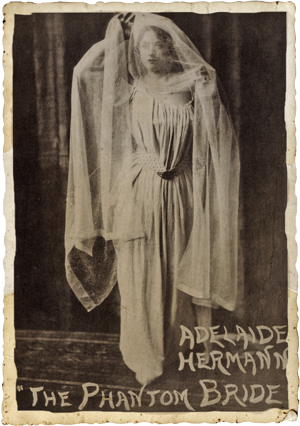
Anderson can be credited with the notion that a wedding gone awry would make a good basis for a haunted house, and in some of his scripts he does show you ghost brides. This might be a good place to ask the question: "Do we ever encounter a ghost bride in popular (or unpopular) culture before now?" Somehow she feels familiar, or at least not odd, but examples of ghost brides are less common than you might expect. Nevertheless:
From Judy, Or The London Serio-Comic Journal, 1876. Hat tip Craig Conley
Doombuggies found another example.
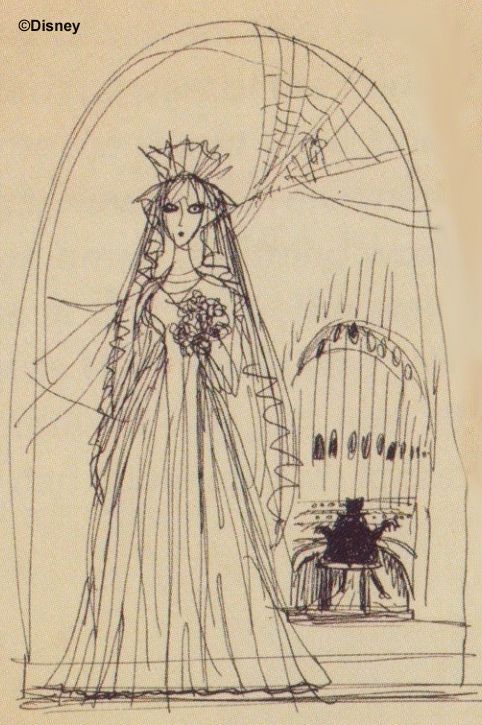
Okay, so when do we get to see a ghost bride in Haunted Mansion artwork? Well, we left off at 1968 in the
previous post, but we are going to need to back up, because Mare Davis did a sketch of a ghost bride in 1964.
MDIHOW (342)
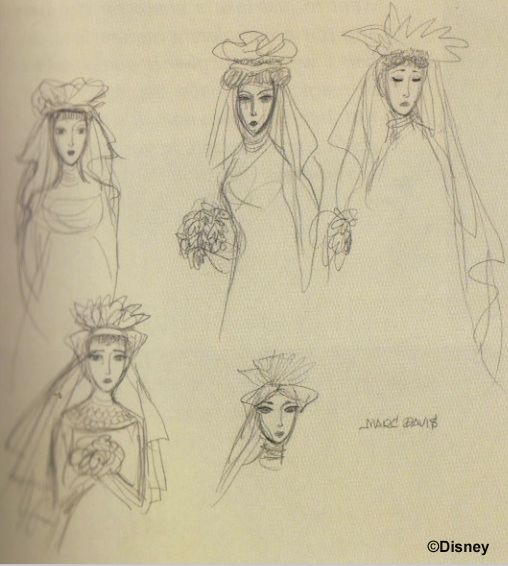
The Haunted Mansion project was put on ice for the remainder of 1964 and 1965, while the New York World's Fair consumed everyone's attention. When it was over, the Pirates ride sucked a lot of the oxygen out of the room. It really wasn't until 1968 that Marc returned to the HM in earnest. At that time he did more bride sketches:
MDIHOW (397)
It's possible that this Davis sketch of a ghost bride on a stairway landing was done about this time.
D23/Disney
Obviously, Davis liked the ghost bride idea, and we may speculate that one day the light bulb clicked on, and he realized that his weird "Beating Heart" ghostette could be conflated yet again with a different ghost, this time the bride.
At last our elusive ghost has donned a wedding gown.
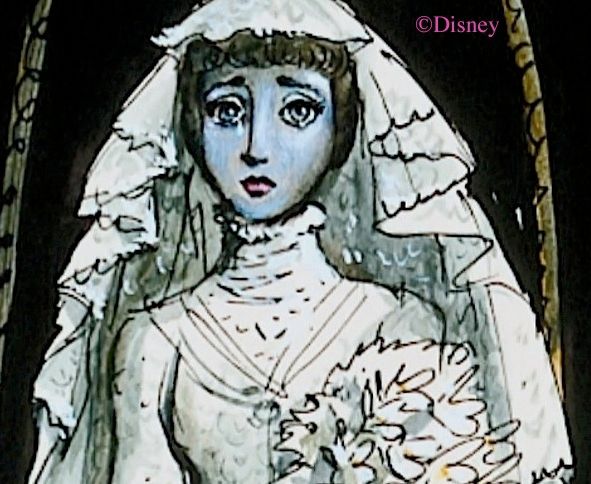
One final decision remained, however. It was decided at some point that the bride should have a corpse-like face. It used to be thought that Marc's "changing portrait" showing a forlorn bride turning into a corpse belongs here, but it has been plausibly explained that this isn't a changing portrait at all but an effects concept showing how the attic bride could be transformed from one stage to the other (presumably through projections of some sort). Since there is no trace here of Moving-Lights (no beating heart, no bubbling weirdness), my guess is that it pre-dates Marc's decision to merge the ghost bride with Beating Heart. See the Comments.
The ghost we finally got was actually a combination of three different characters:
Anderson's candle-holder, Davis's Moving-Lights ghost, and a "corpse bride."
They put Beating Heart in exactly the spot occupied by the maquette figure in the scale model; that is, on the left side, and a little ways to the left of the spot where today there is a ghostly piano (I'm talking DL, of course). For you young'uns with short memories, her heart glowed red and visibly pumped back and forth, while the sound filled the attic: Lub dub. Lub dub.
That's where BH was on opening day, and that's where I remember seeing her on August 14th. Some new information that came to light a few years ago reveals that a large plastic sheet (called "nylon 6") was in front of her, stretching from post to post and floor to ceiling, probably with the intent of making her appear fuzzier. That too jibes with my memory. I remember her slowly rocking back and forth in an area that reminded me of a door frame, and yeah, she was definitely murky.
She was there for perhaps a month. When the (infamous) Hatbox Ghost, which was located near the exit on the right, failed to perform as hoped and was removed, BH was transplanted to his old spot. There she remained from approximately early September 1969 until May 2006, when she jumped the track to the other side and became Constance, that zany hubby-whackin' axe murderer.
What did that original "Beating Heart" bride look like? Her body was essentially that of the Moving-Lights ghost in a wedding dress, and it remained so right up until she was replaced by Constance. Many of you have probably never seen the Moving-Lights body in action. It's
very clear in certain WDW videos:
It may be possible to detect it also in this 1990 video of the Anaheim bride:
It's difficult to say how conspicuous this bubbling effect really was. In WDW videos from about 1993 until the advent of Constance in 2007 it's very clear, and you can also see it in a rare 1976 video of the original WDW bride, but in most videos from either HM it's not visible at all. It may be that this simply reflects the capabilities of video photography at the time, but what I suspect is that the rippling, bubbling effect was toned down or even turned off for most of the bride's history, and in all of the Mansions. Nevertheless, in the schematic for the figure you can plainly see the loops of small light bulbs built into her frame, ready to go. Note that only her left leg has lights in it. Compare that with the 1990 video of the DL bride above, which plainly shows inner lighting only in that leg.

We know more about the appearance of her face. In the beginning it bore a strong resemblance to the corpse phase of the Marc Davis "changing portrait" above, and for that reason this first version of the bride has picked up the name "Corpse Bride." For the Disneyland original, we have a number of good photos of the figure, from pre-opening photos of the figure before installation, down to 1975. Here's a montage:
Here's one of the oldest photos we've got, dating from 1969 or 1970, by Greg Ziak. Although
it's very early, it was nevertheless taken after her move across the attic to the Hatbox Ghost's spot.
Greg Ziak
We also catch a fleeting glimpse of her in the background of a scene from the March 1970 Disneyland Showtime episode, which featured the Osmond brothers and showcased the new Haunted Mansion. The program was filmed in January or February of that year, so we're mere months past opening day. The Osmonds glimpse may seem hopeless, but here's what happens if we blur and fade one of the above photos and put it alongside the Osmonds bride (which is on the right). It's kinda amazing.

However, even
that is not the oldest photography of the original bride in the attic. One day in June of 2011, Disney fan and historian Todd J. Pierce was going through a box of old home movies and photos he had acquired, and there he found a small reel dated August 1969. To his astonishment, this one-minute film featured a rare glimpse of the Hat Box Ghost, as well as about three seconds of murky footage of the bride, to date the
only known photography of the original bride in her original position. An edited version of the film was posted at the
Disney History Institute and eventually Youtube. Not much of the bride is visible, but you can see the red heart, beating back and forth, the tip of her glowing candle, and a number of large white smears and smudges. Occasional details like her hair are visible only in a frame or two here and there.
Here's a GIF with a picture of the Corpse Bride superimposed on a composite of stills from the film. The fit is exact.
The eyes of the Corpse Bride were never very bright, so they don't show up except very dimly in one frame:

Exactly when the Corpse Bride was replaced is not known, neither for DL, nor for her twin at WDW. At DL she was
definitely still there toward the end of 1975 but gone by 1979. At Orlando the change may have happened as early as 1973.
"Long-Forgotten" threadster Michigan Guy has put together an artist's conception of what the Disneyland
original looked like, and based on available evidence I'd say it's pretty accurate. Kids, hide your eyes!
Okay, fine. Not my fault if you have nightmares. Where are your parents?
Meanwhile, in Orlando
UPDATED June 2020: So far we've been focusing mostly on Disneyland. The Walt Disney World story is a little different. For one thing, there's a shocking lack of evidence available. For the first 18 years of her existence, there are currently only
three snapshots, plus a five-second video clip, plus
some mysterious photos taken while Imagineering was re-working her in the early 70's. No doubt there are lots of pictures in the Disney archives and lots more gathering dust and turning magenta in drawers and long-forgotten vacation scrapbooks all over the world, but for now, three or four pix and a short vid are all that's publicly available for her, 1971-1989!
Unbefreakinleevable.
One of the three photos only surfaced in February of 2013 at the irreplaceable Daveland site. With those rings around the eye sockets, it's the Corpse Bride, all right, but it looks like her face in Orlando was never painted with the same amount of detail as the DL version, especially in the lower part of the face.
The second photo is from Hoot Gibson and dates to 1976:
With a little knob-twiddling we can see a bit more of the face and also come up
with something a little closer to what she might have looked like in the dark.
The third snapshot only surfaced in June of 2020. The source who sent it to me dates it 1974-1976:
The film clip is from 1976 and is of remarkable quality, considering the vintage:
Something we can glean from this clip is that the bubbling/rippling light effect was in
operation right from the start (or at least by 1976). Look carefully at her bouquet arm.
Whenever we have a video with a horizontal sweep there's the potential for creating a 3D image by taking two screen grabs in quick succession and making a stereoscopic pair out of them. That means it's possible for us to get a look at the WDW Beating Heart bride in 3D, assuming you can do the "magic eye" thing.
I mentioned some photos taken during a re-tooling in the early 70's.
That's a story in its own right, and it gets its
own post.