Post Script added, July 2017
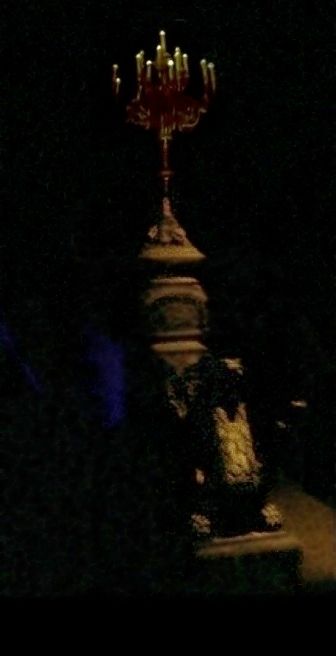
A few posts back we discussed the gryphons at the foot of the stairs. I said that they were like sentinels at the gateway to the unknown, "and that sort of thing." Well, today we plunge headlong into "that sort of thing." We've been schlepping around in the 19th and early 20th centuries looking for things that might have inspired the Imagineers. In this case, however, they are probably not taking inspiration from some specific source so much as they are making use of symbolism that must be measured by millenia rather than a few paltry centuries.

What does it mean to pass between a pair of gryphons? So glad you asked. The place between these creatures is a place of terrible and supernatural power. You often find them on the arms of thrones, in the form of cherubim. Oh yeah, I guess we'd better deal with the terminology thing first. In general:
- Lion body, human head = Sphinx
- Lion body, human head, eagle wings = Cherub
- Lion body, eagle head, eagle wings = Gryphon
But there's a lot of slop in those terms, even among scholars and archaeologists. Most of the time, for all practical purposes, they're more or less the same creature. Interestingly, some linguists think "gryphon" is derived from "cherubim" (which is the normal Hebrew masculine plural form of "cherub"; it's one cherub, two cherubim).
G R PH N
CH R B M
Those are all plausible consonantal transmutations when a word travels from one language to another. Now pardon me for a moment while I get this out of my system. How these pudgy little atrocities picked up the name "cherub" is beyond me.

Gag. Wretch. Drat, there's never a neutron bomb around when you really need one, is there?
These pests are found in Western art only. Eastern Christian cherubim remain properly terrifying.
Okay, I feel better. Now back to cherubic thrones. Those hail from the Ancient Near East, and "ancient" is what they certainly are.
Here's an ivory from Megiddo, ca. 1250 BC, give or take a century.
Here's an ivory from Megiddo, ca. 1250 BC, give or take a century.

From the sarcophagus of Hiram, king of Tyre, ca. 1000 BC.

It's not rocket science. The animals represent gods, and they are guarding the king, who is practically on a par with the gods themselves. The king is seated upon the cherubim, which may ring a bell with the biblically literate among you, since God is seven times described as seated upon the cherubim (1 Sam 4:4; 2 Sam 6:2; 2 Kgs 19:15; 1 Chr 13:6; Pss 80:1; 99:1; Isa 37:16). It's very much a royal image. In the Holy of Holies in Solomon's Temple in Jerusalem, there were two HUGE cherubim, with the Ark of the Covenant between them and in front of them. (The Ark also had a small pair of them on its cover, as any Indiana Jones fan can tell you.) God cannot be seen, but he was apparently understood to be seated upon the cherubim, and the Ark was his footstool (footstool?!? yes, footstool; see Ps 132:6-7; 1 Chr 28:2). The high priest entered and stood before the Ark, in the actual presence of God, once a year, in pitch darkness, protected only by a heavy cloud of incense smoke. He had bells on the fringe of his robe so they could hear if he was still moving around; that is, had not DIED. In later times they tied a rope around his ankle so they could drag out the corpse if something went awry.
Powerful images, and part of our psychic inheritance, whether you're a believer or not.
Sometimes the cherubim are gryphons, in line with the fluid interchangeability of these creatures. Here's a good example from an Assyrian cylinder seal, ca 700 BC. Two gryphons flanking a god.

And we still use them in royal or supernatural settings. If you've got sharp eyes, you'll spy such a chair in Cocteau's La belle et la bête (1946), a film that profoundly influenced Rolly Crump, as many of you know.

And we still use them in royal or supernatural settings. If you've got sharp eyes, you'll spy such a chair in Cocteau's La belle et la bête (1946), a film that profoundly influenced Rolly Crump, as many of you know.

It's no surprise that Caesar is sitting on a chair of this type, as we have seen before. He is, after all, Caesar.
(How the birthday girl gets away with standing on one of these, however, is beyond me.)

But thrones aren't the only option for cherubic pairs. In the iconography of the Ancient Near East they may simply stand on either side of a god or a king—in these two examples a sun god and a prince.


They can also stand like sentinels at the gateway leading to the royal presence, as in this Assyrian example. (For their cherubim, the Assyrians preferred a bull's body to a lion's. Regional variations, blah blah blah.) These have now been destroyed by ISIS.
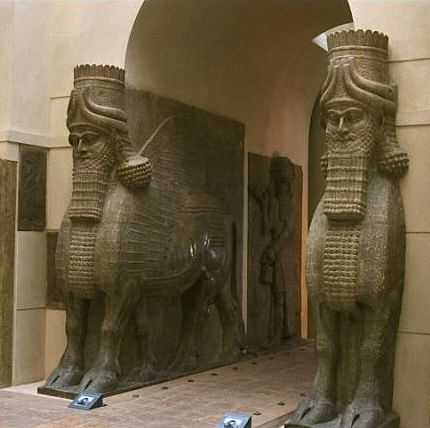
Here's a Hittite example from Asia Minor:

And with that one, the symbolism approaches our home base.

And...so what? I'm just pointing out that in some places the HM traffics in cultural symbols with astonishingly long pedigrees, and that longevity owes something to the power of those symbols to evoke even today a sense of the supernatural, a sense of fear and awe.
Post Script (July 2017)
By the way, I'm not implying that the Imagineers were boning up on Mesopotamian iconography and drawing inspiration directly from there. It's more a matter of pulling up something that's been implanted in our psyches for millennia. If we want to look for a more immediate inspiration, one possibility (and that's all it is) might be the staircase in the old Munsters TV show, which also had a pair of gryphons at the foot of the stairs:


.