Things You're Just Supposed to Know

Most of the time, Long-Forgotten assumes that readers are already familiar with basic facts
about the Haunted Mansion. If you wanna keep up with the big boys, I suggest you check out
first of all the website, Doombuggies.com. After that, the best place to go is Jason Surrell's book,
The Haunted Mansion: Imagineering a Disney Classic (NY: Disney Editions; 2015). That's the
re-named third edition of The Haunted Mansion: From the Magic Kingdom to the Movies (NY:
Disney Editions, 2003; 2nd ed. 2009). Also essential reading is Jeff Baham's The Unauthorized
Story of Walt Disney's Haunted Mansion (USA: Theme Park Press, 2014; 2nd ed. 2016).

This site is not affiliated in any way with any Walt Disney company. It is an independent
fan site dedicated to critical examination and historical review of the Haunted Mansions.
All images that are © Disney are posted under commonly understood guidelines of Fair Use.

________
.
Showing posts sorted by date for query lucretia. Sort by relevance Show all posts

Friday, September 24, 2021

Making Faces


(pic by Michael Hansen)


The old Master himself, Yale Gracey (with modest assistance from Rolly Crump), is credited with coming up with two different ways of creating a ghostly face, one by looking at the convex side of a blank mask ("the Leota effect") and one by looking at the concave side ("the Lucretia effect"). The latter is my own suggested term for what is sometimes called the "follow-you bust" effect, or any number of other clunky titles. [Edit: Richard Kaufman points out to me that the illusion itself has a long history and is commonly called the "hollow man" illusion. "Hollow face" and "hollow mask" are also common.] "The Leota effect" is actually anachronistic, inasmuch as Leota herself has not been done via "the Leota effect" for a very long time. The Singing Busts and Little Leota, however, still use the classic Leota effect, which involves projecting an animated facial image onto a blank white dummy face, so perhaps we should re-christen it "the Little Leota effect" or something like that, but alas, "the Leota effect" has been so standard for so long that it's probably an exercise in futility to try to change it now.

What's not obvious at first is how intertwined the two effects were, both in their original development and later on, when the Imagineers tried to improve both effects in the late 1980s and early 90s. Indeed, so confident were those guys in their new technology that they even conceived of using it to create a take-home souvenir, but that never materialized.

Today's post contains at least one bombshell revelation, along with a bunch of long-forgotten history, in some cases forgotten because it involves plans that either came to naught or half a page of scribbled lines (I'm feeling kinda Pink Floydish lately. Halloween of this year marks the 50th anniversary of the release of their classic album, Meddle, which immediately captured my imagination in 1971 and still lives there rent free.)


The Lucretia Juarez Effect

As many of you know, that sour-faced old spinster who glowers at you in the changing portrait hall (alongside an equally grumpy but nameless man with a Moe Howard haircut) is Aunt Lucretia. That's her official name. Originally, she was going to be part of the singing bust ensemble in the graveyard. Instead she ended up here in the portrait hall and on the mantelpiece in the ballroom. That's all been talked about before. Also well-known is the story of how Yale and Rolly supposedly invented the Lucretia effect. As Rolly tells it, he and Yale were messing around with a Lincoln mask, working out the beginnings of what would eventually lead to the Leota effect, when they noticed the weird optical illusion created by the convex side, and starting from there the two worked out the Lucretia effect (Surrell, Haunted Mansion [3rd ed], 81; Baham, Unauthorized, 89).

Here's a sketch from Yale's notebooks, clearly showing the effect exactly as it is today:


I don't doubt that Rolly is being truthful here, but the fact is, he and Yale were NOT the first to create this effect and put it to use in a haunted house environment. (That's the bombshell I was talking about.) It had already been in use for years in "El Sito Mysterio," a typical "gravity hill"* attraction at Frontier Village amusement park in San Jose, California. The park opened in 1961 and closed in 1980. "El Sito" was not one of the original '61 attractions but was built a few years later.

Before there was Lucretia, there was Juarez. Here he is in a 1968 photo:


Photos from: Bob Johnson, Frontier Village (Charleston: Arcadia, 2013), 50-51

UPDATE! Found a color photo of "Juarez":


I actually saw "Juarez" sometime in the 60s and was so amazed that I lagged behind when the group went to the next room so that I could get up close for a better look, only then figuring out how the effect was done. A few years later, when the HM opened, I immediately recognized the same effect in the portrait hall, but I forgot where I had seen Juarez, although I remembered that it was in one of those "Mystery Shack" attractions. I only ran across his photo in the Frontier Village book a week ago, solving a personal mystery that had baffled me for over half a century. Whether Juarez originated at Frontier Village or came from elsewhere, I don't know. I only know that he was there years before the Haunted Mansion opened.

Someone might argue that Yale saw Juarez while doing research into haunted house attractions, but I rather suspect that this is a case of the same illusion being discovered independently by parties unknown to each other. Any one with a Halloween mask can easily see it.


Lucretia in the 1980s and 1990s

In the late 1980s and early 1990s the Imagineers tried to use the great strides in computer technology to improve both the Lucretia and the Leota effects. The basic catalyst was the fact that photographic and videographic images could now be captured in computer files, opening up lots of new possibilities.

The first thing they did, however, was try to fix a very low-tech problem. Like they say, one picture is worth a thousand words:


The solution to this problem was to (1) round the edges of the cutout hole and (2) make the face shallower. 

They worked out the visibility angles in great detail, before and after.

Basically, change this . . . 


to this . . . 


(A link allowing a download of the entire patent can be found on this page.)

But they didn't do it. Why not? I have no idea. It wouldn't have cost much, and the positive results were meticulously worked out in the patent. The only thing I can think of is the confident belief that few people look at the busts long enough for the effect to fail. So why bother?

It's true enough that first-time visitors are going to stop looking at the busts and start looking into the room they are beginning to enter as they round the bend, well before Lucretia's nose gets pinched, but still, why not fix this thing for those of us who are not new to the ride but know it well and like to examine these details more carefully?

While they were at it, the Imagineers came up with two more ideas on the same patent application, ideas made possible by the new technology available. One of them revived the Gracey-Crump experiment of projecting animation onto the convex side of the follow-you busts while still viewing it from the concave side (i.e., having projectors inside the wall rather than a simple light bulb). That way they could add moving eyes and some limited animation to the mouths and eyebrows for Lucretia and her consort. The Imagineers even wanted to add audio, so that the busts would talk! This idea too came to nothing. My guess is that it either didn't look as good as they thought it would, or else they didn't want that much overtly ghostly manifestation so early in the ride. It does get uncomfortably close to violating the iron-clad "no ghosts shall be visible before Leota" rule, so yeah, I'm glad they didn't do this.

The third idea was to let guests pose for a photo somewhere (after the ride?), and print the photo on a sheet of thin plastic, which would then be heated and vacuformed over a generic face, and then trimmed, giving you a life-size mask imprinted with your face on it that you could use to make a Lucretia effect of your own, featuring your own face! Again, it never happened. Perhaps it didn't look as good as they hoped. Really, how would you find a face mold that worked for everybody, even roughly? Nowadays, of course, they could have a couple of dozen face molds, and the camera could include simple facial recognition software that would automatically select the face mold closest to the guest and rotate the appropriate mold into position for the vacuforming process. I wonder, however, whether the whole thing was rejected not because of technical shortcomings but because it essentially gives away the secret of one of the best and simplest illusions in the Mansion.

Still, one must admit that it would've been a pretty cool souvenir.


Leota in the 1980s and 1990s

As Rolly's account makes clear, the Lucretia effect and the Leota effect were created more or less simultaneously. Here again is a sketch from Yale's notebooks that clearly shows the Leota effect:

But right next to it is a sketch proving that they were also experimenting with projecting a face onto the concave side of the mask, actually foreshadowing the "interior projection" method which eventually came into use for Madame Leota.


By the late 1980s, new technology enabled the Imagineers to fix an old problem with the Leota effect. More radically, it made it possible to introduce a method of presentation similar to Yale and Rolly's experimental idea.

The old 16mm film loop cartridges were replaced with a captured image on laser disc. The loops used to break every few months and needed continual replacing. That's why so many film strips (usually incomplete) show up in the collector's market. It's actually pretty amazing that they lasted as well as they did, running upwards of 16 hours a day. The bin-loop system operated in controlled, dust-free cabinets, which not only increased durability, but reduced noise.

Anyway, concurrent with the laser disc came improved fiber optic technology, leading to the first attempt at an interior projection for Leota. (A link allowing the download of this entire patent can be found on this page.)


That first-generation interior-projected Leota debuted in the early 1990s and gave her kind of a "moon"
 face, not as bright or sharp as the old method and more distorted. Still, this version lasted until 2001.


You can get a pretty good look at her in this clip from a 1997 Discovery Channel special (with Tony Baxter):
Again, all of this history is pretty well known. What is less noticed is the fact that the interior-projection Leota enabled the Imagineers to reach back and realize original proposals for the Séance Circle that were impossible in 1969.

As initially conceived, the carpet under Leota was supposed to be animated with rippling and flapping, and the table with Leota's ball on it was naturally expected to wobble around accordingly. You can see this on one of the effects blueprints, which shows the carpet undulating:


You can also see the concept in Collin Campbell's artwork for the "Story and Song" album:


Why didn't they do this? Well, Imagineers like Marc Davis had a tendency to come up with cool ideas and then deliver them to Yale Gracey without the faintest idea how to realize the effects. That was Yale's job. Usually he succeeded, but sometimes he was stumped. A good example is the See-Saw royal pair in the graveyard. They are supposed to disappear as they go down, but Yale apparently couldn't come up with a way to do that, so it didn't happen.


One suspects that the wild scene you see in Campbell's artwork came to grief over the fact that Leota had to be absolutely stationary if you were going to project a face onto her. They somewhat compensated by making the carpet at least look like it was hovering in midair, although few visitors notice this and just assume the "floor" must be very dark. (And we've all heard the story about the guy who hopped the rail to get to Leota, only to fall about 10 feet and break his leg. That's when the safety screens went in.)


Anyway, with an interior-projected Leota, it became possible to incorporate at least some of the animation that couldn't be done before. It was all so subtle that many riders never noticed it, and as the years go by all memory of it threatens to dissolve into the land of the long forgotten. Be it here known to one and all that the table gently pitched and rolled during the decade or so in which the first-generation interior-projected Mdm L operated. Check these video clips from 1997 and 1999:
When they returned to the original, better looking, front-projected "Leota effect"
in October of 2001, the moving table effect also came to an end, sad to say.


The 21st Century: Floating Leota
 
Lucretia is exactly where we left her, unchanged since she left Yale Gracey's hands, so we're done there, but for the sake of completeness, a few words should probably be said about Leota's final chapters.

Floating Leota concept art by Chris Turner

The first attempt at floating Leota debuted in 2005 at Disneyland, and for the life of me, I can't imagine what they were thinking. It was essentially a projected image aligned with the moving target of the Leota ball. However sophisticated the equipment involved, anyone with half a brain should have been able to tell that it wouldn't work. It requires pinpoint precision, and any moving, physical, mechanical object is going to be subject to friction, wear, stretching (in the support lines), and all the vagaries of electric motors. Of course they couldn't keep the damn thing in acceptably accurate alignment. By 2007 they had abandoned this method for a new interior-projection system that really worked. Unlike its 1990s predecessor, the face really looks good, thanks to much improved technology. WDW got this one first, then DL.

One could argue that floating Leota is another attempt to bring back the more fully animated room that the Séance Circle was intended to be, but personally, I prefer the original, stationary Leota on the table, for thematic reasons. She is the central point of reference in the entire ride. She should be a fixed star in the midst of this mad and whirling firmament. But that's another post:
  • Floating Leota (2005) has never gotten anything more than a lukewarm response. The change felt, and still feels, wrong. Here's where treating this thing like a work of art proves its worth. What had always been the calm, stabilizing center of the ride was now simply another floating object. Everything about her—her chronological placement in the show flow, her pivotal position in the three-act play that is the Haunted Mansion, even her physical location in the room—announces that "here is the center, the eye of the storm." Nothing was gained and something was lost when she took flight.

*******************

*Gravity Hill is a common label for the hundreds of similar attractions around the world that use crazily-built shacks and tilted landscaping to produce a variety of optical illusions that seem to defy gravity and distort dimensions. The "Magnetic Mystery Mine" on WDW's Tom Sawyer Island, designed by Marc Davis, is a gravity hill attraction. Davis also drew up plans for a Fun House for the Fort Wilderness Campground that included gravity hill illusions, but that one was never realized. Knott's had a very good one for many years called "The Haunted Shack."

Monday, September 3, 2012

The Haunted Clock

.
You see an ominous grandfather clock, forever striking thirteen, as the shadow of a threatening hand slowly descends.  The stuff of nightmares, no?  This is another brilliant Haunted Mansion tableau only briefly glimpsed and yet easily grasped.  It works because the imagery is familiar enough for you to need only a glance in order to read it.


As we have done with many other Mansion marvels, we're going to explore the cultural background which helps to explain why this scene makes immediate sense when you experience it.  Then we'll look at the creative process among the Disney Imagineers leading to this particular showpiece.  We'll finish with a few Clock Hall trivia items that need a good home.  If all goes according to plan, when we're finished, you'll know more about that damn clock grandfather clock than you really wanted needed to know.  Yet again your Mansion obsession has lead you to lovely Disney concept artwork rarely seen, to juicy backstage photos, and to a surfeit of mostly unimportant but nevertheless fascinating information, all for the low, low price of "free."  Mmm baby, does it get any better than that?  You betcha!  (Wait . . . did I get that wrong?  I did.  I got that last part wrong.)

(The Disneyland clock in 1990.  Not that the date matters.  Nothing here has ever changed.)


Ghost in the Machine

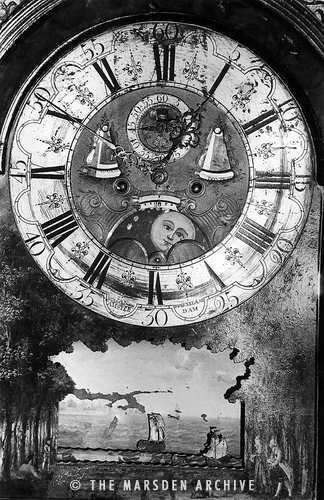
The first thing to say is that there has always been something vaguely unsettling about grandfather clocks.  They're about the same height and girth as a human being, they have a face, and for centuries the clock was by far the most complex piece of machinery most people knew, the closest thing to artificial intelligence.  Long before radio and robots, it was the clock that seemed eerily human.  It's never taken very much to anthropomorphize grandfather clocks in odd or whimsical or sinister directions.

(right pic is from here.  Hat Tip to Grinning Ghost for the left pic.)

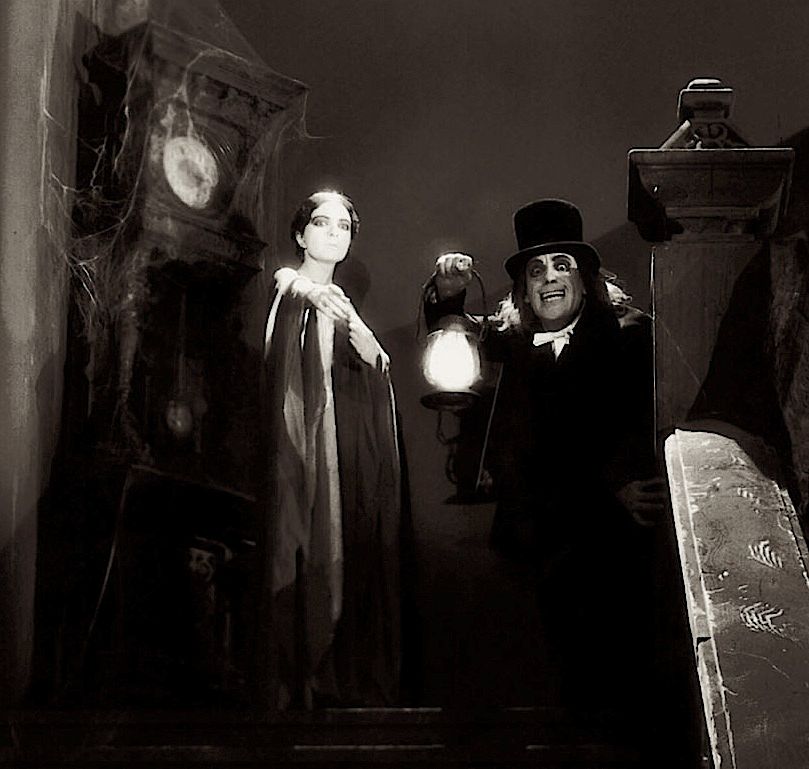
This cultural hangover continues into our own time.  Grandfather clocks have been standard props in scary movies as long as they've been
making scary movies.  They're right up there with suits of armor when it comes to creepy things standing around in dark old houses.  

(Chaney takes the gold, no contest, but the girl must settle for a bronze. That clock squeaks out a silver in a tight competition for second place.)

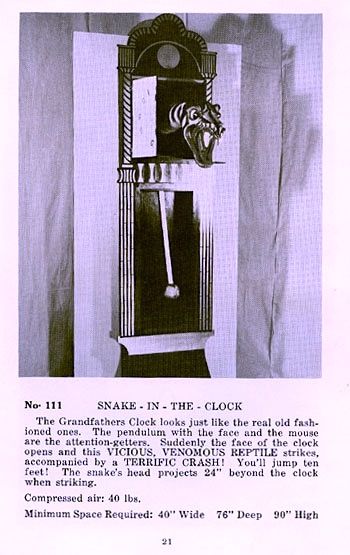
So is it any surprise to learn that scary grandfather clocks inside of dark rides are nothing new?  Foxxfur,
over at the Passport to Dreams blog, has posted an industry ad for a spookhouse clock.  "You'll jump ten feet!"


And if it's a creepy grandfather clock costume you want, check out this.

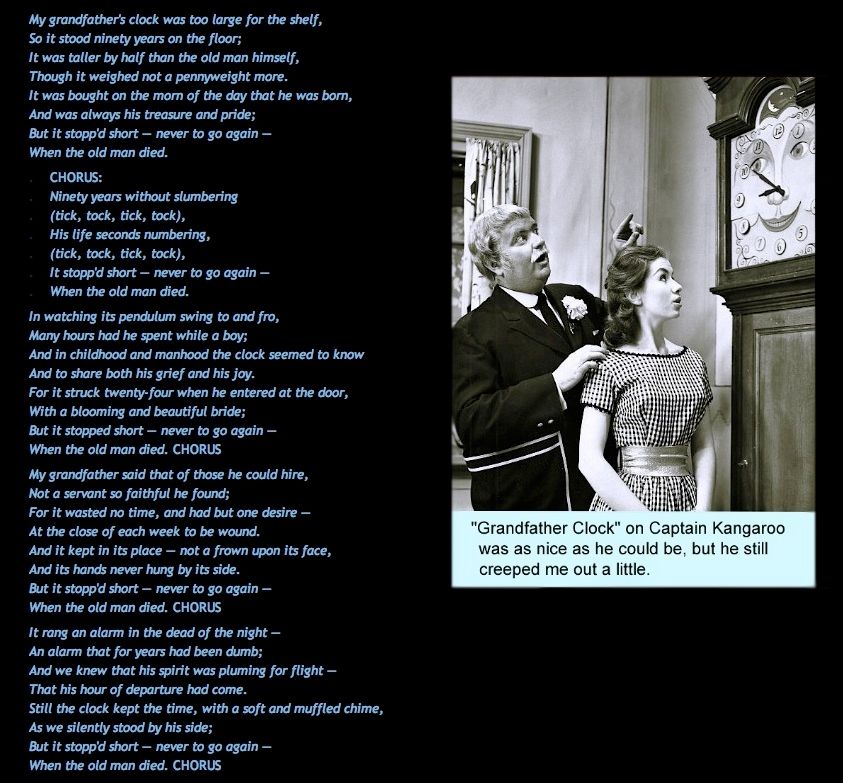
It's a small step from this general eeriness to the notion of haunted clocks, and sure enough, in popular culture haunted clocks are a widely-known phenomenon.  A good musical example is "My Grandfather's Clock," a lively little ditty written in 1876.  I guess it's sort of a folk classic.  We used to sing it in school when I was a little kid.  It's been recorded by the Everly Brothers, Burl Ives, and Johnny Cash, among others.


Stories of "genuine" haunted clocks have been around a long time and continue to be plentiful.  In an article by columnist J.D. Mullane, he describes in detail the strange ways of a grandfather clock he inherited from his sister after she died.  It won't run, can't be fixed, but it chimes at peculiar times, especially when there is a dangerous situation threatening one of the children.  Mullane's column triggered a number of responses from readers about their own creepy clocks:

      "On our first wedding anniversary, my parents gave us an anniversary clock. Not expensive, but I loved it. It kept perfect time for years. Mom passed in 1990. After a few years, it stopped. Changing batteries didn’t help. Because I loved it and it meant something to me, I kept it on the mantel. When we moved, the clock went with us and had its place of honor on a new mantel. But it was quiet, and the pendulum didn’t move.
      Until one evening when my husband and I sat in the kitchen. The clock chimed. Looking at each other, we went to the clock, but it clearly wasn’t working. Puzzled, we forgot about it. Later that evening, my son was in a minor auto accident. Over the years, the clock chimed randomly, always announcing something, not always bad, most of the time good. It got to the point that when it chimed, I would say, ‘Hi, Mom.’
      (On) Jan. 6, 2012, my dad passed away. Dad was a major do-it-yourself handyman. There was nothing he couldn’t fix. ... The clock still randomly chimed, until then. About a week after we buried Dad, we sat in the kitchen talking about him over a glass of wine, and damn, the clock chimed at 10:59 p.m. The next day, while dusting the mantel, I freaked out. The pendulum was spinning and the hands were keeping time! 
      While it doesn’t chime every hour, when it does, it is usually at night and always at one minute to the hour. Guess Dad is still working on it. Between the random chimes I have a connection to my parents, who I miss tremendously. The clock stays, as is."

      "My cousin, Gerri, passed away two years ago in September. Her brother cared for her and was very good to her until she died. Well, just a few months later, our families all got together for Thanksgiving at the brother’s house. Dinner was out on the table, and Gerri’s brother gave a toast to Gerri, and we all raised our glasses to her. He said some really sweet things to his sister, and we were all missing her and wishing she was with us.
     Suddenly, a clock on the buffet started chiming. The brother stood up with a really funny look on his face, and then he told us this: The clock had not worked in over a year. It was sent to a repair shop, but could not be fixed. It just started working right after our little toast. It works to this day. So it must be that our loved ones can somehow communicate to us through clocks. I truly believe this."

     "Many years ago, on our first anniversary, my husband bought an anniversary clock with a chime. It stopped working (they always seem to stop working, no matter who owns them), and we took it to clock repairmen. But ... it wouldn’t work. I left it in our house, always in a place of honor, so everyone could see it. It’s really a beautiful thing.
     (My husband) died five years ago. A few months after he died, I was still missing him, and then the clock began chiming. It was on what would have been our 54th wedding anniversary. The clock now works and keeps good time. I can’t explain it, but I know what I want to believe."

There are plenty of stories like those out there. Some of these creepy time pieces have been acting up for quite a while.  Birr Castle in Ireland reportedly has an old haunted grandfather clock in it:


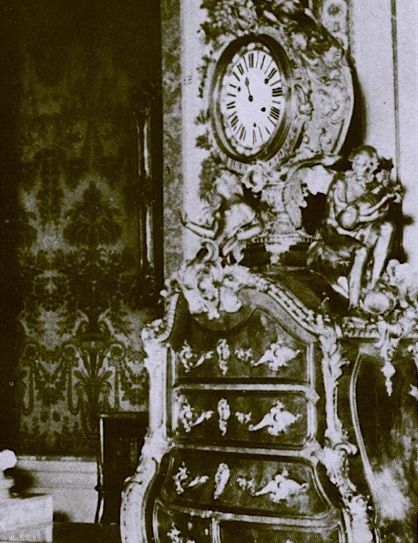
And this ornate timepiece, which belonged to Frederick the Great of Prussia,
did the "My Grandfather's Clock" thing is 1786.  It died when he died.


And guess what?  Sometimes these haunted clocks strike thirteen.

    "I am the fourth owner of a grandfather clock that was first purchased by my grandmother's brother approximately 100 years ago.  Great Uncle Telemac was a man of wealth who could neither read nor write but went on to start one of the largest insurance companies to date. When he passed away, the great clock stopped, and no amount of coaxing would get it to start again. It sat in the dining room of his house in Montreal, Quebec, and when the family was gathered around the dining room table to hear the reading of the will, the clock started again with no outside influence.
     The clock is a seven foot tall unit that has a series of three weights that have to be pulled up by chains to wind it. When my grandmother Blanche died, it again stopped working and would not start. My mother was given the clock by her sister and had the clock shipped a thousand miles to her house. For weeks the clock would not run. When she received a copy of her mothers will in the mail, the clock again started.
     I was living with my mother at this time, and we had gone to town. We found the copy of the will in the mailbox, and when we went into the house we found the clock running. When my mother passed on, the clock struck thirteen and would stop and run in spurts. The clock thus far has been behaving itself, with no other episodes."


     The Sherman House in Plover, Wisconsin is reputed to be haunted.  It's a renovated 19th century building, and it has been plagued with poltergeist activity since opening as a restaurant in the 1980's.  Among other things, they've got glasses flying off the shelves, a massive front door that opens and closes by itself, and a mantel clock that strikes thirteen at midnight.


(There used to be handy links for the above examples, but they're all dead—or are they? Hmmm....I'll check again on the anniversaries of this post, at midnight.)

Make of it what you will.  I tend to credit at least the sincerity of a lot of these accounts, because in many cases it would be
so easy to "improve" the story. ("And the clock stopped precisely at the moment of Uncle Fred's death!  I swear it's true!")

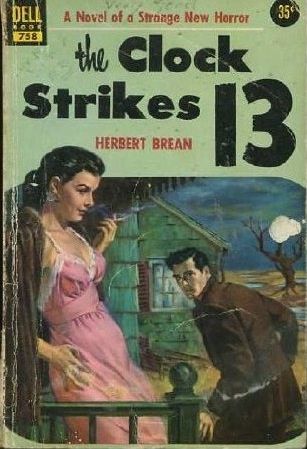
The motif of a haunted clock that strikes 13 as an evil omen
appears in pop fiction and cinema as well.  This is from 1954.


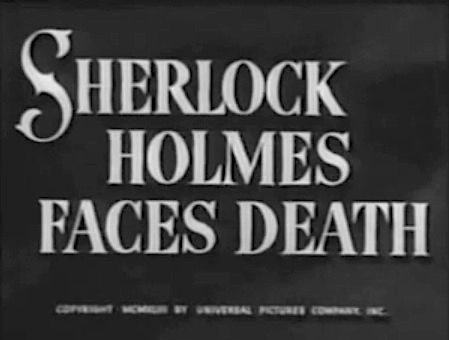
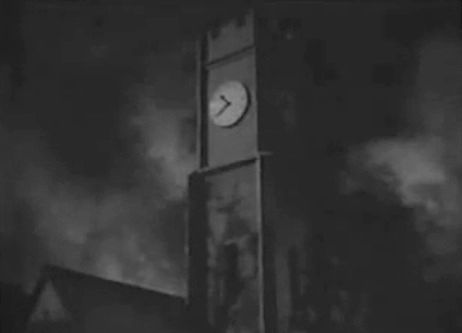
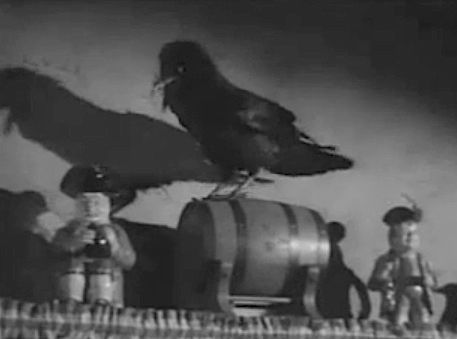
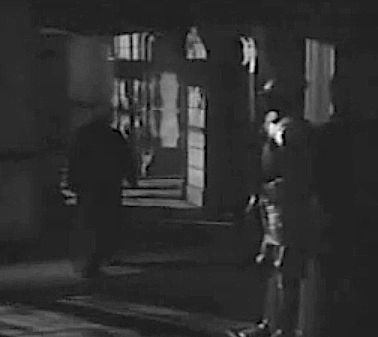
A 1942 Sherlock Holmes movie uses the motif.  In Sherlock Holmes Faces Death (with Rasil Bathbone), not only do we get a clock that
strikes thirteen just before someone dies, we also get a creepy raven and long dark hallways with suits of armor standing around.


Sherlock Holmes Faces Death


Tick Talk

Like so many other ideas, the Mansion version of the haunted grandfather clock originated with the Father of the Haunted Mansion, Ken Anderson, as we can see from a sketch he (and Duane Alt) produced during his pioneering labors on the attraction in 1957-58.  I wish I had a bigger, clearer copy, but what we can see is plain enough:  a normal-looking clock with a ghost inside the cabinet.

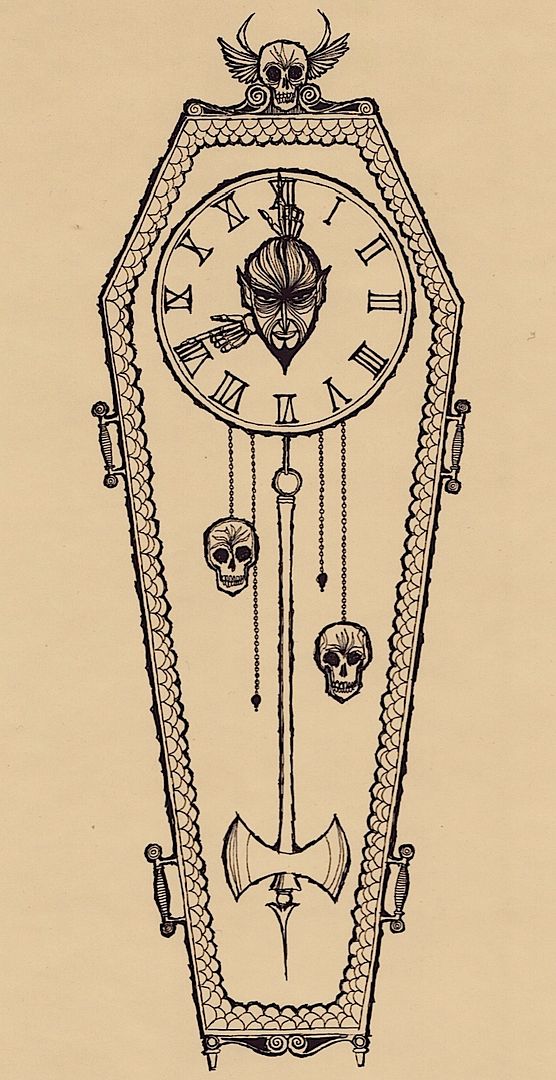
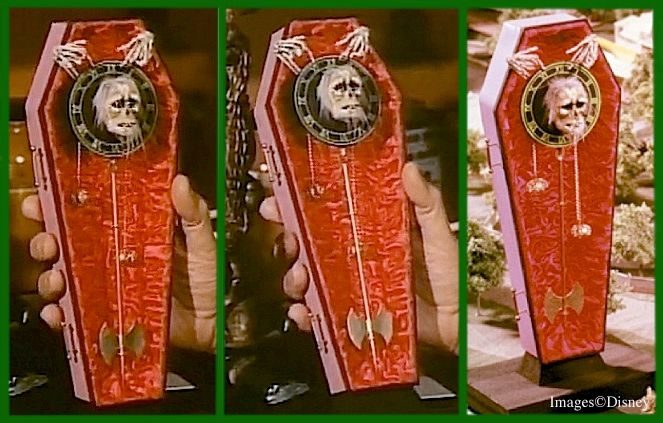
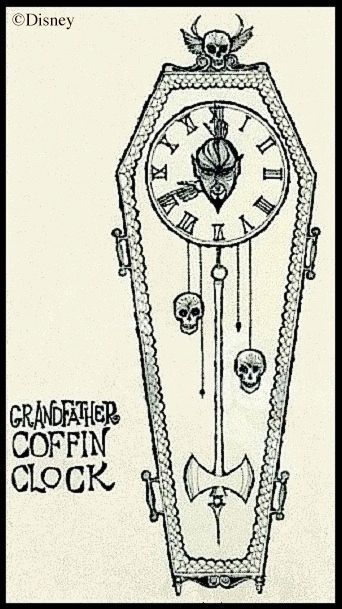
Later on, another Imagineer came up with his own idea for a spooky clock, one that had nothing in common with Anderson's version.  In 1964, Rolly Crump sketched a "Grandfather Coffin Clock" for his Museum of the Weird project (which, as you know, was never incorporated into the ride).  He also had a maquette made up.  The little model is interesting in its own right, as it is far from identical to the sketch.

©DISNEY


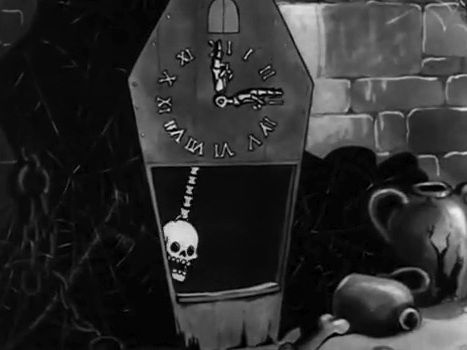
Rolly may have drawn some inspiration from a 1933 Mickey Mouse short,
"The Mad Doctor," which also features a coffin clock with skeletal hands
on its face and a skull pendulum reminiscent of Rolly's skull clock weights.


(Hat tip to Waltzing Ghost at MiceChat for drawing my attention to this parallel.)

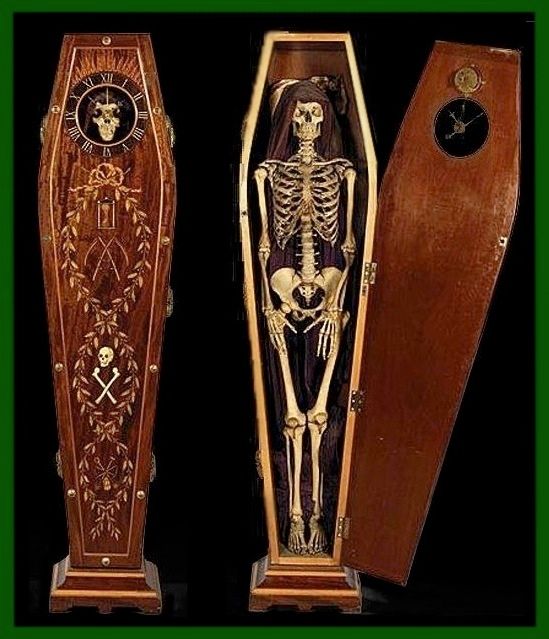
He may very well have found inspiration in real world clocks as well, like this charming
specimen, once the property of the Countess of Rosslyn.  The skeleton is that of her Italian
secretary/lover.  They say the Countess never recovered from his death.  Well, yeah, I'd say not.


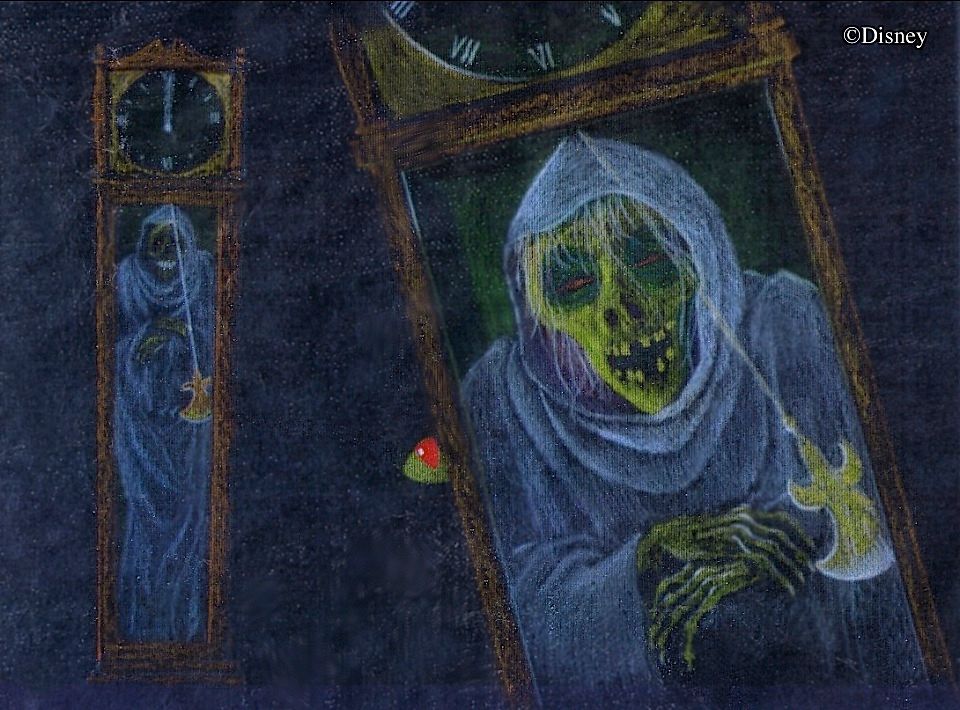
And then around 1968, two more Imagineers came up with a haunted clock.  X
Atencio went back and developed Ken Anderson's original idea, but the wickedly
bladed pendulum could be a nod to Rolly's clock, as well as being an Edgar Allan
Poe allusion, as was the One-Eyed Black Cat that X had in mind for the ride's host
character at this time.  (Note the cat's evil eye peeking out from behind the clock.)


This sketch by Marc Davis from summer of 1968 was unknown until published in 2019. The face of the clock
has become the ghost's face; otherwise, it's not hard to see the influence of Ken Anderson's original idea here:

MDIHOW 388

early sketch (duh)
 

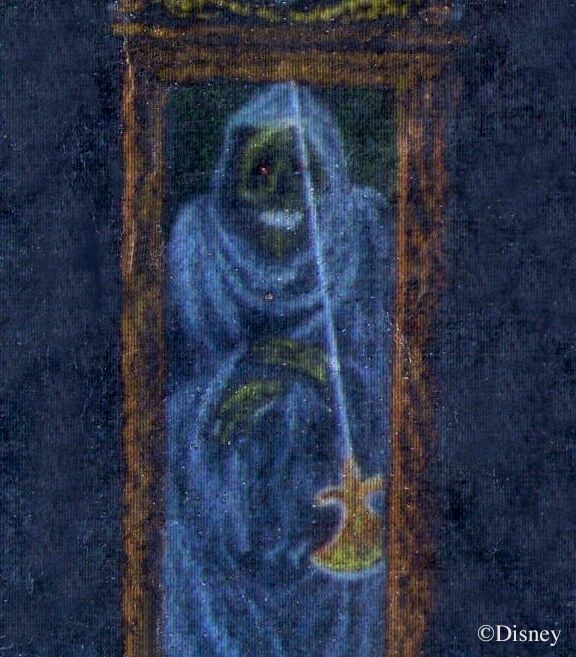
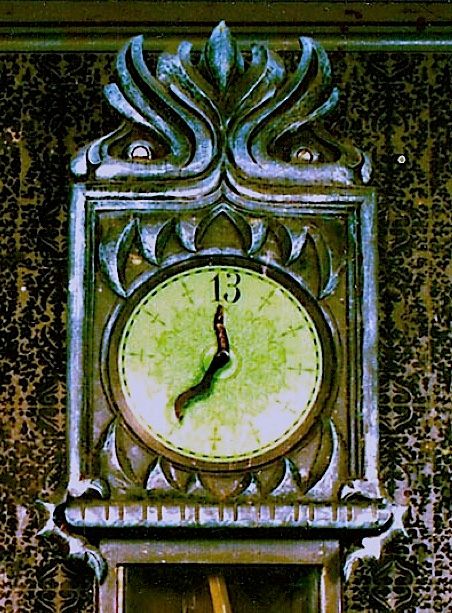
Ken's, X's, and Marc's concepts all have a visible ghost in the cabinet. But once it had been decided that (1) no ghost would be visible until Madame Leota worked her wonders, and that (2) the clock would come before the Séance room, the ghost inside the cabinet had to disappear, as ghosts are wont to do anyway.  Nevertheless, the fixture itself sprouted a few spectral countenances.  The demon face framing the clock face is the obvious one.  I'm sure that many (if not most) of you have long been aware of it.


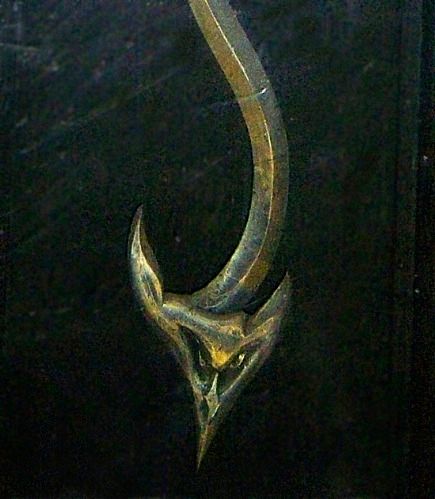
Less well-known is the face on the tip of the "devil's tail" pendulum.  It's right there inside the cabinet where Anderson's and
Atencio's ghost would have been.  Behold, a remnant.  It is all that survives from what we now know was a much bigger idea.


The Real Chill That Came Later

Have you ever noticed that the Ghost Host tells you, "The real chills come later" immediately after the biggest scare of the ride?  Well, if he isn't lying, the only thing he could realistically be referring to (in my opinion) is this scene in the Clock Hall.  It's the climax of Act One in the three act play that provides a broad and basic narrative for the attraction.  As we've mentioned before, the shadow of the hand coming down on you (someone behind you?) is the closest thing to an actual attack in the entire ride, the only undeniably hostile act directed against you personally.  Up until then, you may have suspected that the Ghost Host and the rest of the ghosts are hostile, but there have only been hints and suggestions in that direction, not real evidence.  Until you enter the Clock Hall.  Yep, here's a real chill that came later.


We're not going to discuss the shadow hand, since we covered that subject thoroughly enough in
a previous post.  As you may recall, I suggested that this effect was inspired by Nosferatu (1922).


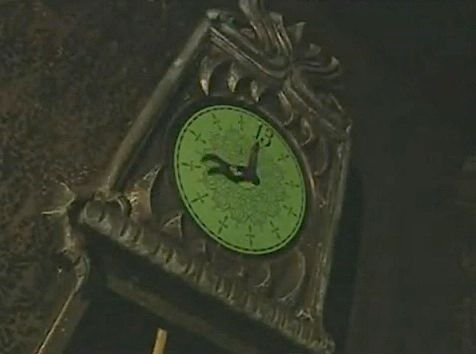
The Haunted Mansion's Clock really is a stroke of genius.  It would have been so easy to get it wrong.  In the first place, we can't very well have our doombuggies stop while the clock in front of us chimes 13 times (hoping all the while that the riders will actually keep count), so in order to convey the concept of "striking 13" in a split second, the Imagineers simply put the 13 right on the clock, a visual clue, and they had the minute hand run backwards at a rapid rate, signifying in an instant the uncanny and the anomalous.  Aurally, the clock simply ticks and chimes continually:

The Clock Hall


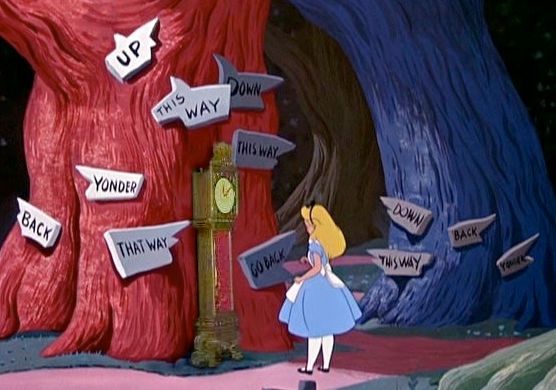
The show details are critically important.  If the minute hand had spun forward, no doubt we would all be sitting here postulating about time speeding up in the Mansion, with the hands agreeing with the number 13 in pushing us forward in time unnaturally, blah blah blah.  On the other hand, if a normal clock face were presented (e.g., with a "12" at the top), but the hands were spinning backward, we would all be chattering about a possible trip back in time.  But we haven't got that either.  The "13" points forward unnaturally and the minute hand sweeps backwards, equally unnaturally, leaving the viewer confused.  It's Tulgy Wood signposting, pointing two different ways at once.  You cannot make sense of it, so your only recourse is to throw up your hands and recognize that you are lost.  You have entered a netherworld, a surreality that follows its own uncanny logic.  Think Alice in Wonderland . . . 

"Well," thought Alice, "if it's thirteen o'clock, then I must certainly have gone further than I have ever gone before, and I shall be very late for lunch, but
if the hands are going backward, perhaps I am going backward too, and in that case it will soon be breakfast again.  Oh dear, this is all very confusing."

Yeah, think Alice in Wonderland, except this time the dream is a nightmare.


Time Pieces

Time now for a few random items to throw into your ever-expanding box o' trivia.™

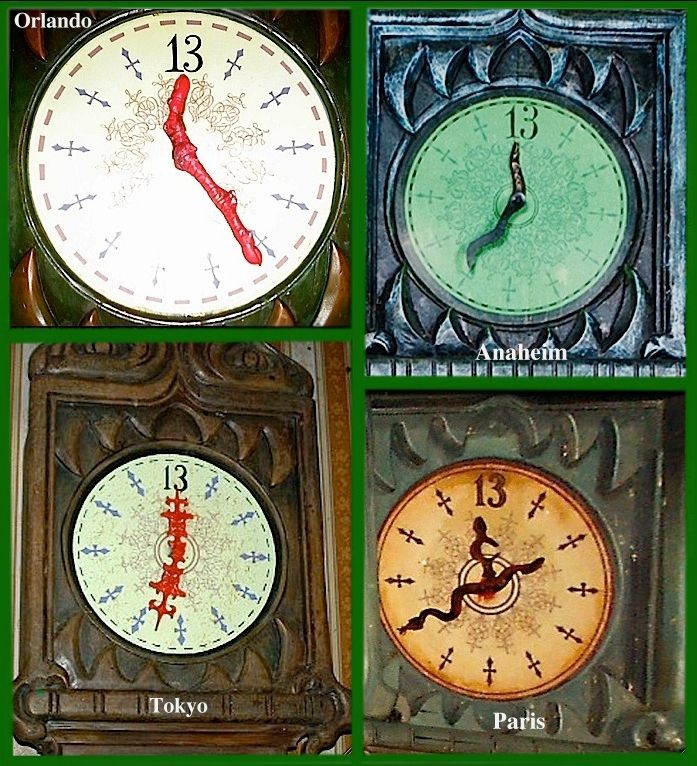
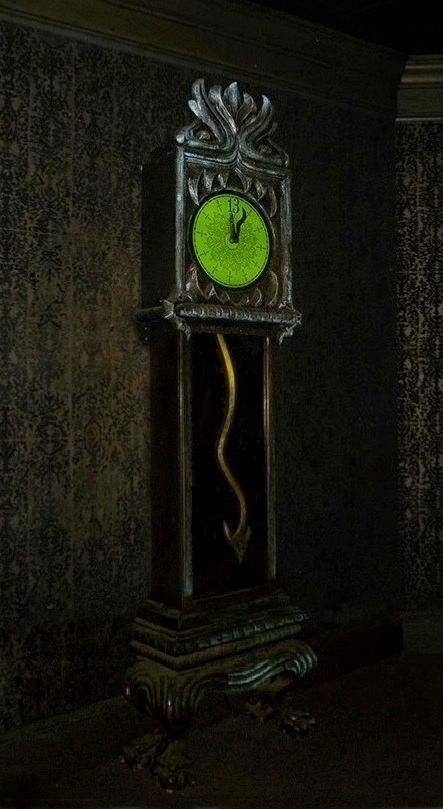
(1) The haunted grandfather clock appears in all of the Mansions (Anaheim, Orlando, Tokyo, and Paris), but each one is slightly different, especially with regard to the hands.


WDW has these weird, bony fingers (see the nails?), Disneyland has what look like leeches, Tokyo
has hands reflecting the artistic stylings of its Japanese setting, and Phantom Manor has snakes.

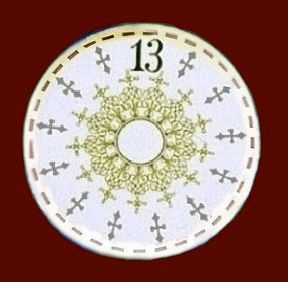
(2) Only the WDW clock face actually has thirteen marks on it; the others simply put a 13 where the 12 would be.

Walt Disney World's clock face

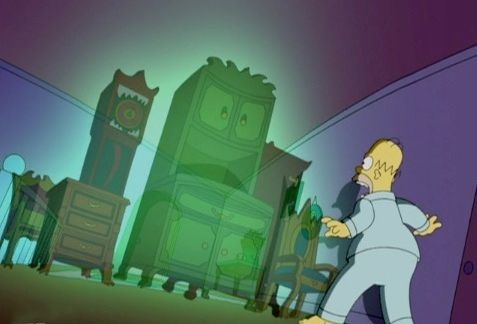
(3) One of the animators for The Simpsons used to be a HM butler and is still a big fan of the ride.  He's been known to sneak
little Mansion tributes into Simpson cartoons.  That includes a cameo by our clock during a "Homer's nightmare" sequence:

(Hat tip to "Dapper Ghost" at the Doombuggies.com chatboards for spotting this one.)

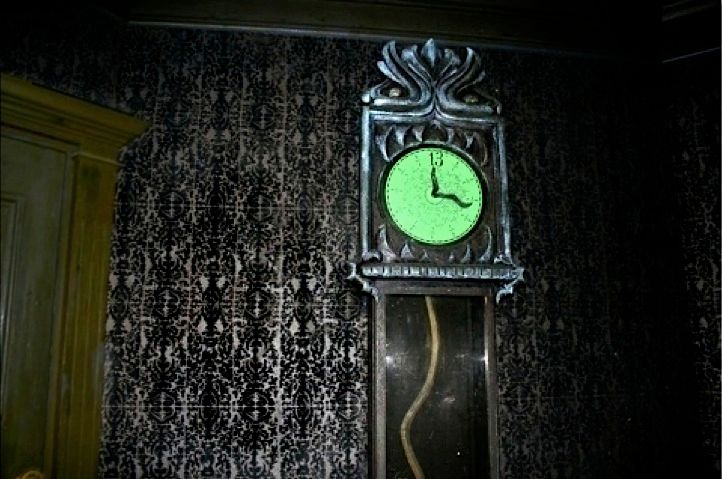
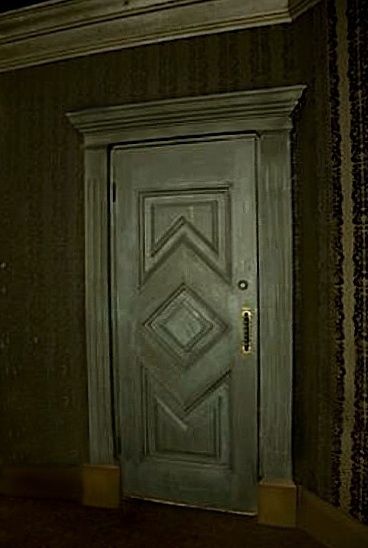
(4) There is a door to the left of the clock as you face it.  It's the only thing
in the Clock Hall other than the clock.  You can see part of it in this photo:

No one ever seems to notice this door, and you
don't find many pictures of it.  Here's the WDW door:


Normally, I don't take you Forgottenistas on backstage tours, because frankly, there isn't anything particularly wonderful to look at most of the time, unless you thrill to the sight of unpainted plywood and swoon whenever you see 2x4 framing.  In this case, however, I'm making an exception, because that door really does lead to some interesting things.  Step all the way in, please, and make room for everyone.

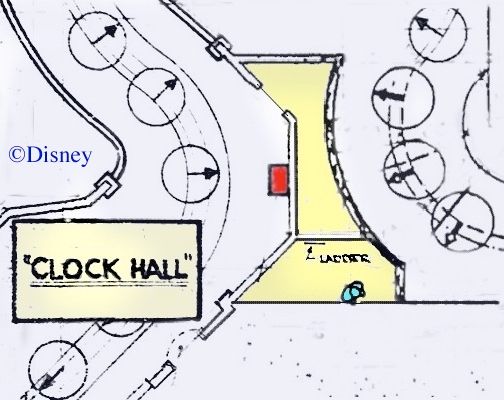
Originally, the door was for access to the projector for Madame Leota's face.  You will recall that she was going to face the other direction, looking toward you rather than away from you as you entered the room.  The Imagineers turned her around sometime in mid-1969, probably because they realized that there would be no way to avoid people seeing the projector as they swung by.  On the blueprint below, you can see the little room (yellow) with the projector (blue) behind the clock (red).  The projection would have come out of the wooden "spirit cabinet" which is still sitting right there behind Mdm L.


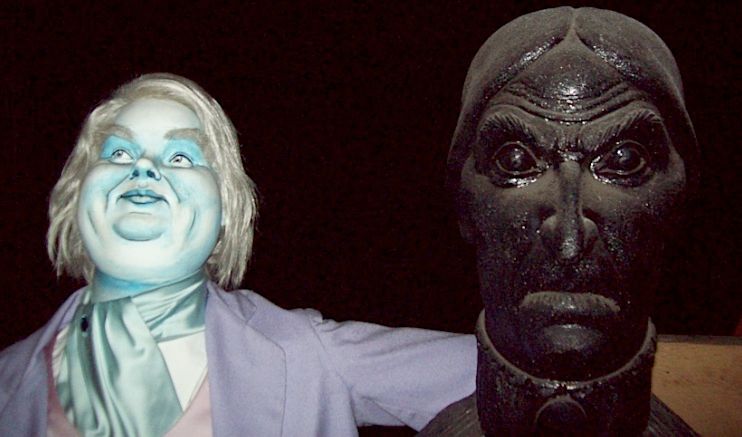
But after the projector was relocated, the room continued to be useful for providing access to the audio-animatronic ghost sitting on the mantelpiece in the ballroom, the one with his arm around the bust of "Aunt Lucretia."  As we have argued elsewhere, the Mantelpiece Guy was a very late addition to the HM.  You can see him (blue) on this WDW blueprint, drawn up a few years after the one above.


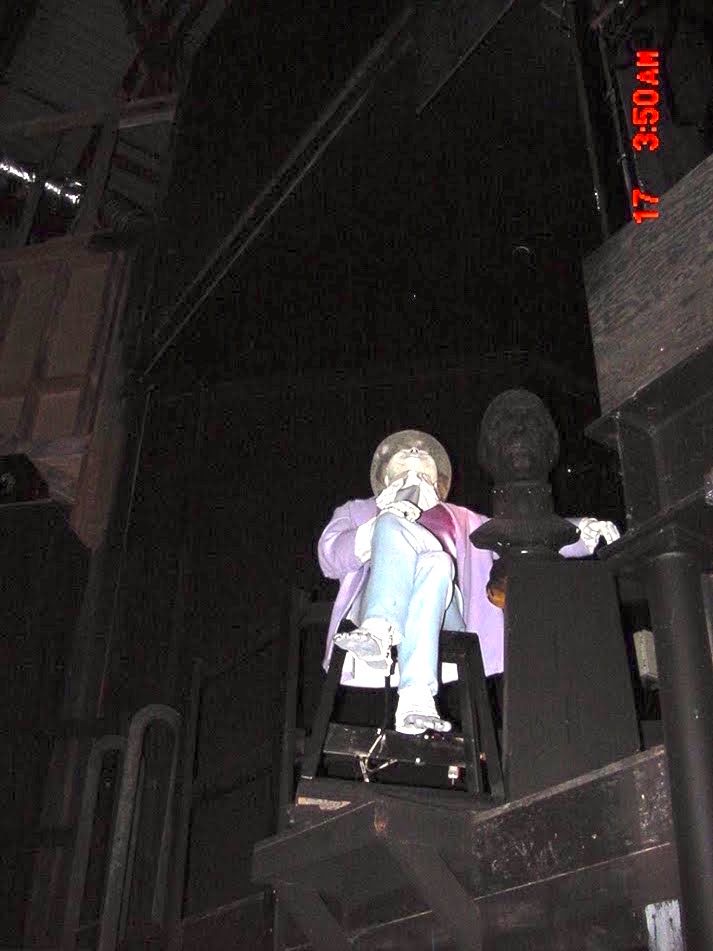
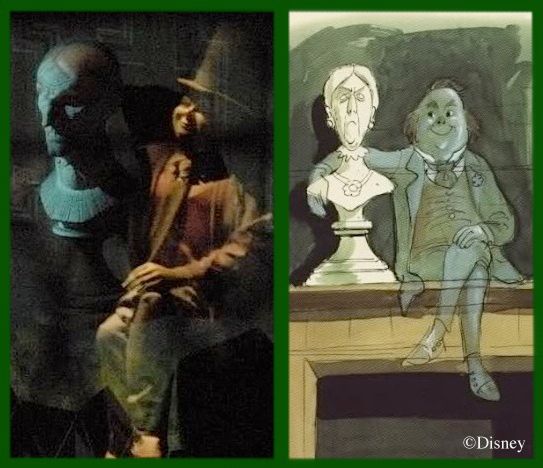
You climb down a ladder to get to the platform where he sits.  Contrary to the blueprint, there are actually two figures: Mantelpiece Guy and a black copy of the Lucretia bust that lines up with the real one on the mantelpiece.  (This is to ensure that anything behind the bust will be blocked out realistically when reflected in the glass that produces the "Pepper's Ghost" effect.  Confused?  It works like this . . . oh never mind.)


Concept art for the Aunt Lucretia bust

pic by Hoot Gibson


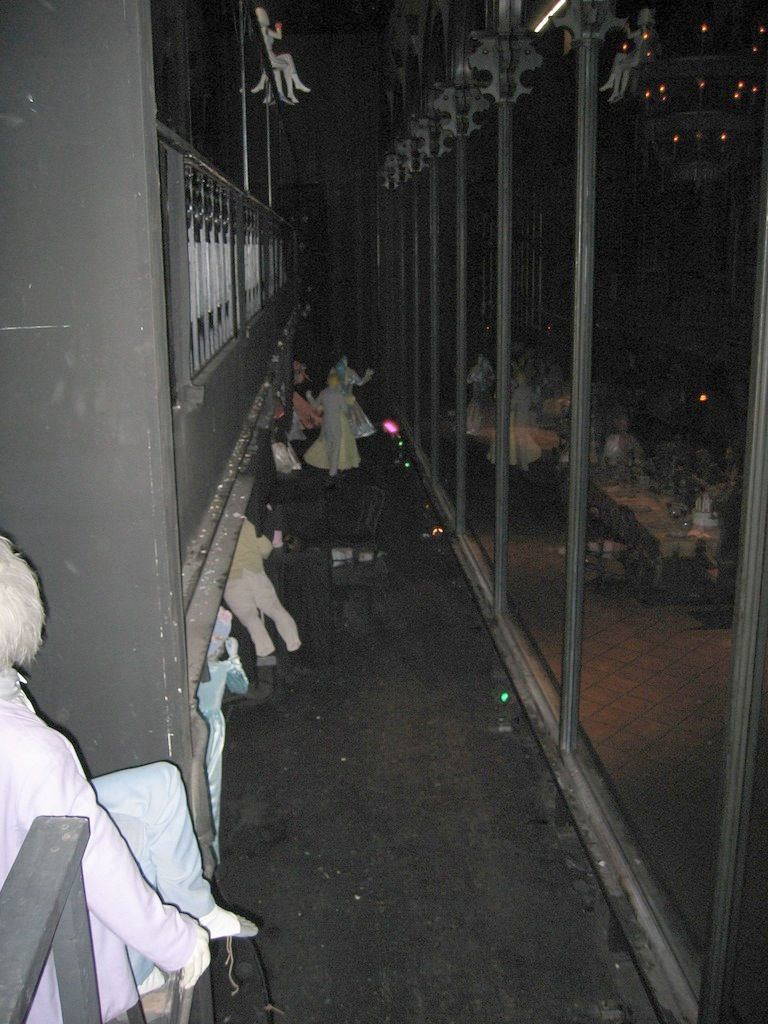
And now, the real reason for our backstage trip.  If you should happen to be
down there and look over Mantelpiece Guy's shoulder, this is what you see:


Okay, that's enough.  Let's get back before somebody sees us here.