.
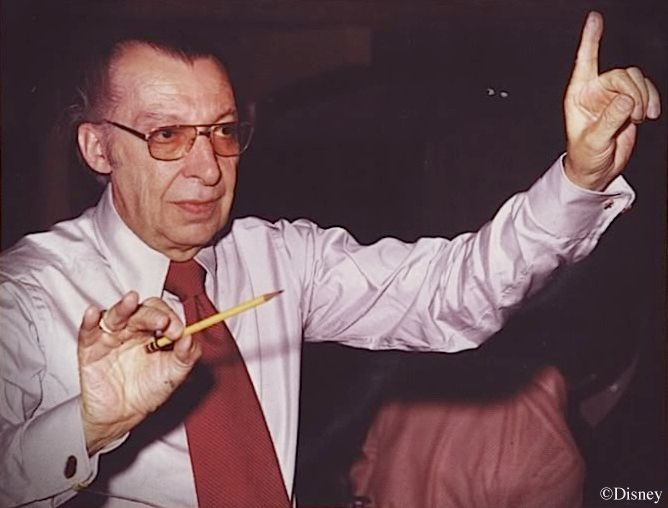
They say that whatever music you loved when you were 17, that's the music you will love the rest of your life. For Buddy Baker, who wrote the music for the Haunted Mansion, that would be 1935. For X. Atencio, who wrote the lyrics to "Grim Grinning Ghosts," it's 1936. That's just an interesting factoid to keep tucked away as you read what follows.
No one doubts that a big part of the Mansion's appeal is its superb musical scoring. The "Grim Grinning Ghosts" tune, written by Buddy Baker, appears in numerous arrangements throughout the ride, and however much it's rearranged and recast, it always sounds creepy. Magic!
The lyrics are not exactly Shakespeare. Actually, the title
is Shakespeare. The phrase "grim grinning ghost" appears in line 933 of the epic poem, "Venus and Adonis."
"Hard-favour'd tyrant, ugly, meagre, lean,
Hateful divorce of love,"—thus chides she Death,—
"Grim grinning ghost, earth's worm, what does thou mean
To stifle beauty and to steal his breath,
Who when he liv'd, his breath and beauty set
Gloss on the rose, smell to the violet?
Too bad it wasn't in line 999. Whether X borrowed the phrase consciously and deliberately or plucked it from a subconscious memory of his readings in Shakespeare—who knows?
Anyway, there is no point in pretending that the lyrics are poetry with a capital P. The graveyard jamboree scene (the only place you hear the lyrics sung) is not conducive to hearing a song with any kind of narrative. "Grim Grinning Ghosts" is calculated so that someone can hear a line here or a piece of a phrase there and still get the general idea of ghosts and ghoulies coming out to party. Except for the tagline at the end of each verse, you could almost put the rest of the lines in a hat and reorder them at random.
[Edit 8/13: But see now the argument by T. Hartwell in the Comments.] The song is a laundry list of spooky phenomena, explained at the end of each verse as ghosts coming out to socialize. The arrangement is suitably rollicking and undeniably catchy:
Grim Grinning Ghosts
Grim Grinning Ghosts
When the crypt doors creak and the tombstones quake,
Spooks come out for a swinging wake.
Happy haunts materialize,
And begin to vocalize.
Grim grinning ghosts come out to socialize.
Now don't close your eyes and don't try to hide.
Or a silly spook may sit by your side.
Shrouded in a daft disguise.
They pretend to terrorize.
Grim grinning ghosts come out to socialize.
As the moon climbs high o'er the dead oak tree,
Spooks arrive for the midnight spree.
Creepy creeps with eerie eyes,
Start to shriek and harmonize.
Grim grinning ghosts come out to socialize.
When you hear the knell of a requiem bell,
Weird glows gleam where spirits dwell.
Restless bones etherialize,
Rise as spooks of every size.
(Laughter)
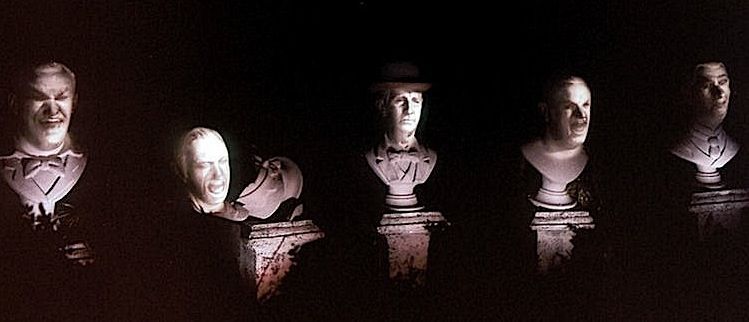
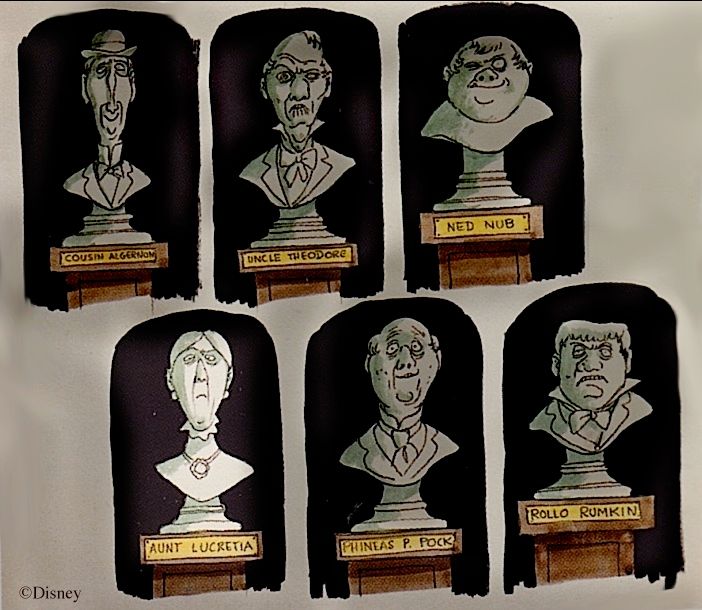
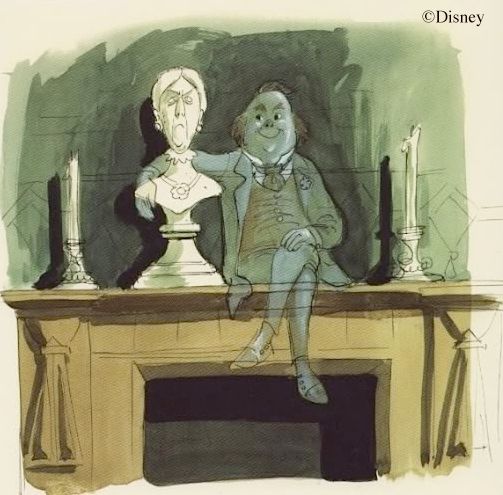
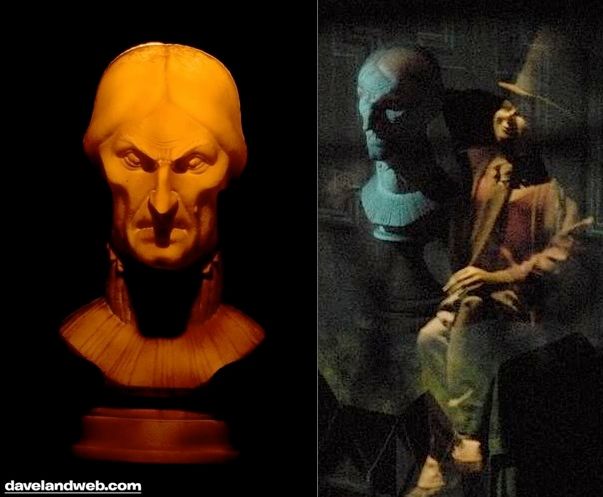
Incidentally, those singing busts have official names, which are on the blueprints and the film strips for each one (before things went digital). Left to right you've got Rollo Rumkin, Uncle Theodore, Cousin Algernon, Ned Nub, and Phineas P. Pock. We've already met Rollo and Phineas as tombstones in the original outside queue. "Cousin Algernon" is the name of a character in the Oscar Wilde play, "The Importance of Being Earnest." There was originally going to be a sixth bust, Aunt Lucretia, but they went with an all-male chorus, and Aunt Lucretia found useful employment elsewhere in the Mansion.


But let's get back to our topic. When it comes to comic songs about ghosts and goblins coming out to party, the first one that comes to most people's minds is probably "The Monster Mash," but long before that record came out the theme was popular. In fact, the heyday of such songs was the 1930's and 40's. If you listen to some of those, you're probably hearing the inspirational roots that led to GGG. Put another way, GGG is part of an established genre of novelty songs rooted in the 30's and 40's. At times, the lyrics to some of these songs come so close that you could almost suspect direct inspiration, but there are no smoking guns that I know of. Nevertheless, I've highlighted a few such lines in what follows. These songs are a real kick to listen to, whatever the excuse for doing so.
The Skeleton in the Closet
The Skeleton in the Closet
There's an old deserted mansion on an old forgotten road,
Where the better ghosts and goblins always hang out.
One night they threw a party, in a manner à la mode,
And they cordially invited all the gang out.
At a dark bewitching hour, when the fun was loud and hearty,
A notorious wallflower became the life of the party.
The spooks were having their midnight fling,
The merry making was in full swing,
They shrieked themselves into a cheerful trance,
When the skeleton in the closet started to dance.
Now a goblin giggled with fiendish glee,
A shout rang out from a big banshee,
Amazement was in every ghostly glance.
When the skeleton in the closet started to dance.
All the witches were in stitches, while his steps made rhythmic thumps,
And they nearly dropped their broomsticks when he tried to do the bumps.
You never heard such unearthly laughter, or such hilarious groans,
When the skeleton in the closet rattled his bones.
That's Satchmo himself, of course, Louis Armstrong, from the soundtrack of the 1936 film, Pennies from Heaven. The similarity of theme between "Skeleton" and GGG is obvious.
Swingin' at the Séance
Swingin’ at the Seance
In a house up on a rock along the countryside,
At precisely twelve o’clock the spooks begin to rise.
Swingin’ at the seance, twelve ticks,
Swingin’ at the seance, hot licks,
With the medium in trance,
How that horn began to dance.
Swingin’ at the seance, five men,
Swingin’ at the seance, jive men,
When the trumpet blasted out,
All the spooks began to shout.
That music came through so sweetly low-down,
Yet nobody knew who was riff-riff-riffin’ around.
Swingin’ at the seance, black coats,
Swingin’ at the seance, blue notes,
While the trumpet could have won a cup,
Its jivin’ broke the seance up,
And who do you think was a riffin’ away?
No one else but Billy May.
That's the Glenn Miller Orchestra, with Dorothy Claire, in 1941. Looks like it may have been written by Billy May.
The Headless Horseman
The Headless Horseman
Now, gather ‘round while I elucidate
On what happens outside when it gets late.
‘Long about midnight the ghosts and banshees
Get together for their nightly jamboree.
There’s ghosts with horns and saucer eyes,
And some with fangs about this size.
Some short and fat, some tall and thin,
And some don’t even bother to wear their skin.
I’m a-tellin’ you brother, it’s a frightful sight
Just to see what goes on in the night.
When the spooks have a midnight jamboree,
They break it up with fiendish glee.
Ghosts are bad, but the one that's cursed
Is the Headless Horseman, he's the worst.
When he goes a-joggin' 'cross the land,
Holdin' a noggin in his hand,
Demons take one look and groan,
And hit the road for parts unknown.
And there's no wraith like a spook that's spurned.
They don't like him, and he's really burned.
He swears to the longest day he's dead,
He'll show them that he can get a head.
So close all the windows, lock the doors,
Unless you’re careful, he’ll get yours.
Don’t think he’ll hesitate a bit,
‘Cause he’ll flip your top if it’ll fit.
And he likes them little, likes them big,
Part in the middle, or a wig,
Black or white or even red,
The Headless Horseman needs a head.
With a hip-hip and a clippity-clop,
He's out lookin' for a top to chop,
So don't stop to figure out a plan,
You can't reason with a headless man.
So after dark he’ll get the goods.
Head home, the way that you should,
‘Cause right outside, a-waitin’ there,
Is the Headless horseman. Beware!
Now we're closer to home. This was sung by Bing Crosby in Disney's
The Adventures of Ichabod and Mr. Toad (1949). Nothing at all against Bing, but I prefer this version by Kay Starr, released only a few months after the original Crosby version. Kay's lyrics are slightly different, as you can see, since I've printed the BC version. When she and those background singers get to "...what goes on
in the nighhhhht" you know you got your money's worth for THAT record.
The Haunted House
The Haunted House
When the doors all squeak
And the windows creak
And the ceilings leak
‘Cause the roof’s antique
And you hear a shriek
And your legs feel weak—
It’s a haunted house
There’s a dismal moan
Like a weird trombone
And the old hambone
Is suddenly thrown
You are all alone
With the great unknown
In the haunted house
There’s only one good spirit, it’s the spirit in the bottle.
With shaking hands you pull the cork and pour some down your throttle.
There’s a clank of chains
And a smell of brains
And a gory stain
Where the Duke was slain
And you’ve got chilblains
And varicose veins
In the haunted house.
When the old oak beam
Feels a corpse [?], you seem
To feel a wet stream
With a sinister gleam
And you wake with a scream
from a horrible dream
Of the haunted house.
When the cavalier
With the dreadful leer
Tried to disappear
Through the chiffonier
And you cling with fear
To the chandelier
It’s a haunted house.
The air is full of clammy claws that clutch you by the collar.
So gargle night and morning just in case you have to holler.
There are lights and sprites
And awful frights
In flesh-pink tights
But the dead of night
Comes a woman in white
So you’re quite all right
In the haunted house.
When the old church clock
Strikes twelve, there’s a knock.
With a sudden shock
You remember the lock
On the door is a crock—
Oh, why did you mock?
At the haunted house.
It is black as pitch
And your eyeballs twitch
In the darkest niche
Sits a dirty witch
And the lighting switch
Is out of reach
In the haunted house.
When the slavey’s filled with gravy why is she so pallid?
Something pushed her in the pantry when she fetched the salad.
“I’m filled with dread.
Yes I’m nearly dead.
I saw a head
Underneath my bed.
Come out if you can.
I could do with a man
In the haunted house.”
That's the oldest one of the bunch (almost: see below). 1931, Ray Noble and the New Mayfield Orchestra. It's British, and there are a couple of pop culture references in there that are hard to decipher at this distance. "Slavey" is slang for any menial servant. What the flesh-pink tights are all about, I don't know [Edit: see comments]. The opening line is startlingly like GGG, and the structure of the song is similar: a litany of spooky phenomena with an explanatory line repeated at the end of each verse. No partying spooks in there, however.
This list could easily be extended by quite a bit. You can buy a whole CD full of these '30s-'40s novelty ghost tunes. But you get the idea. "Grim Grinning Ghosts" features a contemporary arrangement (for 1969), but it feels right at home with some of these old chestnuts, don't it?
Reader Melissa has directed our attention to a Gilbert and Sullivan ditty that may be the granddaddy of all these songs, and as it happens, it's a very good match to GGG in a number of ways. The laundry list of spooky phenomena followed by an explanatory final line. The topic? Ghosts having a midnight jamboree. The repeated lines at the end of each stanza explain that to us. This is a lot like GGG.
When the Night Wind Howls
by: W.S. Gilbert (1836-1911)
When the night wind howls
In the chimney cowls,
And the bat in the moonlight flies
And the inky clouds,
Like funeral shrouds,
Sail over the midnight skies--
When the footpads quail
At the night-bird’s wail,
And black dogs bay at the moon,
Then is the spectre’s holiday--
Then is the ghost’s high noon!
Then is the ghost’s high noon!
As the sob of the breeze
Sweeps over the trees
And the mists lie low on the fen,
From grey tomb-stones
Are gathered the bones
That once were women and men,
And away they go,
With a mop and a mow,
To the revel that ends too soon,
For cock crow limits our holiday--
The dead of the night’s high noon!
Ha! Ha!
The dead of the night’s high noon!
And then each ghost
With his ladye-toast
To their church yard beds take flight,
With a kiss, perhaps,
On her lantern chaps,
And a grisly grim, “good night!”
Till the welcome knell
Of the midnight bell
Rings forth its jolliest tune,
And ushers in our next high holiday--
The dead of the night’s high noon!
Ha! Ha!
The dead of the night’s high noon!
W. S. Gilbert (1836-1911)
Taken from: Ruddigore: or, The Witch’s Curse (London: G. Bell & Sons, 1912)
We will revisit this song and go into greater detail in THIS post.
.