Long-Forgotten had a series of five (count 'em, five) posts devoted to the "Father of the Haunted Mansion," Ken Anderson, back in October of 2010. And just last month (Nov 2012), the last of the five received a major addition, thanks to the discovery of a new blueprint. Today's post will be our sixth look at Ken's contributions.
In the course of those earlier discussions, we went through Anderson's "Ghost House" room by room.
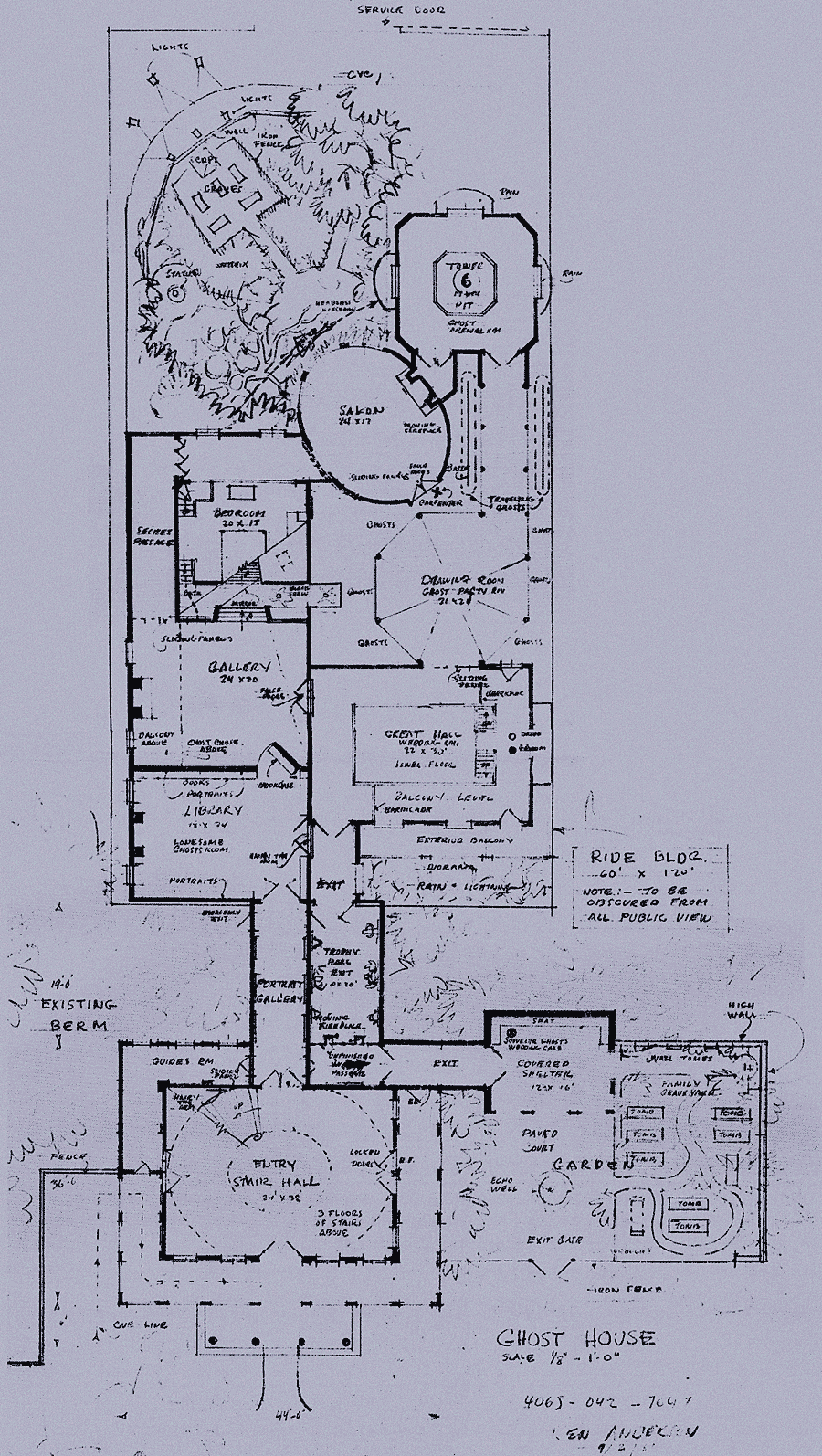
However, there was one item we passed by rather quickly: the large cyclorama. I thought it might be interesting to
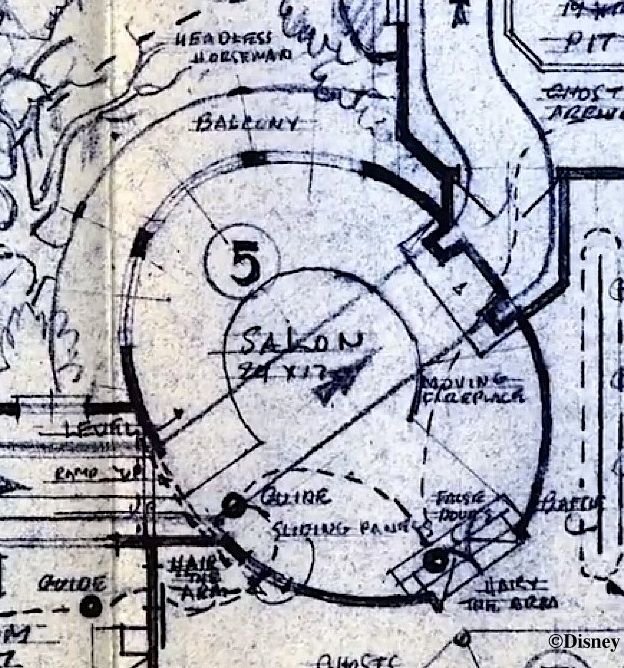
take a good look at that unseen scene seen in the upper left corner. This is how it appears on the original blueprint:
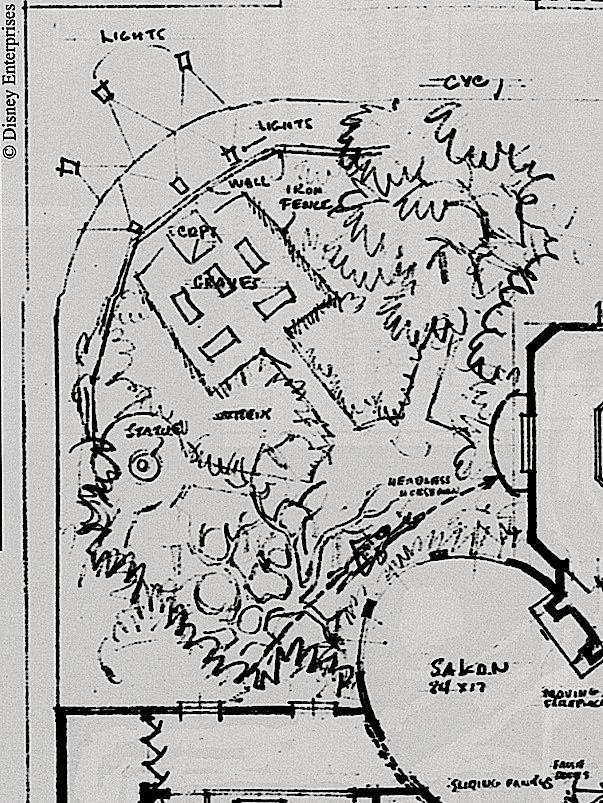
I like how the cyclorama was to be partially visible through the windows in the hallway leading to the Salon.
That hallway was going to have an unfinished appearance, and with the two windows on the left side actually
overlooking the graveyard scene below, we have something eerily similar to the actual Haunted Mansion attic.

The new blueprint reproduces the original faithfully. The only real change is that an "outside" balcony has been added to
That hallway was going to have an unfinished appearance, and with the two windows on the left side actually
overlooking the graveyard scene below, we have something eerily similar to the actual Haunted Mansion attic.
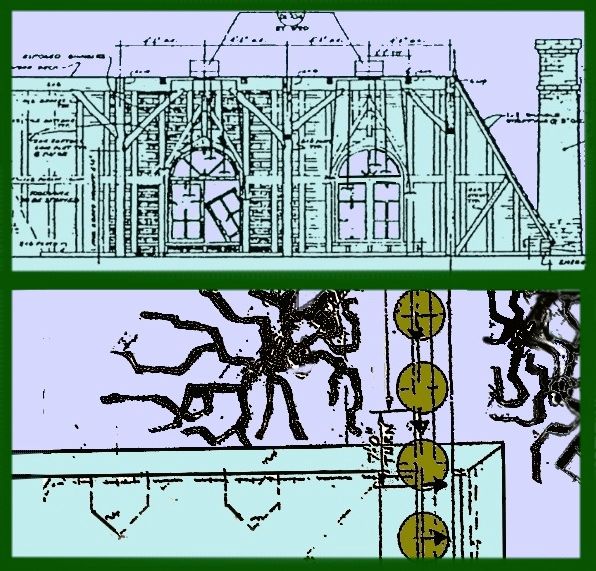
The new blueprint reproduces the original faithfully. The only real change is that an "outside" balcony has been added to
the Salon, and consequently the path of the Headless Horseman figure (toward the lower right) has been relocated slightly.

In addition to these blueprints, Anderson left behind at least three different descriptions of
the scene, plus at least two pieces of artwork, both of which have been posted previously.
the scene, plus at least two pieces of artwork, both of which have been posted previously.
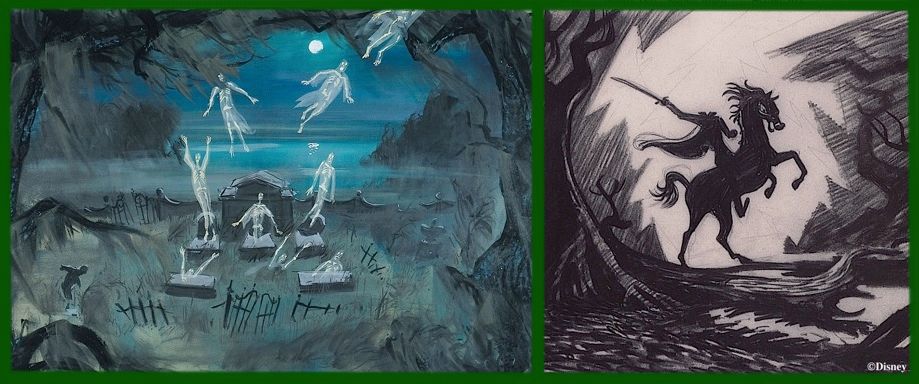
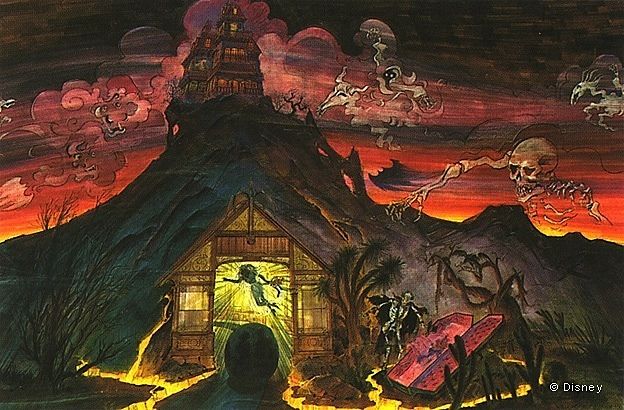
That concept painting on the left (done by Duane Alt) is not some sort of free composition but a careful rendering of the cyclorama in the Ghost House as seen by guests through the windows of the Salon. The correspondance between it and the blueprints is exact and detailed.
With a little cunning photoshoppery, and following Anderson's written texts, the original artwork can be expanded into a sort of "storyboard" for the scene. Since there is more than one version, each of them securely dated, the exercise is pleasantly similar to participating in the creative process as Anderson first devises and then revises his storyboard. You can almost hear the wheels turning as he improves the show script.
Someone like David Witt could do much more with this than I can. On the other hand, there's something to be said for the storyboard format when you're comparing two different ways to block out a basic script. Then again, I did add some sound effects, so . . . whatever.
The Headless Horseman
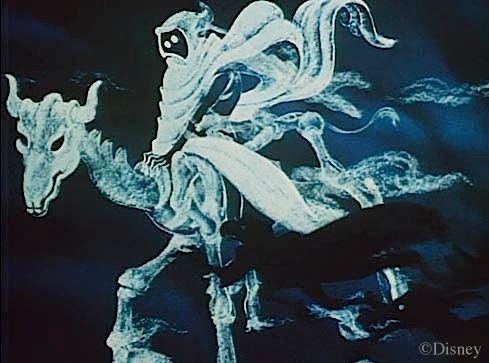
Surveys of the Mansion's history routinely mention the early idea of basing the attraction on the Headless Horseman character from The Adventures of Ichabod and Mr. Toad, but in truth he never amounted to very much. As far as I can tell, this cyclorama in Anderson's Ghost House was virtually the only place where the HH was definitely incorporated into any known Mansion plans. But dang, it was an impressive scene.
Two of the descriptions Anderson wrote are fairly detailed. The first version presented here is storyboarded from his earliest script, using artwork I have adapted from his two actual sketches. Take it away, Ken.
September 9, 1957
"At the centerpiece of our tour, we find ourselves in the ruins of a grand salon."
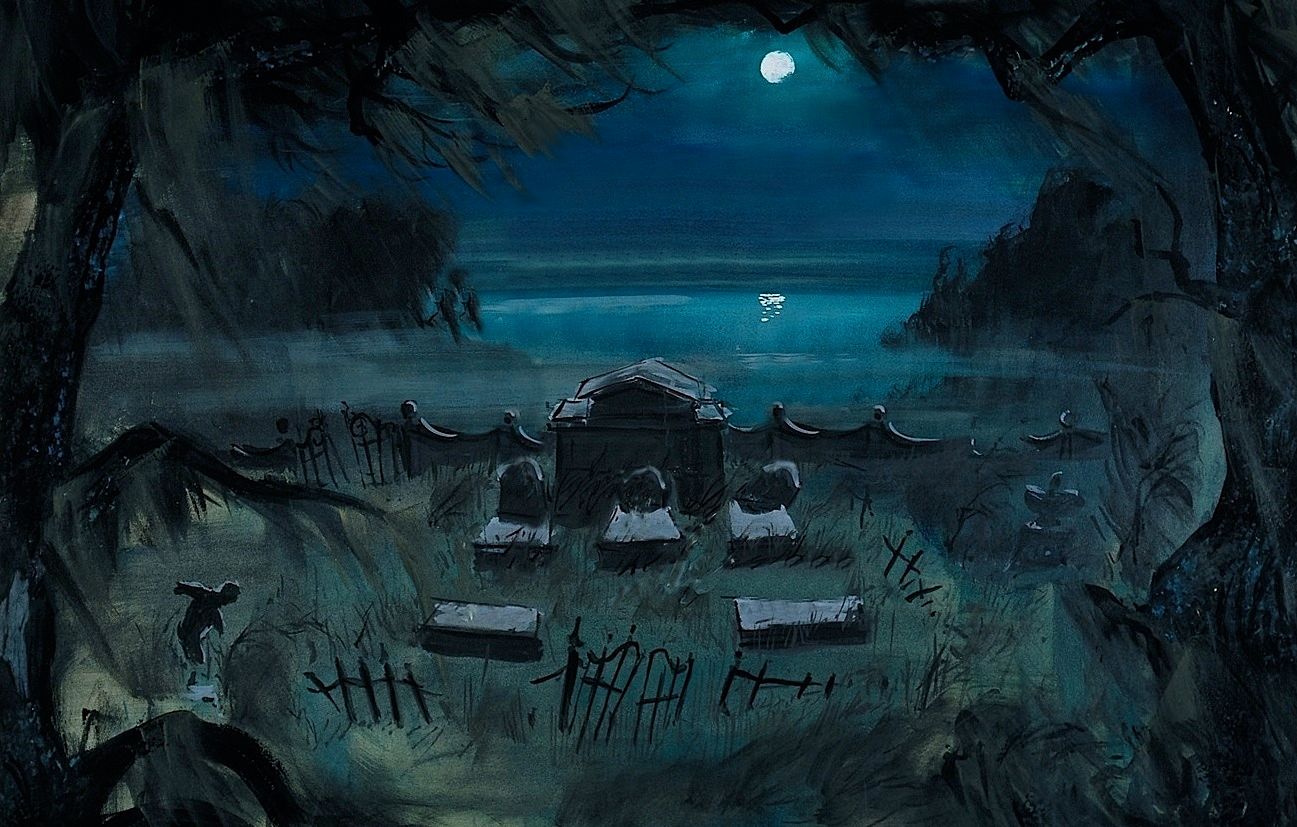
"The once-ornate domed ceiling is high above us, and the rotting planked floor slopes down towards the shattered ruins of a grand bay window looking out over a moonlit scene of wind-swept, moss-filled trees and bayous beyond. A broken wall in the middle distance fences in an abandoned family graveyard of above-ground vaults typical of the marshy New Orleans area."
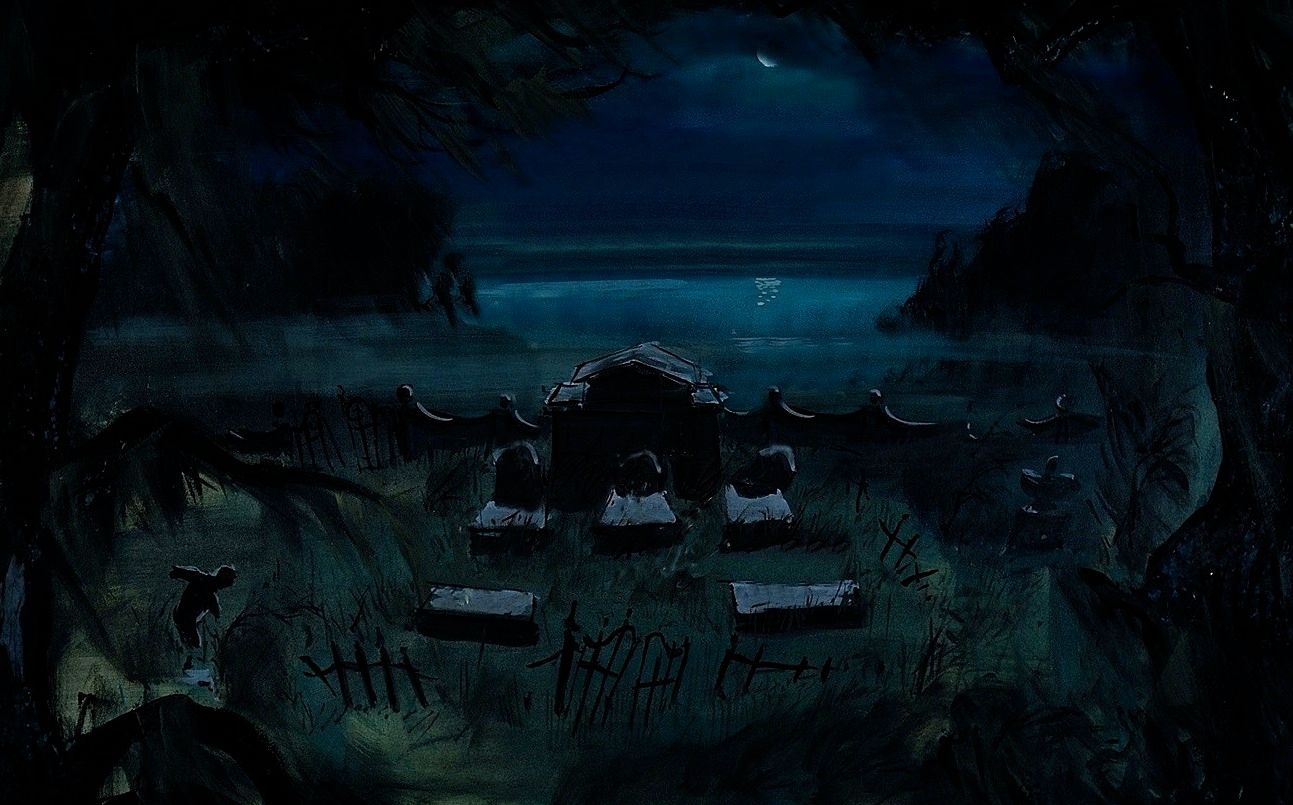
"Far off, a werewolf howls, and the scene outside darkens as clouds obscure the moon."
"Lightning flashes on the horizon and a distant rumble warns of the approaching storm..."
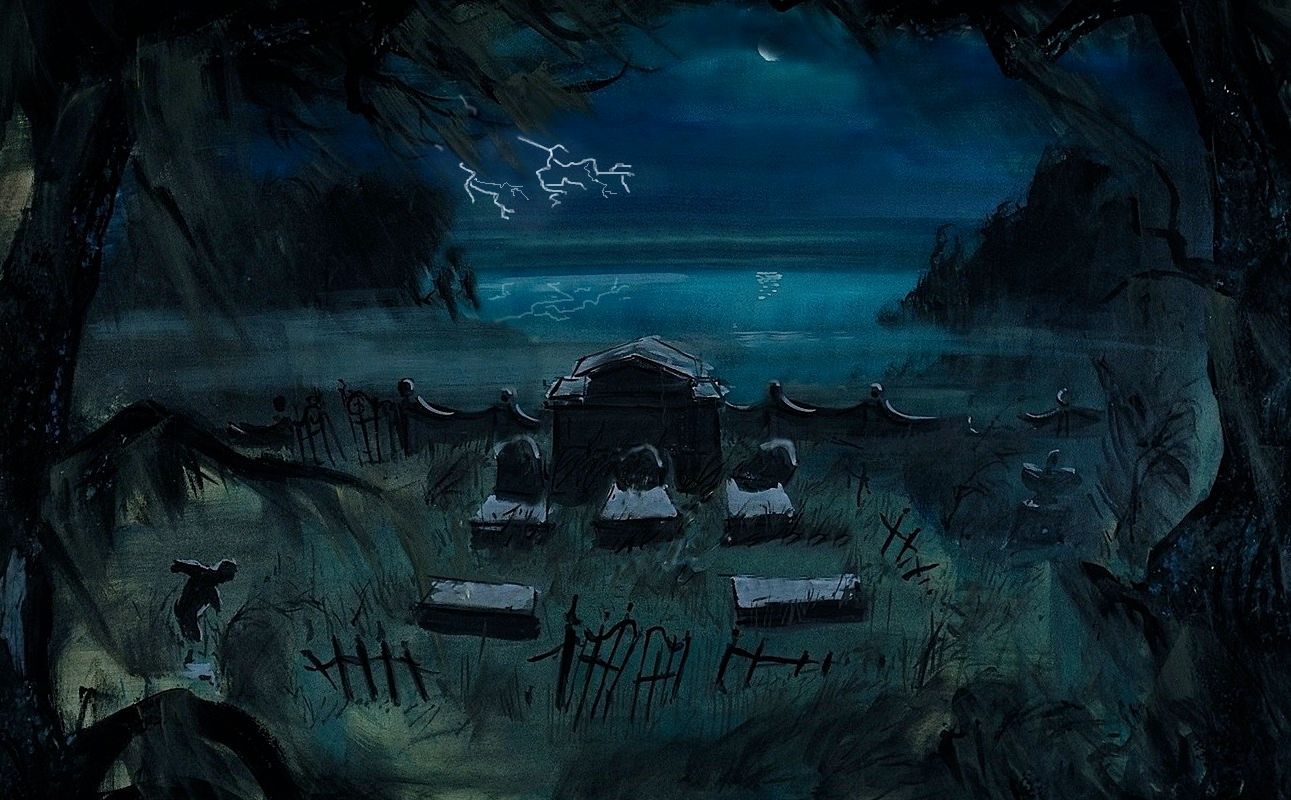
"...but our attention is closer as ghostly skeletons rise from the tombs..."
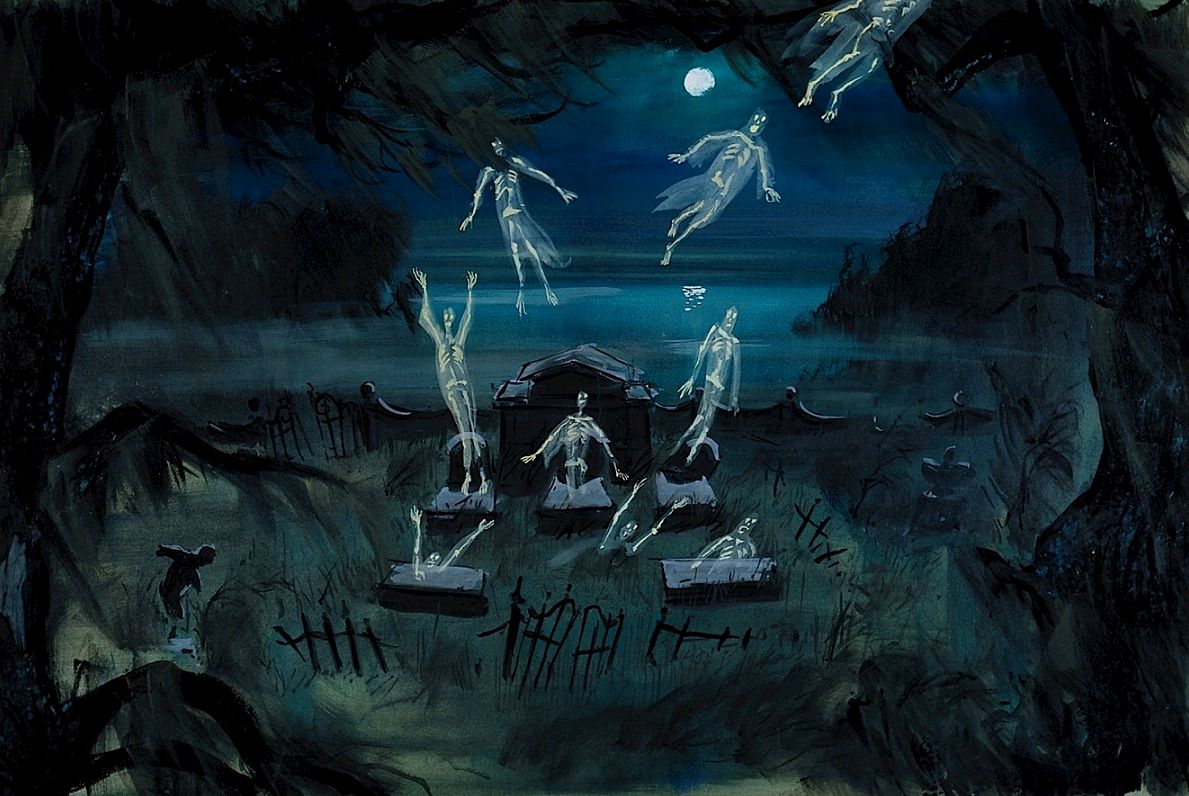
"...growing larger as they approach the window then seem to enter the room above us."
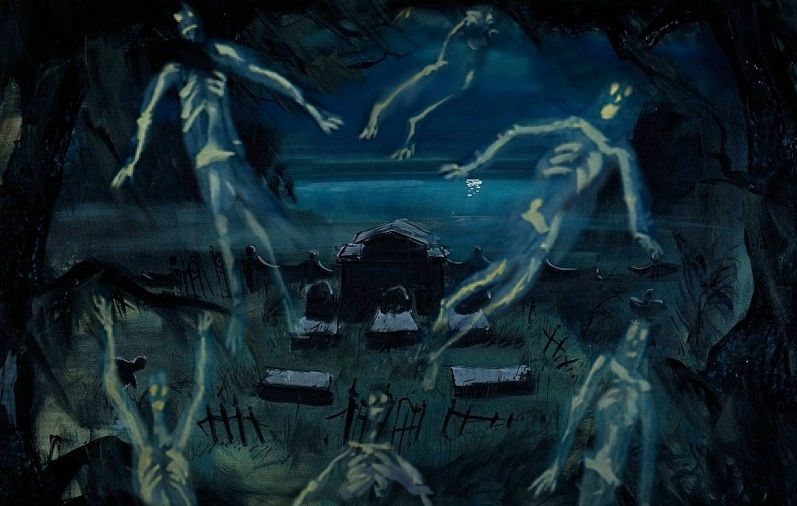
"These are the guests arriving for the wedding, and the sound of galloping hoofs
approaching heralds the arrival of a guest of honor: the Headless Horseman."
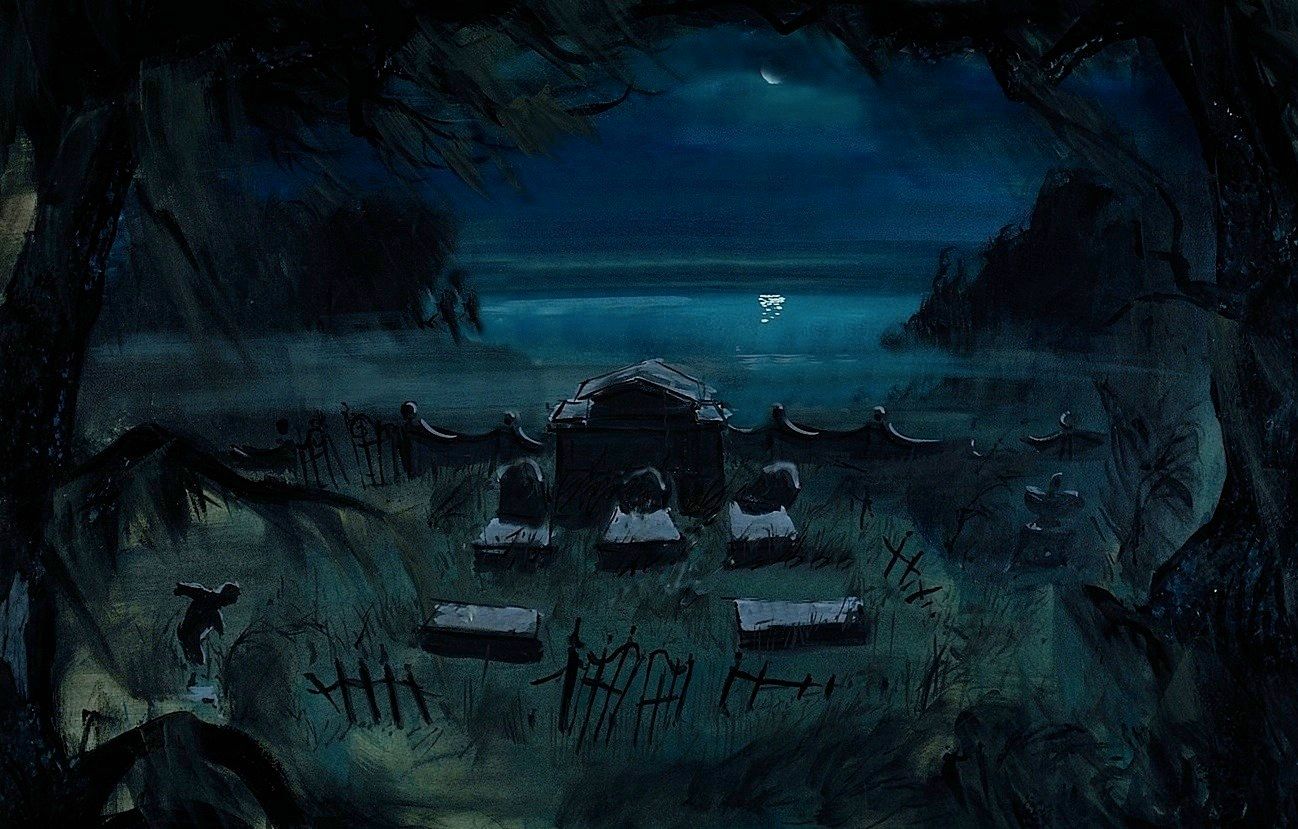
"We don't glimpse him until he thunders past just outside the window, his dark
cape billowing behind, but eerily fastened to shoulders that hold no head above."
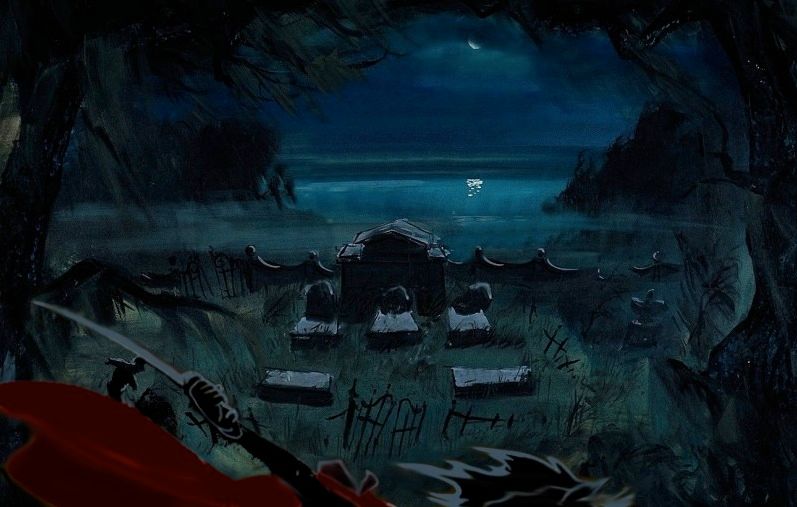
End.
In another description, also dating from September, Ken wrote: "The distant sound of pounding hoofs signal the approach of the Headless Horseman, who finally crosses the scene outside the windows as his horse gallops through the tops of the trees." In that last line, I take it he means that you are looking over the tops of some trees in front of the Salon's windows, and only part of the Horseman is visible.
One month later, Anderson revised the script. It storyboards quite differently, and I think it's a definite improvement.
October 16, 1957
"Commence with a windy moonlit night, with the reflection of the moon in the bayou beyond the graveyard."
"The clouds will obscure the moon..."
"...and distant flashes of lightning and sounds of thunder will next be heard."
"While the sky is darkening, the ghostly apparition of the Headless Horseman will fade into view or
appear from behind a distant tree and gallop toward the graveyard and house from right to left foreground."

"He will disappear behind some trees to the left, but the sound of
his horse's approaching hoofbeats will continue to grow louder."

"Suddenly, he bursts into view in the courtyard just outside the windows and gallops across from left to right...reining
to a noisy halt just out of view below the balcony on our right. His cape is the only part of him we need to see at this last
crossing, since the shrubs will obscure the horse. His cape must match in color and value with the previous projected mirage."

"Next, a bolt of lightning against the sky and a werewolf's howl..."
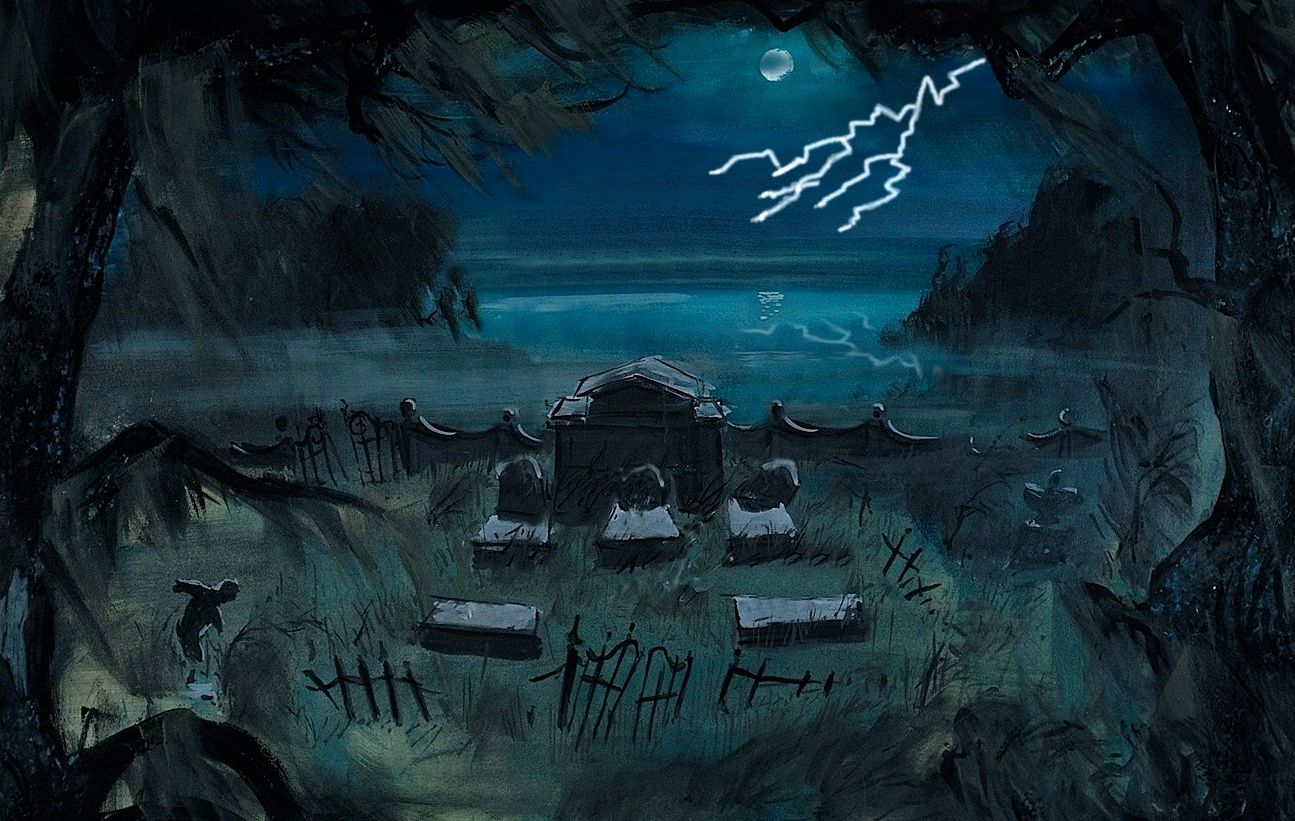
"...signal the appearance of the ghosts rising from the tombs, first one, and then two, and more,
until ghosts are materializing from the earth around the tombs as well as the tombs themselves."
"Finally, a blinding flash of lightning fills the room and dazzles the spectators, while a tremendous thunder clap ends the
scene. The room illumination will increase at this point for the benefit of the spectators so they may see to exit."
**********
In this October treatment, there follows a lot of technical instructions, which includes some interesting notes about special effects:
OPTICAL ILLUSIONS
1. HEADLESS HORSEMAN
a. 1st part is projection with Ub's special loop projector using Kronar based film. b. 2nd part is fluorescent jap silk cape on a wire frame and moved by an aluminum arm from above past the windows. Match the color to the projected image.
2. GHOSTS
a. Projection by slides on scrims. 1. Experiments to be made by Wathel for Ub on panning projectors and placement of projectors in relation to scrims and cyclorama. Also try arc hanging on scrims to give effect of ghosts getting closer to viewers.
It should hardly be necessary to remind you Forgottenistas that ghosts done by "projection by slides on scrims" is exactly what we got in the graveyard scene of the actual attraction, twelve years later.
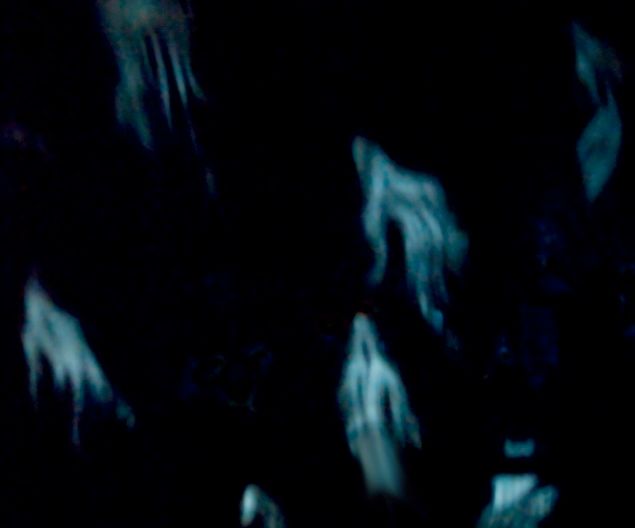
(pic by Jeff Fillmore)
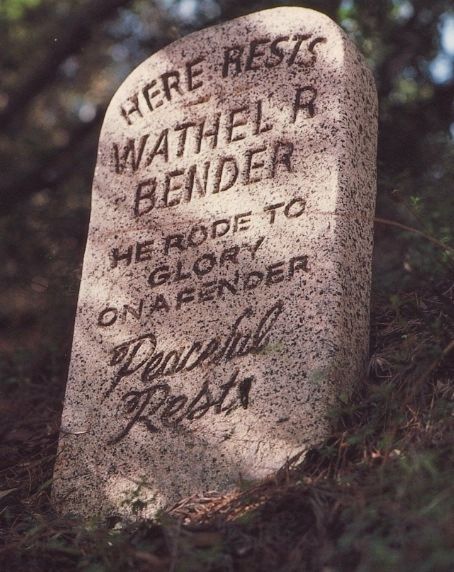
Note the involvement of Wathel Rogers already at this early date in special effects for the Ghost House project. A mechanical genius, Rogers was the audio-animatronics go-to guy in those early years. He eventually merited a tribute tombstone at the Haunted Mansion for his abundant contributions to its success. Many of you knew that already, but did you know he was sporatically involved as early as 1957?
Anderson also mentions "Ub." Of course that's Ub Iwerks, the great Disney legend, the first animator-turned-special-effects-whiz in a long line of such geniuses at Disney. His name is not usually associated with the Haunted Mansion, but did you know that according to legendary Studio cameraman Bob Broughton, it was Iwerks who discovered the "Leota effect," more or less by accident, using a wig stand? Yale Gracey and Rolly Crump have always been credited with making the same discovery, and perhaps they did so independently (see Jeff Kurtti, Walt Disney's Imagineering Legends [NY: Disney Editions, 2008] 123-24).
3. CYCLORAMA
Starts with a stormy moonlit sky...the moon reflected in the bayou is to be accomplished by the actual reflection in a water pan below the cyc. The stormy clouds will be by slide projection on the neutral sky background and will obscure the moon. The flash lightning and the lightning bolt will also be by slide projector. Test for diorama as well as Haunted House.
Clouds and lightning flashes by slide projector, you say? Dude, that effect goes back to the 18th century:
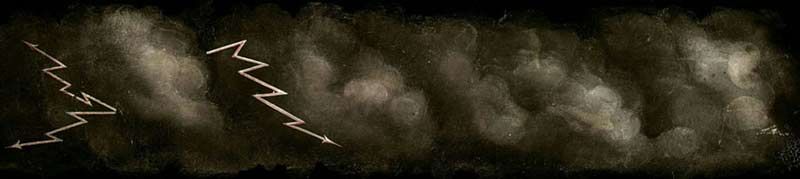
Actual 18th century magic lantern slide
The "diorama" may be a reference to the Sleeping Beauty walk-thru diorama, which Ken was working on during this exact same time period.
4. WIND EFFECTS
Use multiple fans to blow moss and tree branches and to ripple the water and reflections. Try letting scrims blow a little to see if ghosts are improved by it.
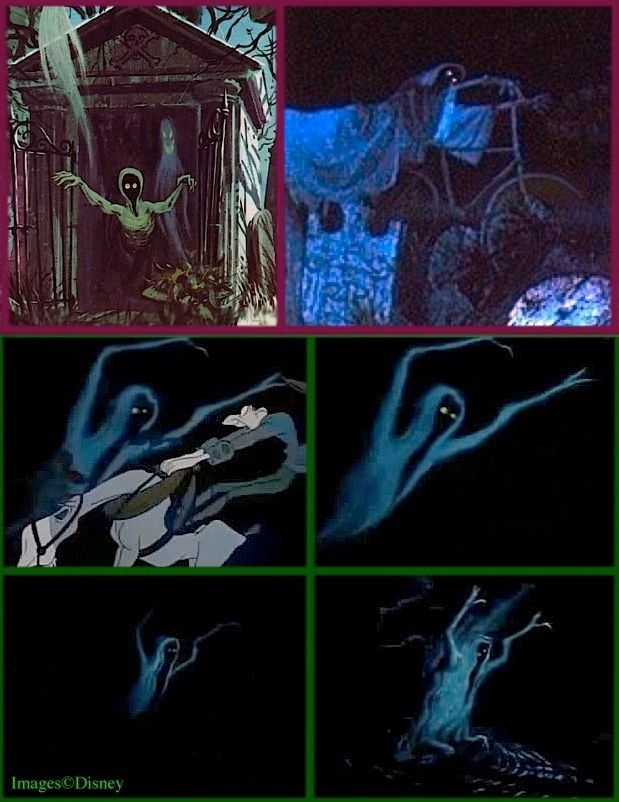
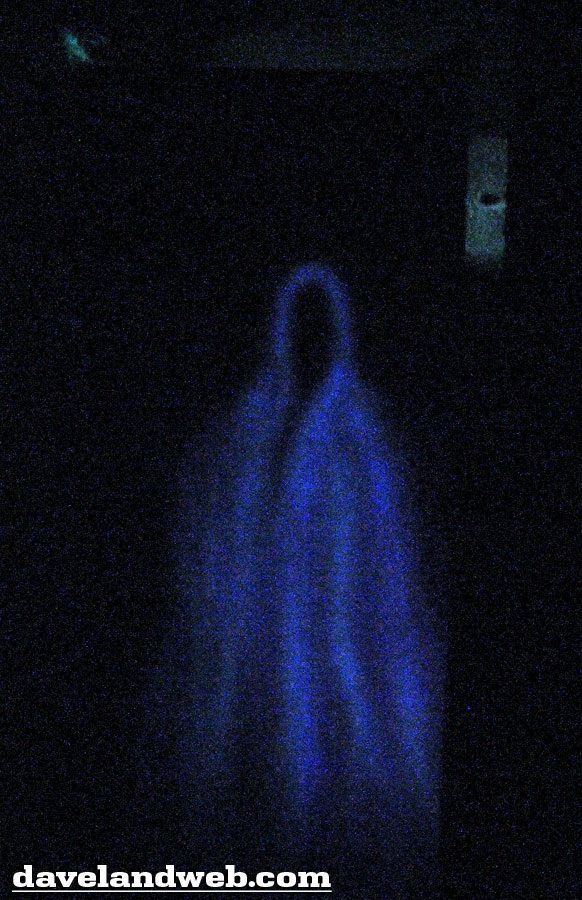
Blowing on the scrims didn't work, apparently, but as we've pointed out before the Mansion does use a fan blowing on a ghost painted on silk in the graveyard crypt. Not the easiest thing to photograph, but the indefatigable Dave DeCaro has managed to get a nice shot:
The Blue Bayou: An Influence?
There are some striking visual similarities between Anderson's concept painting and the Blue Bayou lagoon in Pirates of the Caribbean.
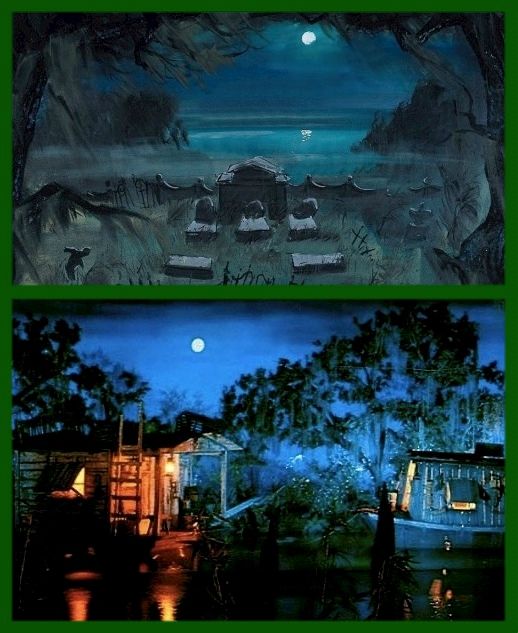
What we may have here are two different works of art using the same source of inspiration, in this case the Disney short, "Blue Bayou: A Tone Poem," included in the 1946 film, Make Mine Music. "Blue Bayou" was originally "Claire de Lune" and created for Fantasia but cut because of length considerations. There can be little doubt that it was a major source of inspiration for the look of the Blue Bayou lagoon in POTC. I mean, come on, the name alone . . .
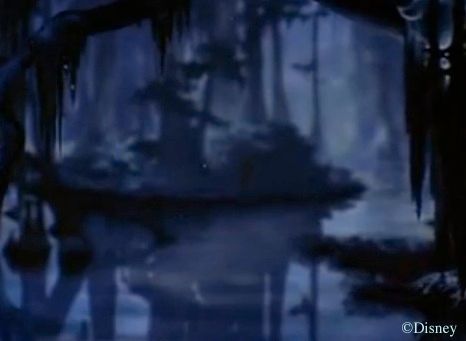
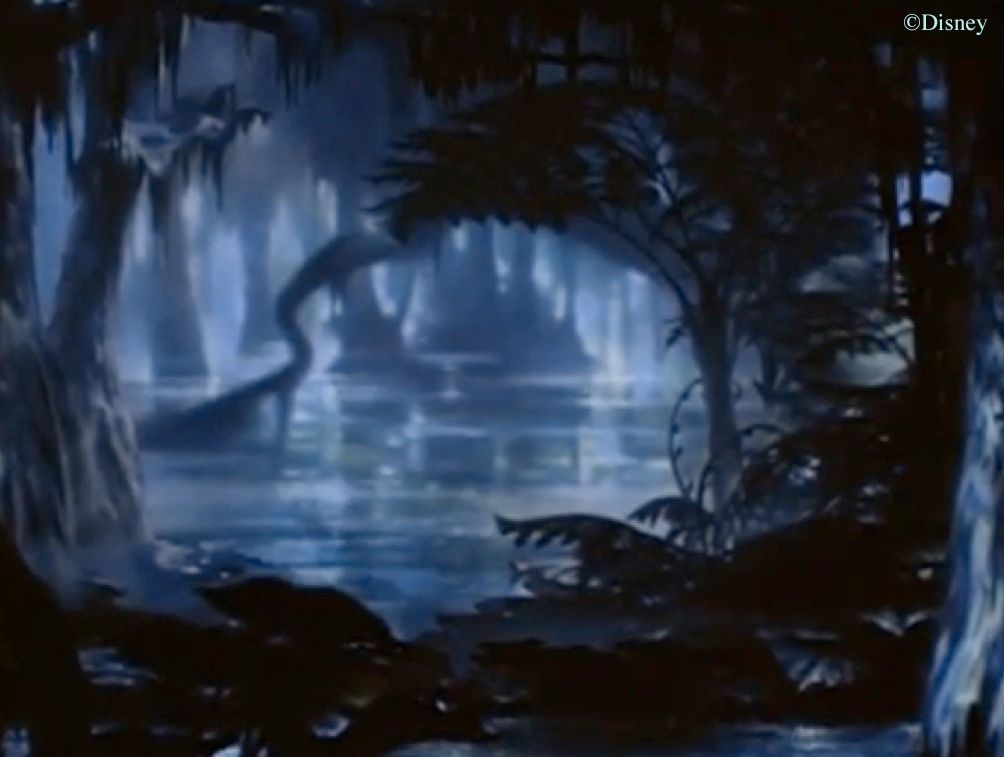
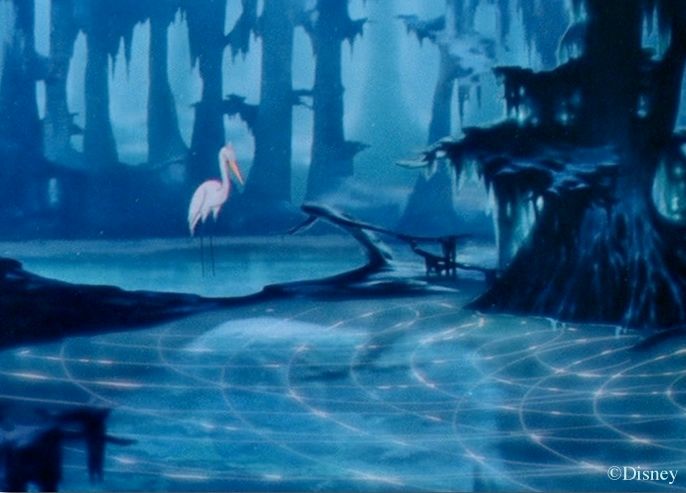
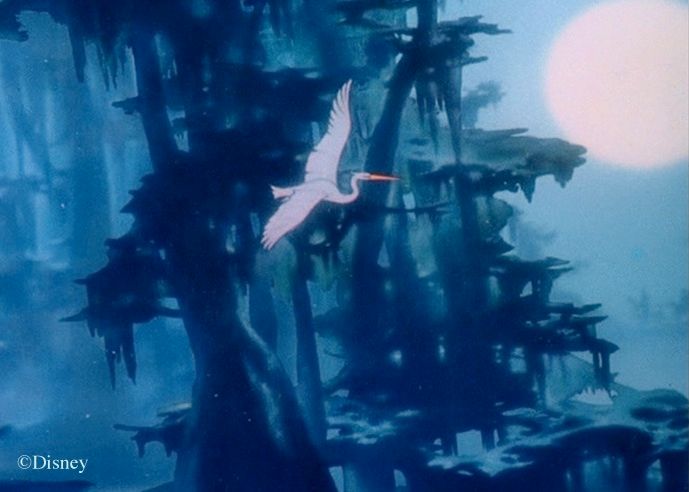
Compare those with any typical section of the POTC cyclorama:
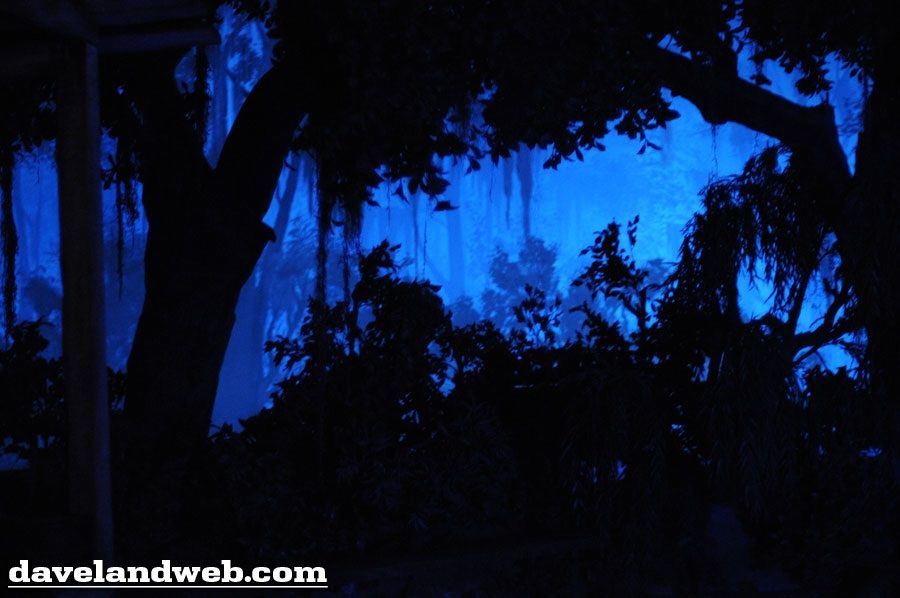
The bayou in the background of Anderson's painting is similar in appearance, and for the cyclorama he suggests having the moon reflected in real water and rippled with a fan. As it happens, a lengthy section of "Blue Bayou" is devoted to the play of the moon's reflection in rippling water.
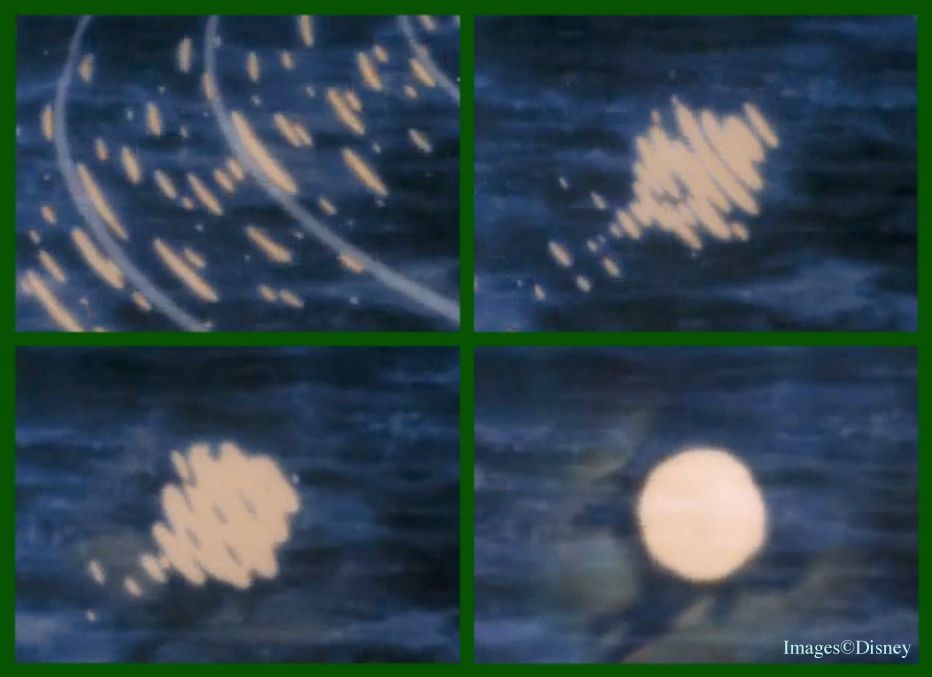
So if the POTC masterpiece and Ken Anderson's concept art for his Headless
Horseman cyclorama have a similar look, there may be a simple reason for it.