Somewhere around the beginning of 1968 the Imagineers finally decided that the Haunted Mansion was definitely, definitely going to be a ride and not a walk-thru attraction. Throughout the latter half of 1967, the Omnimover system had proven itself in the Adventure Thru Inner Space ride in the New Tomorrowland, and so the Imagineers knew that they had at last a ride system that could be successfully adapted to a haunted house.
No area was more radically affected by this decision than the show script. Starting in 1959, Rolly Crump and Yale Gracey had worked out a series of delightful ghostly effects to be used in show scenes that would last perhaps several minutes, but practically all of that had to be scrapped when the walk-thru became a ride. Now you had to have gags that for the most part would last a second or two as people boogied on by.
"For the most part," I said. Before proceeding further in this vein, I need to digress and revisit my argument from a couple of posts back ("Things Fall Apart"), because a huge exception needs to be carved out for the Séance circle. There you settle into a leisurely pace, listening to and watching the Madame without interruption for almost a full minute. You'll notice that your doombuggy stops its squirming and encourages you to gaze toward the center of the room. That's one of the well-known advantages of the Omnimover: it can direct your attention toward whatever the show designers want you to see. Gee, at the Séance, I wonder what that could be?
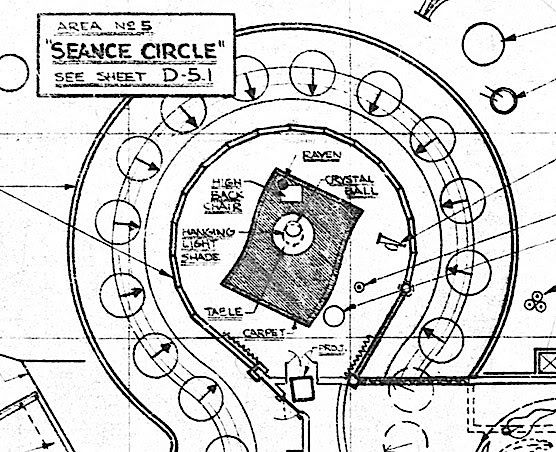
This is one good reason why the original, stationary Leota was superior to the bouncing bubble we now have. She's supposed to be a point of stability in between the frenzy of activity preceding her and following her (frantic terrors beforehand, boisterous celebrations after). Compared with the menacing cacophony and the claustrophobia of the Corridor of Doors—culminating in a whirling clock gone mad and a grasping spirit trying to "better itself" by taking possession of you—the Séance circle is open, peaceful, boundless, and practically timeless. Here, you have reached the eye of the hurricane, further evidence that this is indeed the true center of the ride.
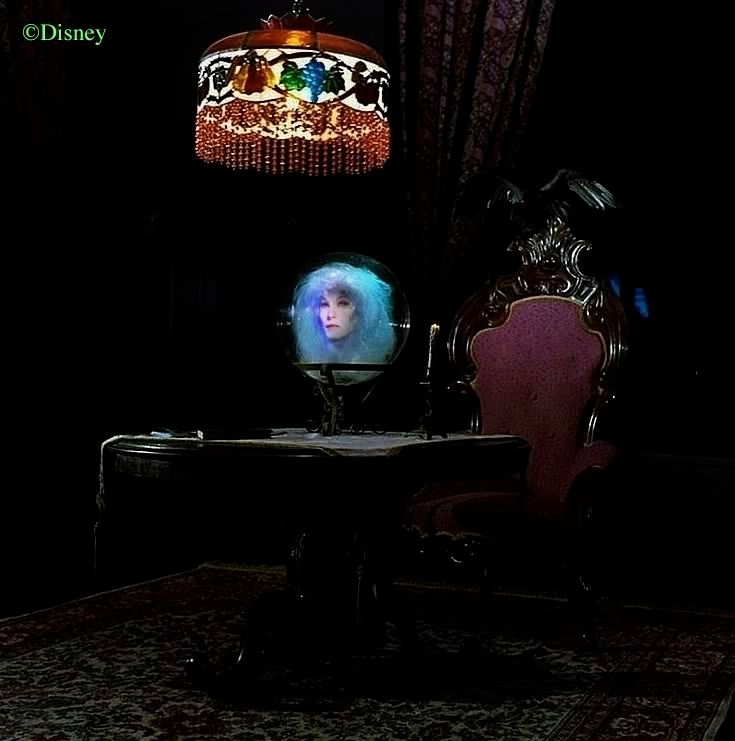
Chill out. Madame L will handle this.
You might think the Ballroom scene is also pretty slow and calm, but I don't think so. There is so much to see there that you still have a sensation of hurry. That's a lot of jokes out there, and each one still has to be told in an instant because your eyes are not going to hang around any one of them for very long, not if it means missing all the rest of the activity. It's a happening party.
Getting back to the original point of this post, it was fortunate that by the time they decided to make the HM a ride, it had for several years been firmly in the hands of an instant-joke master, Marc Davis. He had long demonstrated—most recently with POTC—that he could tell a funny story in half a second flat.
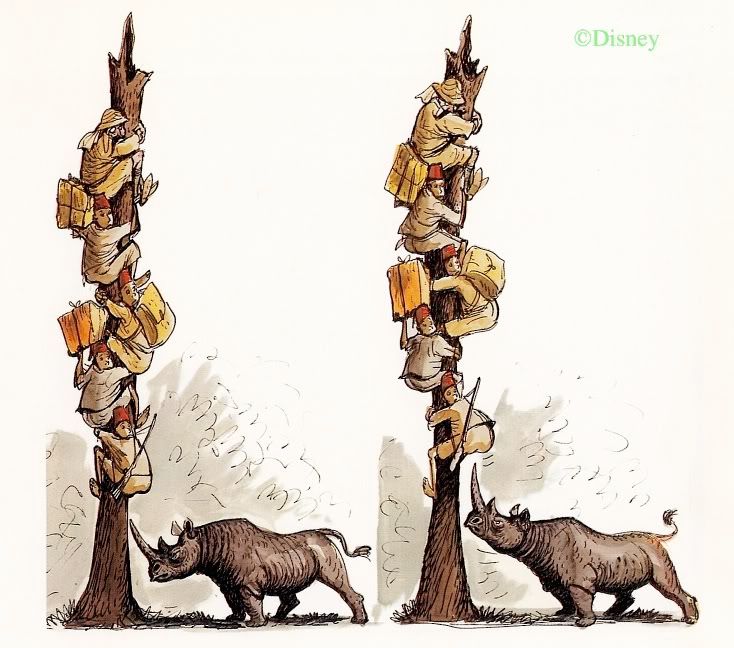
A famous Davis gag on the Jungle Cruise
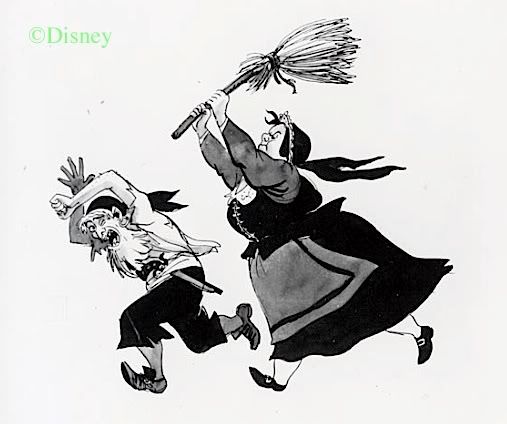
An unused POTC gag. According to my stopwatch, it starts being funny in an incredible .08 seconds.
If you think that sort of thing is easy, just try it. What's the secret to this kind of entertainment? For one thing, you rely on stock characters, clichés, broad personality types that are instantly recognizable. For another, you frame those characters within situations that are well known in the popular culture. Because the HM presents ghost figures in the dark, the characters are hard to read by their facial expressions, and so there is a tendency at the HM to lean more heavily on the framing element than we find in POTC. An easy example occurs near the end of the ride. Almost everyone has heard legends about ghostly hitchhikers, so it takes the typical viewer almost no time at all to figure out the context of the infamous scene.
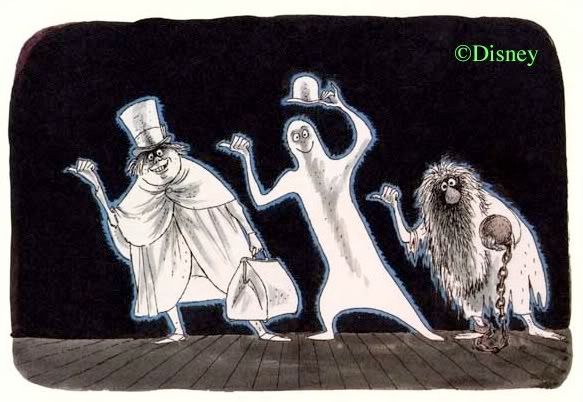
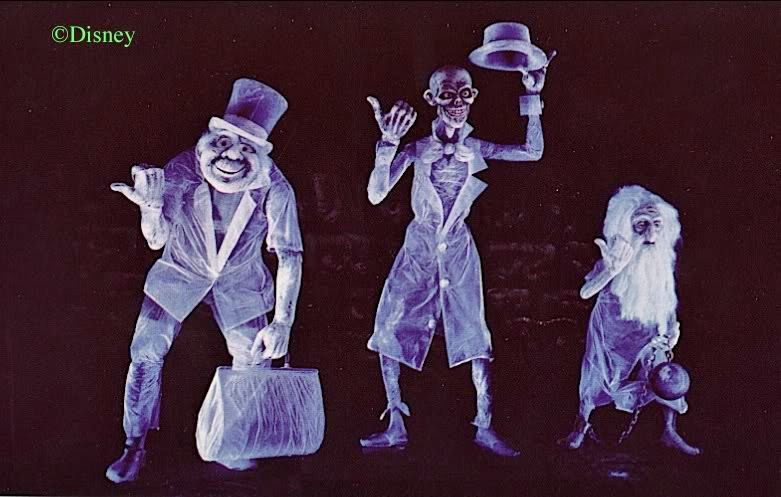
Davis puts a couple of stock characters in there, just the sort of creepy figures you might encounter out on a lonely road: there's the Mysterious Traveler (carpet bag and all), there's the Escaped Convict, and there's the...uh... Nondescript Sheet Ghost. Hmm. Obviously room for improvement there, and thank goodness (or should we say badness?), because we got Ezra. Oh, and notice the exaggerated size of the thumbs, a detail intended to slam their hitchhikerliness in your face instantly.
BUT.
No one bats 1000, not even the master of the insta-joke. The rest of this post examines Marc Davis's biggest misfire in the Haunted Mansion, and maybe in the whole park. He gambled on public recognition of the cultural setting and lost. Forget about getting the joke in under a second; most people haven't gotten this one even after half a century.

Okay, this scene is goofy enough to keep it from being actually boring. The idea of a mummy as a rather wimpy looking geek having a cup of tea, and hard to understand because the bandages are in the way, while a deaf old guy tries to make out what he's saying...yeah, I suppose it's funny in a theater-of-the-absurd kind of way. But what's a mummy and his tomb doing in a cemetery behind a Victorian-era house? And what sort of assumed relationship is there between these characters?
Davis's concept art doesn't do much to clarify things. It has an additional character that was never used, but the joke is still obscure.
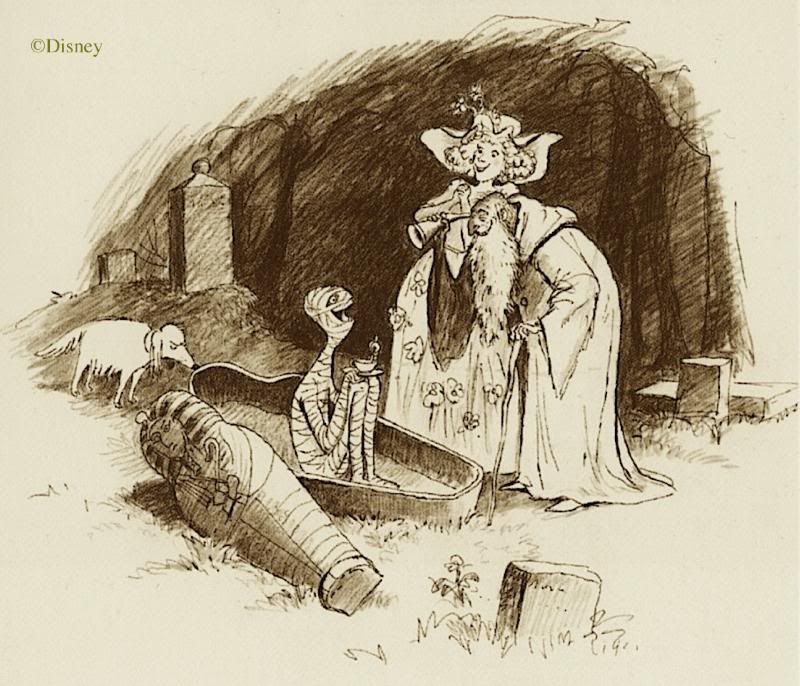
Some have speculated that the old man is Father Time and the woman is Mother Nature. Doesn't make any sense. I didn't know Father Time was deaf, and where's his hourglass? Or something to identify him? The very fact that such a desperate attempt at interpretation has been floated at all is an indication that we just don't get it.
The problem stems from misreading the context. Mummies come down to us in horror culture in not one but two distinct forms: the mummy as ghost and the mummy as monster. Of the two, it is the monster that has come to completely dominate the public imagination, thanks to Boris Karloff's 1932 performance in The Mummy, an image which has only been reinforced by countless TV and film treatments, a good recent example being the 1999 remake of The Mummy, starring Brendan Fraser. We all know the monster mummy: the leg-dragging, lumbering killer, fueled by some ancient curse foolishly disregarded by the soon-to-be victims. He growls a lot, but otherwise has little to say. Some might think that Marc Davis is satirizing this hulking figure with his Don Knotts mummy, but that doesn't explain the whole setting.
Davis's mummy is the mummy as ghost, not monster. The context here is the Victorian mummy craze. Many a 19th c. wealthy Englishman started buying up Egyptian artifacts, including actual mummies, which could be procured with relative ease. England had a fevah, and the only cure was more mummies. In fact, the West in general had a bad case of Egyptomania:

If you want to find a historical counterpart to the Victorian lady in Davis's drawing, you can see her in this painting on the far left:
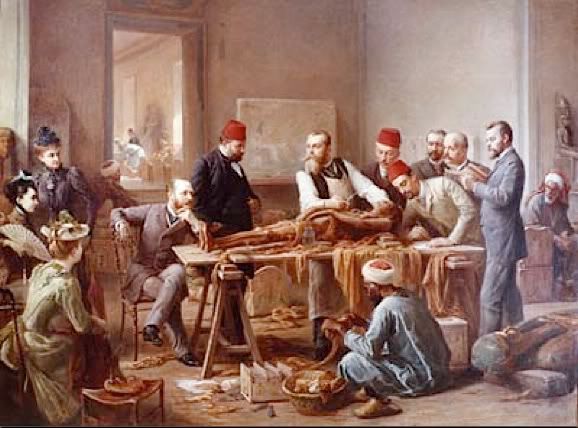
But wait a sec...where's the ghost part? So glad you asked.
Combine this Victorian fascination with mummies with the concurrent Spiritualism craze, and inevitably there was interest in contacting not only dead old aunt Martha but that much older dead guy you haul out for parlor entertainment. And which would you rather hear? Aunt Martha or someone with the lost, ancient wisdom of Egypt? Edgar Allan Poe wrote a story called "Some Words with a Mummy" in 1854, in which a mummy is revived by shooting electricity through it, and it talks (great caesar's ghost does it talk). Bram Stoker and Conan Doyle wrote mummy stories. The latter wrote one called "Lot 249," about a British student who finds a magical papyrus with which he animates a mummy bought at auction. Things eventually go wrong, and presto, the mummy as monster is born. But the chatty mummies favored by Spiritualists didn't vanish without leaving some trace. Even today, "The Mummy Speaks" is a minor league cliché, usable in any number of contexts, even political commentary. Davis gambled that this image of the mummy would be instantly recognizable, but for once his comic instincts failed him.
The presence of an entire Egyptian tomb in the cemetery behind the HM reflects more of the same mania. It became fashionable to use Egyptian motifs like obelisks during the Victorian age.

You know, there was originally going to be a large obelisk in the HM graveyard next to the King on the teeter-totter, but we didn't get it and have to settle for a small non-funerary one, inside, amidst the attic junk.
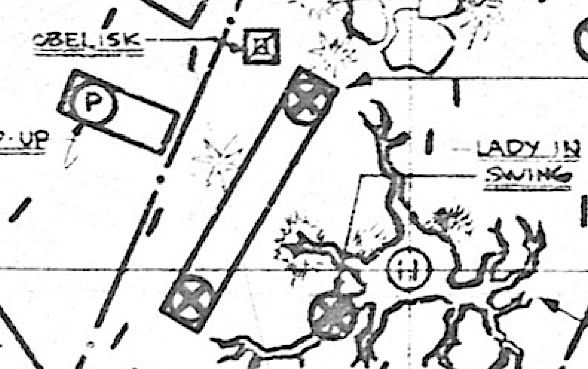
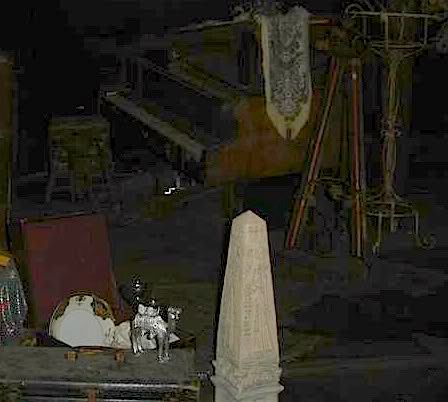
Sometimes a whole section of a British boneyard was done up like an Egyptian temple. There is a famous example at Highgate Cemetery:
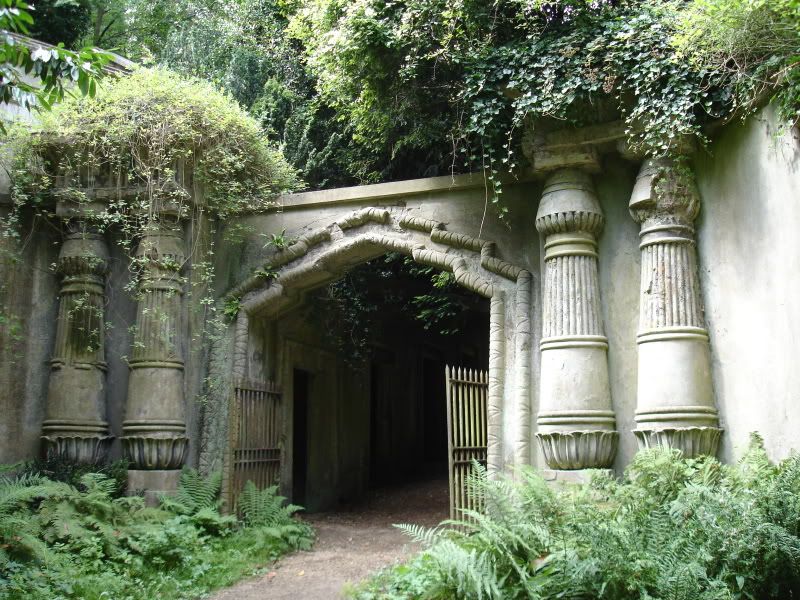
This sort of thing is most likely the historical background for our Egyptian tomb, and apparently some wealthy Victorian eccentric has furnished it with a genuine Egyptian sarcophagus for good measure.
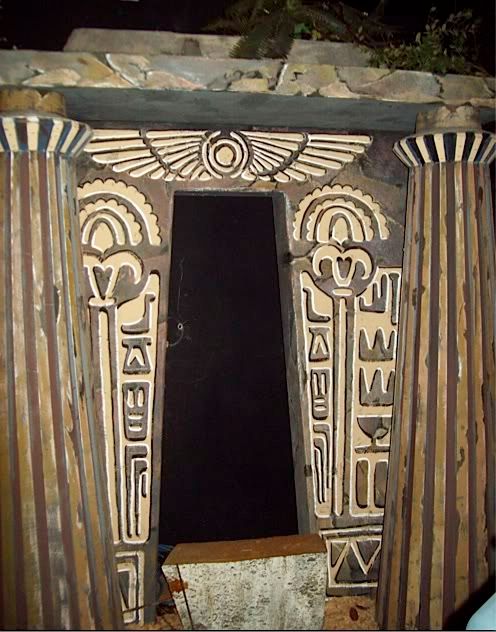
We're zeroing in on our joke, and making fine progress, but we're not there yet. Finish your lunch, and we'll continue...
Who is the deaf old guy? Honest answer? I don't know. Neither Davis's sketch nor the maquette figure provides a clear identification. He may represent a sort of quasi-druidic-priest-type guy, either a real one or a Victorian pretender, and naturally he's very interested in hearing what ancient Egyptian mysteries our mummy might spill. A summary of the ride written by the WED public relations head in April of 1969 describes him as a "venerable, bearded oracle of the Renaissance period," if that helps.
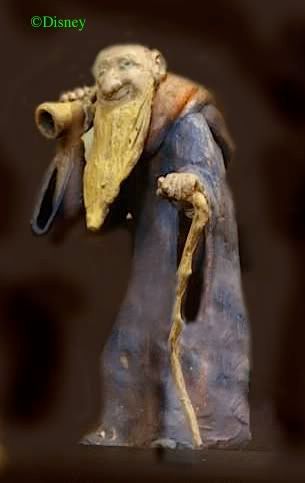
"Wh-what's that?" Heck if I know.
Why did they keep him and ditch the lady? I don't know. This tableau seems to have given the Imagineers unusual trouble. Not only did they cut a whole character, but they had a hard time figuring out how they wanted to arrange the three who remained, plus the sarcophagus lid and other details. The Effects blueprints don't agree with each other, and neither of them shows exactly what is actually there. And the dog? In Tokyo he's on the other side, sniffing the old man. I guess their old man smells more interesting than ours.
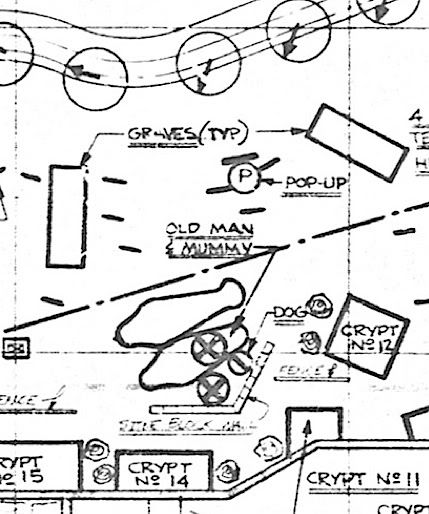
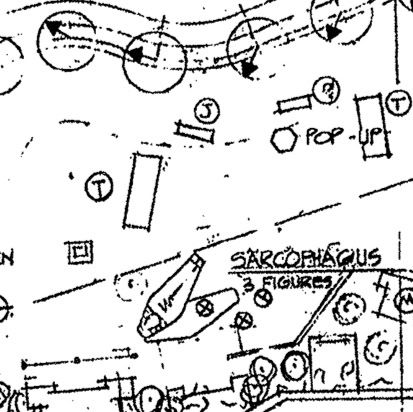
Oh yes, the joke. All this sombre, occultic interest in contacting the dead and hearing the ancient wisdom locked inside the mummy's soul is WASTED because the stupid bandages are making him mumble incoherently, and the old guy is too deaf to hear it anyway.
"After millenia of stony silence, at last the mummy speaks! He speaks, I tell you!"
Oooooh, neato. What did he say?
"Uh...well, I don't know. He was mumbling."
It brings me no joy to point out one of Marc Davis's failures. Pthhh, who am I kidding? I'm loooovin' it. It's heartening for us artistic peons to know that even the best sometimes botch things badly.