Things You're Just Supposed to Know

Most of the time, Long-Forgotten assumes that readers are already familiar with basic facts
about the Haunted Mansion. If you wanna keep up with the big boys, I suggest you check out
first of all the website, Doombuggies.com. After that, the best place to go is Jason Surrell's book,
The Haunted Mansion: Imagineering a Disney Classic (NY: Disney Editions; 2015). That's the
re-named third edition of The Haunted Mansion: From the Magic Kingdom to the Movies (NY:
Disney Editions, 2003; 2nd ed. 2009). Also essential reading is Jeff Baham's The Unauthorized
Story of Walt Disney's Haunted Mansion (USA: Theme Park Press, 2014; 2nd ed. 2016).

This site is not affiliated in any way with any Walt Disney company. It is an independent
fan site dedicated to critical examination and historical review of the Haunted Mansions.
All images that are © Disney are posted under commonly understood guidelines of Fair Use.

________
.
Showing posts with label Albert Hopkins. Show all posts

Friday, August 27, 2010

A Postscript on Changing Portraits at the Cabaret du Néant

.
In discussing the changing paintings in the first room of the Cabaret, I've mentioned twice now that Albert Hopkins, in his 1901 book, Magic: Stage Illusions and Scientific Diversions, explains the effect as a thin cloth painted on both sides, with the back scene visible only when the painting is lit from behind.  Well, it's possible that Hopkins offered this explanation because such a gimmick actually existed, proving that it could be done that way.  I recently came across this interesting item:
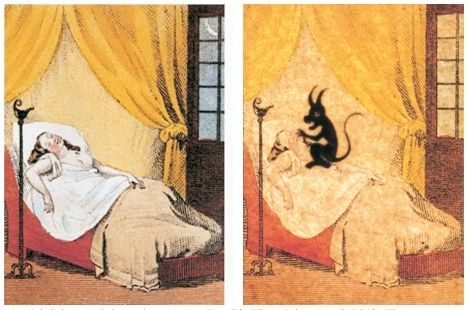

It's a Parisian lithograph from about 1830 featuring a scene based on Henry Fuseli's 1781 painting, The Nightmare.  The little devil is visible only when the lithograph is lit from behind.  Notice also the night/day transition.  I still don't think this can fully account for the effect used at the Cabaret du Néant, but could this have been what Hopkins had in mind?  Regardless, it's an interesting example of a 19th c. changing portrait trick with a horror theme.
.