Things You're Just Supposed to Know

Most of the time, Long-Forgotten assumes that readers are already familiar with basic facts
about the Haunted Mansion. If you wanna keep up with the big boys, I suggest you check out
first of all the website, Doombuggies.com. After that, the best place to go is Jason Surrell's book,
The Haunted Mansion: Imagineering a Disney Classic (NY: Disney Editions; 2015). That's the
re-named third edition of The Haunted Mansion: From the Magic Kingdom to the Movies (NY:
Disney Editions, 2003; 2nd ed. 2009). Also essential reading is Jeff Baham's The Unauthorized
Story of Walt Disney's Haunted Mansion (USA: Theme Park Press, 2014; 2nd ed. 2016).

This site is not affiliated in any way with any Walt Disney company. It is an independent
fan site dedicated to critical examination and historical review of the Haunted Mansions.
All images that are © Disney are posted under commonly understood guidelines of Fair Use.

________
.
Showing posts with label Endless Hallway. Show all posts

Monday, December 11, 2023

The New Hatbox Ghost in Orlando

As everybody in the Mansionite universe knows by now, the Hatbox Ghost made his debut in the WDW HM on November 30, 2023.

After:


Before...


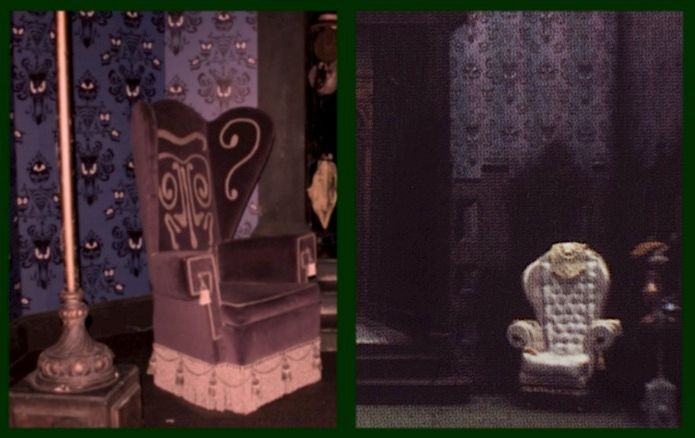
RIP to the "Donald Duck" chair. It now resides at the Walt Disney Studios in Burbank:


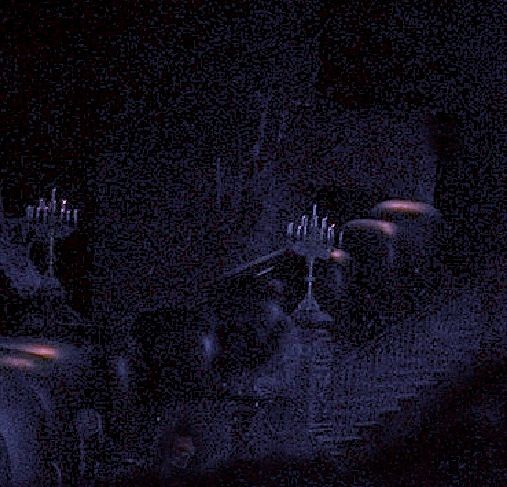
UPDATE (March 2, 2024). The obvious question is why he was installed here and not just outside the attic like he is in Anaheim, only a few yards from where the original HBG stood. At first glance, it looks like the WDW location is a deliberate movie tie-in. As most of you know, in the 2023 movie the HBG makes his first appearance in the Endless Hallway:


And my eyes may be playing tricks, but it does look to me like the animation in the face of the new HBG makes him look more like the movie version. If so, it's quite subtle.


Not only that, but the knick-knacks on the shelf over Hattie's head (which is there
to camouflage the top of a new access panel) are actual props from the 2023 movie.


Peyton Cloudman

HOWEVER, I've been assured by extremely reliable sources that this really is an amazing coincidence and no more, that the location has nothing to do with the movie. I'm not at liberty to say much more about the actual reason why he wasn't put into the same spot as he is in the DL ride, but I am assured that it's rather humdrum stuff having to do with things like structural upgrades and building codes, prohibitive costs, and blah blah blah. At the same time, there was nothing that required he be put HERE rather than somewhere else like the ballroom or graveyard. If it had been up to me, and the attic and porch were ruled out, I'd have put him where the Caretaker is and moved the Caretaker across the track into a newly-created vantage point among the trees on your right side as you descend.

FURTHER UPDATE (March 24, 2024) I now have confirmation that (1) the announcement that HBG was coming to WDW was a complete surprise to WDI East; (2) their pleas to put him by the attic (like DL) or somewhere in the graveyard were ignored, because (3) Top Men at WDW gave WDI a minimal budget to do the install, and the structural work necessary to put him on the roof outside the attic would have broken the budget. He's heavy, and in order to do repairs on the figure, they have to be able to pull him backwards into a work area. That's why there's that open door and room behind him at DL and a camouflaged door behind him at WDW. The necessary structural work at WDW would have included a bigger area than you might imagine.

Anyway, he's where he is because WDW didn't want to spend the money needed to put him where he should be. And this location is an abomination. One of the eeriest and most hypnotic tableaux in the entire ride now has a three-ring circus inches away. No one can deny that the Endless Hallway is thoroughly upstaged and the atmosphere is destroyed. That alone is reason enough to hate this thing.


The Three-Act Play (Again)

The other problem, of course, is the violation of the 3-Act show that is the Haunted Mansion. That 3-Act thing is NOT "backstory." It IS the story. It is simply an outline of the actual show that is there. But you guys know all that. If anyone needs a more in-depth introduction to the 3-Act play, go HERE. The only thing I would add to that is the caution that even Imagineers and other HM experts have routinely gotten the outline of the three acts wrong.

Act One is everything before Leota.
Act Two is Leota.
Act Three is everything after Leota.

Here's Jason Surrell's discussion, but he's not the only one who can't find the correct break between Act Two and Act Three:


You can find evidence for the 3-Act structure in the early 70's. If you read attentively this Vacationland article (Fall-Winter, 1974-75), you can detect the 3-Act outline underlying its description of the ride:


The same team of Imagineers who gave us the 2015 HBG gave us the 2023 version as well, but I don't hold it against them personally. They have to do what they're told to do, and if they don't like it but want to keep their jobs, they have to shut up. What is abundantly clear is that the team was well aware that no ghosts are supposed to be visible before Leota. The official excuse is that the HBG is an "unhappy haunt" and can materialize whenever and wherever. He has no need of Mdm L's assistance.

This is weak tea, of course. After the Ghost Host has explained that the place is a retirement home for ghosts and calls them "happy haunts," it quickly becomes apparent that they are not happy at all. In the original monologue in the Corridor of Doors, the GH concedes the point:

"All our ghosts have been dying to meet you. This one can hardly contain himself."

"Unfortunately, they all seem to have trouble getting through. Perhaps Madame Leota can establish contact. She has a remarkable head for materializing the disembodied."

All. They're ALL "unhappy haunts" until Leota does her thing. Saying that the Hatbox Ghost is an U.H. doesn't really distinguish him much, does it? These lines, by the way, have an interesting history. They were there in the beginning. I distinctly remember them from August 14, 1969. But you don't have to take my word for it. Keith Murray rode the ride at the press preview August 12 and published his review in the Pasadena Star News on Wednesday the 13th. In it, he quotes some of these lines from memory:


The later history of this COD monologue is most curious. They were in and out and in and out:

    1) Aug 1969—ca. Sept 1969........................................Lines are in (less than a month)
    2) ca. Sept 1969—Sept 1995.......................................Lines are out (26 years)
    3) Sept 1995—May 2006............................................Lines are in (11 years)
    4) May 2006—Jan 2008.............................................Lines are out (2 years)
    5) Jan 2008 and Jan—June of 2012............   .. ....... .....Lines are sorta... kinda... (See below)

Things were weird during Jan 2008 and between Jan and June of 2012. You need to know that the GH monologue is repeated every three doombuggies, and during these two time periods it would sometimes be the case that a triad of doombuggies would omit the earlier, "We find it delightfully unlivable..." spiel but include the "All our ghosts ... contain himself" line, while the following triad of buggies experienced exactly the reverse of this! And none of them included the Leota lines.* It all had something to do with a fluky problem during the switchover from HMH back to the regular HM show. Either that or pranky spirits. Since 2012 (as far as I know), the COD lines have been out.

Someone during the major 1995 rehab apparently said, "Hey, why were these lines deleted? Let's put them back in." A stern email went out in May of 2006 from the very top of the food chain at WDI with the "request to permanently delete" the COD lines, and this—ahem—"request" included a warning: "If there is an incident where someone intentionally or accidentally reactivates them ... we will be forced to remove them entirely." Yikes. The next day they were out, so the leaked email was no hoax.

Even though they've now been utterly gone more than a decade, virtually all of the ride-thru souvenir CDs and whatnot that have been sold over the years include them. Every Mansion freak knows about them. They're "canon," if you want to use that term, and they ought to put to rest any doubts about whether the 3-Act play is really the story of the ride.


Shoehorning in the Hatbox Ghost

The 2023 team had to make lemonade out of the lemons the Top Men handed them. The best they could do is declare him an U.H. independent of the predicament Leota and she alone can solve. They have also gone out of their way to make it as clear as they can that the HBG is an intruder in the ride, an interloper, a party crasher, an uninvited guest. His luggage has been dumped unceremoniously in the Endless Hallway (there's a trunk there, not just extra hatboxes), and there are muddy footprints indicating that he's come in the side door, dropped off his stuff (a hand truck with extra hatboxes, like at Disneyland), and he's returned to the door and turned around to look at you. The footprints are already there in the concept art:


But they're more conspicuous in the ride, and the double-tracking (back and forth) is also clear.


pic by travel__time

The whole thing is theoretically possible, story-wise, because the nature of the problem that only Leota can fix is never explained. Some kind of curse, perhaps? In that earlier LF article, I offered my own explanation, which I still think makes good sense, but nothing in the ride is explicit on this point, so yes, it can be argued that the HBG has managed not to get stuck in the Act One predicament. Evidently he has evaded the problem because he was never invited to join the retirement home of happy haunts and has barged in anyway. That must mean that the retirement home invitation had a metaphysical flaw in it that turned the Mansion into a trap. Once they moved in, they found that they could not materialize.

All of this opens doors to more unwanted and unnecessary backstory, of course. Many HM fans will be thrilled at the prospect. Me? I thought the WDW HM was ruined in 2011, so this is just one more reason to continue thinking so. The Endless Hallway scene has been spoiled, and they had to have known it would be spoiled. Anyone with two functioning brain cells could have foreseen that. But they went ahead anyway. That alone tells you all you need to know. Sorry for being such a downer, Floridians, but that's my honest opinion.

*A big hat tip to bigcatrik at Micechat for this info.

***********************


Thursday, January 2, 2014

The Darkness at the Top of the Stairs, and Beyond

.
At Disneyland, after you board your doombuggy and ascend the stairs, do you ever notice a little rocking
and wobbling as you swing to the left?  I suspect this is done deliberately; if so, the intended effect is seldom
experienced nowadays, if ever.  Is this another long forgotten relic from Mansion history?  Or is it my imagination, hmm?


Discombobulating Bob

Here's a little experiment you can do with (1) a blindfold, (2) a chair or stool that spins freely and smoothly, and (3) your best friend Bob. Blindfold Bob well, and ask him to report his movements as he perceives them. Make sure you aren't too close to a wall or anything else that would give the ear telltale clues about the revolutions of the chair. Spin him to the left with a single push. He'll tell you he's turning to the left. Let the chair slow down on its own. If it's a good, free spinner (that is, it spins a long time when you push it), Bob will probably tell you he's come to a halt before he has stopped spinning. Now reach over and stop the chair before it has stopped on its own. Bob will tell you he is now turning to the right. He's sitting perfectly still right in front of you, convinced that he is spinning slowly to the right. He won't be dizzy either. Have him remove the blindfold. Now he's dizzy.

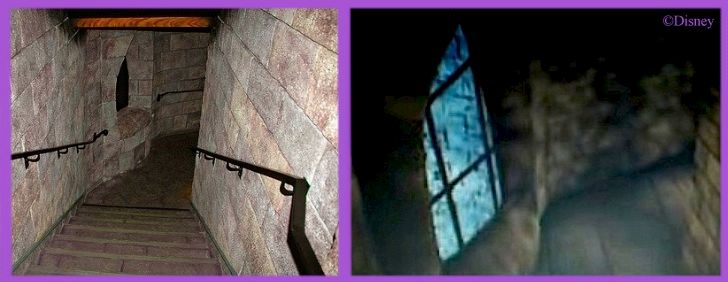
The very first time I rode the Haunted Mansion (August 14, 1969), the Limbo area was very dark indeed.  By the time I got to the top of the stairs it was pitch black, and I had no idea what was coming next.  When the little bump and wobble occurred, I picked up a sensation of spinning but wasn't 100% sure about it.  All I know is that at that moment I could not tell if I was moving or stationary, spinning or not spinning. "Now what happens?"  I remember it well, because that was the first and only time I was ever genuinely frightened on the ride.  When the doorway of the first room began showing its pale rectangular opening in the darkness, I was your woozy friend Bob for a few long seconds.


Like I said, I'm not certain, but I suspect that the wobble was put there for the purpose of disorienting the rider in the darkness.  It might still work if (1) it's your maiden voyage and if (2) your eyes are still sufficiently unused to the dark by that point.  I can't tell, because once you know what the doombuggy does, the effect is gone forever, and if even the tiniest, dimmest light is visible (and that's usually the case), the effect will not work even the first time. If any of you Forgottenistas have ever experienced this effect, I'd be interested in hearing about it.


After passing through the darkness, you are mocked by being offered a choice, only to discover that you no longer have
the power to choose.  This is another long forgotten chapter from the tale that is "your journey through a haunted house."


The Two Corridors of Doors

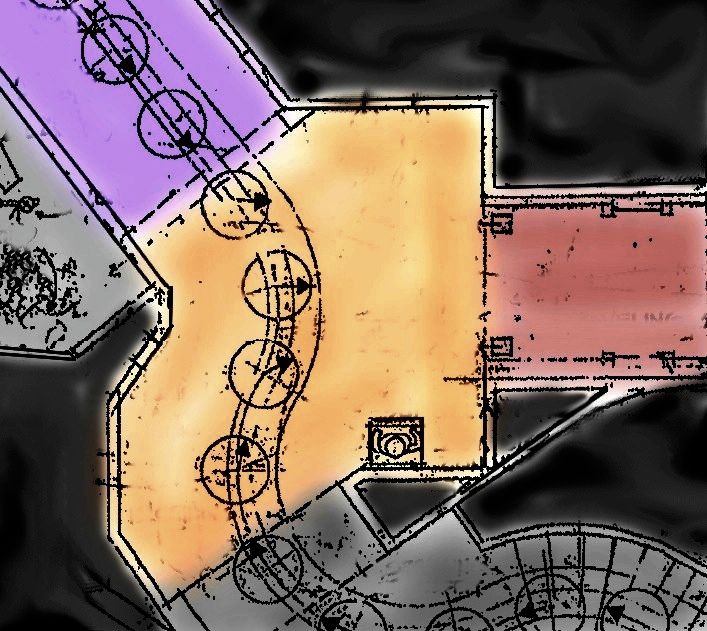
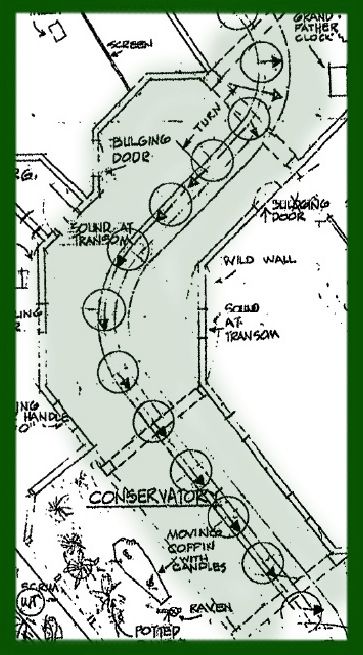
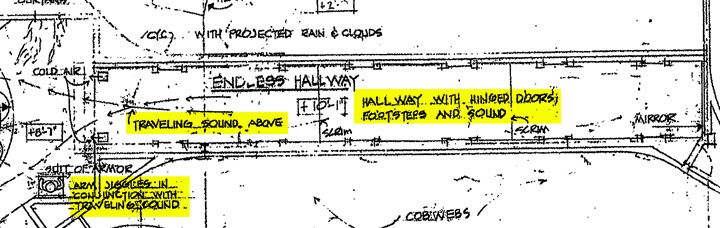
This should have been obvious to all of us all along, but over-familiarity with the ride tends to obscure it.  According to the narrative logic of the ride, at this point you are offered a choice between two corridors of doors, one to the left, one to the right.  The one on the right is better known as the Endless Hallway, but it is just as much a "corridor of doors" as the one that goes by that name.  Since the choice between the two is actually made for you by your doombuggy, it is easy to overlook this element of the "plot."  But take a look at the blueprint:


You swing out of what is supposed to be inky blackness at the top of the stairs into a dimly lit room,
and if the swing simply continued along the same arc, you would go right into the Endless Hallway:


While you are still looking in that direction, however, you are sucked into the
other hallway and dragged down it backwards, as if a vacuum were pulling you in.

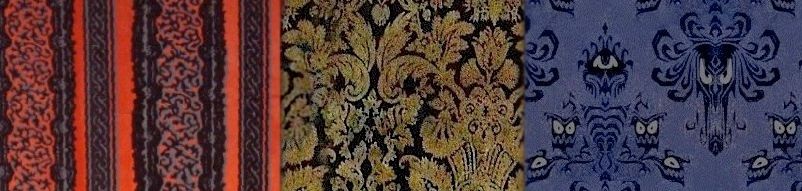
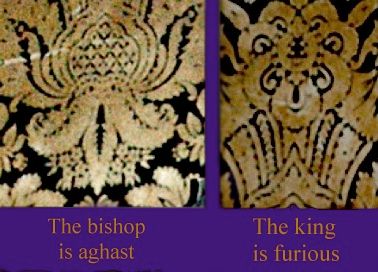
At Disneyland and Tokyo, the pseudo-choice between the two halls is made from a room with yellow wallpaper that is discontinuous with the wallpaper in either hall, the red and black stripes of the EH or the demon-mask damask of the Conservatory and COD.  In other words, neither hall presents itself as the obvious continuation of the room you are in.  This is also true architecturally, thanks to the irregular shape of the room.

Note that we've got the three primary colors at work here.  " So what? " you ask.  Beats me, but note that we've got the three primary colors at work here.

Orlando, on the other hand, replaced their yellow wallpaper with the demon-eye kind in 2007, making the whole room continuous with the Conservatory and COD.  In doing so, they conformed the area to what you see in the scale model from years earlier when the HM was being designed, but by doing so they also diminished the sense of choice between two equal options.  The Endless Hallway is now clearly perceived as a departure branching away from the purple path.  Phantom Manor has always been that way.

Walt DIsney World                                                                    Scale Model

(The wallpaper color is notoriously tricky and varies widely and wildly in photos. Guytano Kalicicka has done the best analysis I've seen, based on a careful scan of the actual wallpaper. He calls it a "medium lavender," mottled with lighter and darker shades. The original paper at Disneyland has never been replaced or redone.)

Guytano Kalicicika

Getting back to Orlando, in 2007 WDW added the effect of eyes coming out of the darkness and fading into the walls, an excellent effect that more than atones for the replacement of the yellow paper years earlier.  There wasn't really any compelling reason to retain it, because after all, 99.9% of the riders at any of the Mansion locales have probably never noticed the "choice" motif anyway, discontinuous wallpaper or not.  You could argue that it was the original Imagineers themselves who nuked it, thanks to the last-minute inclusion of the floating candelabrum in the EH, which instantly made it a much more forbidding sight.  In a real haunted house, most people would not go in there if they had a choice, not with a ghost standing right there, so naturally they head for the other egress.  If this analysis is sound, then the sense of two equally attractive
(or unattractive) options was seriously compromised before the Mansion even opened.

If you're skeptical about this notion of making a choice between two halls, note how similar the two entrances are,
both of them square openings framed with nearly identical wooden beams and bases, and both adorned with looping
drapery. Have you ever noticed how alike they are?  No?  And you call yourself a Mansionologist!  You make me ashamed.


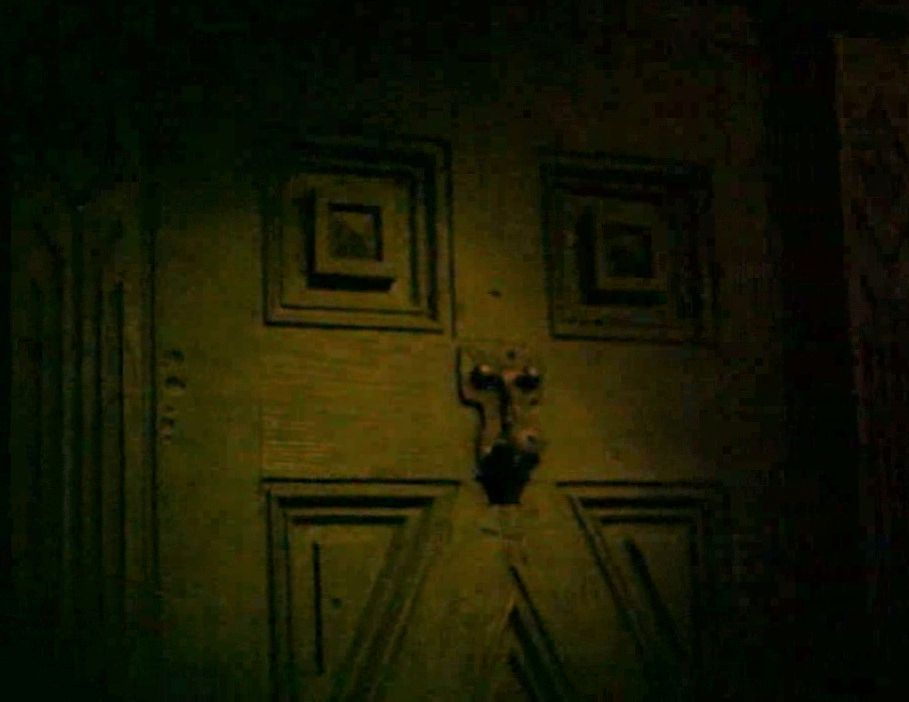
Obviously, the two hallways are also similar in that both of them are lined
on each side with identical doors, and the same design is used in both halls.

The halls are both "endless" too.  The EH is almost literally so, by dark ride standards anyway.  Believe it or not, it's the same length as the Grand Ballroom, and there are 12 doors, six on each side, before you get to the mirror that multiplies them still further.  As for the Corridor of Doors proper (that is the official name), it has a limitless and otherworldly feel to it, and this, my friends, is imagineering magic at its finest.  Magic I say, and I'm feeling inspired.  Even as I write, I can feel the left brain fading and the right brain taking over.  Feebly I resist, but all for naught.

The Corridor of Doors!  Ah, the beloved COD!  Let us cast a hopeful spell, a charm against destructive Imagimeddling.

"Within this hallowed hallway, where normally noisome noises annoy not, may every entrance ever entrance.
May the present perfection of every way out outweigh every impulse to improvise.  Leave it alone, damn it."

∞∞∞∞∞∞∞∞∞∞∞∞∞∞∞∞∞∞∞∞∞∞∞∞∞∞∞∞∞∞

I'm not saying that the Corridor is my favorite part of the ride (I'm not denying it either), but I will
tell you this: when someone says that it's their favorite part, I know I am going to like that person.

Every ingress is outré

The COD may evoke a sense of endlessness, but how many doors are there, really?  If you don't already know the answer, take a guess right now. Yes, now.  Before you move on.  You'll need to decide if you want to include the Conservatory as part of the COD.  If you do, that'll add one more door to the DL tally, and two more to the WDW/Tokyo (remember the Missing Door?).  Those are the doors on the wall opposite the coffin.

Now guess.


dee dee dum . . . Done yet?  Don't overthink this; just take a guess.


Oh come on.  Okay, look, I didn't mean that thing about being ashamed.


And the answer:

Without the Conservatory, there are only two doors on one side and four on the other before you reach the Clock Hall, and one of those is an emergency exit.  You thought there were more than six, didn't you?  I suppose it's possible that some among you who honestly did not know the answer to begin with may have guessed correctly.  Some.  But I'd be willing to bet that none of you underguessed and most of you overguessed. Thanks to crazy angles and clever twisting and turning, the COD seems longer than it is, and the doors seem more numerous than they are. With inspired architectural imagineering like that, who needs a mirror?

Don't get all excited about the "wild wall." That just means, "removable wall."

How exactly is this pseudo-labyrinthian illusion accomplished?  And don't say "imagineering magic."
We are men of science.  The artsy-fartsy right side has had its fun; now show the left brain some respect.

You have a presumption of rectangularity born of lifelong experience with buildings that you bring with you into any room.  You expect right angles at the corners and opposing walls to be parallel with each other.  Stop looking at that animated gif.  I'm talking to you. This presumption makes it quick and easy for your subconscious to give you a nice feel for the size of the room you enter.  But if you are going down a hallway backwards, and the walls are set at crazy angles, and even the width of the hallway varies unpredictably (something easily overlooked—see the blueprint), your poor little subconscious never gets the data it needs in order to comfort you with even a rough sense of the limits of your environment.  Ordinarily that job is done in an instant.  I don't know this for sure, but what I suspect is that the frustration of this automatic process translates into an exaggerated sense of the length of the hallway.  Perhaps this is because experience has shown that when it takes your subconscious an overly long time to give you a report, it's often because the place is huge.  Okay, now you can look all you want.


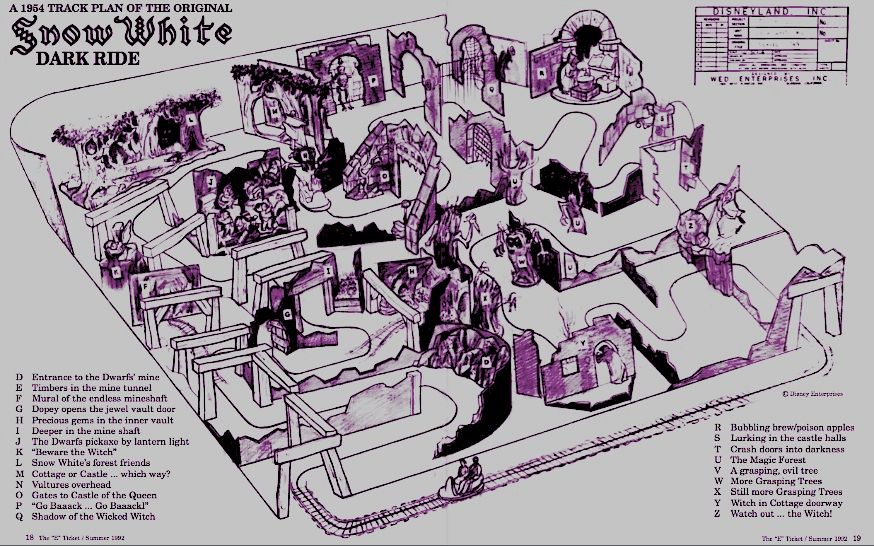
This may explain why a good, twisty dark ride can seem long and uncramped, even in a small area.  The original Disneyland
dark rides (Snow White, Peter Pan, Mr. Toad) were smushed into surprisingly small rooms, and yet you scarcely notice it.


That presumption of rectangularity is also why a lot of "forced perspective" tricks work.  They take
advantage of your long-trained subconscious expectations about normal architecture.  It really isn't fair.


Going Forward Backwards

Scooting the doombuggies down this hallway facing backwards was a stroke of genius, for at least two reasons:

First, you experience a hitherto unknown feeling of being taken against your will, or at least without regard for your will.  No one would walk down an unfamiliar path backwards.  You are being dragged by some force, a "perpetual levitation" presumably supplied by the Ghost Host. Earlier, your doombuggy's ascent of the staircase and entry into the yellow room merely mimicked what would be your own perspective and pace if you were walking voluntarily.  At WDW and Tokyo, this leisurely stroll also includes the portrait hall, library, and music rooms.  But an alien force took you over as you were faced with the choice of two hallways, and before you could choose, it sucked you into one of them and is now pulling you along.  The "choice" was a mockery, you see. Its purpose was to demonstrate to you that your decisions no longer matter at this point: You are captive.  A sense of absolute helplessness sets in for the first time, horrible and sickening, and how cool is that?


Second, by going backwards you notice the animated doors and hear the sounds coming from them as you pass them, which leaves open the possibility that it is you who are getting the ghosts so riled up.  If all this commotion were in front of you as you moved along, you would see that they were already upset before you got there. You would know that it wasn't something you triggered and that therefore they aren't specifically mad at you. And that wouldn't be nearly as scary, would it?  These guys are good.


So there you have it, at least one and maybe two more plot elements in the Haunted Mansion experience that somehow
slipped into the realm of the long forgotten.  Just when we think there can't possibly be any more, there are possibly more.

That's all for now.  Please step out to your left.

This post serves as a warm-up for the next post, a humdinger and a barn burner telling some untold
history about the Corridor of Doors and featuring some delightful artwork never before seen.


Tuesday, August 16, 2011

The Beginning of the Endless Hallway

.
Life~by~the~Drop Jeff Fillmore

Once you've boarded your doombuggy, the Haunted Mansion almost becomes a different ride, doesn't it?  The walk-thru portion has one feel and the ride portion another.  You sit down in your omnimover, and there is an unavoidable feeling that the attraction has kinda hit the restart button.  That's okay; it's really not a problem, but it does mean that the Imagineers who built the ride needed to follow some of the same show dynamics at this point that they would ordinarily use at the beginning of any other dark ride.

At Walt Disney World and at Tokyo Disneyland, the first full tableaux are low-key affairs.  (I don't count either of the portrait halls as "full tableaux.")  The music room and library are just as much about setting the mood as they are about intriguing special effects.  By the time you get to the Endless Hallway, the subject of today's post, you're well into the ride.  This is also true of Phantom Manor.  Ah, but at the Disneyland original, the Endless Hallway is the first full tableau that you see after boarding your doombuggy, so it's far more important there.  It has the responsibility of leaving that good first impression people are always talking about.

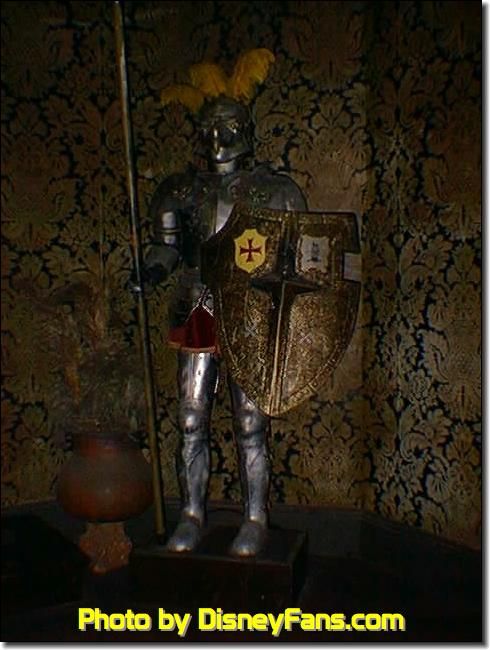
I think it succeeds very well.  The tableau is low-key but gives you four distinct gags: the armor, the drapes, the candelabra, and the hall itself.  Shameless gasbag that I am, I have something to say about all of these, plus a history lesson, plus a post-script.

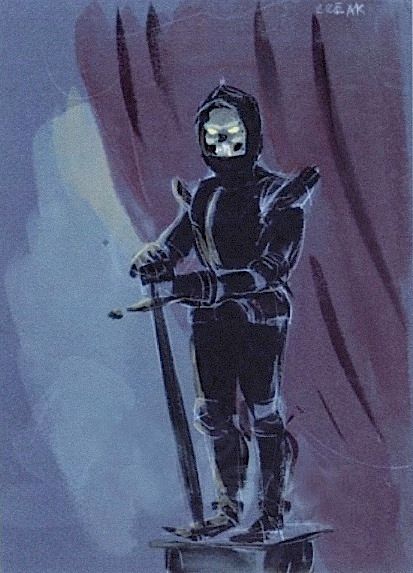
First the armor.  As it does so often, the story begins with Ken Anderson:


Yeah, it's a cliché, but it's a good one.  Marc Davis seems especially to have liked suits of armor.  You see them prominently in the concept artwork we looked at a couple of posts back (the "Weirder" one).  Here's an unfinished Davis sketch that you've probably never seen.  This was done after he had done the artwork for the Grand Hall (as it was called then), so you wonder what this was for.


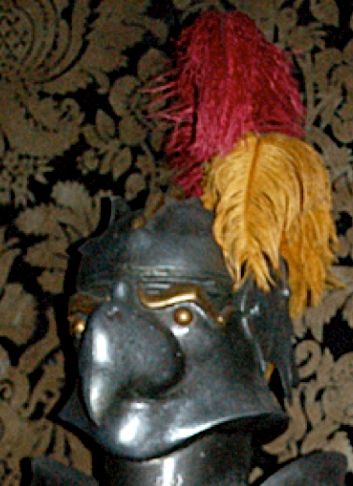
They all look pretty normal, so you wonder how we got our odd-looking fellow.  There is no shortage
of really bizarre medieval helmets out there, but I haven't found anything that looks quite like ours.
 [Edit: this strange helmet is no longer a mystery.]


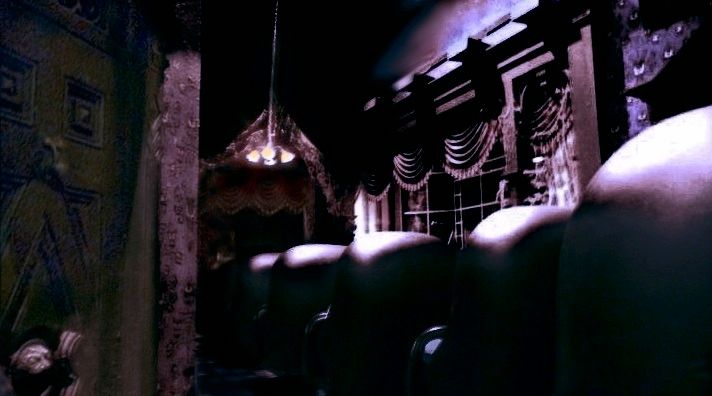
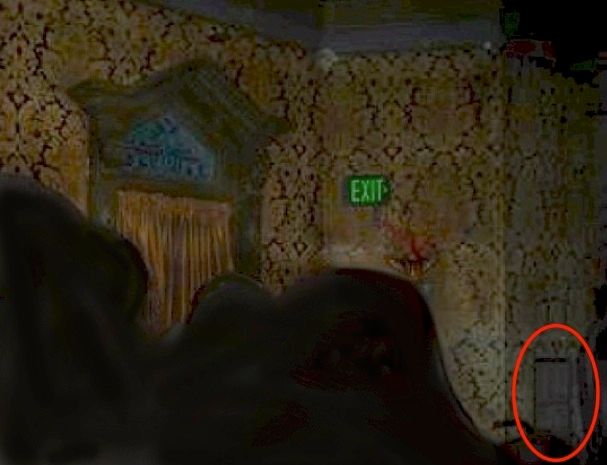
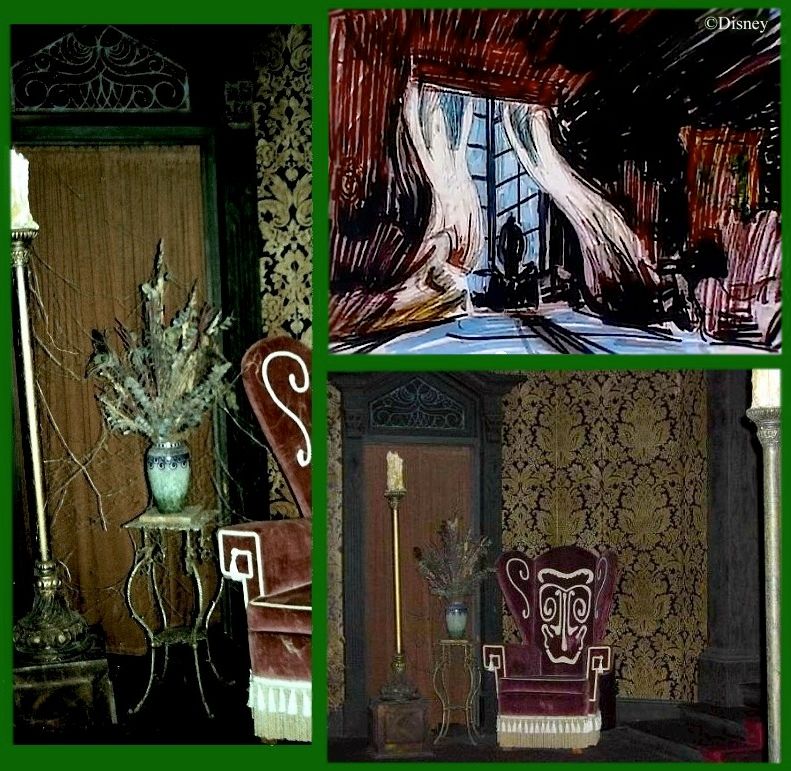
Now the billowing curtains (alas, often not visible due to the darkness).  There are actually two doorways with the blowing drapes, the first one immediately on the left as you round the corner.  It has the honor of being the first special effect you encounter up here, but it's easy to miss and hard to photograph, because your doombuggy immediately turns away from it, and the other buggies do their best to block it out.


(Just ignore the highlighted duct for the moment.  We'll get back to it.)


In the Claude Coats concept art, notice the pink chair and its position.  And did you see the ghosts in the drapes?

They're another cliché, but they represent an important idea.  The Ghost Host has already saddled you with one unanswerable question: real or imagined?  The blowing drapes pose another: natural or supernatural?  Seems like every haunted house story has a character who tries to explain everything as natural phenomena. "It's just the wind.  Someone probably left a window open somewhere.  That's probably what made the armor rattle too.  You're turning into a bunch of nervous Nellies."  Characters sometimes internalize this conversation.  After all, now that you're convinced that the ghosts are real—that this can't all be just a hallucination—there's still the danger of going to the opposite extreme.  Your skeptical side may have admitted defeat with regard to the big question, but that doesn't mean it has utterly abandoned you.  "Come on Jennifer, get a grip; every creaking hinge and every flickering candle isn't necessarily a ghost.  Some of these things have a perfectly rational explanation.  Good lord, next thing you know you'll be finding ghosts in the wallpaper!"   Heh heh.

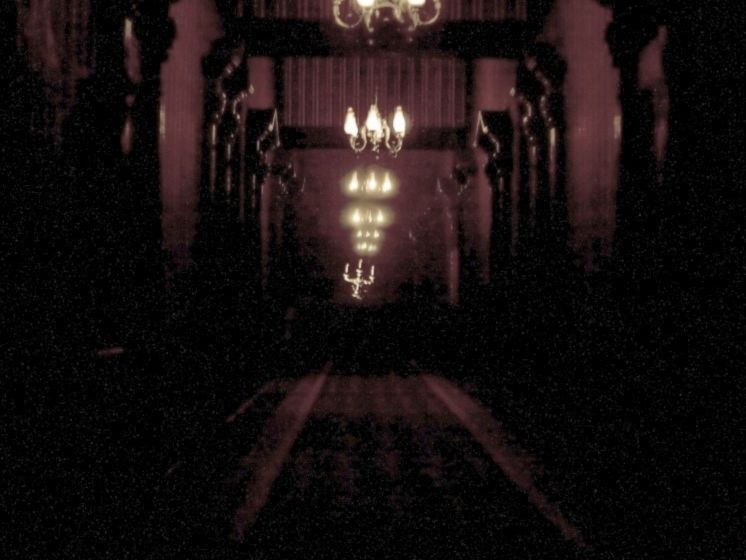
Then there are the other two gags, the candelabra and the hall itself.  You've seen plenty of ghostly tricks up to this point, and you've heard plenty of eerie things, starting with the Ghost Host himself, but at Disneyland the first irrefutable ghost that you actually unsee is the floating candelabra.  I mean, there's an invisible ghost standing right there, holding a candelabra.  That's a real escalation in ghostliness.  And finally, what can you say about that hallway?  It's immense.  It's incredible.


It's also scary.  You look down that eerie hall, with all those doors, and you feel like you could easily get lost in this house forever.

Oh, it's all just perfect, isn't it?  Hard to believe that what you're seeing is . . . a patch job.

That's right.  This seemingly flawless scene is the result of some slapdash, improvised, last minute imagineering.  The hallway itself is basically what was planned, but if you could back up just a few months before opening day and experience it as it was planned up to that point, it would have gone something like this:

Your doombuggy moves in front of the Endless Hallway and you are hit with a blast of cold air, which flutters the armor's feathery helmet ornament and explains the billowing curtain.  There is no floating candelabra.  The Ghost Host says, "Ssssssh.  Listen!" and you hear the tramping of loud footsteps coming down the hall toward you.  As the sound passes the suit of armor, its hand moves.  The steps continue to travel toward you and pass right over you (or through you), only to continue on the other side as if you weren't there.  There are other sound effects with the footsteps: panting and chain rattling, and it's possible that a smoke-like effect is also used.


Huh?  What happened here?  Let's go back to the beginning, the very beginning . . .

The original inspiration for the Endless Hallway could be found in the old Sleeping Beauty Diorama, the castle walk-thru that was beautifully re-done and re-opened just a few years ago.  It's a hidden gem, recreating much of the look and feel of the 1957 original. (Thank you Chris Merritt and team.)  One scene from the original that was not re-created and which perished in the 1977 Barbie doll make-over was the Bottomless Pit.  It was located where the waltzing spinning wheels are found today.  You could peer into what looked like a stone turrett, but it had no top or bottom.  You couldn't quite get your head in there, but you could scrunch up pretty close and see a long way in each direction.


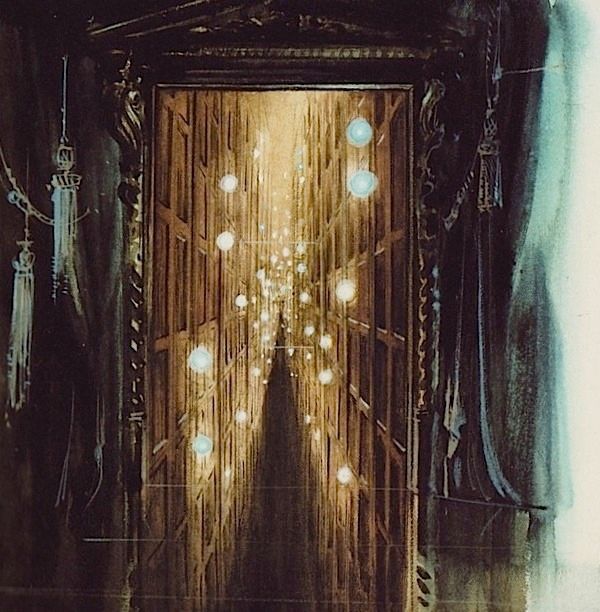
Way cool.  It was done with mirrors, of course, one on top and one on the bottom, reflecting each other into eternity.  Now if you think about it, this is exactly like the Endless Hallway, except that one is blue, vertical, round, and made of stone, while the other is brown, horizontal, square, and made of wood.  Don't bother me with such trifling details.  You might also object that the EH only uses one mirror, back there in the fog, while the bottomless pit uses two.  That's true, but at one point the Mansion team did toy with the idea of using several mirrors for the EH.  Here's a favorite piece of concept art, a watercolor by Dorothea Redmond:


Nice, eh?  But how would they have done that?  Well, the first vertical mirror, immediately in front of you, is a two-way mirror.  It's relatively dark where you're sitting, and it's brighter inside what is essentially a box made of four mirrors and two wooden sides, so you see through it like glass, but from the inside looking back at you, it acts just like a regular mirror.  How would you light up the inside, though?  There's no place to hide fixtures.  Simple, you just have these glowing orbs hanging down on very thin electric cables through holes in the ceiling mirror.  If the wires are thin, they can't carry much current, and the lights will have to be of very low wattage.  You'll compensate for that by having lots of them in there, as bright as the wiring will tolerate.  Really, they're just like Yale Gracey's fireflies from the Blue Bayou.  They can dance around like the fireflies too.

Anyway, you can see the Sleeping Beauty bottomless pit influence here.  But of course, they didn't do it like this and elected to go for a more natural look.  They settled for one mirror placed well back in the mist (i.e. multiple scrims).  Here's a 3D.  It may not be endless, but it's still a pretty long room.


The script for the "Story and Song from the Haunted Mansion" record album is based largely on an early  script for the ride, as we've mentioned before.  Consequently, with the record you can sometimes hear what they had in mind before they changed things, if they changed things.  For example, when the hero and heroine, Mike and Karen, climb the stairs (sans doombuggy, the lucky ducks), they notice a change in temperature:

Appalling Cold


This effect was really going to be used in the ride, and possibly it was for a short while at the beginning.  Two vents hidden on either side of the hallway entrance, probably in the steps, were going to blast you with cold air.  An exhaust vent on the wall behind you was going to suck it out of there as fast as it came in.  (That's the vent highlighted in the earlier photo.)  WED engineer Paul Saunders, who worked on the HM in 1967 and 1968, thinks the cold air effect was actually used.  I don't have any memory of it.     If it was used, it wasn't for long.  Perhaps it was difficult to confine and control the stream of cold air.  So the scene has lost one special effect.

[Edit] Or almost lost.  Several readers affirm that you can feel a slight blast of cold air about this point, especially at WDW.  The effect is still there, but it seems like it's toned down quite a bit.  The building is air conditioned, after all, and according to someone who used to work there, air conditioning vents are very deliberately arranged in that area to create a cold spot.  It's soft enough for a guest to think without thinking, "Oh, that's the air conditioning" and fail to appreciate the "special effect."  The blast of cold air coming out of the EH and hitting you full in the face – that's gone, perhaps never was. [Edit]

The traveling sound was more interesting.  Once again, take it away Thurl:

Through the Dimly-Lit Mist


To accomplish this effect, they installed a string of speakers in the hallway on the left side wall, continuing up to the track, and continuing again on the other side.  The sound would simply pan along this string of speakers.


They actually installed the speakers in the hallway, and they're still there today.


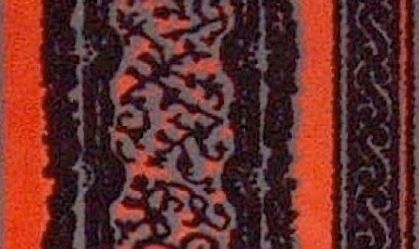
The red wallpaper has never been replaced, so it's no surprise that it's faded in some places.  That's why the speaker cover camouflage paint is now too bright in some places.  Otherwise, look how carefully those covers were painted!  Speaking of the EH wallpaper, here's a tile so you can use it for your wallpaper, a fine freebie for faithful Forgottenistas.  It's made from a photograph of the real thing.


If the "Story and Song" narrative is to be trusted, there were footsteps, screams and rattling chains.  A sound file for the footsteps has been preserved.  Here's a clip:

Footsteps  (many thanks to Brandon, "GRD")


[Edit] As reader "Grinning Ghost" has pointed out to me, that's probably the full blend of footsteps and other sounds that you hear in the background on the Story and Song album during the "Corridor of Doors" sequence. [Edit]


These heavy footfalls are directly inspired by the 1964 film, The Haunting.  There are two places in the film where the same kind of heavy, slow, marching, muffled footsteps are heard, and one of them is in the same scene in which the "bulging door" effect is used (although the footsteps don't actually start until after the door stops bulging).  That effect, of course, is another idea directly borrowed for the Haunted Mansion.

Footfalls from The Haunting


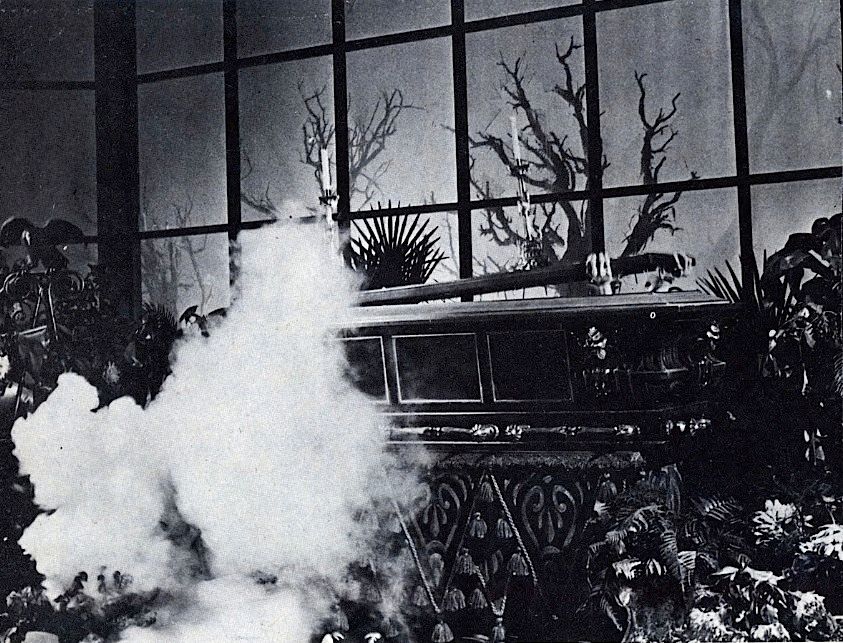
The record also mentions some kind of "ghost-like figure."  The only hint I have seen of a lost visual effect at this point is this peculiar but widely used publicity photo.


What's with the smoke?  No one seems to know.  I've been told that it's probably just something they threw
in for the photo shoot, but I don't buy it.  Seems like a lot of bother for something you don't need at all.

It's really no mystery why these effects were never used:  The sequence takes too damn long.  So there go some more gags, right down the drain.  Oh fine, that's just great.  We're well into 1969 now, and that Endless Hallway tableau is going to seem pretty bare unless someone can come up with an idea, and whatever it is, they'd better come up with it soon.

What did they finally do?  They moseyed down the hall to the Séance circle and stole an effect that was intended for that room and put it in the Endless Hallway instead.  That would be the floating candelabra.  It was simple, but it looked great in its new location.  Problem solved.


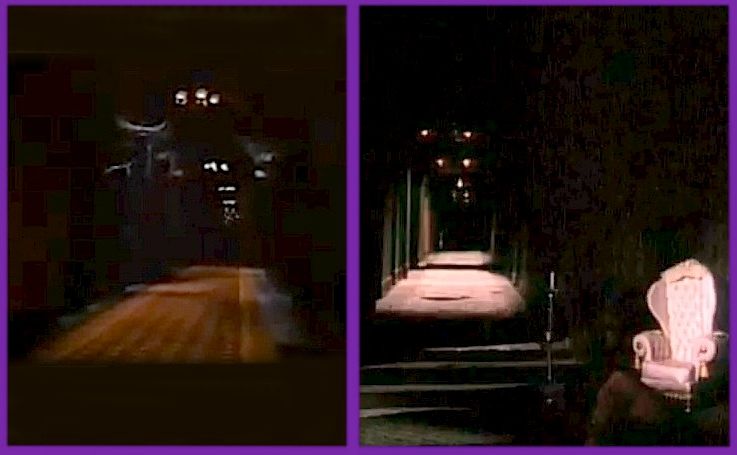
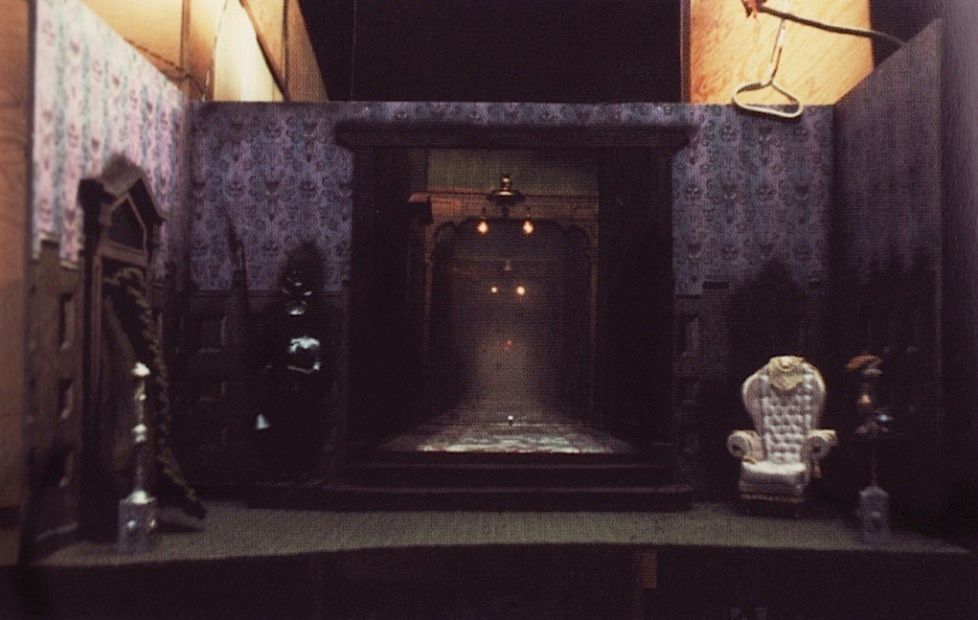
They must have done this before they filmed the inside of the ride (July probably, maybe June), because you can see the candelabra in that film.  (You will remember that the WED film was edited and has been re-used ever since as stock footage of the HM interior, so you see parts of it even today in Disney commercials, TV shows, etc.)  There is our candelabra below on the left, but notice that in the scale model of the ride (below right), it isn't there.


Those scale model photos are mighty fine things.  Besides being just plain fun to look at, you can see what made the cut and what didn't in the final attraction.  Here's another shot of the EH model:


The blowing drapes, the suit of armor, and the overstuffed chair are all there.  Even the large floor candelabrum is there in the scale model (see the blowing drapes photo above).  That handsome, paneled wainscoting was going to be used throughout, but I suppose time and money considerations eliminated it.

One remaining curiosity is the wallpaper.  The models show that they intended to use the demon-eye wallpaper starting here and continuing all the way down the corridor to the Séance room.  That is indeed how it is at Phantom Manor and at WDW since the big refurbishing of 2007, where it provides the basis of an impressive new gag, as the eyes appear before the walls do.  But before 2007 all three Mansions (DL, WDW, Tokyo) had this yellow, off-the-shelf wallpaper in the EH tableau:

(1999 pic by Allen Huffmann)

Disneyland and Tokyo still have it.  I don't know why they used this instead of the demon-eye paper, but whatever the explanation, I like the yellow stuff.  I know I'm going well beyond the conscious intentions of the Imagineers here, but the fact is, that pattern serves as a good transitional step.  It's not fake; it's real-world wallpaper.  It's got a perfectly normal, old-fashioned design.  In other words, it's not supposed to have faces in it, but like many intricate patterns, you can't help but find faces in it if you have any sense of whimsy, or if there's anything left of your kidhood imagination.


I guess it's possible that whoever picked it out noticed that the pattern lent itself to this sort of thing very easily, and that it would therefore be a good pick for the Mansion, but even that much is probably pushing it.  At the very least, it's a happy accident.


A Post-Script: Pink Floyd and the Endless Hallway.

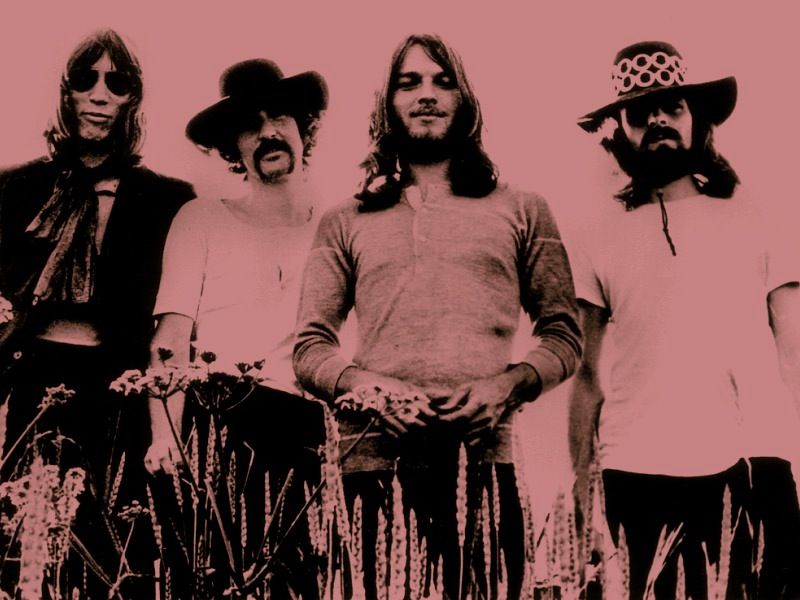
I'm a fan of early Pink Floyd, so this little example of synchronicity is a hoot.  Skip it if you want.


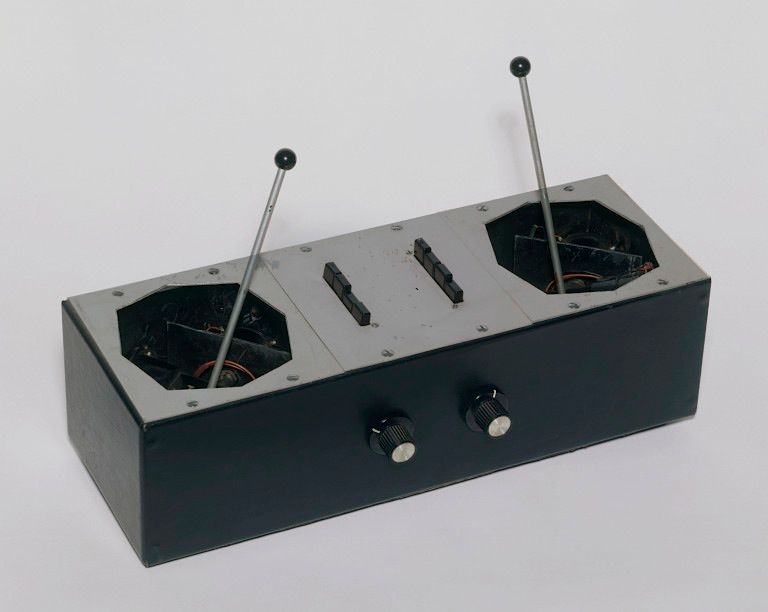
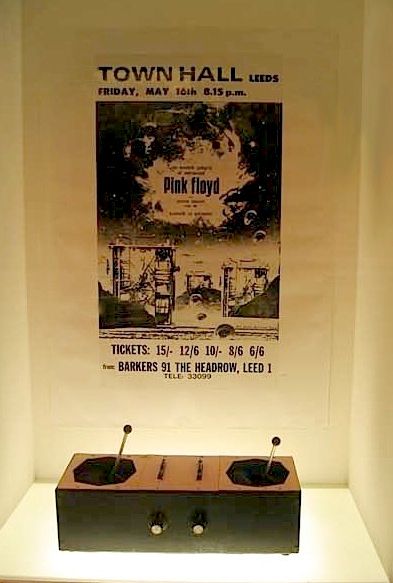
Floyd was always a bold, experimental band, and in 1969 they were the first to use a quadraphonic sound system, with speakers placed in all four corners of the room.  They had a home-made device, whimsically called the "Azimuth Co-ordinator," which enabled them to pan the sound around the auditorium with a simple joy-stick.


The first time they used it was at a concert on May 16th, 1969


What they did at one point in the show was play a tape of some heavy footsteps invisibly walking around in the audience, pausing now and then to jingle some keys (rattling chains!) and slam a door, all of it with lots of reverberation.  It worked great, and it was an audience pleaser, so they used this gimmick in their concerts for the better part of a year.

In other words, a bunch of guys at Disney and a British rock band were creating exactly the same sound effect at exactly the same time, with no apparent knowledge of each other.  Here's a clip of the Floyd effect from a concert on September 17th, 1969.  Compare it with the HM version.

Pink Floyd


Haunted Mansion


Of course, at Disney they added further sound effects to the footfalls, but then, they never used any of it anyway.

The phantom footfalls at the Floyd concerts were put into the middle of "Cymbaline," a song from their third album, which was released in the US on . . . wait for it . . . August 9, 1969.

LOL, as the kids say.