Things You're Just Supposed to Know

Most of the time, Long-Forgotten assumes that readers are already familiar with basic facts
about the Haunted Mansion. If you wanna keep up with the big boys, I suggest you check out
first of all the website, Doombuggies.com. After that, the best place to go is Jason Surrell's book,
The Haunted Mansion: Imagineering a Disney Classic (NY: Disney Editions; 2015). That's the
re-named third edition of The Haunted Mansion: From the Magic Kingdom to the Movies (NY:
Disney Editions, 2003; 2nd ed. 2009). Also essential reading is Jeff Baham's The Unauthorized
Story of Walt Disney's Haunted Mansion (USA: Theme Park Press, 2014; 2nd ed. 2016).

This site is not affiliated in any way with any Walt Disney company. It is an independent
fan site dedicated to critical examination and historical review of the Haunted Mansions.
All images that are © Disney are posted under commonly understood guidelines of Fair Use.

________
.
Showing posts with label Sleeping Beauty Diorama. Show all posts

Monday, January 10, 2022

Maleficent's Torture Chamber

Clickbait title, I know, but actually, it's accurate, so why not?

Makes a pretty good trivia question, too. We have learned that the happiest place on earth has been home to an awful lot of graveyards, but a medieval torture chamber? Try this one on your favorite Disneyland trivia lover and see if they're stumped:  

Is there currently a torture chamber anywhere at Disneyland? Not torture scenes, mind you, but an honest-to-gosh medieval torture chamber?" 

(You need to stipulate like that, because torture scenes there are aplenty. They would include dunking the mayor in POTC, forcing Wendy to walk the plank in Peter Pan, and the queue for Spider Man on a hot day.)

Some of the scenes in the older versions of Snow White's Adventures would have qualified, but those have mostly been scrubbed. If we're restricting ourselves to gloomy dungeons with implements of torture sitting around, then there is one and there is only one. It's in the Sleeping Beauty Diorama (aka the SB walk-thru).


pic by Roger Weeks

I ran some of what follows past good buddy Chris Merritt, one of the masterminds behind the 2008 version of the walk-thru, and he was so tickled by it that I was encouraged to go ahead and do a post. I'm going to label it an excursus, like I did with the Tom Sawyer Island graveyards, even though a slender case could be made that the ultimate source of inspiration for the scene above also left a mark on the Haunted Mansion. The connections are so pathetically weak, however, that I'm not going to pretend this is a legitimate Mansion post. It's an excursus into the roots of one scene in the Sleeping Beauty Diorama. I don't expect much blowback anyway, because Mansion fans tend to be fans of the Sleeping Beauty film and the walk-thru attraction as well.

There are plenty of good reasons for this crossover fandom, by the way. There's the Eleanor Audley vocal connection between Mdm Leota and Maleficent. There's also what we might call a common DNA to both attractions due to their mutual emergence from the imagination of Ken Anderson, who was in fact working on the earliest concepts for the HM and on the original SB walk-thru at the same time.


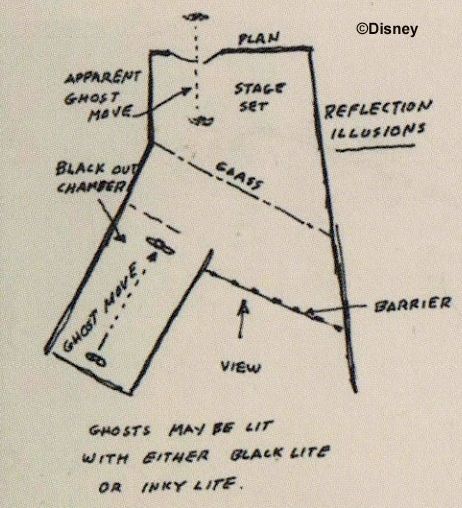
There is also the fact that the humble, A-ticket, Sleeping Beauty walk-thru was by far the most special-effects-laden attraction at Disneyland prior to the advent of audio-animatronics, and most of those same effects were heavily re-used in the HM (e.g. Pepper's Ghost, mirror trickery, lighting and shadow effects of all sorts, and ingenious use of forced perspective). This comes as no surprise, since special effects wizard Yale Gracey was responsible for much of the magic on display in the walk-thru, although he has never been properly credited for it.


Imaginary Prisons

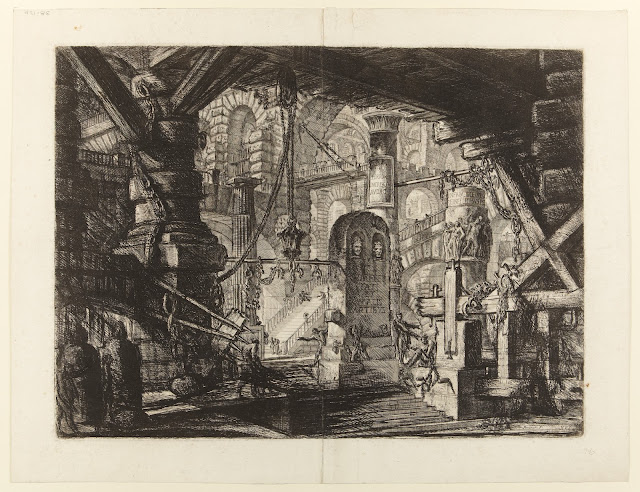
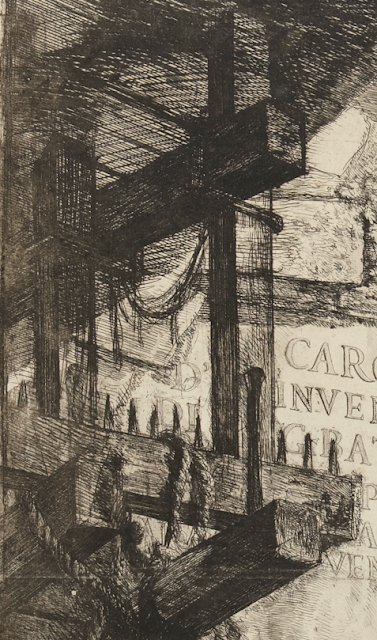
For the "ultimate inspiration" promised above, we go back two and a half centuries. Meet Giovanni Battista Piranesi, a Venetian artist of repute:

He did thousands of etchings. These could be mass produced and sold in portfolios at affordable prices. He was best known for his renderings of ancient Roman ruins and landmarks, done in realistic fashion but also with a heavy dose of romance and fantasy. The etchings were the 18th century equivalent of coffee table books, aimed at a middle/upper class clientele who would love to travel to see all these famous historical places but would probably never be able to do so. Some of his etchings became pretty well-known, like his rendition of the Pantheon:


Anyway, according to one account, some time in the 1740's Piranesi fell ill, and upon recovery he began a series of etchings based on visions he "saw" while in a feverish delirium. Unlike anything else he had done, these were entirely imaginary. The series was called "Le Carceri d'invenzione" (Imaginary Prisons) and was published in two editions. We are concerned here with the second, 1761 edition.

The Imaginary Prisons set is widely admired and recognized as an important influence on later artists in the Romantic and Surrealistic schools. They are indeed pretty amazing. I think there is good reason to think that Ken Anderson laid them under contribution when he designed Maleficent's dungeon for the SB walk-thru.


You can see the entire set of 16 prints HERE. They're all good.


Torture Devices! (or...something)

The Sleeping Beauty movie did not come out until 1959, but the walk-thru attraction opened in 1957, while the film was still in development. That's why the original diorama contained scenes that never appeared in the movie. Eyvind Earle did a concept painting of Maleficent summoning her demons for a celebration. This is not a concept for the movie but for the walk-thru:

I don't see much here that looks like it could have been inspired by Piranesi, unless the coffins (or are they iron maidens?) in the corner were inspired by these, which are equally ambiguous as to what they are.


If we want to hunt down possible influences on the Earle painting, I think there are better candidates elsewhere:


The Ken Connection

But never mind Earle. It was Ken Anderson who designed the actual scene in the walk-thru, including all the torture implements. The original was revamped entirely in 1977 (the wretched "Barbie doll" version), and that one closed in 2001. But the current incarnation, which opened in 2008, tries to adhere as closely as possible to the look of the Earle-Anderson version. We actually have a pretty good idea of what Maleficent's dungeon looked like in 1957 (here recreated by Chris Merritt):

Amazingly enough, even though interior photos of the original SB walk-thru are EXTREMELY RARE, a photo of precisely this scene came to light just last year, posted by Mark McGuire at the Vintage Disneyland site on FB. It took a little knob-twiddling to improve the readability of the photo, but there's been no fiddling with the contents, I assure you. The pieces seem to have been moved around.

pic by Mark McGuire

Besides all this, I've seen Anderson's blueprints for the dungeon furnishings (but I can't show you them).

Not all of Maleficent's toys were inspired by Piranesi. The guy spread-eagled on some sort of frame obviously comes from Earle's painting, and the guy strapped to the wheel just as obviously comes from this cheerful little number rather than the wheel in Earle's artwork.


But the weird "star wheel" and the spiked sawhorse with descending arrow points in the middle certainly came from the Imaginary Prisons.

 
The catwalks too, I think. Ken needed something to disguise the top edge of the glass pane slanting across the stage, and now that it seems certain he took ideas from Piranesi, we're probably safe in concluding that he took the design of the catwalks from there as well.


Digital recreation by Chris Merritt

See now the following post for an additional item that may be from Piranesi.


The Big "So What" Moment

To me, the most interesting thing in all of this is that the actual function of the borrowed devices is unclear. In fact, even though Piranesi's prisons are full of what are obviously implements of torture, it's not at all clear what they are or how they would have been used. They are wholly imaginary, perhaps the product of Piranesi's delirium, and it's apparently enough that they look like scary torture devices, even if they are ultimately indecipherable.

I wonder if that very fact may have been the thing that attracted Anderson to them. This is a Disneyland attraction, after all, and this is a scene in a fairy tale. How many historically accurate torture devices do we really want to put in this tableau? Wouldn't it be better to put in something more suggestive of a torture chamber than a literal reproduction? It's enough that that wheel and that rack (if that's what it is) are included. Maybe Anderson welcomed the opportunity to introduce items that were deliberately much vaguer, things less factual and more fantastical.

Merritt was particularly pleased by the Piranesi discovery, since neither he nor Tony Baxter had any idea what these crazy things were, and they decided to simply follow Anderson's blueprints as slavishly as possible, all the while wondering what the hell they were making.

Almost none of this survived into the movie, although if you're paying attention, you'll notice a chopping block in Prince Phillip's cell. It made a good perch for Diablo, but that seems to be all that's left of Maleficent's torture chamber.


Haunted Mansion Connections?

Like I say, this is pretty thin gruel, but for what it's worth . . .

It has been noticed that the 1761 edition of the Imaginary Prisons set incorporated here and there what look like "impossible objects."
Not surprisingly, it has been suggested that Piranesi was an influence on M. C. Escher. These are often compared:

Since that particular Escher piece is the obvious inspiration for the WDW HM "Grand Staircase" scene, Someone might argue for a connection here between Piranesi and the Mansions at second or third hand.

I think a slightly better case may be made that some of Nathan Schroeder's concept art for the 2003 Haunted Mansion movie could have been inspired by the Imaginary Prisons artwork. Here's Schroeder:

Alas, not much of this design for the crypt scene made it into the movie, which rejected those heavy stone arches in favor of lighter wrought iron work. Admittedly, that's more in keeping with a New Orleans setting, and besides, it offered greater flexibility for camera angles.

But anyway, compare Schroeder with some of the Piranesi etchings above, as well as some others in the set, like this one. There's enough there to at least raise suspicions.

I'm afraid that's about all you're going to get in the way of Mansion connections. Sorry.

****************


Tuesday, October 29, 2019

The "Boy Mechanic" Myth (OR IS IT? UPDATED!)

.
Edit: November, 2020. I've been in communication with a source that potentially calls into question the whole premise of this post, or most of it. But first, go ahead and read the original blogging below, and then take note of the update that immediately follows it.

Kind of a downer post, folks. Sorry about that. But it's time for someone to turn a KNOW into a NO.

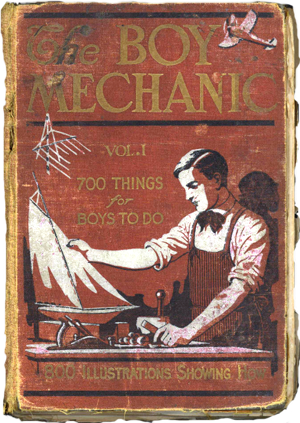
If you're any kind of Mansion history nerd, one thing you know (or think you know) is that special effects whiz Yale Gracey was heavily influenced by a book called The Boy Mechanic, which came out in 1913 and gave him all kinds of neat-o mosquito, tough torpedo ideas he would later use to cook up illusions for the Haunted Mansion.


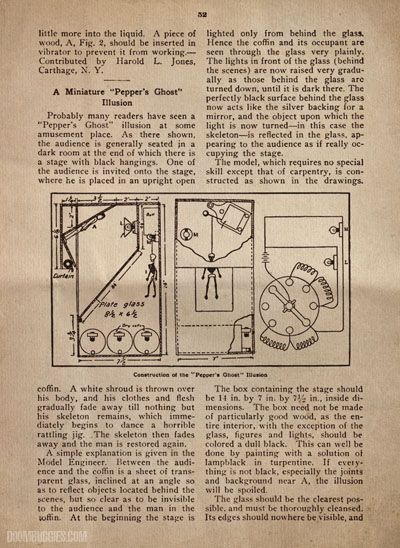
The example everyone points to is the "Pepper's Ghost" illusion on pages 52-53:


I'm sorry to report that Rolly Crump is the man chiefly responsible for promoting the Boy Mechanic myth. It was he who first pointed out the Pepper's Ghost chapter, implying that this is where Yale got the idea for this most convincing of all Haunted Mansion illusions.

I don't doubt Rolly's sincerity, but the simple fact is that there is virtually nothing in the book that looks to me like it might have served as inspiration for anything in the Mansion. Yes, I've read it. Nothing there. It's a compendium of projects contributed by a host of readers of Popular Mechanics magazine, with all sorts of "how to make this" and "how to do that" instruction, some of it extremely rudimentary and some of it remarkably sophisticated. It is true that there are lots of magic tricks in it, but they are mostly the kind of things you found in that first ever "magic set" you got as a kid. Coin, card, and handkerchief tricks. Think of the beloved Magic From the Haunted Mansion 1970 souvenir booklet. That level. Oddly enough, however, and at the other extreme, The Boy Mechanic also includes explanations of how some very professional stage tricks are done, and these go well beyond the scope of DYI at home even by adults, let alone boys. There's the levitating lady with hoops passed over her, and very sophisticated black boxes that require trained assistants and special lighting. You wonder why they're in there, except as spoilers. Nevertheless, I didn't find anything even among those that I could connect with something in the Mansion. (By the way, the books have thorough indices, making it easy to find all the "tricks," "magic," and "illusions.")

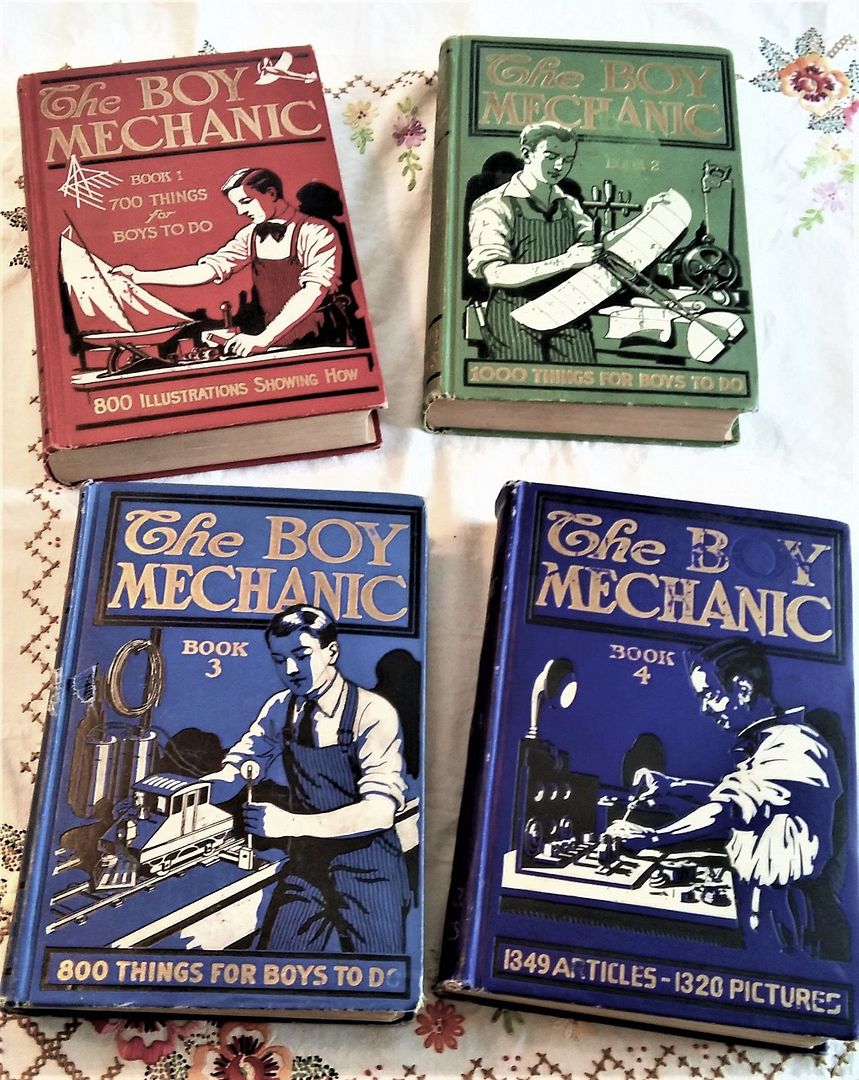
Did I say "books"? Yep, there are actually four volumes in the series, not just the one.


But what about that Pepper's Ghost chapter? Well, we've covered this ground before (HERE, and HERE), but to recap, Ken Anderson's plans for the Disneyland Haunted House featured several applications of Pepper's Ghost. You will remember that those plans date from 1957-58, and Yale's involvement in the project began in 1959, so it's not as if Ken's plans were lost in a file somewhere and forgotten over time.


But there's even more Pepper there than we knew. We've seen this Anderson sketch before:


What we didn't know until it was published recently is that Anderson did a second sketch of this scene,
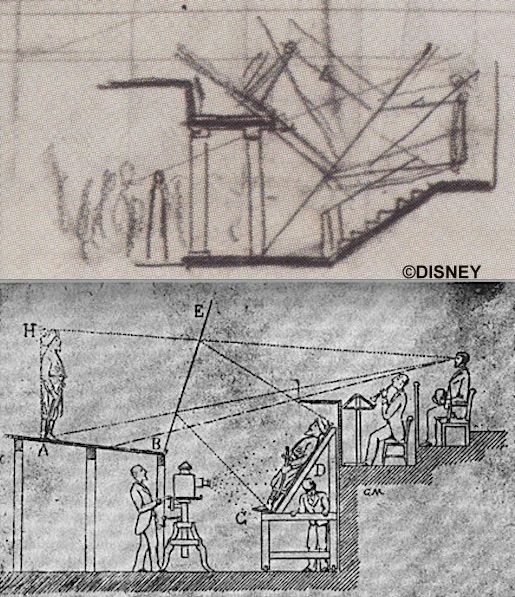
this time included a diagram of how the illusion would be achieved, using classic Pepper's Ghost:

MDIHOW 337

Ken's diagram is crystal clear and reminds me of 19th century specimens:


Turning to Yale, more complete and better quality copies of pages from Yale's notebooks have also been published recently, in
MDIHOW (421) and at Doombuggies . com. They provide good examples of how Yale would have used Pepper in the attraction:


Looks to me a heck of a lot more like Ken Anderson than Boy Mechanic.

And then there's the fact that the original '57 Sleeping Beauty walk-thru was absolutely loaded with extremely sophisticated examples of Pepper's Ghost, thanks to Anderson. Perhaps the best way to appreciate this is to get ahold of the Sleeping Beauty 50th Anniversary Platinum Edition DVD. In the Special Features is a fascinating history of the original walk-thru attraction (hosted by Tony Baxter and Chris Merritt). Everyone talks about what a special effects genius Yale Gracey was, but I'm telling ya, our boy Ken was not far behind.


It's perfectly possible that Ken's work stirred memories in Yale of seeing such an illusion in an old book he had
read as a kid, and perhaps he made some remarks to Rolly about it, and the whole thing grew out of that. Whatevv.

*****************

And now for the update. My source is a former WDI Imagineer who once worked with a couple of WDI guys who worked with Yale in earlier years. One of them was in fact Yale's assistant not long before Yale's retirement and took over the department as it moved into the EPCOT years. Anyway, according to my source, both of those guys told him that Yale worked on the Sleeping Beauty walk-thru, heavily implying that the sophisticated Peppers Ghost effects (and other effects) in the diorama were in fact the work of Yale Gracey, not Ken Anderson. The problem is that there is currently no hard evidence for his involvement, like his name on a project document. But as second-hand hearsay goes, this is much more solid evidence than usual, and it comes from excellent sources. If it's true, then we can imagine a scenario in which Yale first learned about Peppers from those famous pages in the original Boy Mechanic volume and was directly responsible for introducing that effect at WED, to Ken, Rolly, and others. It's still true that there is nothing else in the books that looks remotely like anything seen in the Mansion or elsewhere, so that part of the myth is indeed mythical, but the notion that it was the original source for the Peppers Ghost effect could well be true after all.


Tuesday, August 16, 2011

The Beginning of the Endless Hallway

.
Life~by~the~Drop Jeff Fillmore

Once you've boarded your doombuggy, the Haunted Mansion almost becomes a different ride, doesn't it?  The walk-thru portion has one feel and the ride portion another.  You sit down in your omnimover, and there is an unavoidable feeling that the attraction has kinda hit the restart button.  That's okay; it's really not a problem, but it does mean that the Imagineers who built the ride needed to follow some of the same show dynamics at this point that they would ordinarily use at the beginning of any other dark ride.

At Walt Disney World and at Tokyo Disneyland, the first full tableaux are low-key affairs.  (I don't count either of the portrait halls as "full tableaux.")  The music room and library are just as much about setting the mood as they are about intriguing special effects.  By the time you get to the Endless Hallway, the subject of today's post, you're well into the ride.  This is also true of Phantom Manor.  Ah, but at the Disneyland original, the Endless Hallway is the first full tableau that you see after boarding your doombuggy, so it's far more important there.  It has the responsibility of leaving that good first impression people are always talking about.

I think it succeeds very well.  The tableau is low-key but gives you four distinct gags: the armor, the drapes, the candelabra, and the hall itself.  Shameless gasbag that I am, I have something to say about all of these, plus a history lesson, plus a post-script.

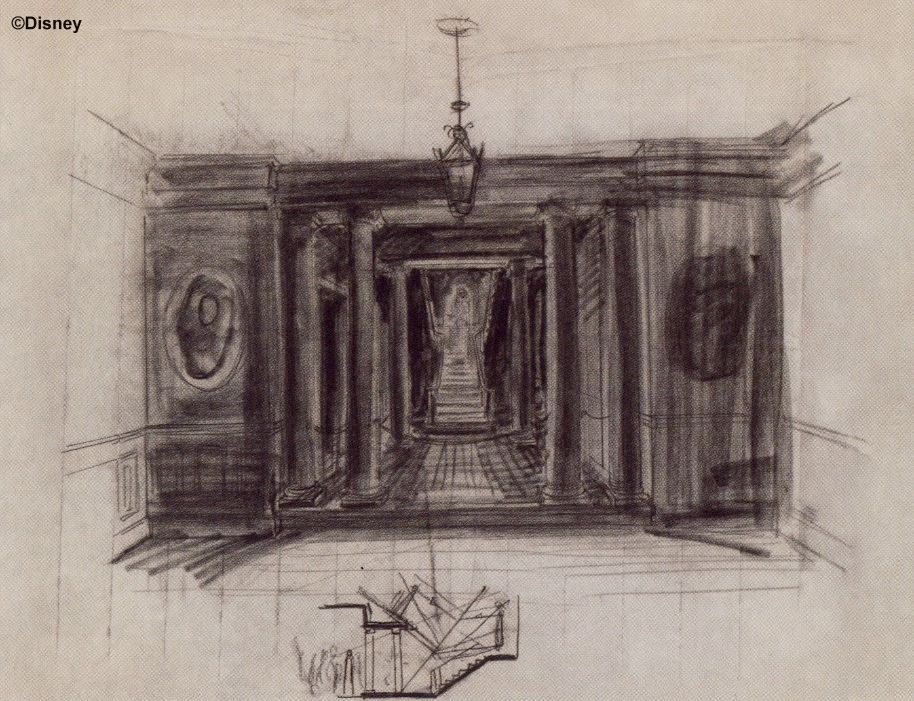
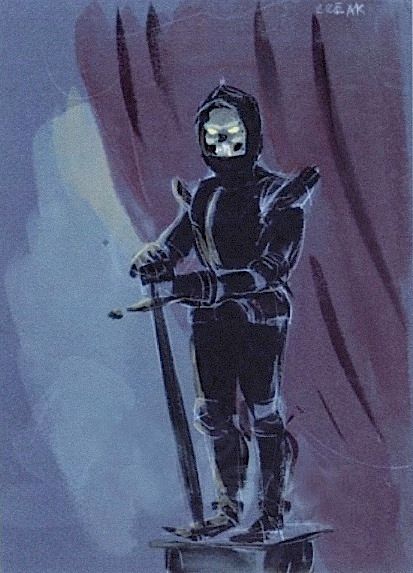
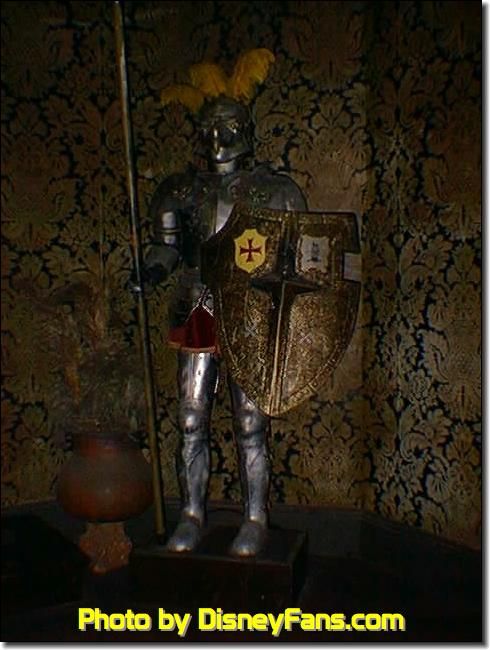
First the armor.  As it does so often, the story begins with Ken Anderson:


Yeah, it's a cliché, but it's a good one.  Marc Davis seems especially to have liked suits of armor.  You see them prominently in the concept artwork we looked at a couple of posts back (the "Weirder" one).  Here's an unfinished Davis sketch that you've probably never seen.  This was done after he had done the artwork for the Grand Hall (as it was called then), so you wonder what this was for.


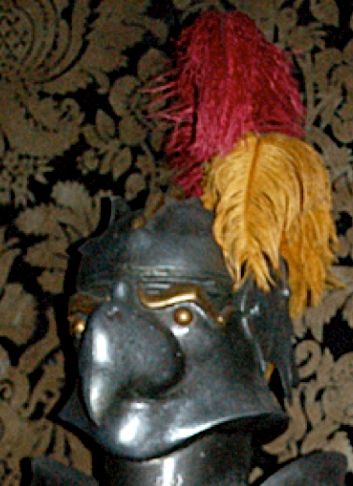
They all look pretty normal, so you wonder how we got our odd-looking fellow.  There is no shortage
of really bizarre medieval helmets out there, but I haven't found anything that looks quite like ours.
 [Edit: this strange helmet is no longer a mystery.]


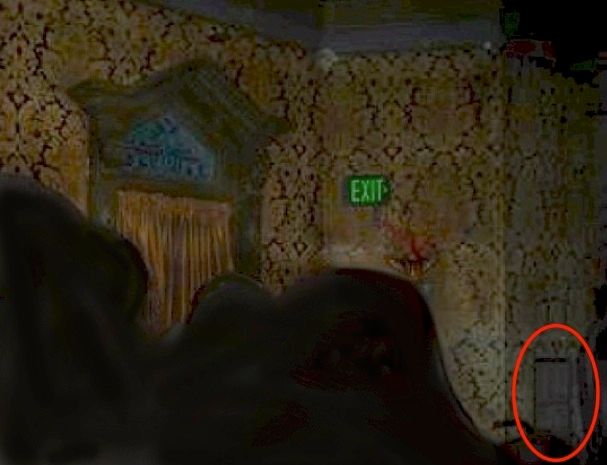
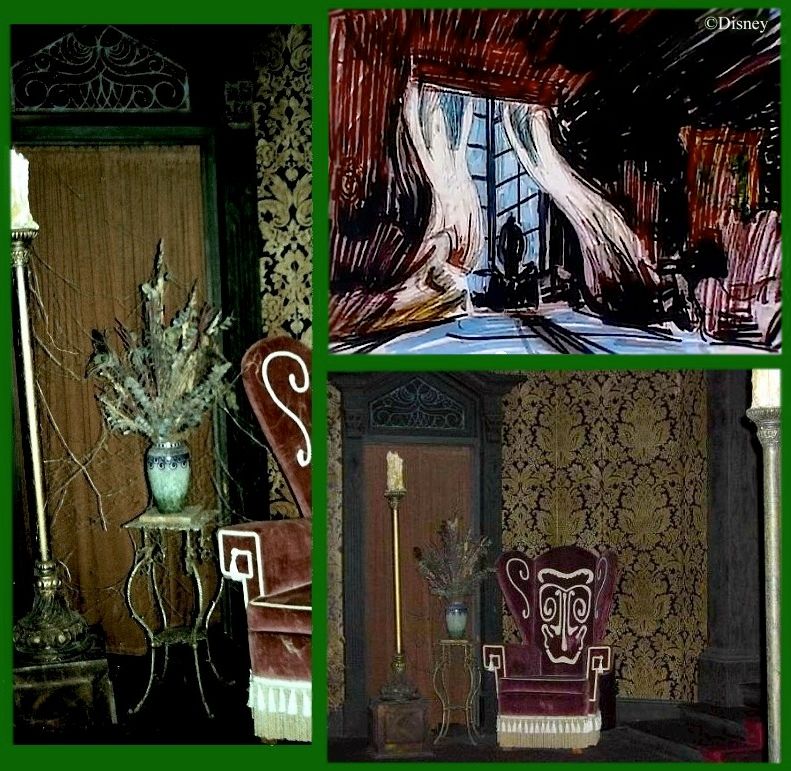
Now the billowing curtains (alas, often not visible due to the darkness).  There are actually two doorways with the blowing drapes, the first one immediately on the left as you round the corner.  It has the honor of being the first special effect you encounter up here, but it's easy to miss and hard to photograph, because your doombuggy immediately turns away from it, and the other buggies do their best to block it out.


(Just ignore the highlighted duct for the moment.  We'll get back to it.)


In the Claude Coats concept art, notice the pink chair and its position.  And did you see the ghosts in the drapes?

They're another cliché, but they represent an important idea.  The Ghost Host has already saddled you with one unanswerable question: real or imagined?  The blowing drapes pose another: natural or supernatural?  Seems like every haunted house story has a character who tries to explain everything as natural phenomena. "It's just the wind.  Someone probably left a window open somewhere.  That's probably what made the armor rattle too.  You're turning into a bunch of nervous Nellies."  Characters sometimes internalize this conversation.  After all, now that you're convinced that the ghosts are real—that this can't all be just a hallucination—there's still the danger of going to the opposite extreme.  Your skeptical side may have admitted defeat with regard to the big question, but that doesn't mean it has utterly abandoned you.  "Come on Jennifer, get a grip; every creaking hinge and every flickering candle isn't necessarily a ghost.  Some of these things have a perfectly rational explanation.  Good lord, next thing you know you'll be finding ghosts in the wallpaper!"   Heh heh.

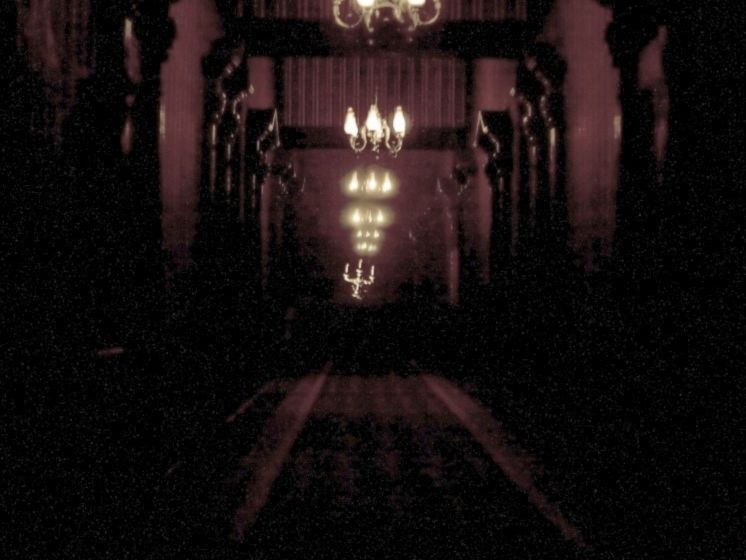
Then there are the other two gags, the candelabra and the hall itself.  You've seen plenty of ghostly tricks up to this point, and you've heard plenty of eerie things, starting with the Ghost Host himself, but at Disneyland the first irrefutable ghost that you actually unsee is the floating candelabra.  I mean, there's an invisible ghost standing right there, holding a candelabra.  That's a real escalation in ghostliness.  And finally, what can you say about that hallway?  It's immense.  It's incredible.


It's also scary.  You look down that eerie hall, with all those doors, and you feel like you could easily get lost in this house forever.

Oh, it's all just perfect, isn't it?  Hard to believe that what you're seeing is . . . a patch job.

That's right.  This seemingly flawless scene is the result of some slapdash, improvised, last minute imagineering.  The hallway itself is basically what was planned, but if you could back up just a few months before opening day and experience it as it was planned up to that point, it would have gone something like this:

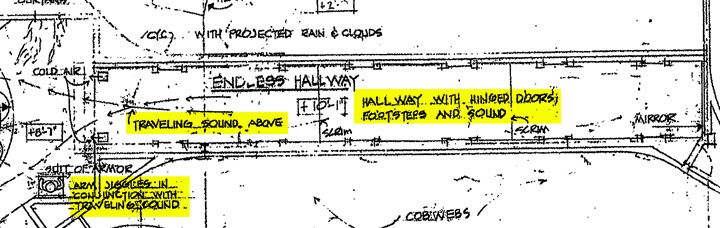
Your doombuggy moves in front of the Endless Hallway and you are hit with a blast of cold air, which flutters the armor's feathery helmet ornament and explains the billowing curtain.  There is no floating candelabra.  The Ghost Host says, "Ssssssh.  Listen!" and you hear the tramping of loud footsteps coming down the hall toward you.  As the sound passes the suit of armor, its hand moves.  The steps continue to travel toward you and pass right over you (or through you), only to continue on the other side as if you weren't there.  There are other sound effects with the footsteps: panting and chain rattling, and it's possible that a smoke-like effect is also used.


Huh?  What happened here?  Let's go back to the beginning, the very beginning . . .

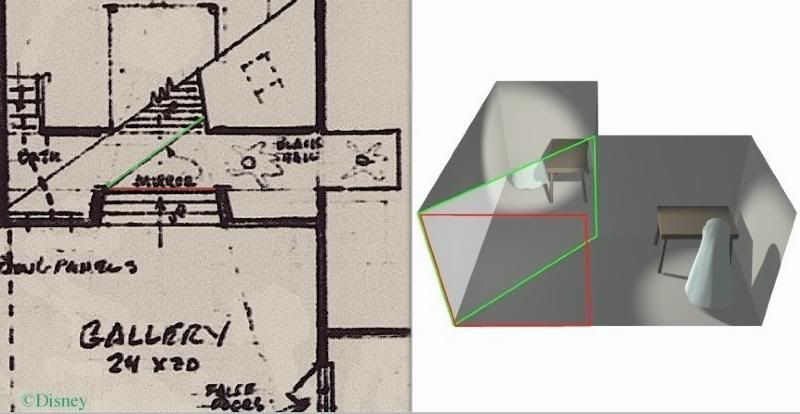
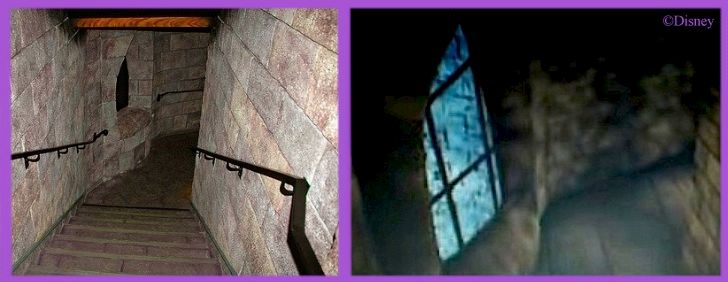
The original inspiration for the Endless Hallway could be found in the old Sleeping Beauty Diorama, the castle walk-thru that was beautifully re-done and re-opened just a few years ago.  It's a hidden gem, recreating much of the look and feel of the 1957 original. (Thank you Chris Merritt and team.)  One scene from the original that was not re-created and which perished in the 1977 Barbie doll make-over was the Bottomless Pit.  It was located where the waltzing spinning wheels are found today.  You could peer into what looked like a stone turrett, but it had no top or bottom.  You couldn't quite get your head in there, but you could scrunch up pretty close and see a long way in each direction.


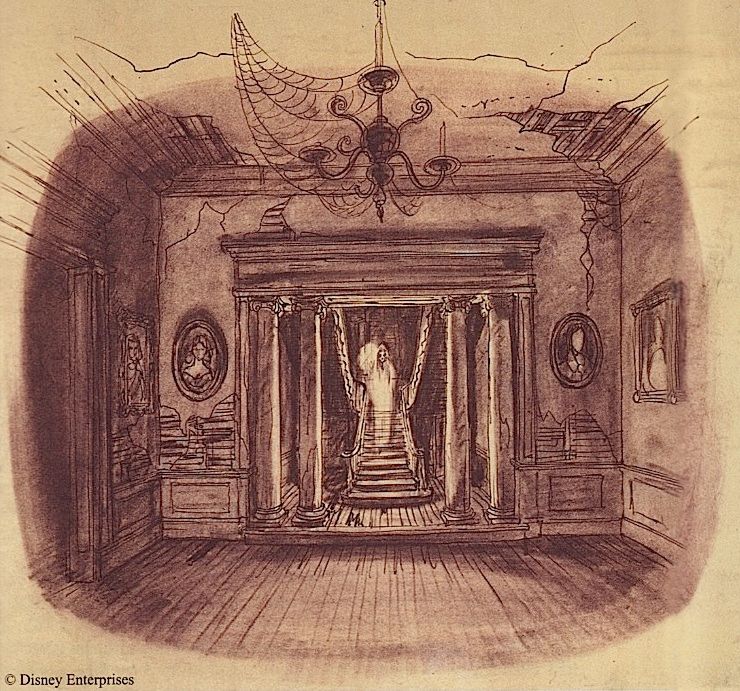
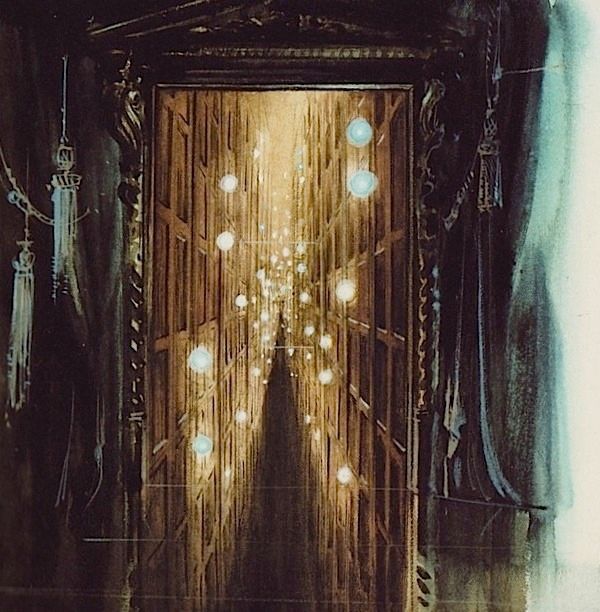
Way cool.  It was done with mirrors, of course, one on top and one on the bottom, reflecting each other into eternity.  Now if you think about it, this is exactly like the Endless Hallway, except that one is blue, vertical, round, and made of stone, while the other is brown, horizontal, square, and made of wood.  Don't bother me with such trifling details.  You might also object that the EH only uses one mirror, back there in the fog, while the bottomless pit uses two.  That's true, but at one point the Mansion team did toy with the idea of using several mirrors for the EH.  Here's a favorite piece of concept art, a watercolor by Dorothea Redmond:


Nice, eh?  But how would they have done that?  Well, the first vertical mirror, immediately in front of you, is a two-way mirror.  It's relatively dark where you're sitting, and it's brighter inside what is essentially a box made of four mirrors and two wooden sides, so you see through it like glass, but from the inside looking back at you, it acts just like a regular mirror.  How would you light up the inside, though?  There's no place to hide fixtures.  Simple, you just have these glowing orbs hanging down on very thin electric cables through holes in the ceiling mirror.  If the wires are thin, they can't carry much current, and the lights will have to be of very low wattage.  You'll compensate for that by having lots of them in there, as bright as the wiring will tolerate.  Really, they're just like Yale Gracey's fireflies from the Blue Bayou.  They can dance around like the fireflies too.

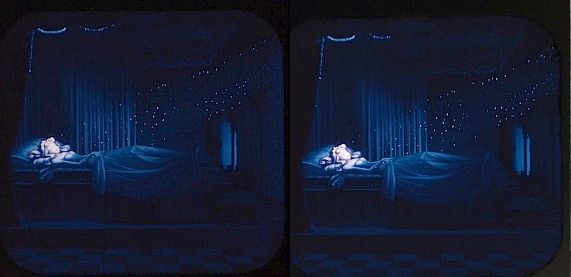
Anyway, you can see the Sleeping Beauty bottomless pit influence here.  But of course, they didn't do it like this and elected to go for a more natural look.  They settled for one mirror placed well back in the mist (i.e. multiple scrims).  Here's a 3D.  It may not be endless, but it's still a pretty long room.


The script for the "Story and Song from the Haunted Mansion" record album is based largely on an early  script for the ride, as we've mentioned before.  Consequently, with the record you can sometimes hear what they had in mind before they changed things, if they changed things.  For example, when the hero and heroine, Mike and Karen, climb the stairs (sans doombuggy, the lucky ducks), they notice a change in temperature:

Appalling Cold


This effect was really going to be used in the ride, and possibly it was for a short while at the beginning.  Two vents hidden on either side of the hallway entrance, probably in the steps, were going to blast you with cold air.  An exhaust vent on the wall behind you was going to suck it out of there as fast as it came in.  (That's the vent highlighted in the earlier photo.)  WED engineer Paul Saunders, who worked on the HM in 1967 and 1968, thinks the cold air effect was actually used.  I don't have any memory of it.     If it was used, it wasn't for long.  Perhaps it was difficult to confine and control the stream of cold air.  So the scene has lost one special effect.

[Edit] Or almost lost.  Several readers affirm that you can feel a slight blast of cold air about this point, especially at WDW.  The effect is still there, but it seems like it's toned down quite a bit.  The building is air conditioned, after all, and according to someone who used to work there, air conditioning vents are very deliberately arranged in that area to create a cold spot.  It's soft enough for a guest to think without thinking, "Oh, that's the air conditioning" and fail to appreciate the "special effect."  The blast of cold air coming out of the EH and hitting you full in the face – that's gone, perhaps never was. [Edit]

The traveling sound was more interesting.  Once again, take it away Thurl:

Through the Dimly-Lit Mist


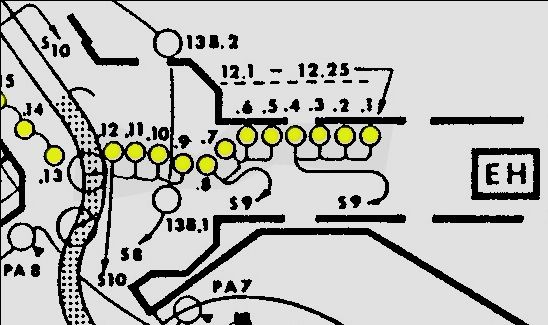
To accomplish this effect, they installed a string of speakers in the hallway on the left side wall, continuing up to the track, and continuing again on the other side.  The sound would simply pan along this string of speakers.


They actually installed the speakers in the hallway, and they're still there today.


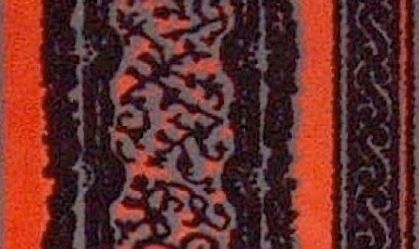
The red wallpaper has never been replaced, so it's no surprise that it's faded in some places.  That's why the speaker cover camouflage paint is now too bright in some places.  Otherwise, look how carefully those covers were painted!  Speaking of the EH wallpaper, here's a tile so you can use it for your wallpaper, a fine freebie for faithful Forgottenistas.  It's made from a photograph of the real thing.


If the "Story and Song" narrative is to be trusted, there were footsteps, screams and rattling chains.  A sound file for the footsteps has been preserved.  Here's a clip:

Footsteps  (many thanks to Brandon, "GRD")


[Edit] As reader "Grinning Ghost" has pointed out to me, that's probably the full blend of footsteps and other sounds that you hear in the background on the Story and Song album during the "Corridor of Doors" sequence. [Edit]


These heavy footfalls are directly inspired by the 1964 film, The Haunting.  There are two places in the film where the same kind of heavy, slow, marching, muffled footsteps are heard, and one of them is in the same scene in which the "bulging door" effect is used (although the footsteps don't actually start until after the door stops bulging).  That effect, of course, is another idea directly borrowed for the Haunted Mansion.

Footfalls from The Haunting


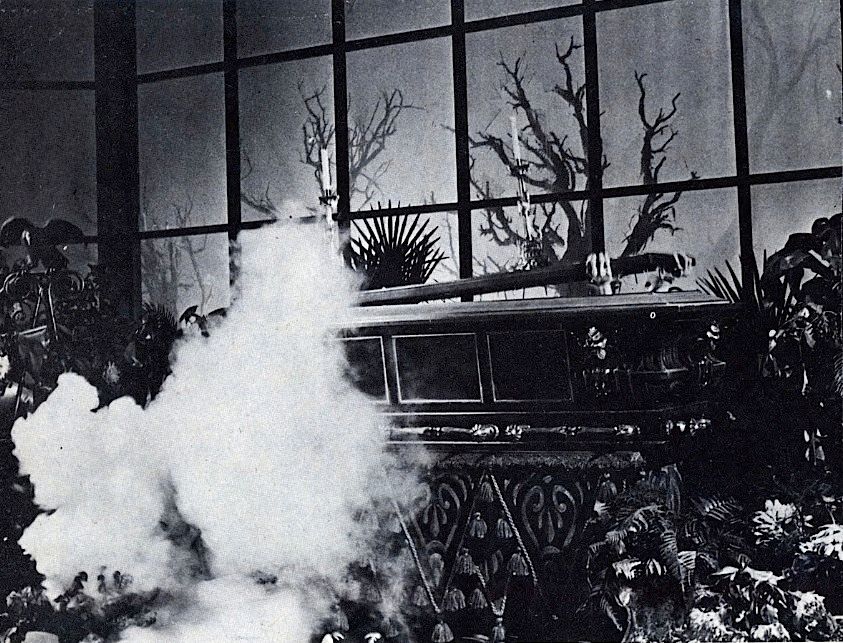
The record also mentions some kind of "ghost-like figure."  The only hint I have seen of a lost visual effect at this point is this peculiar but widely used publicity photo.


What's with the smoke?  No one seems to know.  I've been told that it's probably just something they threw
in for the photo shoot, but I don't buy it.  Seems like a lot of bother for something you don't need at all.

It's really no mystery why these effects were never used:  The sequence takes too damn long.  So there go some more gags, right down the drain.  Oh fine, that's just great.  We're well into 1969 now, and that Endless Hallway tableau is going to seem pretty bare unless someone can come up with an idea, and whatever it is, they'd better come up with it soon.

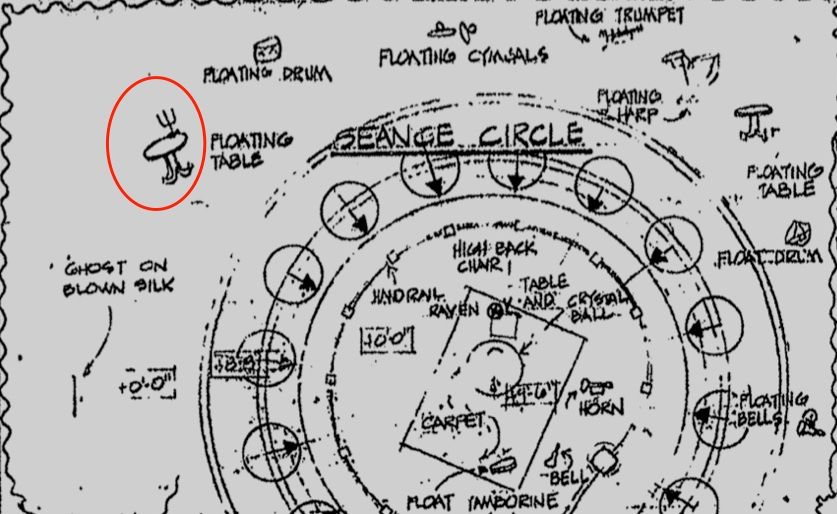
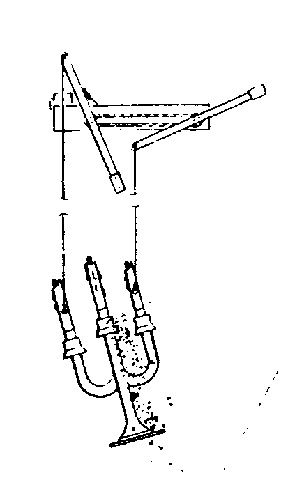
What did they finally do?  They moseyed down the hall to the Séance circle and stole an effect that was intended for that room and put it in the Endless Hallway instead.  That would be the floating candelabra.  It was simple, but it looked great in its new location.  Problem solved.


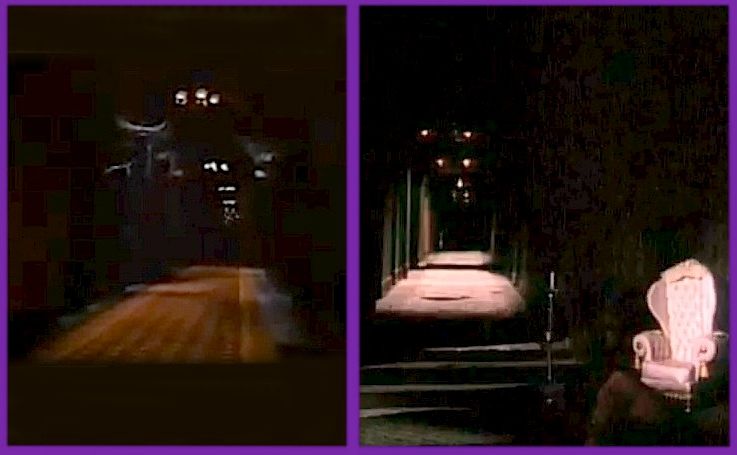
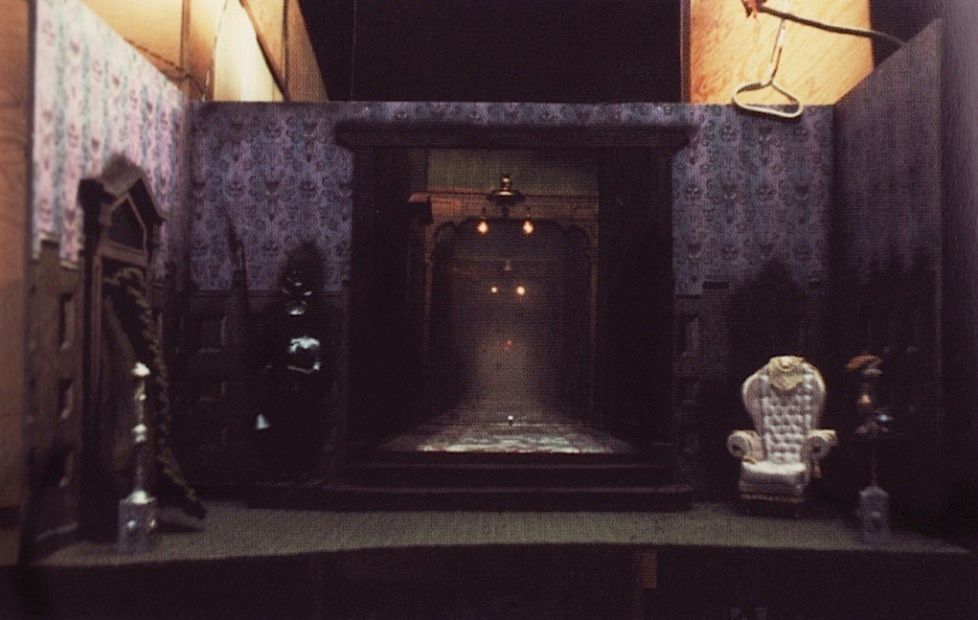
They must have done this before they filmed the inside of the ride (July probably, maybe June), because you can see the candelabra in that film.  (You will remember that the WED film was edited and has been re-used ever since as stock footage of the HM interior, so you see parts of it even today in Disney commercials, TV shows, etc.)  There is our candelabra below on the left, but notice that in the scale model of the ride (below right), it isn't there.


Those scale model photos are mighty fine things.  Besides being just plain fun to look at, you can see what made the cut and what didn't in the final attraction.  Here's another shot of the EH model:


The blowing drapes, the suit of armor, and the overstuffed chair are all there.  Even the large floor candelabrum is there in the scale model (see the blowing drapes photo above).  That handsome, paneled wainscoting was going to be used throughout, but I suppose time and money considerations eliminated it.

One remaining curiosity is the wallpaper.  The models show that they intended to use the demon-eye wallpaper starting here and continuing all the way down the corridor to the Séance room.  That is indeed how it is at Phantom Manor and at WDW since the big refurbishing of 2007, where it provides the basis of an impressive new gag, as the eyes appear before the walls do.  But before 2007 all three Mansions (DL, WDW, Tokyo) had this yellow, off-the-shelf wallpaper in the EH tableau:

(1999 pic by Allen Huffmann)

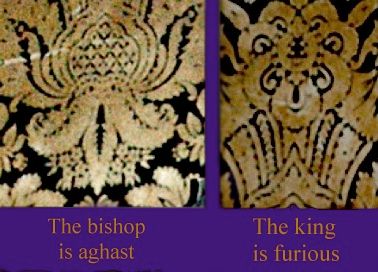
Disneyland and Tokyo still have it.  I don't know why they used this instead of the demon-eye paper, but whatever the explanation, I like the yellow stuff.  I know I'm going well beyond the conscious intentions of the Imagineers here, but the fact is, that pattern serves as a good transitional step.  It's not fake; it's real-world wallpaper.  It's got a perfectly normal, old-fashioned design.  In other words, it's not supposed to have faces in it, but like many intricate patterns, you can't help but find faces in it if you have any sense of whimsy, or if there's anything left of your kidhood imagination.


I guess it's possible that whoever picked it out noticed that the pattern lent itself to this sort of thing very easily, and that it would therefore be a good pick for the Mansion, but even that much is probably pushing it.  At the very least, it's a happy accident.


A Post-Script: Pink Floyd and the Endless Hallway.

I'm a fan of early Pink Floyd, so this little example of synchronicity is a hoot.  Skip it if you want.


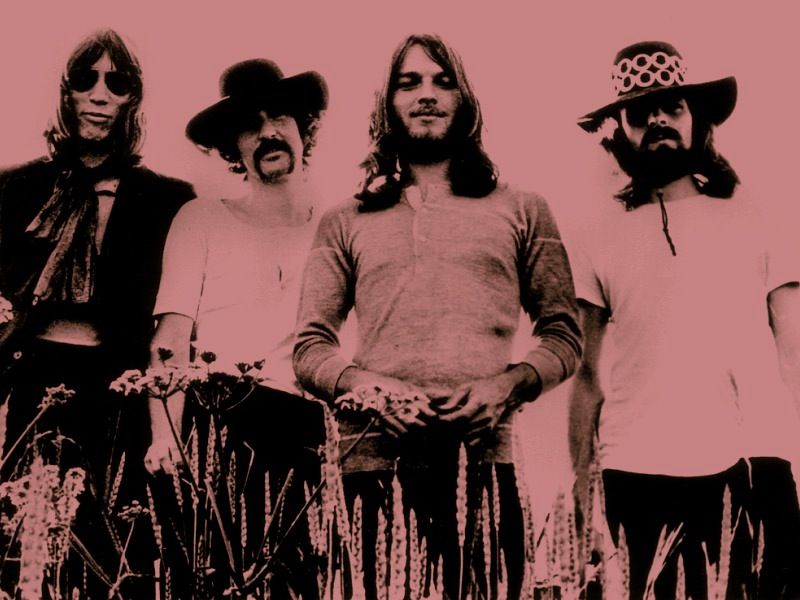
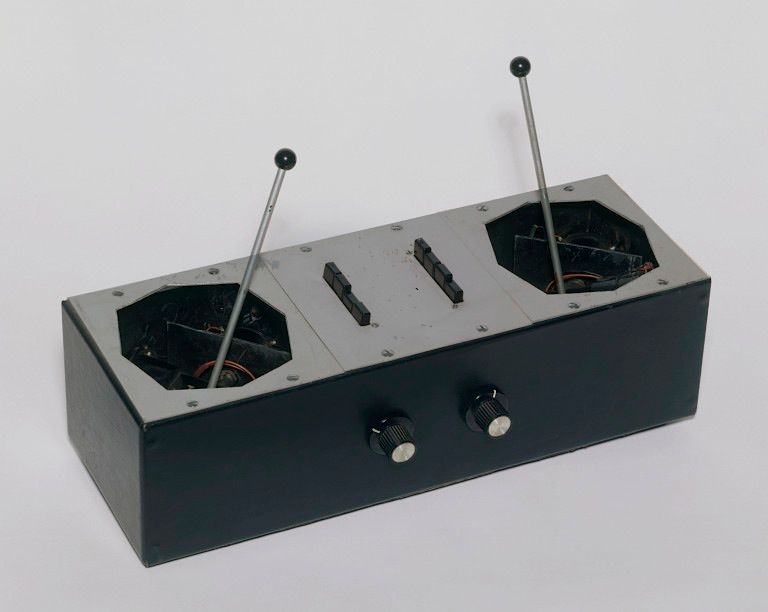
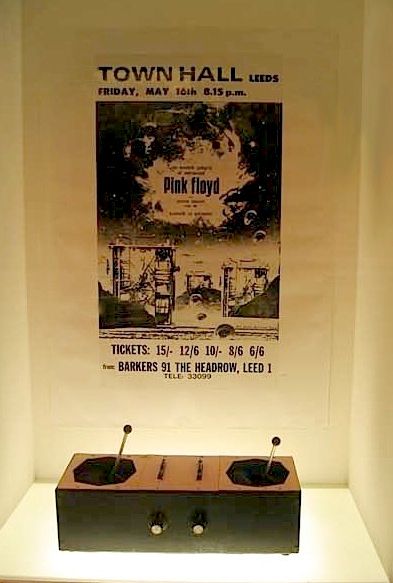
Floyd was always a bold, experimental band, and in 1969 they were the first to use a quadraphonic sound system, with speakers placed in all four corners of the room.  They had a home-made device, whimsically called the "Azimuth Co-ordinator," which enabled them to pan the sound around the auditorium with a simple joy-stick.


The first time they used it was at a concert on May 16th, 1969


What they did at one point in the show was play a tape of some heavy footsteps invisibly walking around in the audience, pausing now and then to jingle some keys (rattling chains!) and slam a door, all of it with lots of reverberation.  It worked great, and it was an audience pleaser, so they used this gimmick in their concerts for the better part of a year.

In other words, a bunch of guys at Disney and a British rock band were creating exactly the same sound effect at exactly the same time, with no apparent knowledge of each other.  Here's a clip of the Floyd effect from a concert on September 17th, 1969.  Compare it with the HM version.

Pink Floyd


Haunted Mansion


Of course, at Disney they added further sound effects to the footfalls, but then, they never used any of it anyway.

The phantom footfalls at the Floyd concerts were put into the middle of "Cymbaline," a song from their third album, which was released in the US on . . . wait for it . . . August 9, 1969.

LOL, as the kids say.