I've just about run out of decapitation jokes and puns, so let's move a head to our next destination, which is only a few feet away. This is yet another in our series of probes for the ultimate inspirations and cultural roots of the Mansion residents. This one seems like a slam dunk, or is it your imagination, hmm?
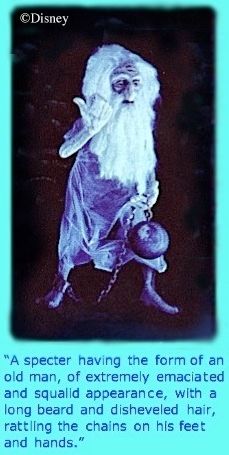
Seems like a pretty good match, doesn't it? Of course the "chain" detail is slightly different, but otherwise that sounds a lot like "Gus," as the little prisoner is known. ("Gus," "Ezra," and "Phineas" were names given to the hitchhikers by a veteran Cast Member at WDW, and they've stuck, climbing to the level of official Disney sanction.) Anyway, the description comes from an almost 2000-year-old ghost story,
well-known and often cited in surveys of beliefs about ghosts and spirits throughout history. The story is in a letter by Pliny the Younger (ca. 62—113 AD). You can read it HERE. It's in a stuffy, Edwardian English translation (the only one in the public domain), so take your time, or else you can make do with this synopsis.
well-known and often cited in surveys of beliefs about ghosts and spirits throughout history. The story is in a letter by Pliny the Younger (ca. 62—113 AD). You can read it HERE. It's in a stuffy, Edwardian English translation (the only one in the public domain), so take your time, or else you can make do with this synopsis.
Pliny wants to know his friend's opinion about whether ghosts exist or not. He relates several examples he has heard of supernatural visitations purported to be genuine. The longest and most interesting is about a haunted house in Athens. A chain-rattling ghost, as described above, terrified the owners so much that they abandoned the place, and no one would live there. It was put up for rent, and a Stoic philosopher, curious as to why such a nice house was renting so cheap, learned the story and decided to take the place. He stayed up late, alone, writing, and sure enough the ghost appeared, rattling its chains. The philosopher pretended to ignore it, but the ghost only rattled louder and closer, beckoning the man to follow him. The philosopher obliged, and after reaching a certain spot, the ghost vanished. The philosopher marked it, and the next day he had the police dig it up. They found the skeleton of a man chained like the ghost, had him properly buried, and the hauntings ceased.
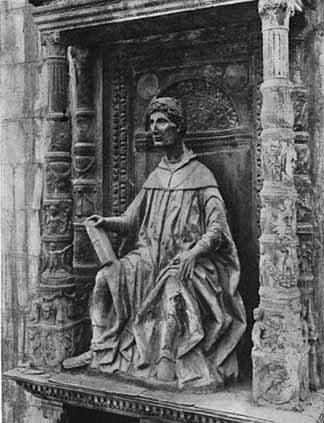
Pliny the Younger. No, it doesn't sing.
For our purposes, the main point here is that Pliny's famous letter would likely have been part of the research into ghost lore that the Imagineers did when they were working on the Haunted Mansion. Considering how well Pliny's ghost matches dear old Gus, we might be tempted to conclude that we have found Gus's archetype. But it's not that easy.
It's true that the Gus we see in the ride today looks a lot like Pliny's ghost, and he always has. Gus has changed very little over the years (unlike some others who have had noticeable hair and costume alterations), and he looks the same in both of his HM appearances, as part of the headsman trio and as one of the hitchhikers. Here he is in 1969 (left) and today (right).

Heh. Notice that somewhere along the line they quietly fixed the original costume discrepancy?
In 1969 he was long-sleeved in the headsman trio and short-sleeved as a hitchhiker. Quelle horreur!
The problem is that the further back you go from this finished Gus figure to his origins on the drawing board, the less he looks like Pliny's ghost. That's the opposite of the case we have seen with others, where the original inspiration is unrecognizable by the time it reaches the ride (The Raynham Lady —> the Attic Bride; the Tedworth Drummer —> the Graveyard Band).
Gus started out as a pudgy blob, chained at the neck.
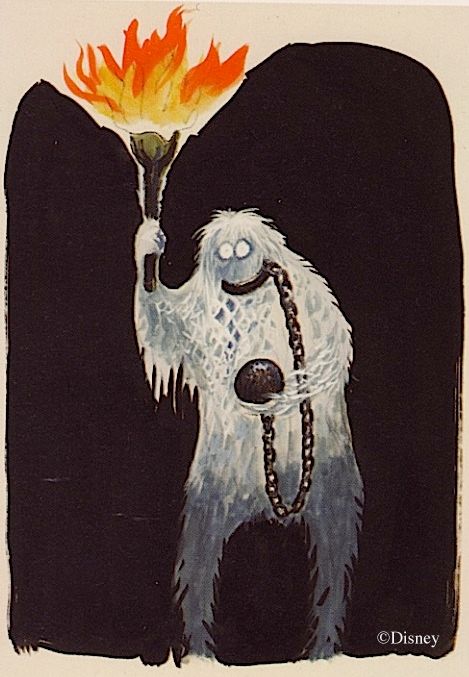

That evolved into the character we know so well from Marc Davis's sketches:
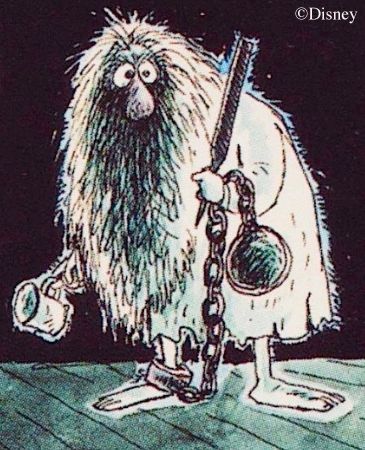
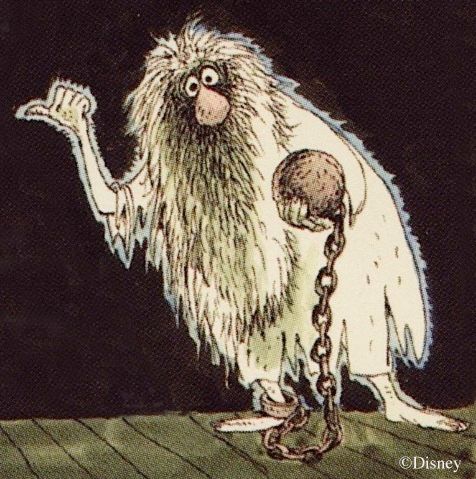
By the way, here we have an example of how good Marc's instincts were. It's obvious today that the hitchhiking ghosts are THE iconic characters of the HM, but how obvious was it in the beginning? There were a lot of candidates, but Davis somehow knew that Gus was the best choice for Mansion mascot, and he gave him that role right off the vampire bat, as we have seen in the early ads he drew.

. I like this ad. It's snotty. And look at the acts they had back in the day...
Anyway, he looks like an avocado wearing a Barney Rubble costume. He's still this odd-shaped, pudgy-looking character. When Collin Campbell painted his interpretation of Gus, based on Marc's sketch, "emaciated" clearly wasn't in the job description as far as he could see.
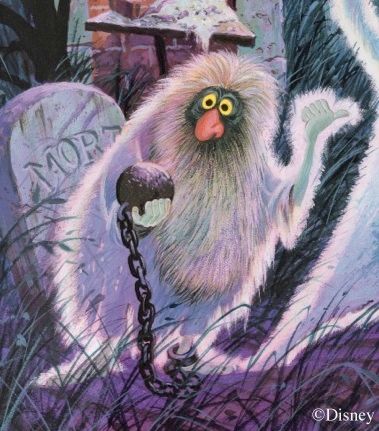
With the maquette figure, we can see that Gus has acquired a real skeleton and is now on his way to scrawny, although he isn't quite there yet.

It is only with the final show figure that Gus is unambiguously a skinny old bloke. So if Pliny's ghost is laid under contribution, it would be interesting to learn how it influenced the final design. Maybe we should look over the shoulder of Blaine Gibson or someone like that to see what they were reading.
More Gus Talk
Just for fun. How many of you have never noticed that the Gus of the headsman trio is holding a file, just as he is in one of Marc Davis's sketches? Thanks to the railing in front of him, the file is hard to see, even in many photos.

. (Tip 'o the hat to Brandon for the photo)
I don't know if it's a coincidence, but all three members of the headsman trio are holding cutting tools appropriate to their professions. "I'm a knight, and with this sword I vanquish evildoers." "I'm an executioner, and with this axe I mete out justice to criminals and enemies of the state." "I'm a prisoner, and with this file—I escape! HA!"
Gus is also the most fleet-footed ghost in the graveyard, zipping from the headsman trio to the hitchhiking trio with lightning speed—too fast to see—and from there into your buggy (33.3% chance) with the same velocity. Speed, he is speed. So...the fastest ghost around is the one wearing a ball-and-frickin-chain. How droll is that?
.