Things You're Just Supposed to Know

Most of the time, Long-Forgotten assumes that readers are already familiar with basic facts
about the Haunted Mansion. If you wanna keep up with the big boys, I suggest you check out
first of all the website, Doombuggies.com. After that, the best place to go is Jason Surrell's book,
The Haunted Mansion: Imagineering a Disney Classic (NY: Disney Editions; 2015). That's the
re-named third edition of The Haunted Mansion: From the Magic Kingdom to the Movies (NY:
Disney Editions, 2003; 2nd ed. 2009). Also essential reading is Jeff Baham's The Unauthorized
Story of Walt Disney's Haunted Mansion (USA: Theme Park Press, 2014; 2nd ed. 2016).

This site is not affiliated in any way with any Walt Disney company. It is an independent
fan site dedicated to critical examination and historical review of the Haunted Mansions.
All images that are © Disney are posted under commonly understood guidelines of Fair Use.

________
.
Showing posts with label pop-up ghosts. Show all posts

Wednesday, July 28, 2021

The "Enhauntsments" of 2021

Aug 12, 2021: Check out additional observations by Foxxy and others at the end of the post.

Mar 29, 2022: New note about the Conservatory.

Since the rather colorless term "enhancements" seems to be the only collective noun Disney is using for the changes and additions to the Anaheim Mansion this year, I have made bold to tweak it a bit and will henceforth use "Enhauntsments" as the official Long-Forgotten designation, inspired in part by the "Rehaunting" of the WDW HM in 2007. Now that I have visited the park in person, I'm in a position to give an eyewitness report.

When there is a major set of revisions or additions to a Haunted Mansion, I have found from previous experience that it's good to have a catalogue like this laying around somewhere, since it won't be many years before the memories will grow murky, and it will all start mooshing together in our overtaxed brains, and we won't remember exactly when this or that particular thing happened. 

I strongly suspect that most or all of these enhauntsments were intended as part of the Mansion's 50th anniversary in August of 2019. None of them were there, of course, but it seems like Disney gives themselves a generous, two year window for such things, so that anything that happens a year before or after the actual day being celebrated counts as being "on time." (Try using that same logic with your significant other's birthday and see how well it works.) Anyway, with COVID adding almost a whole additional year to the debut of the enhauntsments, it became absurd to try to connect any of them with the Golden Anny, so they didn't try. That's my theory, anyway.

Be that as it may, for posterity's sake, here's a catalogue of the changes made, at least as far as I've been able to glean from the many sources out there along with my own first-hand observations. If I've missed anything, leave a comment.


(1) Our Girl April!

©DISNEY

First and foremost, of course, is the return of April-December. As pointed out in our April post, she's been restored beautifully, and the place they have created for her is perfect. She's done in a six-stage, morphing form, which is a new presentation for her but utterly authentic and true to the original Imagineers' intentions, as we now know. Zero complaints! A+. I don't like to brag (well, yes I do, some), but I had been saying for a long time that the obvious thing to do for the 50th Anny was to bring back April, and obviously someone else thought the same, because they did.


(2) April's Hallway


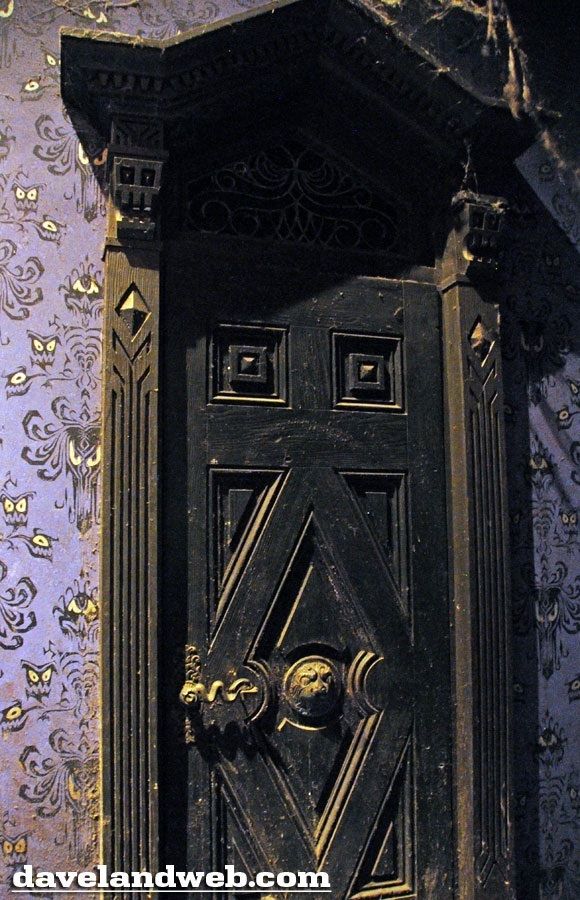
I'll lump into one bullet point all the enhauntsments that accompany April in her immediate environment, including (1) the wallpaper, the wainscoting, and the new candle lighting along one wall of what was previously the right side of the limbo-load area as you enter, plus the visually pleasing metal screen to the left of the guests; (2) a new door beside April in the classic style seen elsewhere in the house, with a moving blue light in its transom, indicating a ghostly presence; and (3) a one-eyed cat statuette.

As noted before, the urns that used to be in this area have not been tossed out but are now congregated over by the staircase where the doom buggies come down.

The cat is recognized as a shout-out to an old, unused concept of X Atencio. You will recall that a one-eyed black cat gradually asserts its demonic presence throughout the ride and serves as your host (or co-host). The connection seems valid, since the new cat has a single red, gleaming eye, as did X's cat, but I hasten to note (and not without appreciation) that this particular enhauntsment offers only a subtle or partial hint to the old concept, not the sort of blatant, elbow-in-your-ribs "tribute!" that characterizes PLQ. The cat is white, after all, not black.

As others have noted, the statuette is actually an off-the-shelf, commercially available item.

It's really only there as an intriguing object to look at briefly as you pass, which is fine with me.


(3) Enhauntsments to the Portrait Hall

A few related changes have been made in the Portrait Hall. The official video makes a point of this, calling attention to the new, lighter color of the heavy drapes around the windows, and I gave them a good hard look when I was there, as no photography can do justice to such things. They looked fine to me. Here's the old on the left, the new on the right.


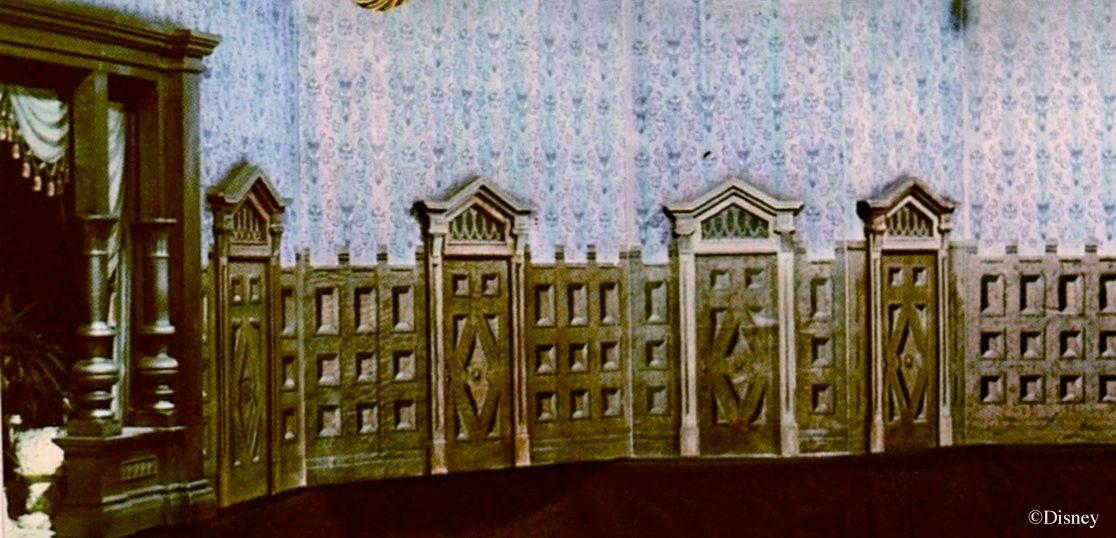
Also, the wallpaper was redone so as to match the wallpaper behind April around the corner, which is sensible...


...but I deeply regret the loss of the original paper, which offered so many opportunities for finding hidden faces. You can find a face or two in the new paper, but let's face it: the new stuff isn't nearly as rich an environment for that sort of thing.


Pity. Also, when I was there, the rain effect in the stormy windows was gone, and I dearly hope that isn't a permanent change.


(4) The Rolly Chair

At least that's what everyone seems to think it is. There's a new chair hanging around in the Séance Circle that is widely regarded as a tribute to the talking chair in Rolly Crump's unused "Museum of the Weird" artwork, but as far as I can see, their designs actually have very little in common.


The chair isn't animated in any way, and much of it is in deep shadow, so it's not even 100% certain that it has "eyes" (although that does seem likely). Very mysterious, this one.  Which bothers me not at all . Hmm. More may be coming with the new chair, but for now, it's a curious addition to the ride.

UPDATE June 14, 2023. The chair has been missing ever since Classic Mansion returned after the last HMH overlay. In other words, it didn't return. Why so is a mystery. But Brandon Hardy has made a significant discovery about it: it's an off-the-shelf item from Wayfair called a Deangelis Rattan wicker chair, and you can get one for yourself if you've got an extra $550 kicking around.


My Latin is a little shaky, but I think it's "The Rottenness of the Angels."
Okay, a LOT shaky.


In case you had any doubts...

Brandon Hardy


(5) Spruced, Juiced, and Loosed

The ballroom dancers and the ghosts in the graveyard (and perhaps others) have been spruced up and are now much more visible. When I visited in 2019 for the 50th Anny, I was unhappy to see that the vague gray blobs to which time and ultraviolet lighting had reduced the ghosts in the graveyard had not been refurbed for the Mansion's golden anniversary that year, but I now suppose that there were plans to do so soon enough thereafter to count as being part of that year's celebration, as described earlier.

pic by Matthew Bumgardner

pic by Matthew Bumgardner


(6) Another Cat Statuette, and a Refreshed Garden

Yep, they've added not one but two kitty statues. The Disney video calls attention to the new cat in the birdbath out front.


pic by Laurie Holt Dickey

(It's behind/beside the hearse, for those of you who have never noticed it.) That birdbath has been there, unmoved, since 1969, but it became a planter after only a few years and remained in such employ until this year. It's gratifying to the purists among us to see it restored to its original function. And with a macabre bit of statuary added for good measure, we are a happy crew.

The video also highlights the garden landscaping throughout the Pet Cemetery, but in all fairness, the horticulture department at Disneyland has ALWAYS done a great job everywhere, including here, with appropriate plants around the various fixtures, so that what you find there now is not really as big a deal as they make it out to be, but only a sprucing up of something that had not and never has been allowed to fall into ruin in the first place. But all of that just makes me happier that the horti guys are getting the kind of proper shout out they deserve, and yes, some of the garden work is indeed new.

Incidentally, they had to take out the large Magnolia tree that had been in the Pet Cemetery area since before the HM was even built, and it's a relief to see that another large tree was brought in to replace it. I'm sure there was a good reason to remove the old gal (diseased? causing structural damage?).


(7) The Telescope

Hip hip hooray, the telescope on the upper balcony is back after a 20 year absence.

Intelligently, it's on a tripod rather than attached to the railing like the earlier model, so it can easily be removed for the HMH and put back afterwards. (That's what doomed the old one.) Really happy to see this one.


(8) Phineas Gets a Wardrobe Upgrade

Sharp-eyed Forgottenistas like yensidtlaw at the Micechat "Thread" have noticed that Phineas has been given a new cloak, one which more closely matches the concept art for the figure. Subtle stuff indeed, and well done. That's the old Phineas on the left, the new on the right.


Other Items

Some changes may not be changes at all but merely temporary flukes. The deaf guy with the mummy had lost his long beard, but last week it looked to me like it had miraculously grown back. I've mentioned the rain effect in the Portrait Hall windows. I also noticed that the door knockers in the Corridor of Doors were much quieter than they used to be. I hope this isn't a deliberate muffling. I like the clack-clack-clack. It gets your attention and has you looking for the cause, which is a good thing. I also liked that they were a "practical" effect and continued clacking noisily away even during "pranky spirit" interruptions. It makes sense, doesn't it? Some ghosts care not one bit what their prankier brethren are doing and are going to keep up their racket regardless. Screw you all; clack we shall. More power to them.

Reader Imagineer999 points out in the Comments that the Caretaker has his original scraggly beard once again. So far as I know, this is the first time he's had it since the earliest days of the Mansion.

Foxxy has some additional observations after visiting in August: (1) The changing portraits seem to have individual spotlights on them now, making them easier to "read." Mark Hille, in the Comments below, had already noted this; (2) the "monotone chorus" in the graveyard (by the hearse tea party) is more conspicuous, either louder now, or restored after being absent; (3) darker, more mysterious lighting on the exterior porches at night; (4) the so-called Donald Duck chair by the Endless Hallway is new and plusher looking. Vickie Bramm (at the Haunted Mansion fan club on Facebook) explained this to me a couple of weeks ago: The old chair was apparently too decrepit to clean up, so they just made a new one. It looks like it was made to resemble the old one as closely as possible.

When I was there, the blowing drapes were not blowing—in either doorway. The rotting fruit on the ballroom table is not yet rejuvenating. Little Leota's projection was out of alignment, like it was last time I was there. I wonder when the last time it was correct? Other stuff that is obviously just temporarily busted I won't bother mentioning, but I must say something about the pop-up spooks in the graveyard, which I saw July 20-22. They were a disgrace. One didn't pop at all, some did manage to pop but were unlighted, and some popped so anemically that the word pop almost seems like a dishonest use of language, unless, perhaps, in some such sense as "great-grand-pop." Ol' Blasty was working, but he barely cleared his sarcophagus lid. None of the seven were in tip-top shape, I'm afraid. Bad show, that.


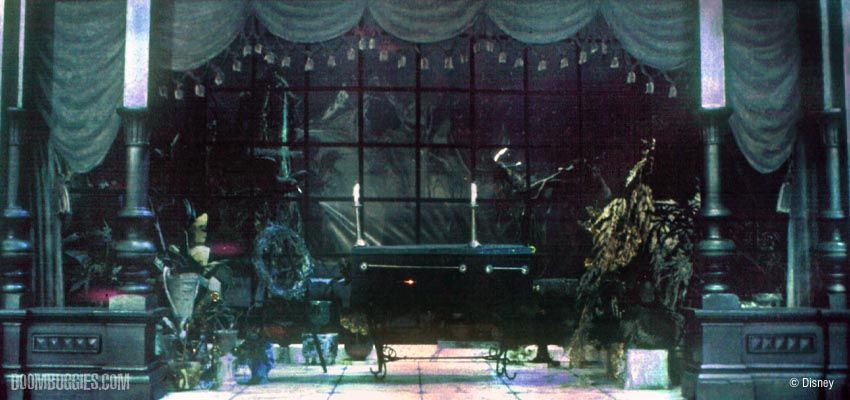
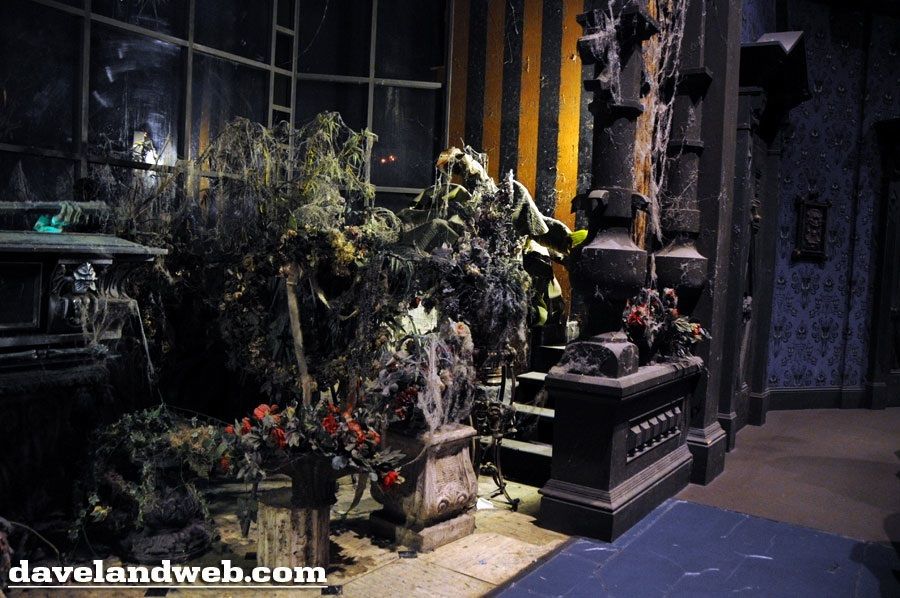
NEW: The Conservatory

Overlooked at the time, it wasn't until early in 2022 that we noticed some changes to the Conservatory. Victorian-era details were added in the form of cards and banners with writing on them attached to some of the floral arrangements, only one of which has been deciphered at this point (Mar 29, 2022). When they were put back in, following the HMH of 2021-22, several were relocated. The largest placard then became much more noticeable. This clip is from 2021:


***************************


Monday, October 1, 2012

The Haunted Mansion in Miniature

.

Extensive new additions October 2019

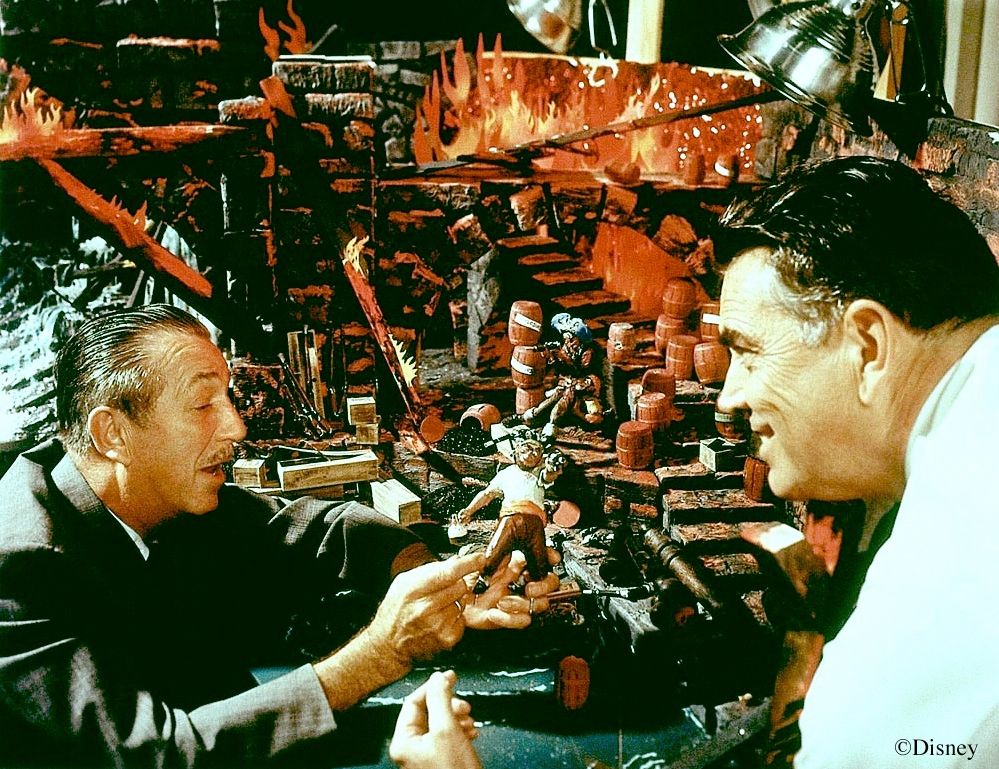
In an earlier post I mentioned how the Disney Imagineers create scale models of the attractions they are building, a doll house version.  The models are set up high on tables with a narrow gap snaking between the two sides, representing the ride path.  The Imagineers can then literally walk through the model and see it from the guests' perspective.  Some photos of the scale model of Pirates of the Caribbean have been widely reproduced.  Like this one.  There's the big man himself, pretending to say something important about a pirate's knee to Claude Coats, who pretends to listen enthusiastically.  Meanwhile, the pirate is pretending to shoot Claude, and we're pretending to believe this is a candid photo.  It's all a part of that special Disney bullsh . . . er, magic.  Disney magic.


Shots of the Mansion model also show up here and there, and it occurred to me that it might be fun to assemble as many such photos as I could find and see how completely they reproduce the ride.  As it turns out, a fairly full presentation of the attraction can be put together in this way.  That's nice, but let's face it, is something like that really worth a Long-Forgotten post?  Hm?  Probably not.  Let's forget it.

. .  .  .  .  .  .  .  .  .  .  .   .   .     .       .         .           .               .                     .                           .                                    .

Oh all right, we'll do it, but I don't want to hear any whining.  Since I've assembled these from a variety of sources, they vary in quality.  Some are nothing more than screen grabs from mediocre-quality videos (I'm not proud).  Also, some of the photos are well-known, and some have appeared here before, and some have even been the subject of specific commentary.  Ah, but there are some that are seldom seen and that provide occasions for quaint and curious new observations.  In fact, there's practically a full post on the Conservatory waiting below.

In October of 2019 Doombuggies posted a bonanza of scale-model photos. It seems that Imagineer Harriet Burns did a lot of work on the model and had a pretty good set of photos. Some are actually inferior to ones I've already posted here, but many are improvements. I've supplemented this post with some of the newly-discovered shots. Several new shots were also found in the new Marc Davis book (MDIHOW).

Ready? Let's get small.


The Stretching Gallery

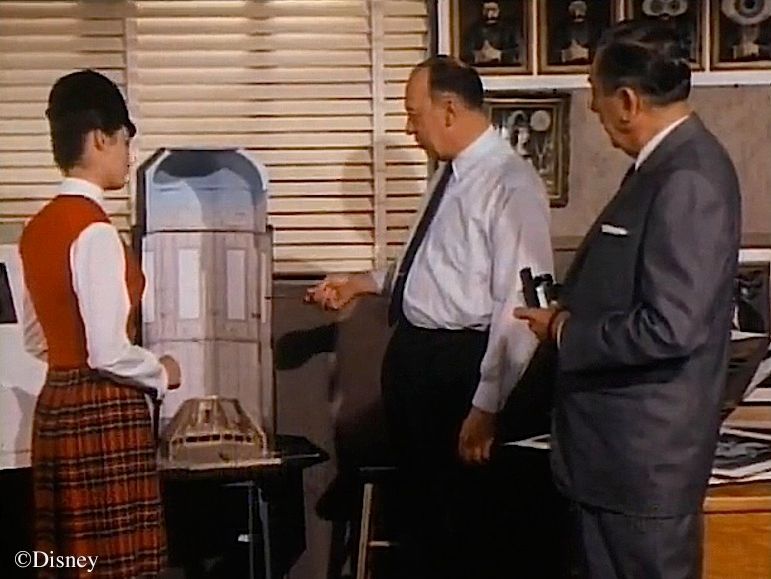
In the January 1965 "Tencennial" TV special, Marc Davis shows us a model of the stretching room.  It's too small and too empty, and at that date it's much too early to expect a scale model of the ride to be built, so we're already cheating by including this one.  Still, it's full of interest.

"The new urinals in the Main Street restrooms are a big improvement, Walt"

We know that Yale Gracey created a model of the stretching room, and possibly this
is what we're looking at, but I think Yale's was a more elaborate, working model.

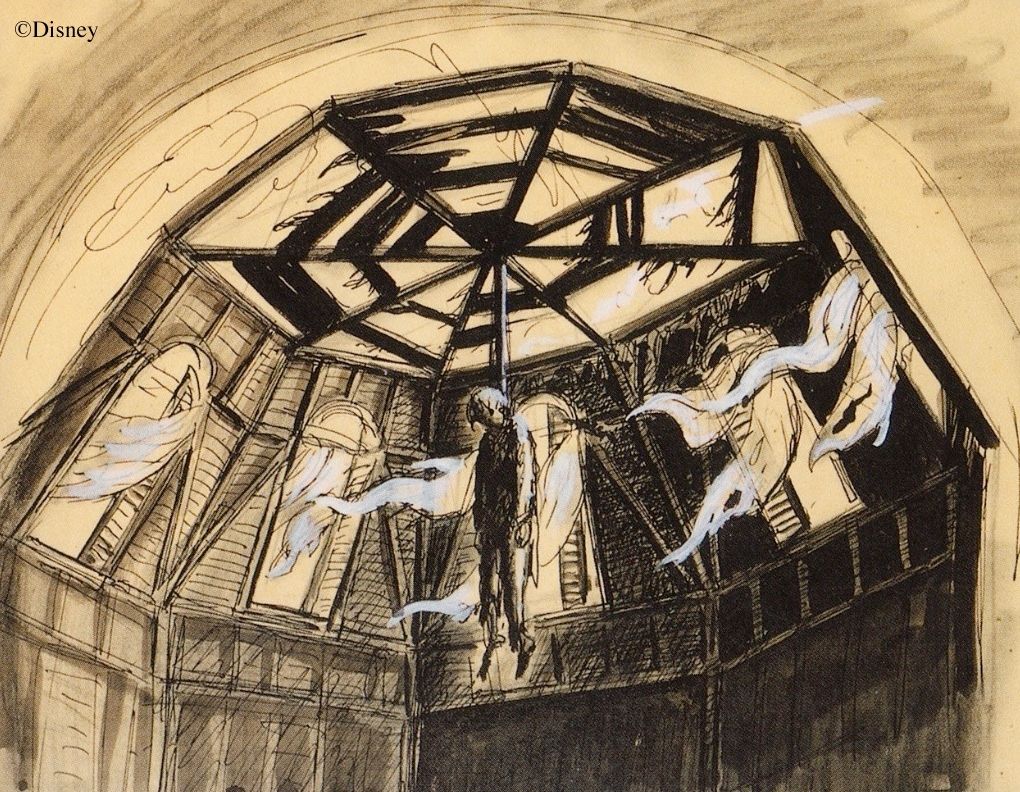
That wooden-looking structure is actually a model of the garrett area, a loose piece resting there on
the floor of the stretchroom for want of a better place to keep it.  Compare it to Marc's concept art:


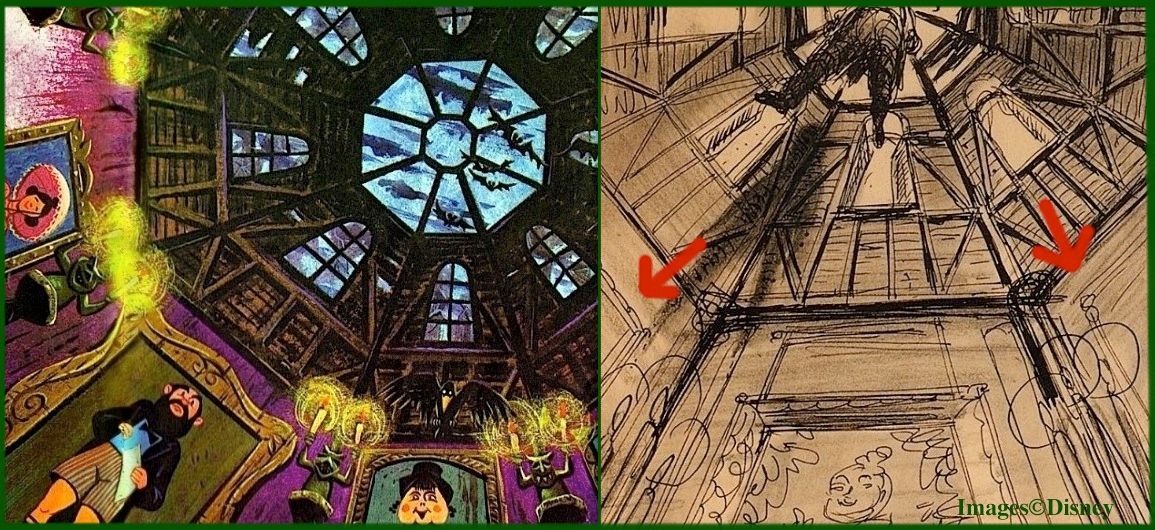
The most interesting thing about the model is that it looks like there are spaces for stretching portraits on all eight sides of the room, not just four.  Don't get too excited though, because in a few moments, Marc will show the concept art for the familiar four stretching portraits to Walt and to that robotic audio-animatronic figure that follows him around throughout the program.  (Actually, that's Julie Reihm, the first Disney Ambassador, and probably a very nice person, but in this show . . . well, let's just say I've gotten more heat from a popsicle.)  Anyway, it's clear from the presentation that there were only four stretching portraits planned at that point, no matter what the model implies.  Questions remain, however, since there is other artwork that may suggest an eight-painting gallery; in fact, it's some of the same artwork we looked at in the post before last (The Gargoyles):


Of course, the one on the left is only an illustration for a children's record, so you can't press it too hard for details.  The one on the right, however, is a Davis sketch, so it's more interesting.  Are those picture frames peeking in from the edges?  Hmmm.  It's intriguing, but at this point in our knowledge the idea that there may once have been plans for portraits on every wall in the gallery is only a tantalizing possibility.


The Changing Portrait Hall

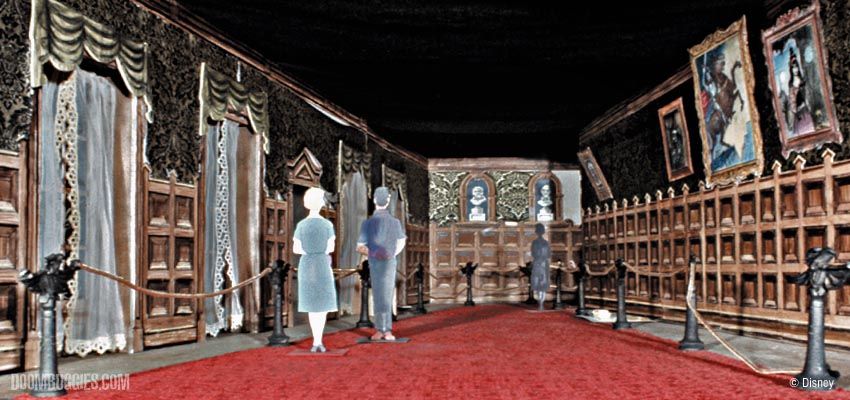
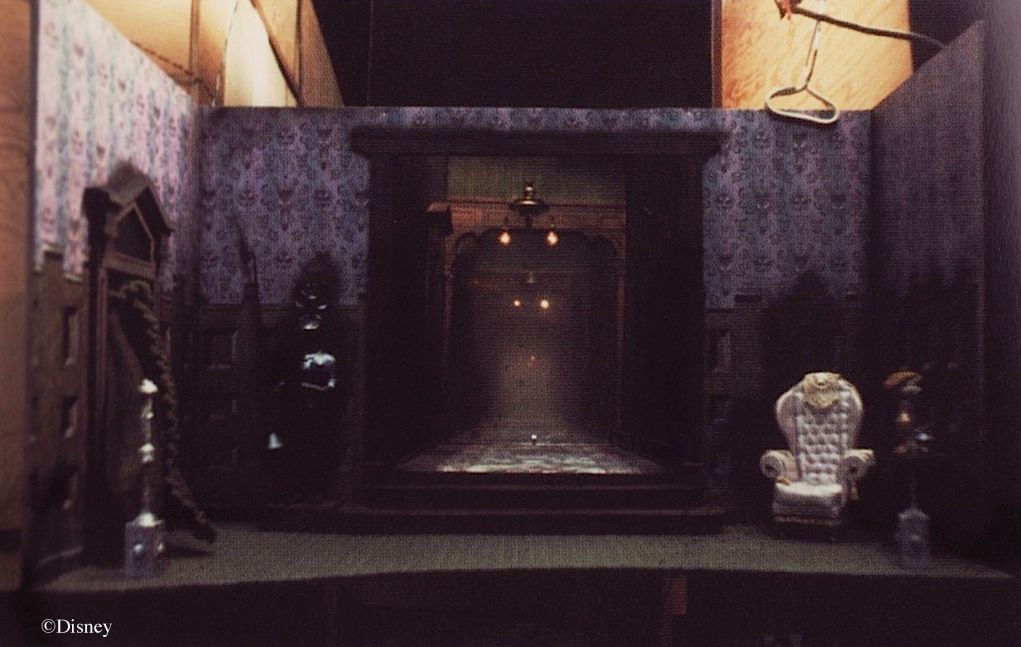
Now we're rolling.  Several photos of this part of the model are out there, and as you can see, the finished attraction followed it pretty closely.


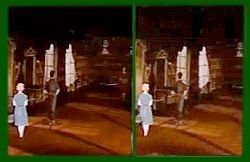
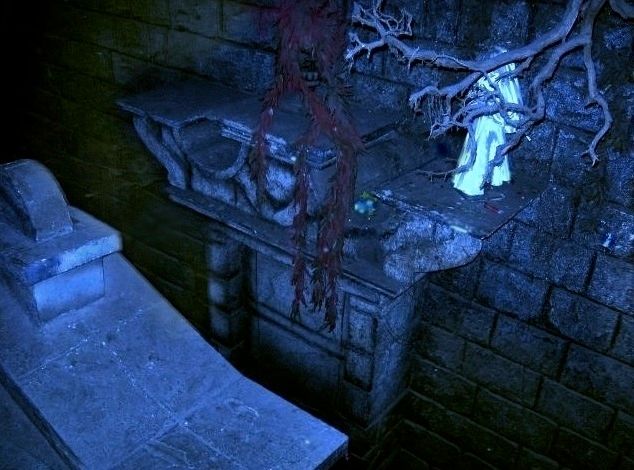
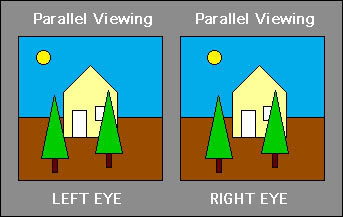
You say you'd like to see it in 3D?  Yeah, we got that.  Do the "magic eye" thing.


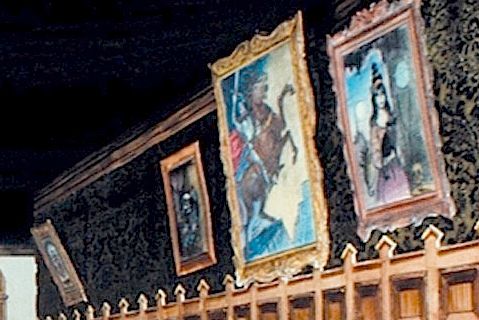
One thing the model shows is that the selection of paintings they were going to use was still fluid at
this point.  Of the visible paintings, only the Black Knight portrait will make it to the final attraction.


The Witch of Walpurgis is on the far right.  She'll make it into the WDW Mansion as part of the "Sinister 11" set,
following you with her eyes but not morphing.  The two on the left are concepts that were never used.  The one
furthest away is more clearly seen in the following photo.  It's the bouquet of roses wilting away.


See the heart on the vase?  Nice touch.  This would have fit right in if it
had been used.  It's a botanical "Master Gracey," a floral April-December.

The other portrait is of an old miser who sold his soul to the
Devil, who has decided the time has come to collect his due.


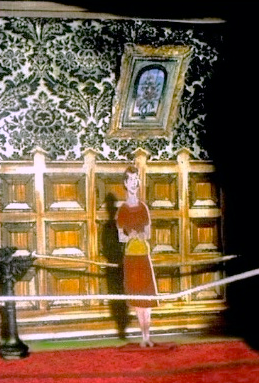
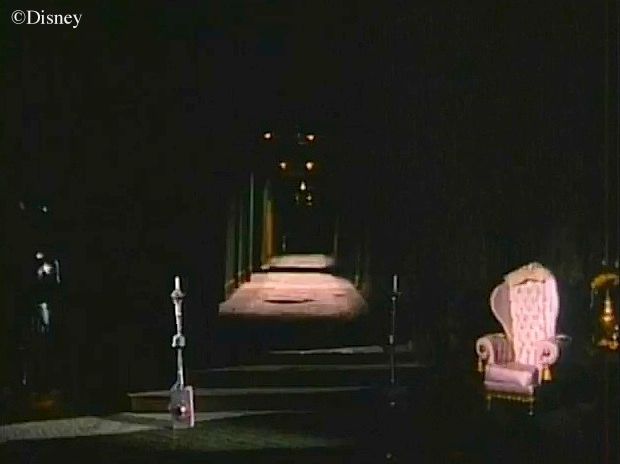
The blank spot on the wall in the model probably had April-December in it
originally, but she was borrowed for use as random junk in the attic model.
We'll see her later.  Her removal from her "rightful" spot in the hallway, however,
eerily foreshadows her actual fate, since she was taken out at the end of 2004.

 April-December originally changed by lightning flash)

April is much missed by fans.  She'll
probably be the subject of the next post.


Limbo

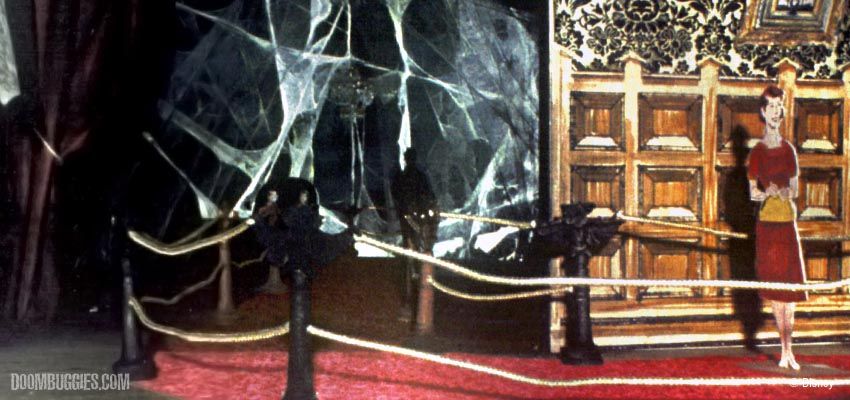
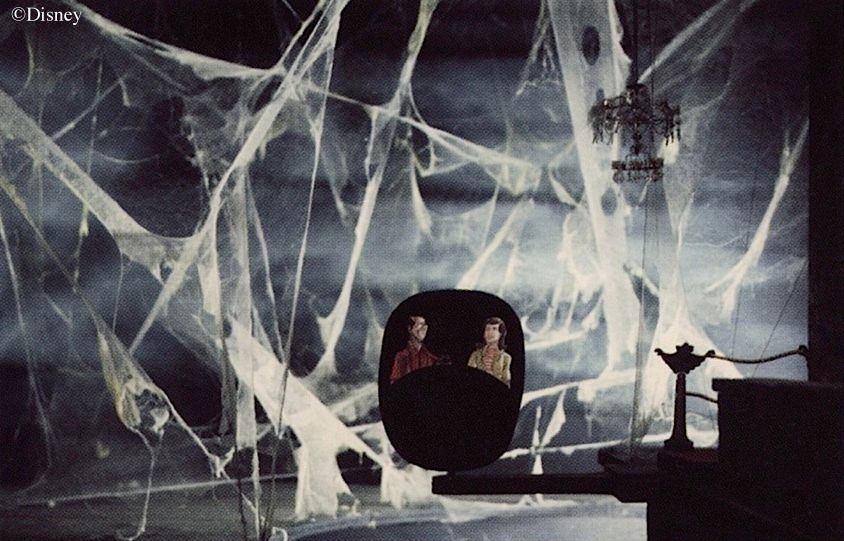
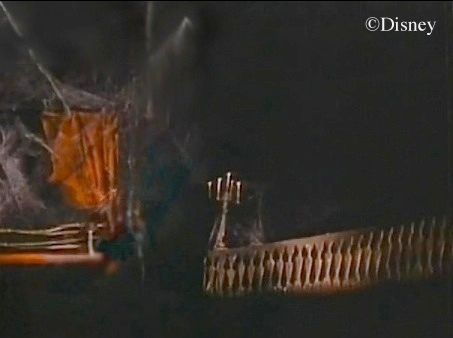
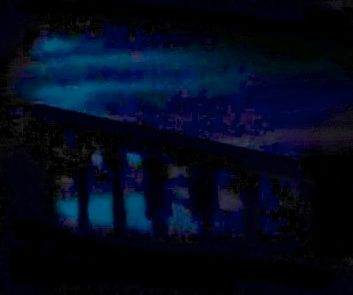
Here are two shots, showing two different areas of the model.


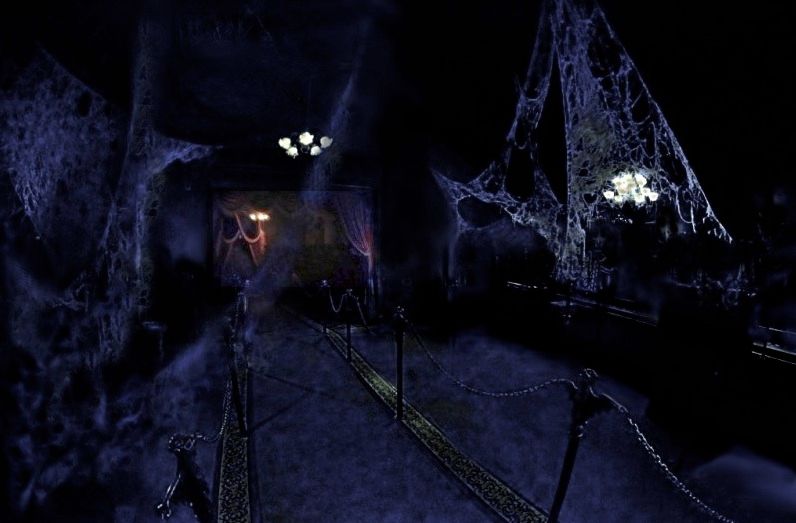
Beyond the skeins of cobwebs, you were apparently supposed to find only bluish gray mist around the doombuggy loading area (top) and total blackness elsewhere (bottom).  My guess is that the mist itself was supposed to make for a brighter area around the loading belt, and combined with the few hanging lamps it was hoped that this would provide sufficient lighting.  Of course, the blue mist is there, but it does little to illuminate the area.  It does make for some moody silhouetting as you ascend the stairs, however.  A Claude Coats contribution, don't you think?


If you go on the HM when it's broad daylight outside, your eyes will still not be used to the dark at this point and the effect of total blackness is mostly there, but there are still places where you can see walls and lights that you should not be able to see.  For safety purposes, all kinds of lights have been added, illuminating the floor.  You'll have to take my word for it that when the ride was new, this room was more impressive. As lighting increased, the overall effect was inevitably diminished, and the "boundless realm" in its original dark glory is a thing of the past.

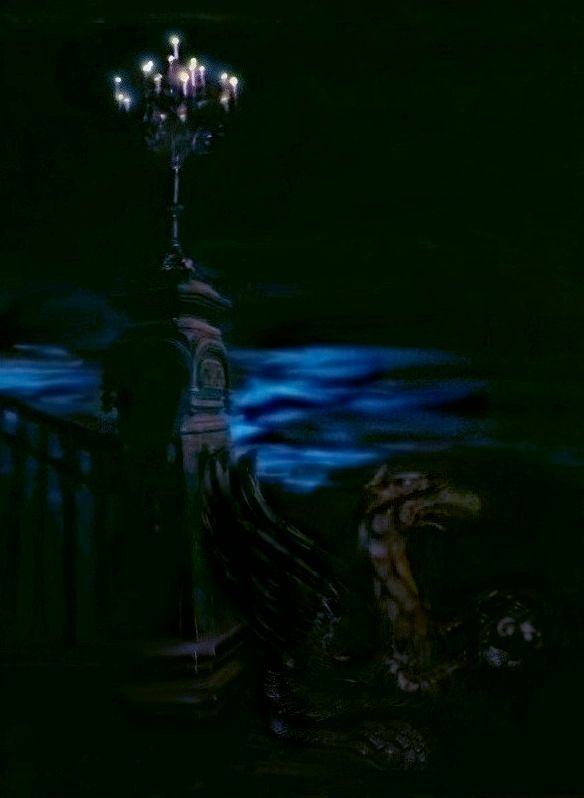
Today, it's a Catch-22 situation.  If your eyes are not yet adjusted to the dark, the limbo area is black enough (with some exceptions), but you can't see any details like the gryphons or the newel posts and staircases.  If your eyes are used to the dark, you can see some of those things, but you can also see the walls and ceiling.

Now and then I've tried to produce something that conveys the intended feel of the place.  Nostalgia, I suppose.


The Endless Hallway

We did this one pretty thoroughly HERE, so there isn't much to add.


The Conservatory and Corridor of Doors

We ran this photo in our Walls and Stares post, so I haven't much to add about the Corridor, but I said nothing about the Conservatory, which is partially visible on the left, and that's an interesting story.


An architectural feature resembling, in design, the eventual Conservatory shows up surprisingly often
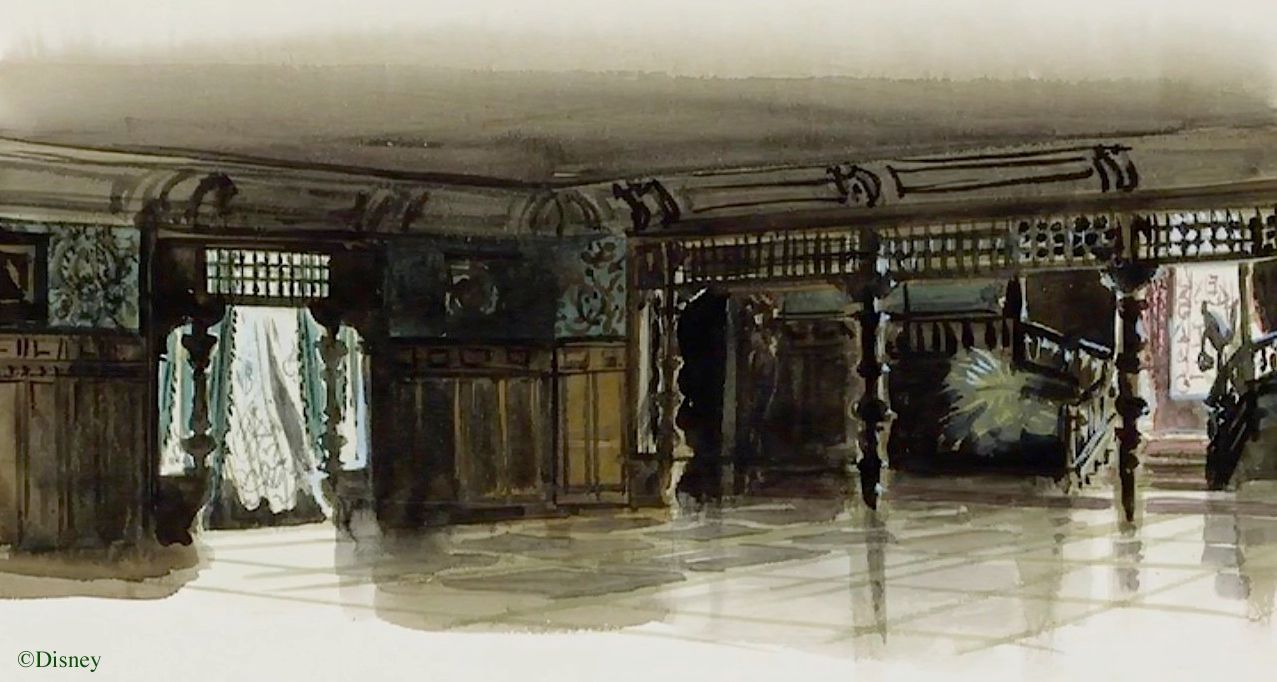
in various concept artworks, such as this watercolor by—I think—either Marc Davis or Dorothea Redmond. . . 


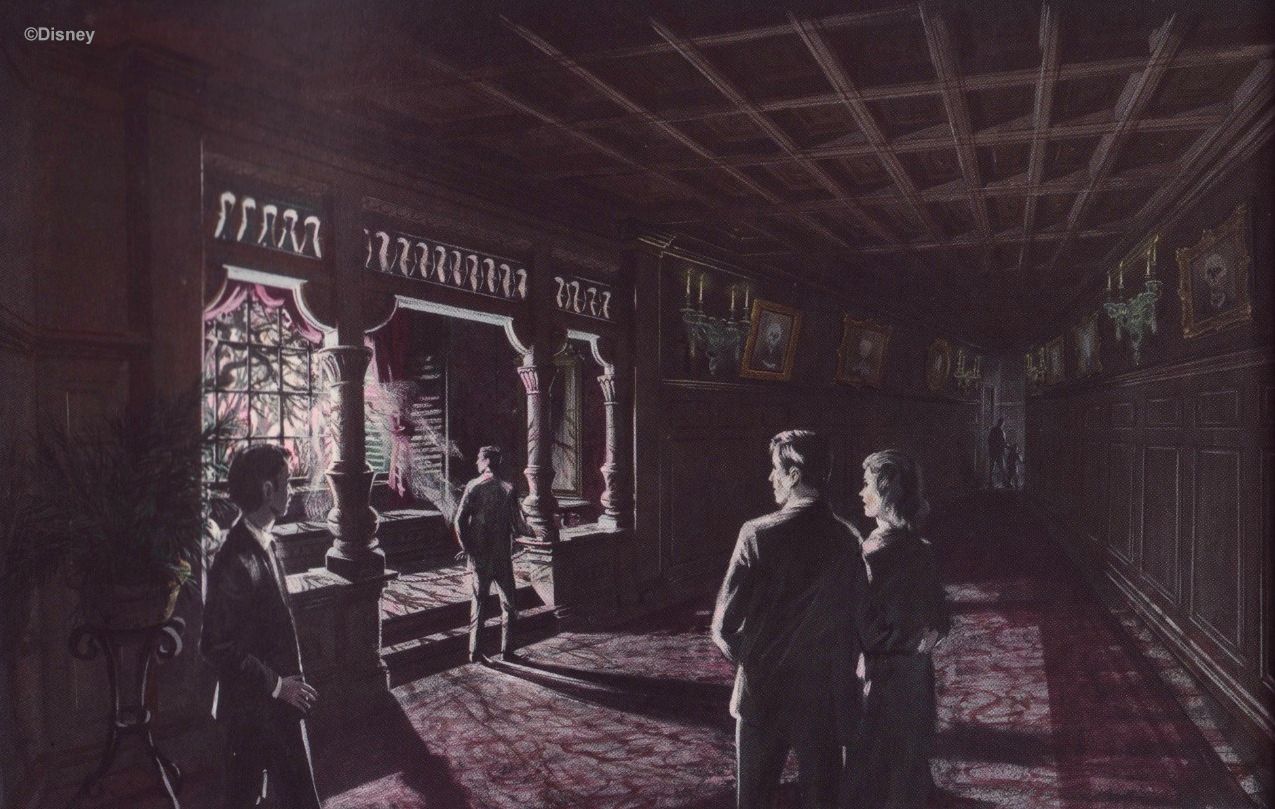
. . . or in this Collin Campbell concept sketch (unknown before 2019) placing it in the Portrait Hall!

MDIHOW (378)

Notice the handsome turned columns on either side of the opening.

 That's what you see in the model too:


That's also what you see in Collin Campbell's colorful artwork for the "Story and Song" souvenir record album:


At first glance it seems that this attractive architectural feature
was preserved in the final attraction with little alteration.


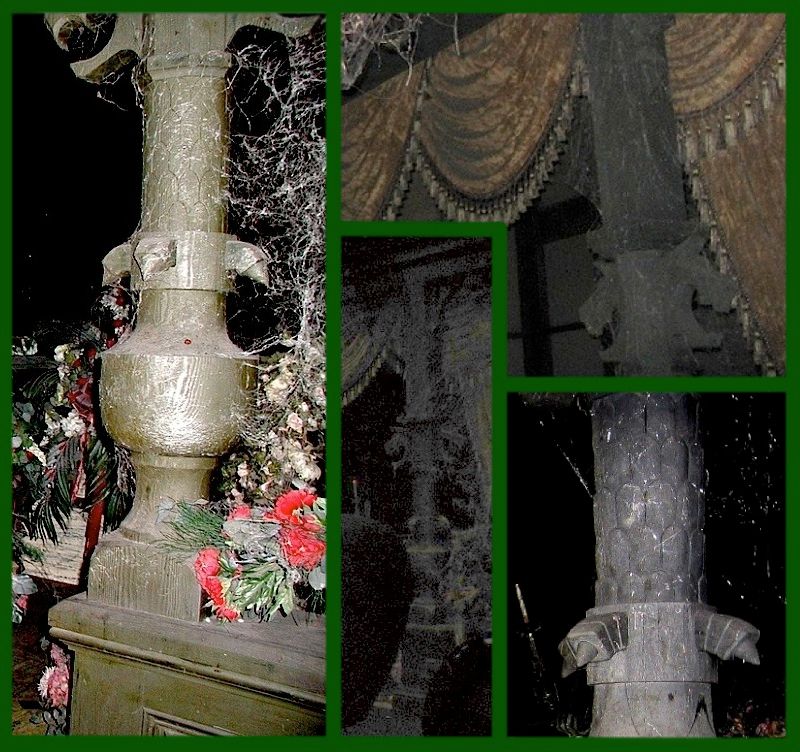
But "at first glance" doesn't cut it at Long-Forgotten, kid.  Look again at those columns.  They're
not the simple turned columns of the model and the preceding artwork.  They're . . . bizarre.  


They're also hard to photograph in their entire floor-to-ceiling verticality from
the doombuggies, so we'll settle for a montage in order to take a closer look.


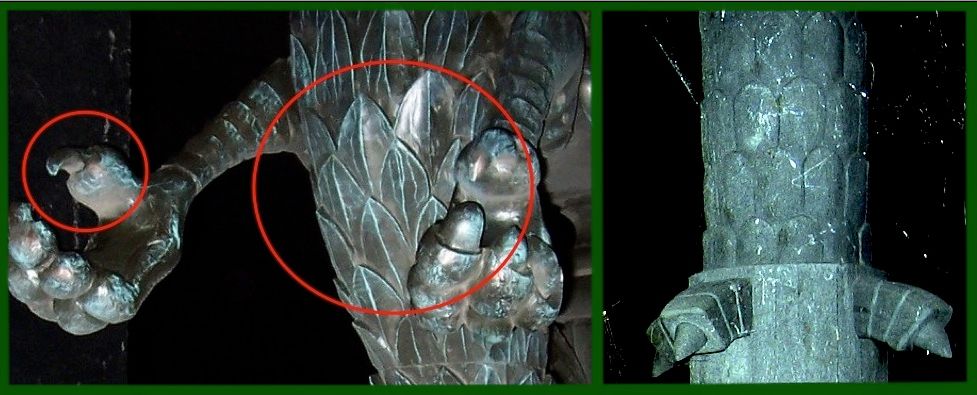
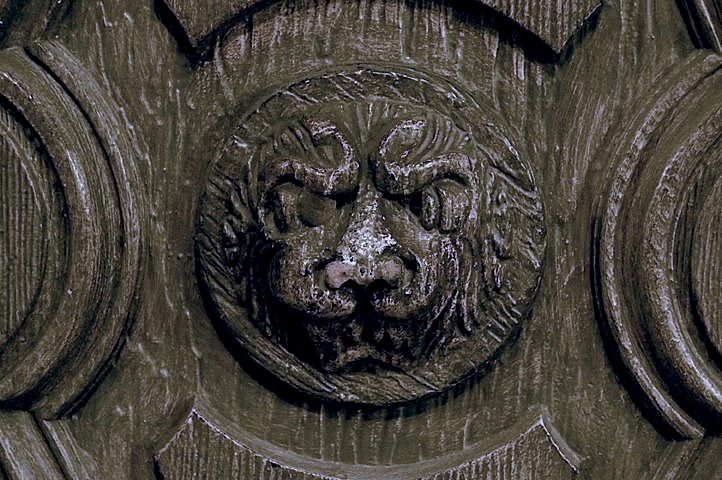
You've got dragon scales (or something), weird claws (or something), and lion head corbels.  Is this some sort of belated nod to the Rolly Crump approach to Mansion design?  A touch of phantasmagoria added to the mix?  I used to think so, but I've changed my mind.  I now suspect that this is the handiwork of the man who saved the gryphons, Ciro Rolando Santana y Arrite.  As you will recall, the hiring of this talented Cuban-born sculptor early in 1969 enabled the WED team to enhance the detailing of the Mansion interior, including (probably) the restoration of abandoned plans for putting the two gryphons at the foot of the stairs.

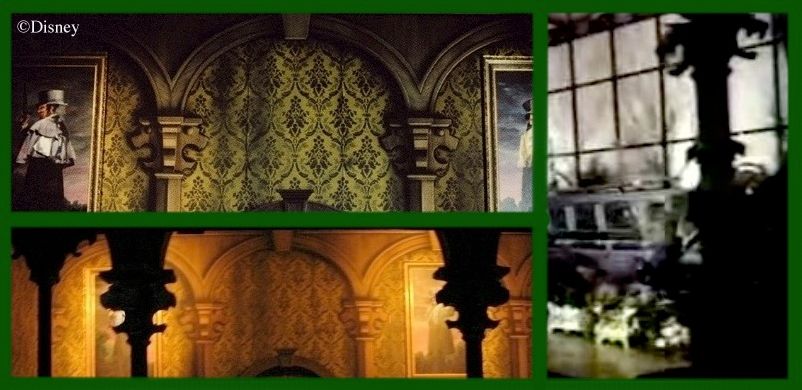
Far from being a surrealistic flight of fancy, the Conservatory columns are all about bringing continuity and consistency to the interior architecture of the HM.  The lion head corbels, for example, match the similar corbels that were already installed in the grand ballroom when the giant glass panels went up and the trompe-l'oeil background mural was painted.


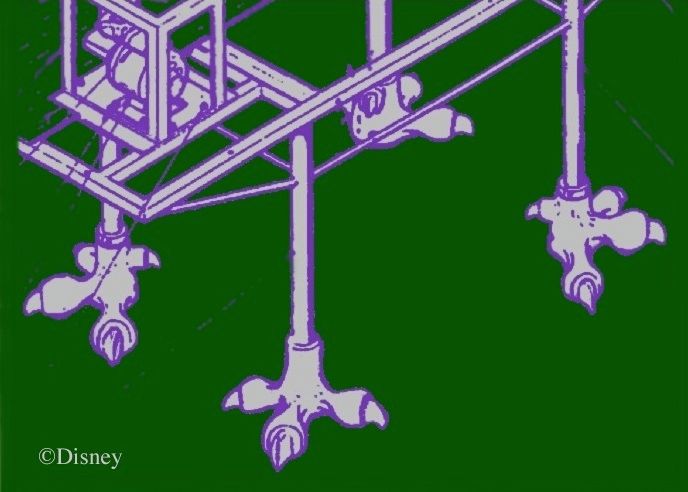
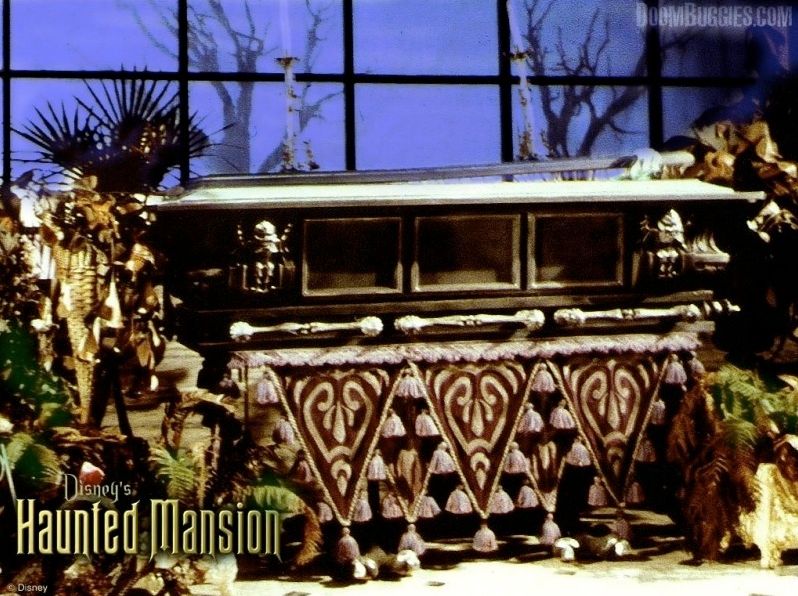
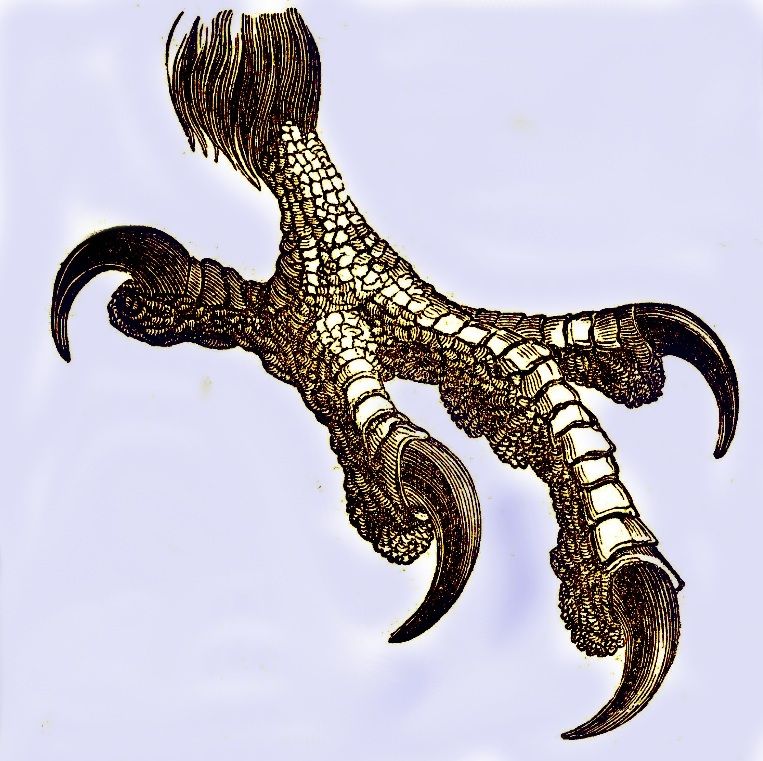
But what about those claws?  Ironically, those are most easily identified by comparison with something you can't even see: the feet of the
bier holding up the coffin.  Under optimal conditions, you might be able to see the toes sticking out a little bit, but even that much is doubtful.


They're stylized representations of eagles' talons, complete with "thumb" or "spur."


That spur, in a similarly stylized form, is also what you see ringing the columns.  Hmm...if the spurs are taken from eagle anatomy, do you suppose the "scales" can be explained the same way?  Perhaps they're a stylized representation of the scales we see on the eagle's foot?  Let's think about this.  We've got eagle anatomy at the bottom of the columns and lion's heads at the top.  We've seen that the columns were clearly given leonine features in order to tie them in with the upcoming ballroom.  Do you suppose the aquiline features also tie in somewhere else?  Eagles...eagles.  Eagles and Lions. *insert lightbulb*  D'oh, EAGLES + LIONS!  Of course!  The gryphons at the foot of the stairs!
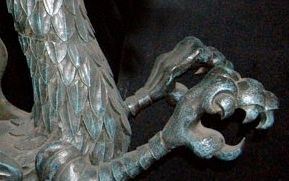
And the fog slowly lifts.  Those may not be scales at all, but feathers, heavily stylized
eagle feathers.  Both they and the spur/claw can be seen on the carved gryphons.


It's actually easier to see the similarities if you look at either the gryphons or the columns upside down.  Understandably, the
gryphons are more naturalistic and less stylized, so the resemblance is not precise, but nevertheless I think we have a winner.


So the claws and feathers point back to the aquiline features of the stairway gryphons, while the corbels point
forward to the lion heads in the ballroom.  There are also lion heads in the center of the doors in the upstairs Corridor.


Since gryphons are half eagle, half lion, they furnish you at the beginning of your second-floor journey with two of the animal motifs you will be seeing along the way until you get to the attic and exit the house.  (They aren't the only ones, however; there is also a recurring serpent motif in doorknobs and corbels.)

Alas, this subtle architectural continuity pretty much goes to waste, because you can scarcely see some of it, and much of it is stylized, but it's there, friends, it's there.  The absence of these flourishes from the scale model points to a late stage, the kind of detailing they didn't think they would have time to put in.  But let's get back to the model, since that is what we're supposed to be talking about.

Before we enter the Séance Circle, dig on the Ghostfather Clock model, from the Burns collection:


The Séance Circle

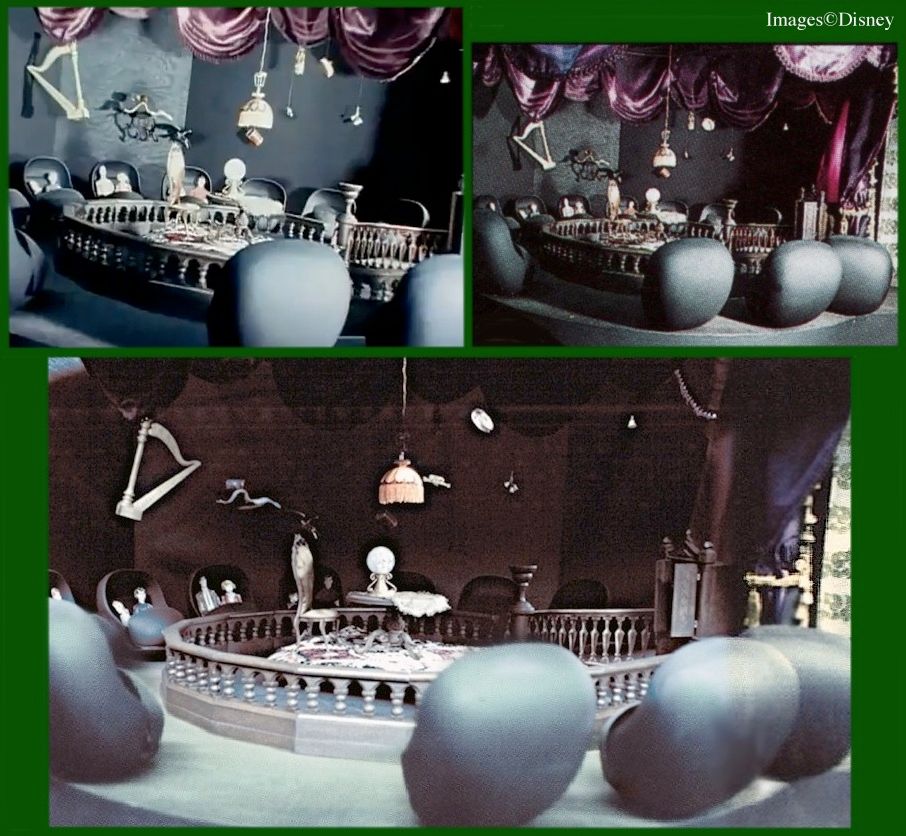
For some reason, there are a lot of photos out there of the Séance circle model before they turned Leota around to face the other way.


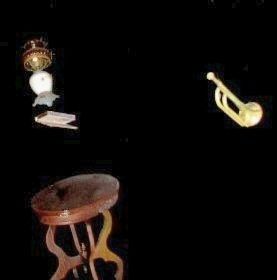
One curiosity is the flying object toward the upper left.  What is that thing, anyway?


It's a round, three-legged table, very similar in fact to the table
found at this location in the actual Séance circle of the Orlando HM.


In this photo of the model, the table is casting two shadows, one faint, one heavy, from two lights being used for illumination.  The table cloth is all rippling and wavy, not laying down on the table top.  I'm not sure what the third, smaller object is.  Another piece of cloth, like a doily or something?  I don't know.

We have a later film clip of the Séance circle model after they had turned Leota around into her current position.  Many of you no doubt have seen it.  It's from the Osmonds 1970 TV special.  In fact, if you hear Kurt Russell's voice in your head saying "...and the ever-popular horn-blowing," as you look at the lower photo, then you've seen the clip way too many times.  Don't raise your hands; this is between you and your priest.


The Ballroom

The working scale model of the ballroom came complete with the "Pepper's Ghost" reflection effect.  To some degree all they did was reproduce what Yale Gracey had already done in his original working model.  Both used a small turntable to have ghosts come into the room through a door on the back wall.


Some of the film of this model in action was so good that they spliced it into the reel
of stock film otherwise made up of ride-through footage of the actual attraction.

In this shot you can see the row of doombuggy models coming out on the balcony overhead and even part of
the Séance room railings through the doorway.  Dang, this model must have been some fun to be around.


The Harriet Burns collection contains some very nice photos of the ballroom,
showing how amazingly closely the final attraction followed the model:


The Attic

This wide shot shows the gap within the model where Imagineers could walk.


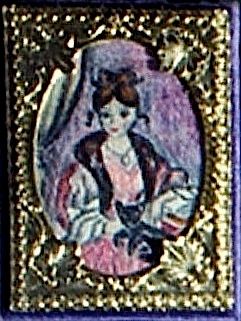
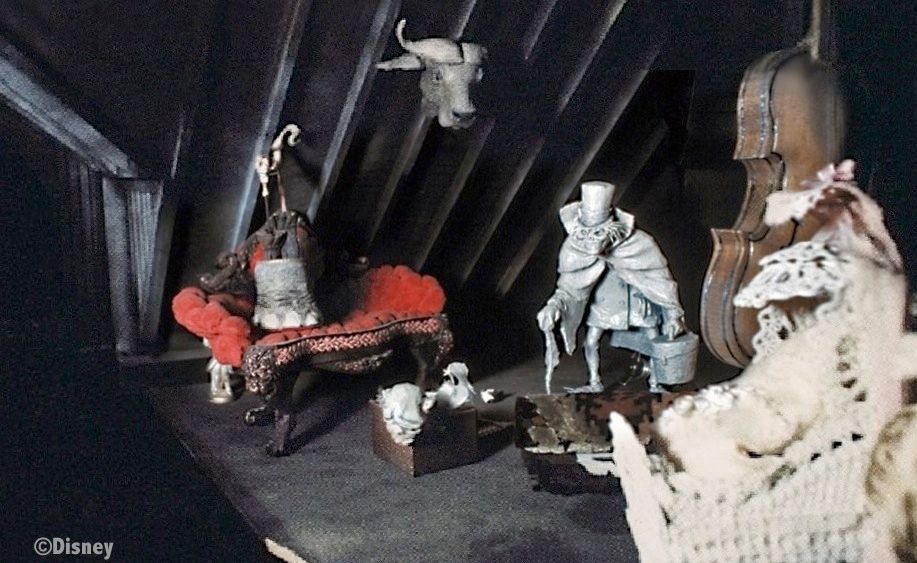
We've looked at this particular photo in close detail many ... times ... already, so we won't linger over it now, but as promised, there's the April-December portrait, probably moved here from the portrait hall.  That painting rattles around inside the lunatic fringe of our great Jean Lafitte conspiracy, of course.  Fun detail:  She's got a cat in this one.


This photo of the other side of the attic model has also been posted
  before, but there's something strange in it that hasn't been discussed.


Look at that grotesquely HUGE bass fiddle.  My guess is that they just got hold of the smallest toy violin they could find and used it in the model
to save time and effort.  Oddly enough, Collin Campbell reproduces it in a "Story and Song" painting with the same ludicrous proportions.


This is probably nothing more than an example of Collin's extreme conservatism whenever he rendered other peoples' artwork, but still, you have to wonder about that bass.  This may sound off the wall, but . . . is it possible that the Imagineers were tapping into vague childhood fears of big, slightly menacing, serious-looking . . . um, things, you know, the unidentified things standing in nooks and crannies and dark closets over at uncle Fred's or grandma's house?  Fascinating but strange and unfamiliar things, "grown-up" things, things not yet explained to you, unlike anything you have seen at home?  I'll bet there are lots of little 'uns who have never seen a bass fiddle up close and would be scared of one standing in a dark corner.  Maybe it's just me, but I suspect that a huge bass like that lurking in the shadows of the attic would have been creepy in some inexplicable way.

Unless I just explicated it?

That's what we do around here, friends:  comprehend the incomprehensible, explain the unexplainable, unscrew the inscrutable.


The Graveyard

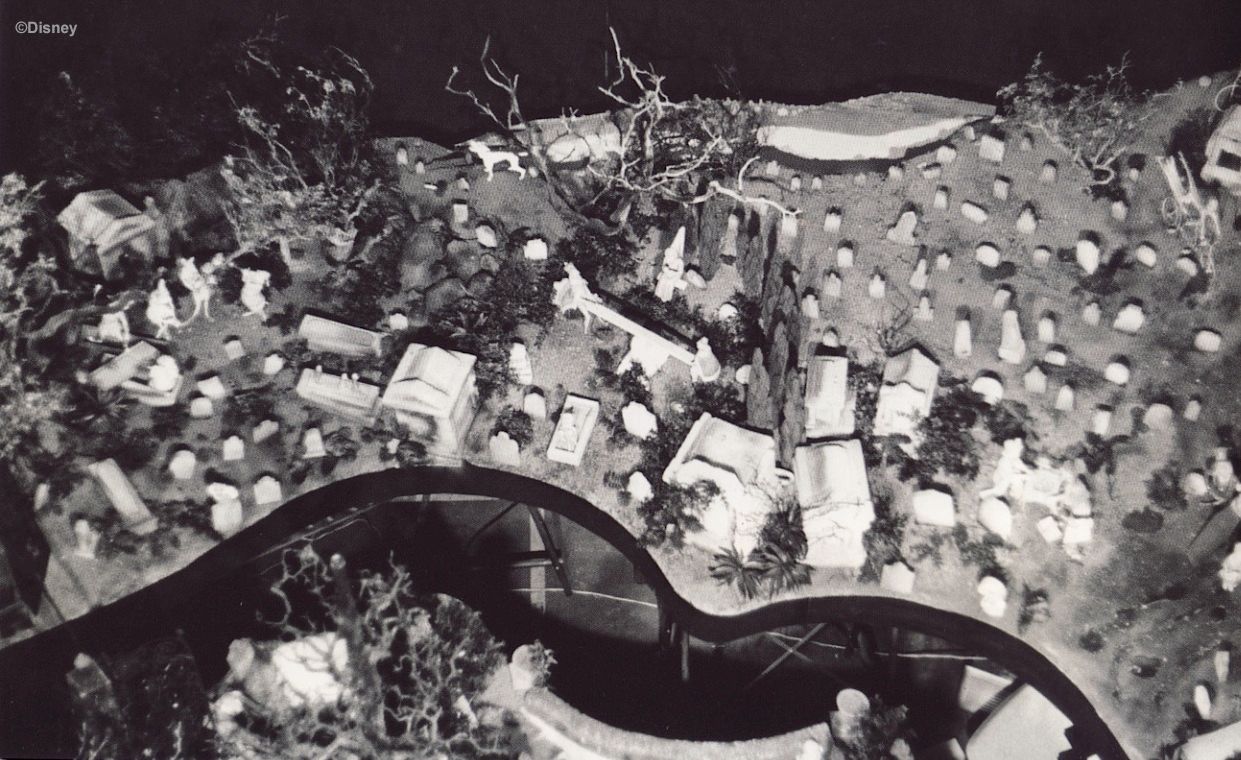
Oooooo, lots of nice pix here, not surprisingly.


MDIHOW 404


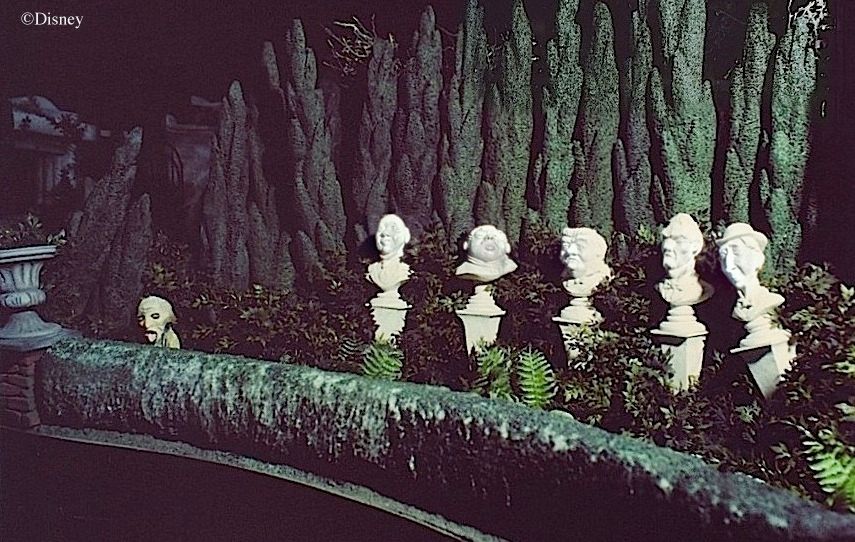
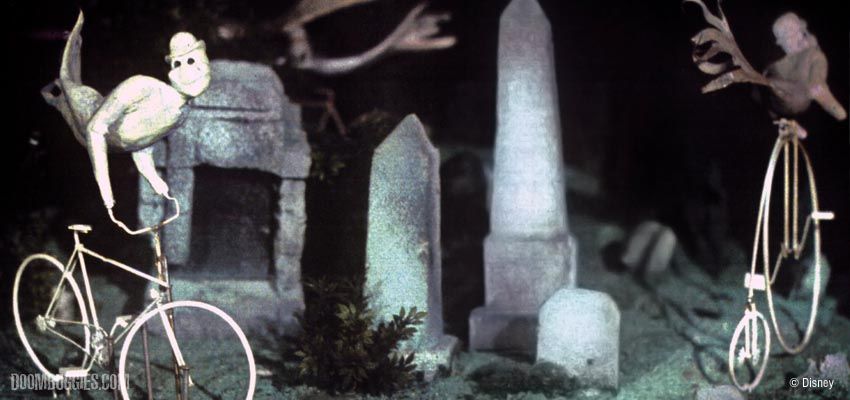
The most curious thing about that shot of the singing busts, of course, is the pop-up ghost.  He would have been the eighth one in the graveyard, and he's on the effects blueprints, but I'm pretty sure he was never installed.


MDIHOW 406

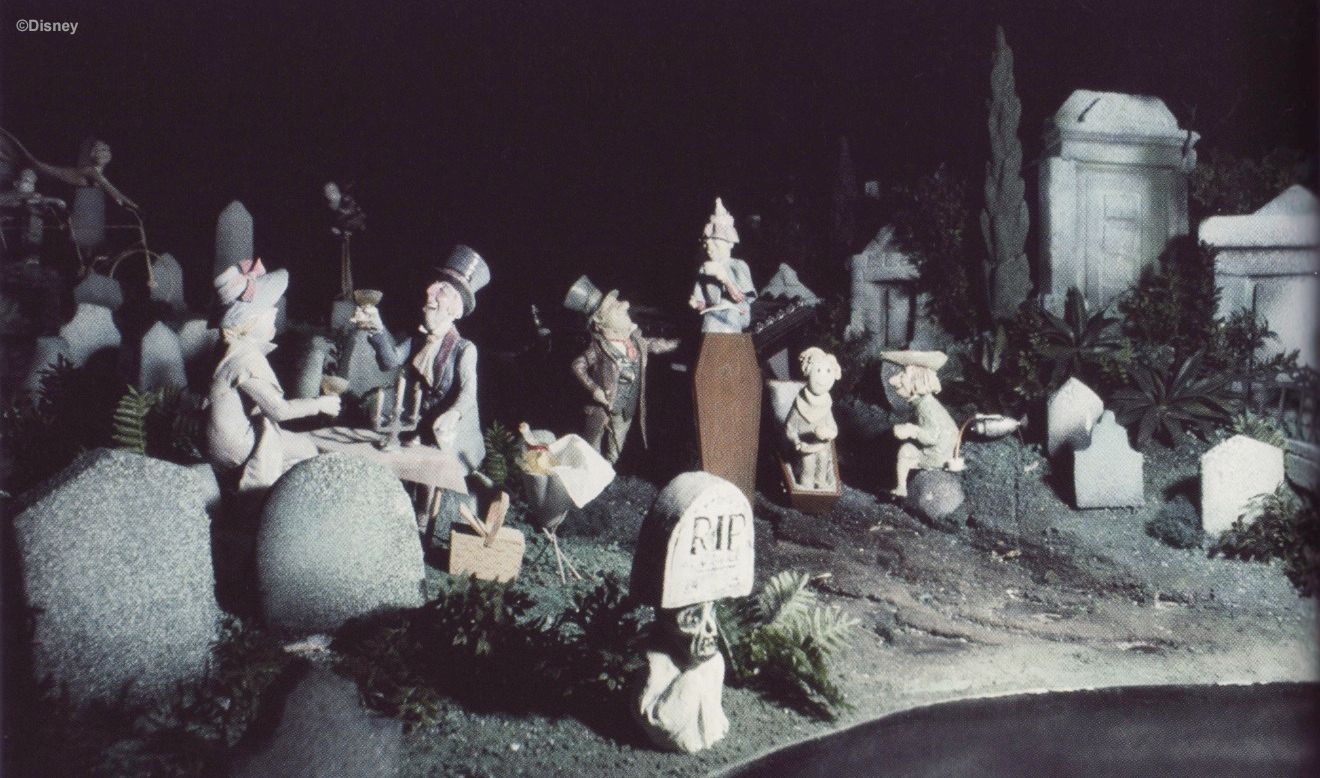
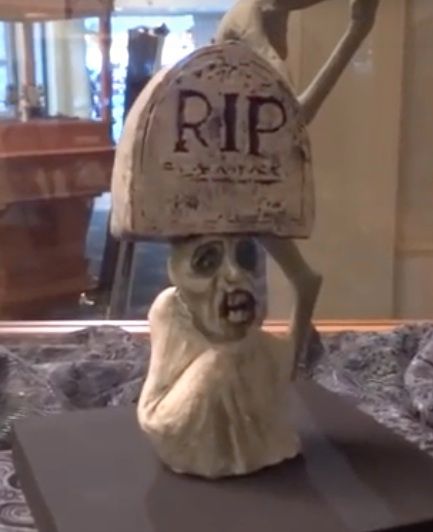
The maquette figurines populating these models closely reproduce the designs in Marc Davis's concept art.  It was only when they were turned over to Blaine Gibson for their transformation into life-size figures that they changed to a more realistic appearance.  Speaking of Gibson, do you see that pop-up ghost with the tombstone on his head?


There's an interesting story to be unearthed there, and around here we leave no stone unturned and no pun unemployed when it comes to interesting stories.

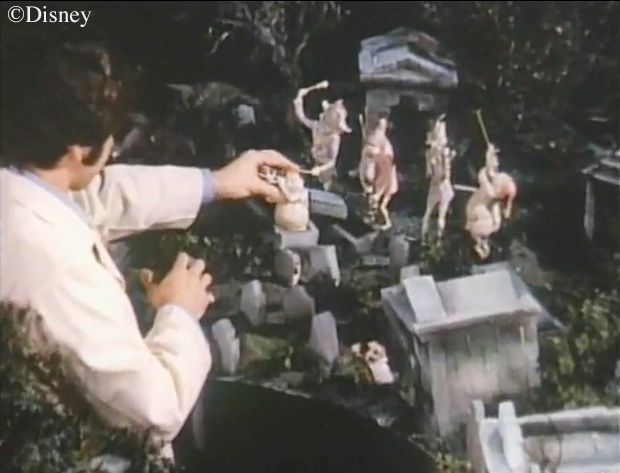
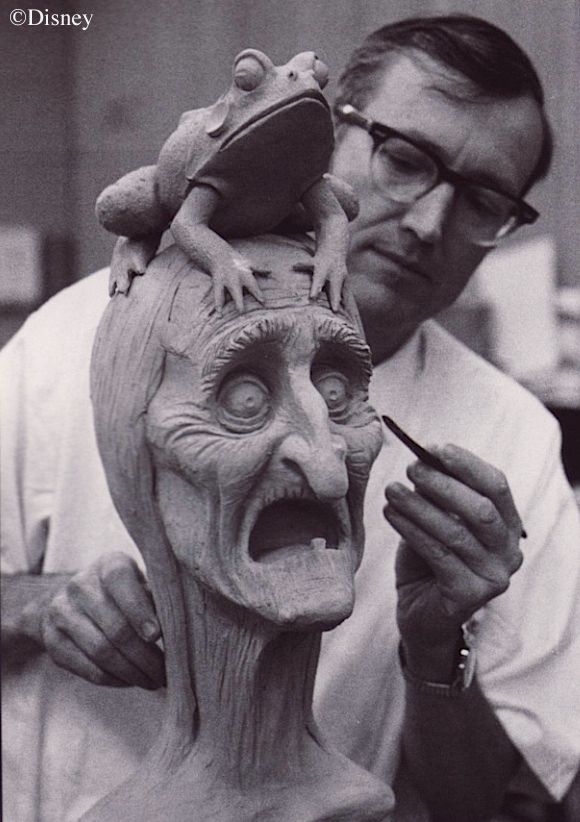
The Imagineers were originally going to do a lot more with the pop-ups than they did.  Here we have a tombstone that suddenly rises up with a ghoul underneath.  They were also going to have one with a frog on his head.  Here he is with Blaine working on him:


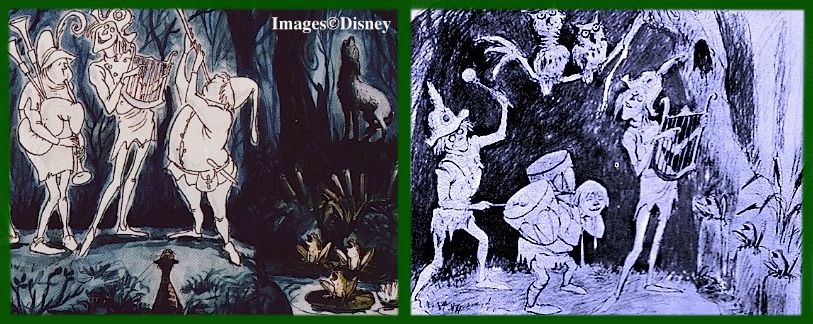
The frogs were going to be over by the band, either on lily pads or on stones:


It's that familiar gag you've seen oh so many times in cartoons.  Someone crosses a creek on stepping stones, and one of the "stones" looks up quizzically.  Surprise surprise, it's a turtle.  Or a big rock standing in a grain field turns out to be a rhino (Peter Pan).  So here, the "rock" that the frog is sitting on turns out to be a pop-up ghoul's head.  You can easily imagine more examples (e.g., a bush turns out to be the hair on a silly spook).  I'm glad they ditched this idea.  Too cutesy, too corny.


The Exit Crypt

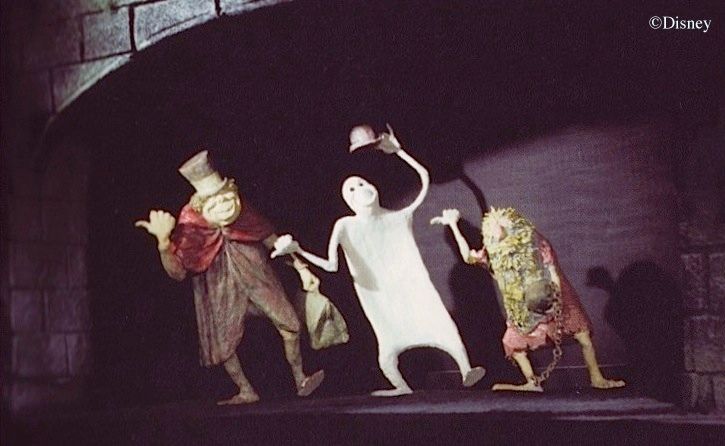
We end our tour with the famous trio . . .


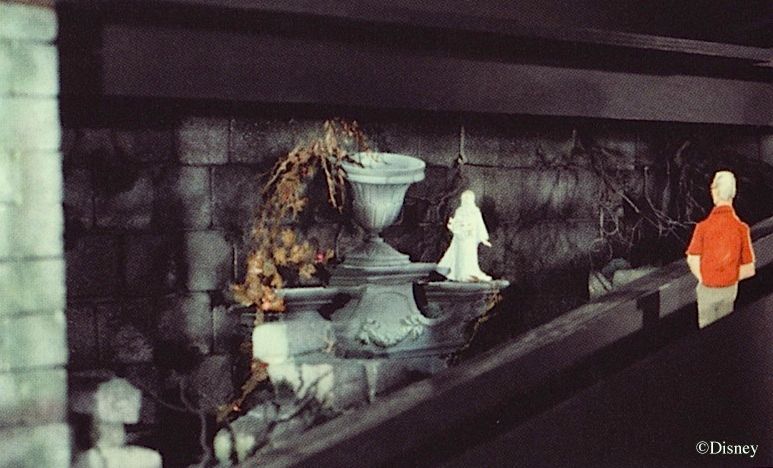
.               . . . and Little Leota, who is very little indeed in this case.  The actual tableau follows
the scale model almost exactly.  It's one of the most perfect things in the Disneyland Mansion.


If you manage to be the last in your group, and the Mansion is not too busy that day, you can walk slowly backwards on the escalator and enjoy the little ghost as long as you want, all alone.  Also, those of you who have never been to Anaheim may not know this, but if you lean over and look down in there, the walls descend a long way and disappear beautifully into the darkness.  There is a convincing feeling of a bottomless pit to the scene, which somehow adds a great deal.  The little ghost beckons to you and taunts you at the same time.  In one way, she seems so close you could almost reach over and touch her, but in another way, she's separated from you by a "great gulf fixed" (cf. Luke 16:26).  It's a memorable and deeply satisfying way to end your experience.  This is one place where the Anaheim original is unquestionably superior to the other Mansions.


Hurry back.