Things You're Just Supposed to Know

Most of the time, Long-Forgotten assumes that readers are already familiar with basic facts
about the Haunted Mansion. If you wanna keep up with the big boys, I suggest you check out
first of all the website, Doombuggies.com. After that, the best place to go is Jason Surrell's book,
The Haunted Mansion: Imagineering a Disney Classic (NY: Disney Editions; 2015). That's the
re-named third edition of The Haunted Mansion: From the Magic Kingdom to the Movies (NY:
Disney Editions, 2003; 2nd ed. 2009). Also essential reading is Jeff Baham's The Unauthorized
Story of Walt Disney's Haunted Mansion (USA: Theme Park Press, 2014; 2nd ed. 2016).

This site is not affiliated in any way with any Walt Disney company. It is an independent
fan site dedicated to critical examination and historical review of the Haunted Mansions.
All images that are © Disney are posted under commonly understood guidelines of Fair Use.

________
.
Showing posts with label Clem Hall. Show all posts

Tuesday, June 24, 2025

FOUND: One of the Original 1969 Stretching Portraits (UPDATE: new photos)

 UPDATED: new photos added 7-4-25

This may be the most amazing and unexpected discovery of an original Mansion prop since the Phineas Pock tombstone resurfaced in 2020. This is even better, really. Back in January of this year (2025), a guy who goes by the moniker "BlueCollardBastard" (BCB) put up a post at Reddit about successful restoration work on an old stretching gallery portrait of the Wicked Widow (aka Constance, and before that Abigail Patecleaver). As he tells it, his grandfather was an elevator mechanic with Amtech and did some servicing on the Haunted Mansion stretchrooms back in the day. He somehow got hold of an old Widow portrait, apparently from a Disney engineer who fished it out of the trash when they were swapping out the portraits for fresh ones. They wear out and have to be replaced regularly.

(You regular Forgottenistas will have to forgive the inclusion of a lot of stuff that you already know and has been discussed before. I'm expecting this post to attract the attention of a number of outside readers. Disney history buffs they perhaps may be, but sadly, many are still shockingly underMansionized. We must be patient with them.)

BCB chronicled the restoration with a nice series of photos. (They also did an Ally Gal portrait of more recent vintage.)


Photos: https://www.reddit.com/r/thehauntedmansion/comments/1il2owt/2_stretching_portraits/#lightbox

A sharp-eyed threadster brought the Reddit post to our attention (VicariousCorpse), and another
one noticed that this particular painting looks like a match to one of the originals (yensidtlaw1969).
 
Long story short: it is.
 
What we have here is one of the original 1969 stretching portraits,
a rare and valuable historical relic, risen from the dead.
 
 
From a historian's point of view, doing restoration work on an old relic beyond what is necessary for preservation is definitely a no-no, but from an aesthetic and possibly a collector's point of view, it's hard to argue with the results.

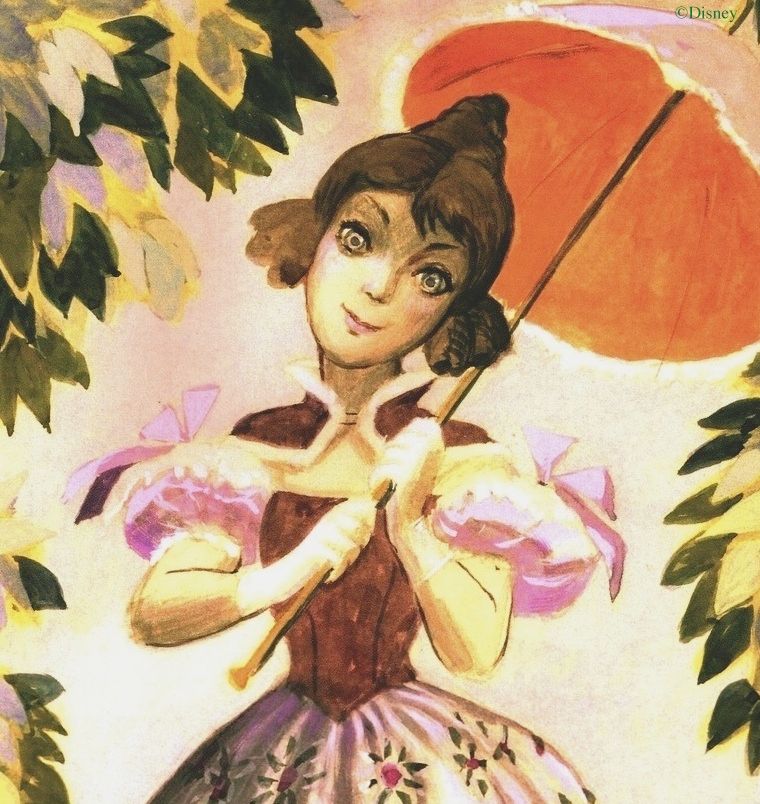
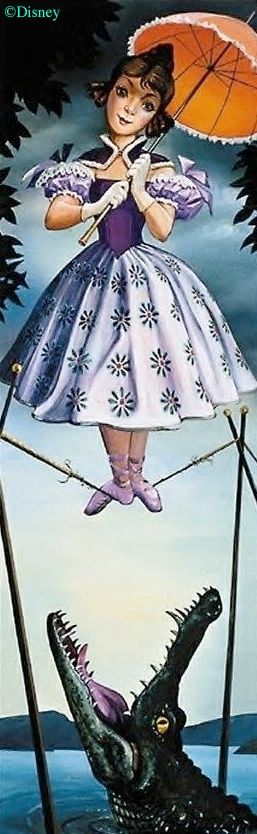
How do we know it's one of THE original portraits? First of all, it's the right style. As I've pointed out elsewhere, the Imagineers' first impulse was to preserve the design of Marc Davis's concepts but alter the coloration to something more realistic so they would look like typical 19th century oil portraits rather than watercolors using somewhat nonrealistic colors. You've seen it many times before, but these Daveland shots are among the most recent and most accurate photographs of Marc's concept art:


The portraits seen in the Mansion when it opened were not painted by Davis but by Ed Kohn, the same guy who translated Marc's changing portrait concept artwork into the finished designs still seen today. Ed did a pretty good job preserving Marc's designs while naturalizing the colors, but this approach did not last for many generations, perhaps not even two. It was apparently felt (correctly, I think) that the spirit of Marc's creations did not fit this approach, and if they were going to go with natural coloration they needed a more naturalistic design overall. That remains to this day the governing philosophy. Clem Hall is often credited for the new look, which is still in use, but Elmer Plummer may actually be the man to thank. Whoever is responsible, the difference between the newer style and Marc's is pretty obvious.

pic by Bassbone

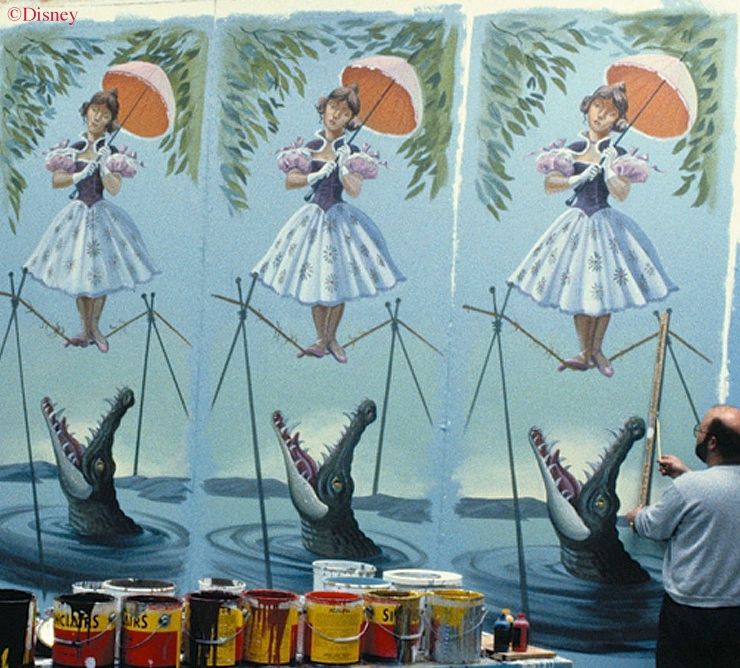
My best information is that the paintings were done by hand until about 2005, although there were some unsuccessful attempts before that to come up with an effective printing technique. An "assembly line" approach can be seen in this photo of paintings being produced for the Tokyo Mansion in the 1980s. Of course, as long as paintings were still being produced by hand, the artists had some leeway. Notice that the foliage in the three Ally Gals is not leaf-for-leaf exactly the same from painting to painting. And why should it be?

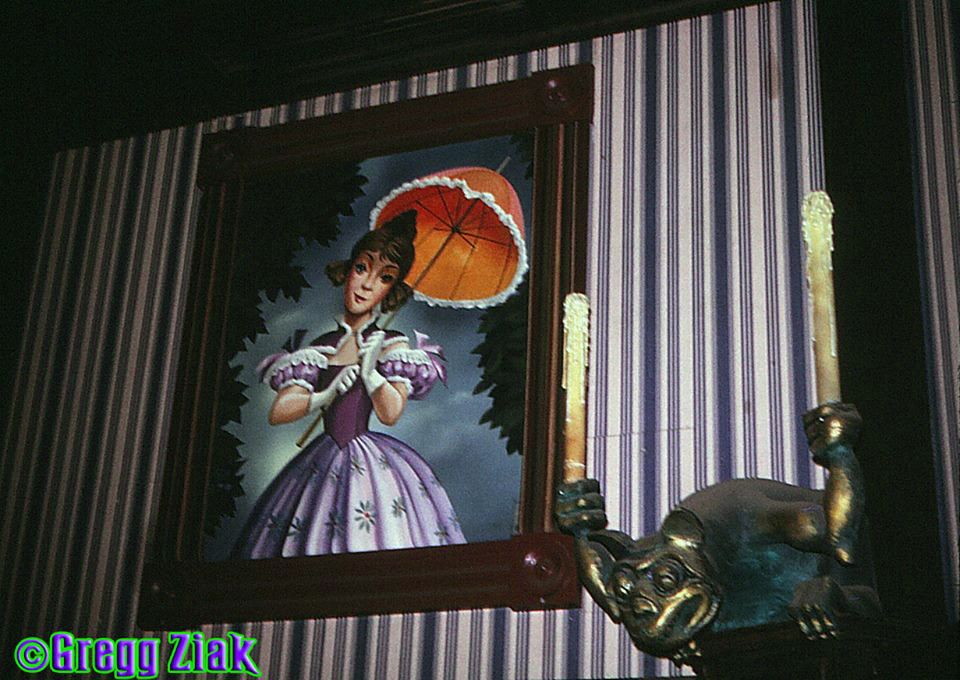
Which brings us to the point first raised by yen69. There are photos from 1969 and 1970 showing the original paintings in situ, and it should therefore be possible to check whether or not the BCB relic is in fact the one in those photos. The painting can be seen in the Osmonds TV special from March 1970, but that one is a bit too distant to supply the sort of detail we want.

Better are these two from 1969/70, one acquired by Daveland a number of years ago, the other a shot by Gregg Ziak taken by himself back then.


With a little effort, it's possible to line these up with the BCB painting. Looks to me like an exact match. It's almost certainly the same painting.

Hey, what about the Widow portrait in the second stretching gallery? As it happens, Gregg has a photo of that one too (well, sort of):

This time the foliage is NOT an exact match, so this must be from the other stretching gallery.

A second photo exists (owned by Master Gracey and posted at Facebook).

Oh my.  Not the best quality, and not a very helpful angle for making comparisons, either. Nevertheless, with a few adjustments it's good enough to create an overlay with the Ziak photo. There's no doubt in my mind that we have another match. (You have to look not only at the outlines of the foliage but at things like the patterns of "sunlight holes" through the leaves.)
Worth the effort, because this gives us a DATE. The photo is stamped February, 1972. Assuming the paintings in both galleries were changed out at about the same time, this proves that the original paintings were in use for at least two and a half years, and BCB's grandfather couldn't have gotten his lucky hands on this relic until sometime in the spring of 1972 at the earliest. I've seen wildly different accounts of how long those hand-painted portraits lasted before needing to be replaced, from a couple of months to a couple of years. We now have solid evidence that they could indeed remain in use for at least two and a half years.


Orlando

What about WDW? Less mystery there. When they removed the original paintings from the WDW galleries, they cut one down, framed it, and put it in the chicken exit corridor:

 
Full-length photos also exist. It's fun to put one alongside the newly
recovered Disneyland example and see how similar they were:

Anyway, BlueCollardBastard, if you're reading this, know that you have an extremely rare piece of historic Disneyana on your hands. That's the very same painting people like me saw in the Mansion when it opened in August of 1969. I hope that whoever ends up owning it appreciates what they have.

 UPDATE: two more pre-restoration photos have been posted online HERE:


******************

Thursday, March 10, 2011

The Many Faces of...the Other Stretching Portraits

.
Following up on the Tightrope Walker post, it seems only fair to give the other portraits the same treatment.  The differences in artistic interpretations of these characters are at least as noticeable as was the case with Ally Gal, and in some cases they are even more dramatic.

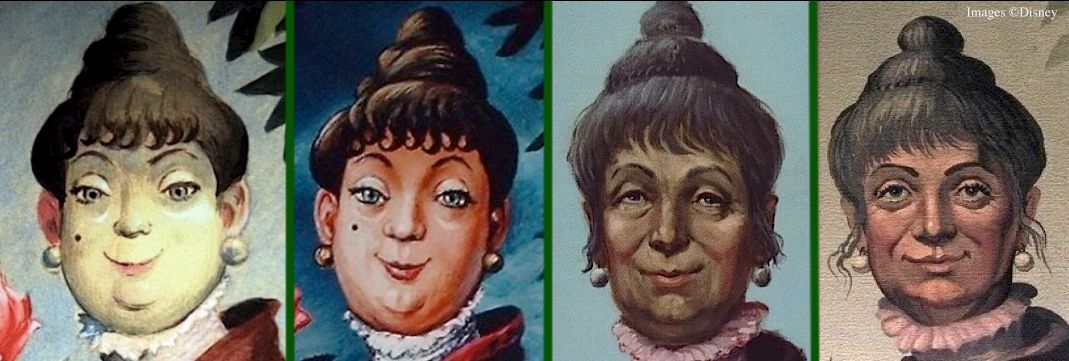
Here's Connie (née "Abigale Patecleaver," her name in that same old X. Atencio script cited earlier).  Left to right we've got (1) Marc Davis's original sketch, (2) a Davis-style canvas actually used in the attraction during the first year or two,* (3) Clem Hall's version ca 1982, and (4) the current DL version.  We'll use that formula with the other characters as well, displaying the same four representations in the same order.


The first thing I always notice about Marc's original is that this widow is not very old.  She's put on a few, but she's still cooking on all burners.  Secondly, there's a huge contrast between the fried-egg madness in the eyes of Marc's Tightrope Walker and the nimble intelligence of this widow.  If this is madness, it's an utterly different form of madness.  This is truly a classic Marc Davis sketch, in my opinion.  The self-confidence is there, the cold-bloodedness, the wicked edge.  She seems quite pleased with herself.  She keeps her secret without a trace of guilt feelings.  And check out the colors in that face!  Yellow skin, grayish-green shadows, pink ears—and yet, mirabile dictu, she doesn't look sickly but very much alive and well.  Unless someone had called your attention to it (like I just did), would you ever have noticed how daring and original Marc's palette is in this sketch?

As I pointed out in the Ally Gal post, the first stretching portraits tried to retain the Davis drawings, but they "naturalized" the colors.  As was the case with Ally Gal, the widow done this way isn't nearly as good.  And don't think Marc didn't notice the way they trashed his color scheme.  During an interview with Alice Davis during one of the 40th Anniversary events in 2009, she lamented that many of Marc's gags were either not used or were "overloaded."

Interviewer:  "But a lot of Marc's stuff is still in the Mansion, with—like the stretching portraits, and things like that."
Alice:  "Yes, but they're not his.  They're somebody else's, and the color is not as, uh, nice as what Marc's or Mary Blair's would be to the eye."

When we get to Clem Hall's widow, we have a real revolution.  She's quite a bit older.  She's drunk.  She's got a droopy, somewhat vacant look as a result.  But she's still got a few essential qualities remaining from the Davis original.  She's smug and self-satisfied.  She knows something that you don't know, but that woozy look keeps her from looking pompous about it.  You suspect that there's definitely something going on in there when she's sober.

And then there's the current version.  Another disappointment.  That woman has been drinking iced tea, not wine.  Too friendly, too sincere, and like the current Ally Gal, seriously lacking in personality.  Does she look to you like she's keeping a secret?  Pthh.  On to the next...


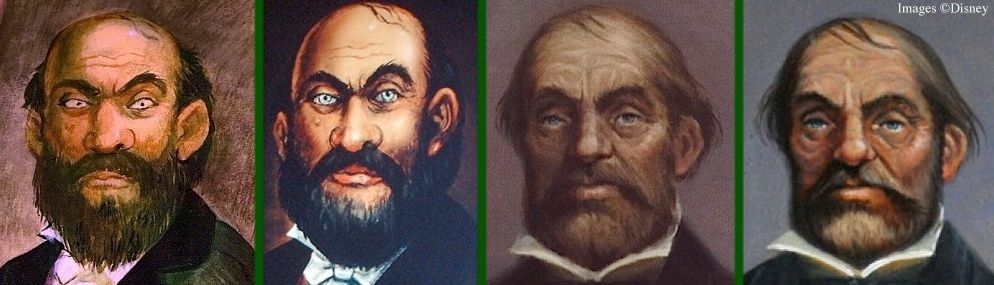
Marc's original Dynamite Guy looks like a leftover pirate from POTC, and I mean one of the mean ones.  Look at those beady eyes.  This is a look of undisguised cruelty and barely-suppressed rage.  The colors are much more natural this time, so the canvas version is not such a radical departure.  Very little difference, except that the eyes have been softened.  With those pretty blue peepers, you're tempted to think that maybe, just maybe, this guy started out in life as a nice little boy and turned bad at some point.  Davis's original, on the other hand, was born bad.

Clem Hall, once again, reinvents the character.  This guy isn't evil or angry (let alone crazy or drunk); he's just plain stupid.  It's a study in pride and vacuity.  The more you look at him, the more convinced you are that he hasn't had an interesting or intelligent thought in his life, but that apparently hasn't kept him from becoming a Somebody.  Are those eyes gazing unfocused at something in the distance, or are they gazing inward at the void where his soul should have been?  Seriously, if you were told that this is a painting of a blind man, you might well believe it.

In this case, the current version has aped Hall's version so closely that there isn't a lot to say.  So that's it.  On to the next...


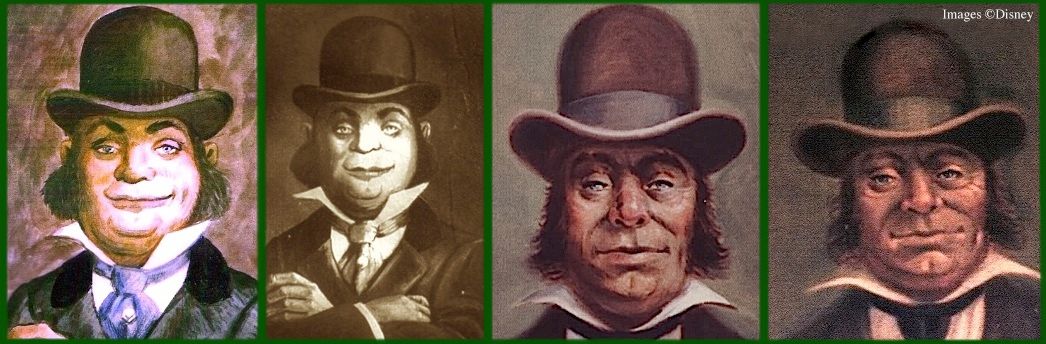
What we have here is a smug toad.  He's self-satisfied and superior, but he's not threatening, not particularly vicious.  Alas, I have no color photo of the Davis-like canvas, so we are at a disadvantage there, but it looks like they botched the shape of his face a little.  The smile is not as broad, the cheeks don't bulge out as they should.  Something is definitely lost in that part of the face.

Once again Clem Hall, it seems to me, has given us a drunk.  Nose and cheeks are red, eyes are pale and watery.  He's feeling no pain.  It's another study in vacuity.  Those eyes are staring out at the world unseeing.  Remember the overall message of the stretching portraits?  The things most highly prized in this life are mere vanities that only serve to distract us from the reality of death.  That is what many would call a "sobering thought."  With Hall's characters, the state of mind untroubled by that sobering thought is represented, quite naturally, by what looks like an alcoholic haze.

As usual, the current version has sobered up the subject considerably, and as usual it has failed to fill the void with anything particularly interesting.

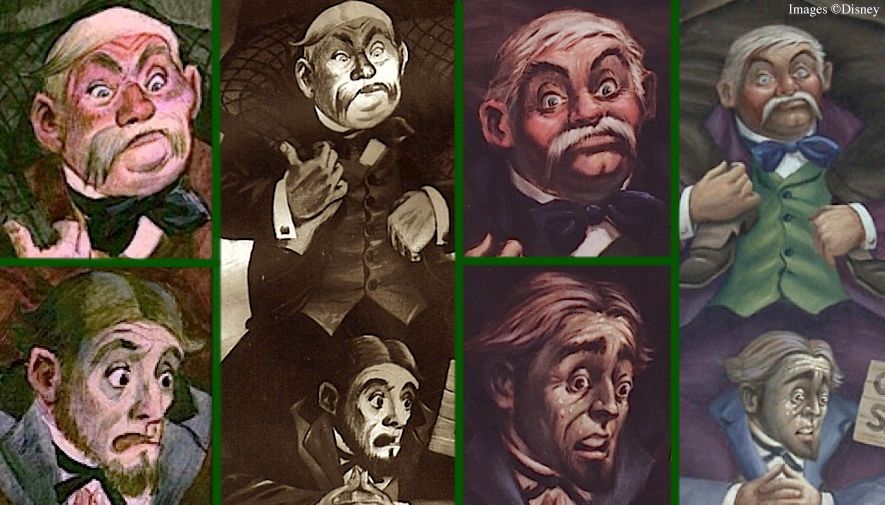
The remaining Quicksand Men are of less interest, since by the time you see them the joke is beginning to unfold.  As the ironic distance between the smug upper portrait and the macabre reality beneath diminishes, so also opportunities for artistic reinterpretation of the joke diminish.  Not surprisingly, then, the post-Davis versions don't reinvent the two lower Quicksand Men very radically.


The middle guy has only just now spotted the quicksand sign and has only begun to realize his dire situation.  You see pure shock in his face.  Even in this moment, he still has his sense of self-importance with him.  It's not, "This can't be happening!" so much as "This can't be happening to me!"  The bottom guy is past that.  He's been aware of the situation for several seconds by now.  Initial panic has turned into a full comprehension of the inevitable.  Hall et al have added sweat droplets to Davis's original.  Hmm.  Is that the hot sweat of exertion or the cold sweat of terror?


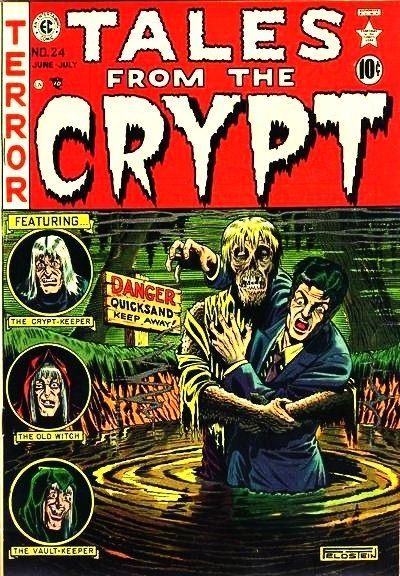
On a lighter note, we discussed in an earlier post the evidence that Davis looked through old EC horror comics for inspiration from time to time.  Seems to me there are enough elements in common between this Al Feldstein cover art and Davis's Quicksand Men to raise suspicions.


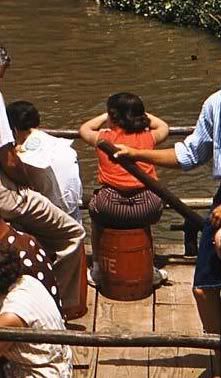
On the other hand, there is no need to go rummaging through old comics in search of inspiration for the basic gag in the Dynamite Guy portrait.  A plausible source can be found right under our noses, mere yards from the Mansion.


* And now, of course, one of the original 1969 Wicked Widow portraits from a Disneyland stretching gallery has surfaced.

••••••••••••••••••••••••••••••••••


Sunday, February 20, 2011

The Many Faces of the Tightrope Walker

.
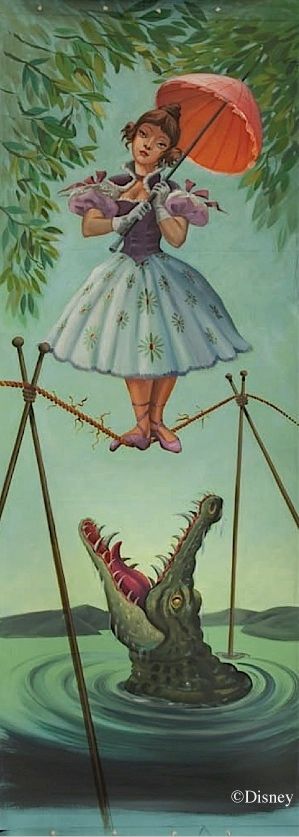
In our last post, we got all philosophical and theological and stuff with the stretching gallery portraits.  This time out we'll be looking at the artistic interpretations of the most popular of these Marc Davis masterpieces (for such they are widely regarded).  I'm speaking of the Tightrope Walker (aka Alligator Girl).  Recently we were given fresh proof of how much interest there is in this piece.  On December 17, 2010, a collector paid $47,500 at auction for an Ally Gal portrait actually used in the attraction.  The canvasses get worn out with continual rolling and unrolling and are replaced at regular intervals (every few years is what I've heard).  This hand-painted copy was dated in the auction catalogue to 1969-1972, based on the testimony of a Disney employee that they no longer hand-painted the portraits after 1972.


I hope the early date was not a major factor for the buyer, since the information supplied by the employee (and hence the catalogue) was wrong.  According to Brandon "Ghost Relations Department" Champlin, all of the stretchroom canvasses were hand-painted until around 2005, when they went to a large format printer.  The printed portraits can be done in about 12 minutes, and they last longer too, so it's hard to blame Disney for going to the mechanical reproduction.  It's not impossible that the auctioned painting goes back to 1972, but unless there is evidence other than the fact that it's hand-painted, the odds are not good.  Even without GRD's testimony, it is obvious that the portraits were hand-painted long past 1972, as there are variations in the style, depending on the individual artists involved.  Yes, they used a paint-by-numbers approach and cranked them out in a more-or-less assembly line fashion, but at the same time a certain leeway was allowed to the painters.


In our last  post, we dissected the joke represented by this stretching portrait (and the others).  By looking at the surprising differences among the various Tightrope Walkers produced by different artists down through the years, you can see some interesting readings of that joke, much as different performers produce different interpretations of the same material.  Hey, if somebody was willing to shell out $47,500 for one of these, you can't claim that nobody cares about the topic enough to justify a measly blog post.

The place to begin, obviously, is with Davis's concept artwork.  It isn't hard to figure out his take on the character he created...


She's just plain bats.  Utterly gone.  Look hard into those eyes, if you dare.  Dude, those circuit boards are fried.  There is no longer a connection between this chick and the world, any world.  As it stretches open, the portrait's joke is as simple as it can be:  she's oblivious to the reality of death because she's oblivious to any reality at all.

The first few generations of HM stretching portraits stayed conservatively with Davis's design, but they abandoned his bold colors (pink sky? yellow skin?) for a more "natural" look.  The result was an unsatisfactory hybrid.  Since they only followed this formula for the first few sets, these "Davis-style" canvasses are certainly the rarest in existence.  That doesn't necessarily make them good. [Edit 8-31-16: I am given to understand that Ed Kohn was the artist who did these.]


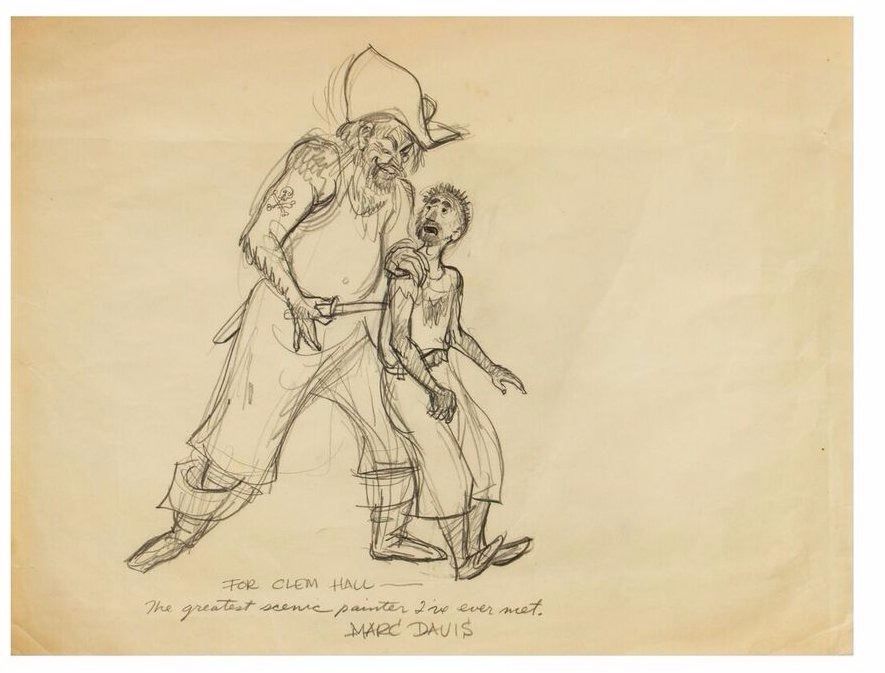
Wisely, they abandoned their efforts to rigidly preserve the look of the Davis characters and allowed artists to re-imagine their appearance.  Almost all of the stretching portrait artists are anonymous, but the more realistic style that replaced the Davis type is attributed to Clem Hall. Hall was an apt choice, since Davis held him in high regard: 

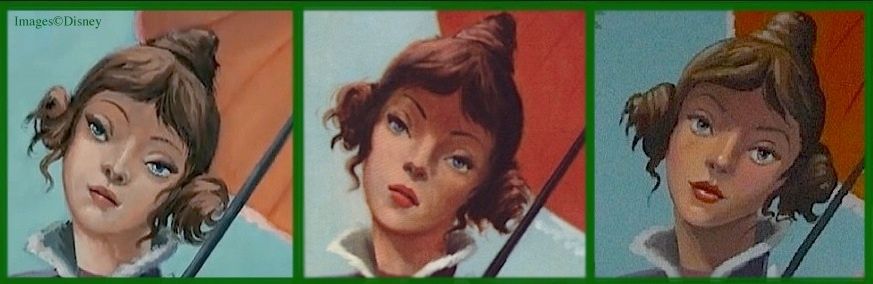
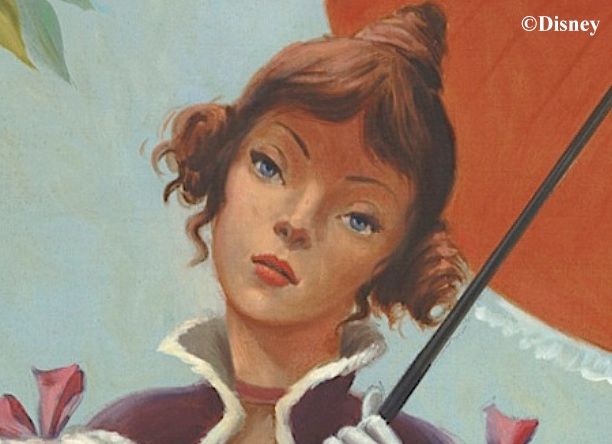
That's really something when you consider that Marc Davis was notoriously chary in handing out praise. Anyway, one set of portraits Hall produced around 1982 has been widely reproduced in books and posters.  Here's a set of three non-Davis Ally Gal heads, with the recently auctioned "1972" model on the left, Hall 1982 in the middle, and the current DL version on the right.  (In the remarks that follow, bear in mind that it's possible Hall did both left and middle.) [Edit: the "1972" canvas is now being attributed to Elmer Plummer.]


It is obvious at a glance that we are justified in speaking of a variety of interpretations of the character.  If you look closely, these three faces read quite differently, don't they?  Our '72 girl has a dreamy, far-away look in her eye, but her mind is clearly occupied.  She looks like she's remembering something.  The look is wistful but intelligent.  You might conclude that she's oblivious to the presence of death because she's not really present, she's daydreaming of some past event or person.

There are some nice details in this one.  For one thing, her mouth is open, and you can even see her teeth (very well done too).  That's unusual, maybe even unique.  Those eyes seem almost impossibly far apart, but that contributes to her look, doesn't it?  I see a certain sweetness in this one not found in most of the others.  It may not go back to '72, and I don't think I'd pay forty-seven and a half K for it, but there's no denying the collector picked up a nice piece by a talented painter.


As for Hall '82, his Ally Gal has an equally distant look in her eye, but unlike the '72 girl, she looks...stoned.  Seriously, it reminds me of the look a lot of models cop when they're trying to look blank and decadent and ready to be taken advantage of, if you know what I mean, and I think you do.  Now that I've said that, I won't exactly be covering myself with glory if I suggest that she may be the sexiest of all the Alligator Girls, so I won't suggest that.  I'll let someone else suggest that.  I won't suggest that.  Oh, and do you see the unique facial feature?  She's almost frowning.  In fact, she's on her way to a full-on pout, but I don't think she will ever get there.  Pouting takes too much energy, and she's pretty wasted.


Whereas other Ally Gals have a look of innocence about them, Hall's girl is anything but innocent.  Not with that drug problem.  With this version of the joke we have someone who isn't so much unaware of her fragile mortality as she is uncaring about it.

Then there's the current version.  No doubt about it, this girl is a lot more chipper than Hall's.  Look at the shape of the eyes.  I think the idea was to get back some of the wide-eyed innocence that Hall threw out the window.


She looks a little older to me than the others, and I guess a little more sensible, but frankly it's hard for me to tell, because for some reason this face is seriously lacking in personality.  To me, she's easily the most boring of the lot.

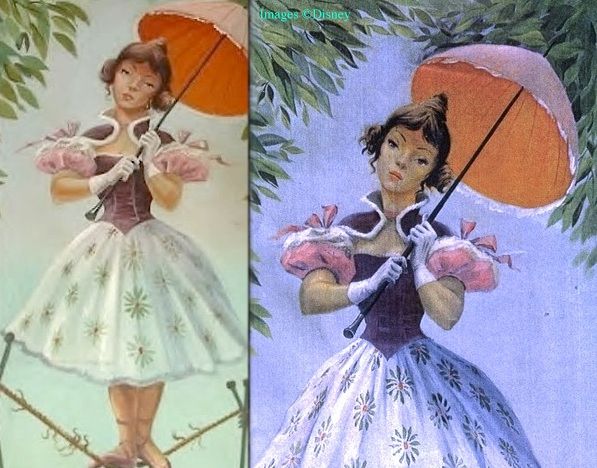
There are photos of other post-Davis Alligator Girls out there too, but I don't have anything high-rez enough to facilitate the kind of scrutiny we've given to the three above.  Here are two others:


If I had to render a judgment based on those inadequate photos, I'd say the one on the left looks a little p.o.'d, but again, that may be the photograph's fault.  The one on the right is very Hall-esque, but with a slightly more perplexed and disturbed look.  It's very subtle, but the Clem Hall frown almost means something here.  In some ways, she seems to me the most poignant of the Tightrope Walkers we've looked at, since you could interpret her expression as a sort of dawning realization that beauty doesn't mean much in the long run.  No, she isn't there yet, not by any means, but she may be the closest of the lot to realizing, vaguely, that she too has a hungry alligator beneath her pretty little feet, like all the rest of us.

Next up:  The other stretchroom denizens get the same treatment.
.