Following up on the Tightrope Walker post, it seems only fair to give the other portraits the same treatment. The differences in artistic interpretations of these characters are at least as noticeable as was the case with Ally Gal, and in some cases they are even more dramatic.
Here's Connie (née "Abigale Patecleaver," her name in that same old X. Atencio script cited earlier). Left to right we've got (1) Marc Davis's original sketch, (2) a Davis-style canvas actually used in the attraction during the first year or two,* (3) Clem Hall's version ca 1982, and (4) the current DL version. We'll use that formula with the other characters as well, displaying the same four representations in the same order.
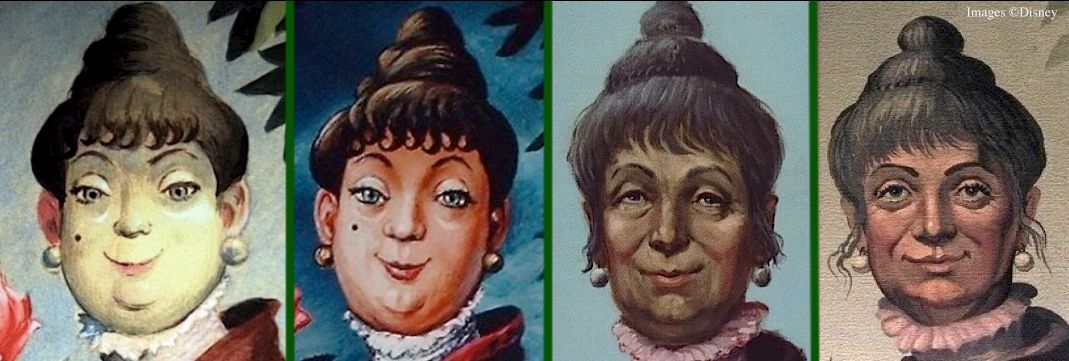
The first thing I always notice about Marc's original is that this widow is not very old. She's put on a few, but she's still cooking on all burners. Secondly, there's a huge contrast between the fried-egg madness in the eyes of Marc's Tightrope Walker and the nimble intelligence of this widow. If this is madness, it's an utterly different form of madness. This is truly a classic Marc Davis sketch, in my opinion. The self-confidence is there, the cold-bloodedness, the wicked edge. She seems quite pleased with herself. She keeps her secret without a trace of guilt feelings. And check out the colors in that face! Yellow skin, grayish-green shadows, pink ears—and yet, mirabile dictu, she doesn't look sickly but very much alive and well. Unless someone had called your attention to it (like I just did), would you ever have noticed how daring and original Marc's palette is in this sketch?
As I pointed out in the Ally Gal post, the first stretching portraits tried to retain the Davis drawings, but they "naturalized" the colors. As was the case with Ally Gal, the widow done this way isn't nearly as good. And don't think Marc didn't notice the way they trashed his color scheme. During an interview with Alice Davis during one of the 40th Anniversary events in 2009, she lamented that many of Marc's gags were either not used or were "overloaded."
Interviewer: "But a lot of Marc's stuff is still in the Mansion, with—like the stretching portraits, and things like that."
Alice: "Yes, but they're not his. They're somebody else's, and the color is not as, uh, nice as what Marc's or Mary Blair's would be to the eye."
When we get to Clem Hall's widow, we have a real revolution. She's quite a bit older. She's drunk. She's got a droopy, somewhat vacant look as a result. But she's still got a few essential qualities remaining from the Davis original. She's smug and self-satisfied. She knows something that you don't know, but that woozy look keeps her from looking pompous about it. You suspect that there's definitely something going on in there when she's sober.
And then there's the current version. Another disappointment. That woman has been drinking iced tea, not wine. Too friendly, too sincere, and like the current Ally Gal, seriously lacking in personality. Does she look to you like she's keeping a secret? Pthh. On to the next...
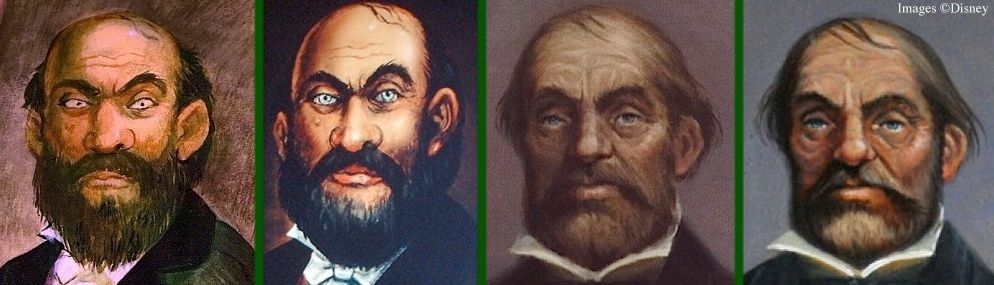
Marc's original Dynamite Guy looks like a leftover pirate from POTC, and I mean one of the mean ones. Look at those beady eyes. This is a look of undisguised cruelty and barely-suppressed rage. The colors are much more natural this time, so the canvas version is not such a radical departure. Very little difference, except that the eyes have been softened. With those pretty blue peepers, you're tempted to think that maybe, just maybe, this guy started out in life as a nice little boy and turned bad at some point. Davis's original, on the other hand, was born bad.
Clem Hall, once again, reinvents the character. This guy isn't evil or angry (let alone crazy or drunk); he's just plain stupid. It's a study in pride and vacuity. The more you look at him, the more convinced you are that he hasn't had an interesting or intelligent thought in his life, but that apparently hasn't kept him from becoming a Somebody. Are those eyes gazing unfocused at something in the distance, or are they gazing inward at the void where his soul should have been? Seriously, if you were told that this is a painting of a blind man, you might well believe it.
In this case, the current version has aped Hall's version so closely that there isn't a lot to say. So that's it. On to the next...
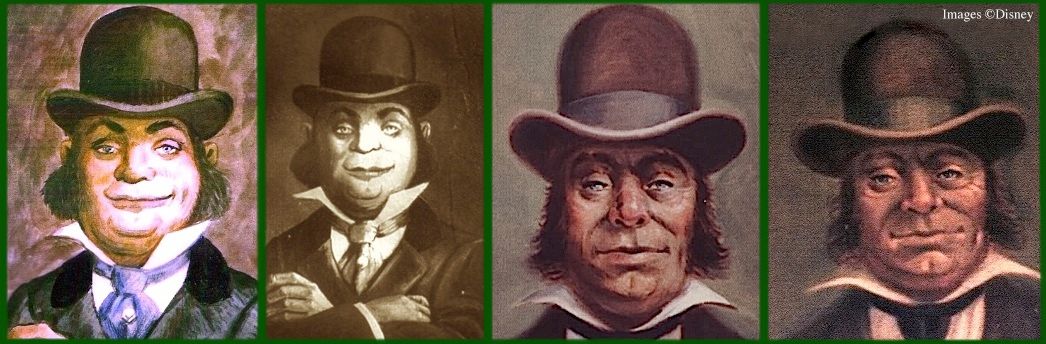
What we have here is a smug toad. He's self-satisfied and superior, but he's not threatening, not particularly vicious. Alas, I have no color photo of the Davis-like canvas, so we are at a disadvantage there, but it looks like they botched the shape of his face a little. The smile is not as broad, the cheeks don't bulge out as they should. Something is definitely lost in that part of the face.
Once again Clem Hall, it seems to me, has given us a drunk. Nose and cheeks are red, eyes are pale and watery. He's feeling no pain. It's another study in vacuity. Those eyes are staring out at the world unseeing. Remember the overall message of the stretching portraits? The things most highly prized in this life are mere vanities that only serve to distract us from the reality of death. That is what many would call a "sobering thought." With Hall's characters, the state of mind untroubled by that sobering thought is represented, quite naturally, by what looks like an alcoholic haze.
As usual, the current version has sobered up the subject considerably, and as usual it has failed to fill the void with anything particularly interesting.
The remaining Quicksand Men are of less interest, since by the time you see them the joke is beginning to unfold. As the ironic distance between the smug upper portrait and the macabre reality beneath diminishes, so also opportunities for artistic reinterpretation of the joke diminish. Not surprisingly, then, the post-Davis versions don't reinvent the two lower Quicksand Men very radically.
Once again Clem Hall, it seems to me, has given us a drunk. Nose and cheeks are red, eyes are pale and watery. He's feeling no pain. It's another study in vacuity. Those eyes are staring out at the world unseeing. Remember the overall message of the stretching portraits? The things most highly prized in this life are mere vanities that only serve to distract us from the reality of death. That is what many would call a "sobering thought." With Hall's characters, the state of mind untroubled by that sobering thought is represented, quite naturally, by what looks like an alcoholic haze.
As usual, the current version has sobered up the subject considerably, and as usual it has failed to fill the void with anything particularly interesting.
The remaining Quicksand Men are of less interest, since by the time you see them the joke is beginning to unfold. As the ironic distance between the smug upper portrait and the macabre reality beneath diminishes, so also opportunities for artistic reinterpretation of the joke diminish. Not surprisingly, then, the post-Davis versions don't reinvent the two lower Quicksand Men very radically.
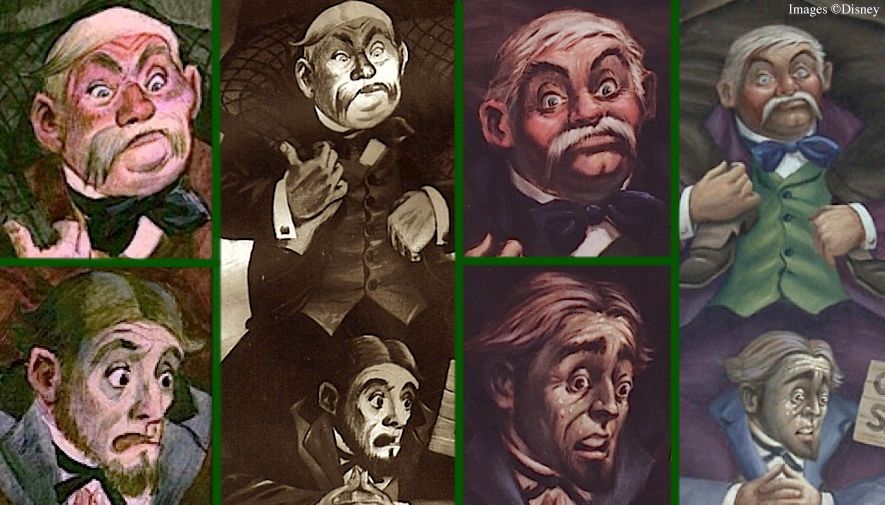
The middle guy has only just now spotted the quicksand sign and has only begun to realize his dire situation. You see pure shock in his face. Even in this moment, he still has his sense of self-importance with him. It's not, "This can't be happening!" so much as "This can't be happening to me!" The bottom guy is past that. He's been aware of the situation for several seconds by now. Initial panic has turned into a full comprehension of the inevitable. Hall et al have added sweat droplets to Davis's original. Hmm. Is that the hot sweat of exertion or the cold sweat of terror?
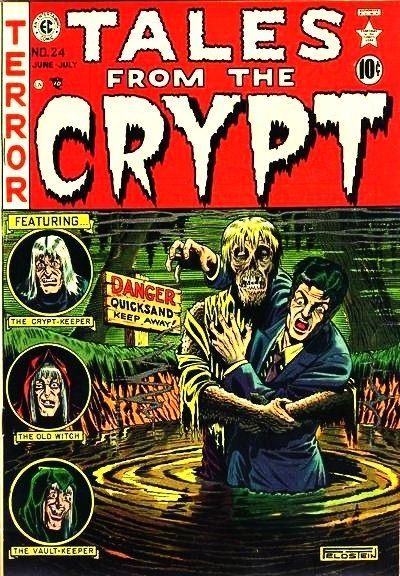
On a lighter note, we discussed in an earlier post the evidence that Davis looked through old EC horror comics for inspiration from time to time. Seems to me there are enough elements in common between this Al Feldstein cover art and Davis's Quicksand Men to raise suspicions.
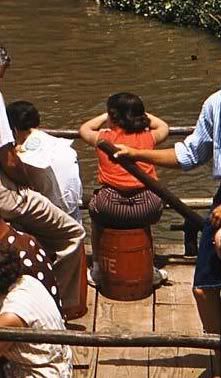
On the other hand, there is no need to go rummaging through old comics in search of inspiration for the basic gag in the Dynamite Guy portrait. A plausible source can be found right under our noses, mere yards from the Mansion.

* And now, of course, one of the original 1969 Wicked Widow portraits from a Disneyland stretching gallery has surfaced.
••••••••••••••••••••••••••••••••••