Things You're Just Supposed to Know

Most of the time, Long-Forgotten assumes that readers are already familiar with basic facts
about the Haunted Mansion. If you wanna keep up with the big boys, I suggest you check out
first of all the website, Doombuggies.com. After that, the best place to go is Jason Surrell's book,
The Haunted Mansion: Imagineering a Disney Classic (NY: Disney Editions; 2015). That's the
re-named third edition of The Haunted Mansion: From the Magic Kingdom to the Movies (NY:
Disney Editions, 2003; 2nd ed. 2009). Also essential reading is Jeff Baham's The Unauthorized
Story of Walt Disney's Haunted Mansion (USA: Theme Park Press, 2014; 2nd ed. 2016).

This site is not affiliated in any way with any Walt Disney company. It is an independent
fan site dedicated to critical examination and historical review of the Haunted Mansions.
All images that are © Disney are posted under commonly understood guidelines of Fair Use.

________
.
Showing posts with label Walt Disney. Show all posts

Friday, November 26, 2010

How the Haunted Mansion Changed the Game

.
When Disney commissioned a 50-state survey in anticipation of Disneyland's 50th anniversary in 2005, the three favorite attractions of all time were:  (1) Space Mountain, (2) Pirates of the Caribbean, and (3) The Haunted Mansion.  But even though the HM ranks third in a survey of the general public, it is well known that it enjoys the most passionate and devoted fan base of any Disney park attraction.  (Can you imagine trying to do a blog like this for Space Mountain?)  Someone might argue that the steam train crowd is much larger and equally fanatic, but the Disney trains are only one set among the many other steam trains out there, and I'd say it is that collective that is the object of the train enthusiast's ardor, not just the Disney specimens (however lovely they may be).  From time to time there have been attempts to gin up an internet following for Pirates of the Caribbean, but despite the ride's broad popularity, the response to these attempts has always been tepid in comparison with the Mansion.  In terms of its cult following, the Mansion is in a class by itself.
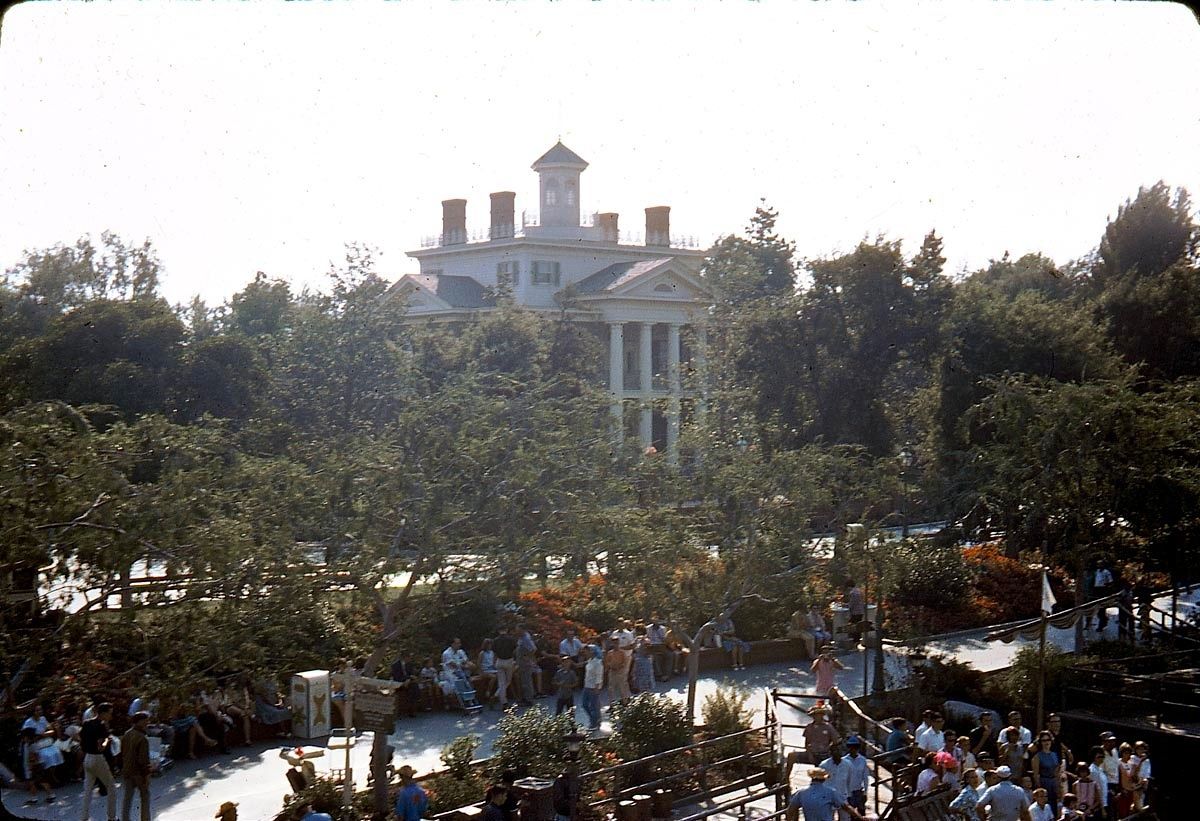
One of my all-time favorite HM photos.  July 1964, fully five years before opening.  Thanks to the haze, the building itself looks like a ghost, doesn't it?
You can easily imagine it just...fading away, like a mirage, leaving only trees where once it stood.  (Photo from the indispensable Gorillas Don't Blog)

If today the HM is widely recognized as one of the crown jewels in the Disney parks, it will no doubt be surprising to some of its fans (especially the younger ones) to learn that the HM was once regarded as something of a disappointment.  True, it generated a lot of excitement when its doors finally creaked open.  Early reviews were positive, and it was responsible for setting a new park attendance record the weekend following its debut (August 16, 1969: 82,516 guests).  To judge by those early crowds, the HM was an unqualified hit.
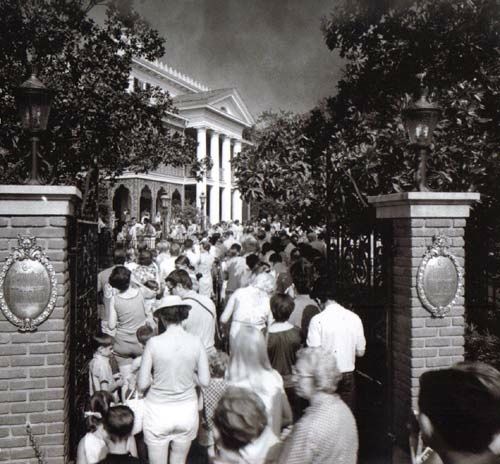
Ugh, I shoulda brought a magazine.
(pic from Disney twenty-three [Fall 2009] 28)
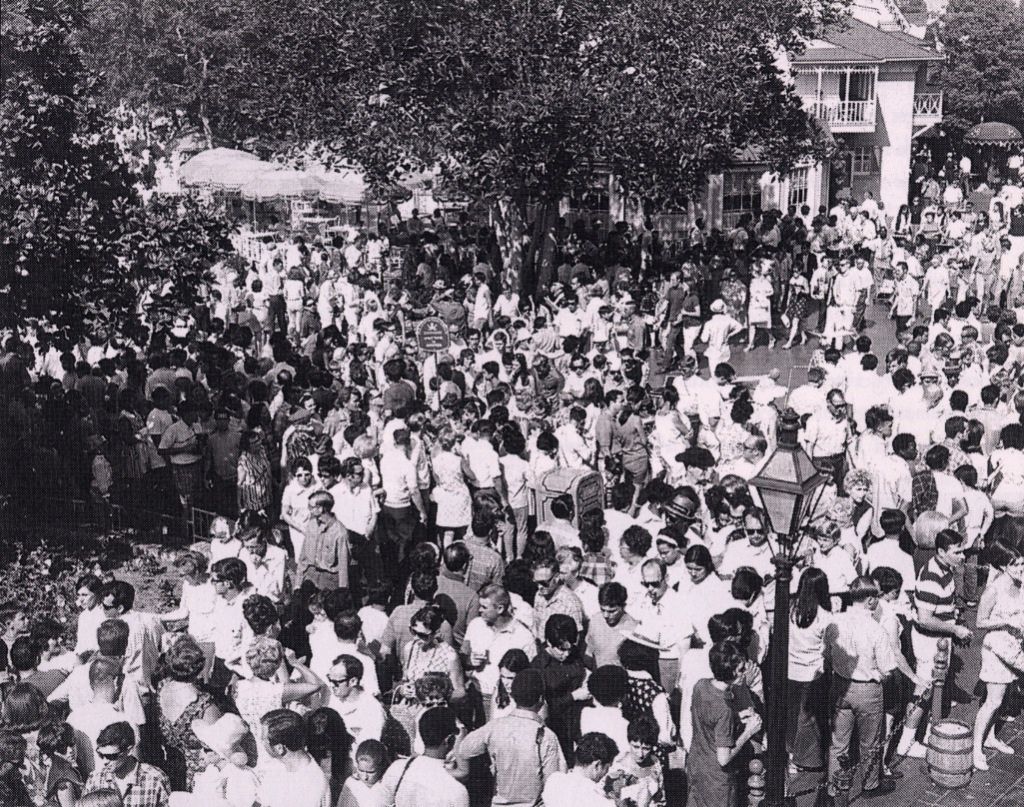
Did I say magazine?  I shoulda brought a book.
(August 16, 1969. This photo has also been identified with the opening of POTC two years earlier)

Nevertheless, the early excitement didn't last very long.  The Imagineers themselves were less than enthusiastic about their latest production.  It's well-known that Marc Davis was dissatisfied with it.  He thought that too many cooks had spoiled this particular broth, too many good ideas had been compromised on the way to execution.  Rolly Crump has been known to articulate a similar view.  He believes that the overall show quality suffered a major blow when they finally decided once and for all against the walk-thru format and went with the omnimover system.  When Ken Anderson got around to seeing the attraction for the first time, he said that frankly he was "very disappointed."  There was from the beginning a segment of the public that was disappointed with the lack of real scares, but there is evidence that after a year or so the public in general had also begun to cool on the new attraction.  The HM was celebrated in a March 22, 1970 episode of The Wonderful World of Disney.  When that program was rerun later in the same year, you could find notices like this one in the TV listings:
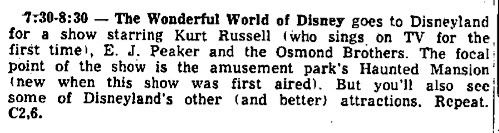

That's unusually snarky, but it jives with my own recollection of those early years.  The consensus was that the Haunted Mansion was
good, but not great.  The early prophecy published in the Chicago Tribune, August 17th, 1969, turned out to be eerily accurate:


Some of you Forgottenistas may well wonder why this attraction, so admired today, was regarded as a bit of a letdown after the initial excitement had worn off.  I think it's because the Mansion did not meet the public's expectations.  It did not fit the trajectory established throughout the course of the sixties by a succession of increasingly spectacular new attractions.  This was the golden age of audio-animatronics.  When the Tiki Room debuted in 1963, it was a real jaw-dropper, a quantum leap beyond anything that had preceded it.  But Walt barely let people catch their breath.  He astonished them anew at the 1964 World's Fair with the audio-animatronic wizardry of Mr. Lincoln, the Carousel of Progress, and Magic Skyway.  Lincoln was brought to Disneyland in 1965.  It's a Small World and Primeval World (from Magic Skyway) came in 1966.  By that point we were beginning to expect at least one miracle per year from Mr. Disney.  And sure enough, this dazzling parade continued into 1967 with the multiferous wonders of the New Tomorrowland (including the Carousel of Progress) and Pirates of the Caribbean.  In those days it seemed to us that Disney was committed to topping itself each time it unveiled a new attraction.  They intended to leave no jaw undropped, no mind unboggled, world without end, amen.
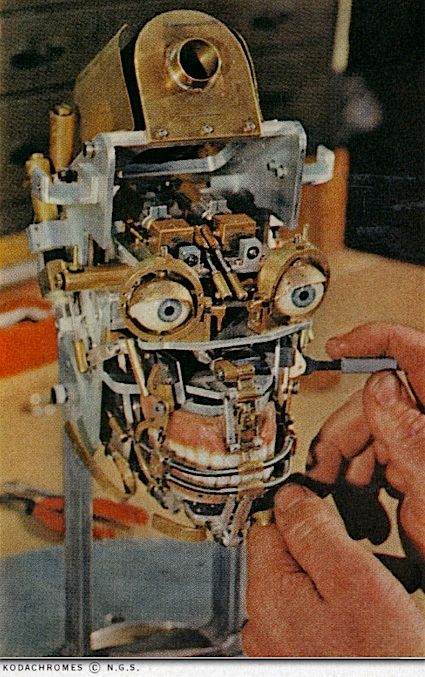

You know, I think that to some degree this crescendo of marvels was a mirage.  From the Tiki Room to Lincoln and the Carousel of Progress was indeed a leap forward, but that was it.  1964 proved to be the AA climax, the point beyond which '60's technology simply could not go.  But Walt was nothing if not a marketing genius, and since most Disneyland guests had never seen the World's Fair, the skillful introduction of 1964 attractions in '65, '66, and '67 created the illusion of continual technological progress.  The Disneyland version of Small World was much larger than the NYWF version, using sheer scale as part of its "wow" factor.  The same was true of POTC.  From a purely techno point of view, there's only one AA figure in Pirates (viz, the Auctioneer) that is of comparable complexity with the Abraham Lincoln figure or "Father" in the COP, but no one seemed to notice that.  With Pirates, once again sheer scale and the quality of showmanship gave the impression that the ball continued to move downfield in every sense.  What will those R & D geniuses at Disney come up with next year?  They haven't disappointed us yet!

Then 1968 goes by.  Then half of 1969 is gone.  All eyes are impatiently set on the next miracle-in-waiting.  Great Caesar's ghost, what technological marvels will the Mansion display when it finally opens?  What eye-popping explosion in show scale?  And a haunted house!  Can you imagine?  We couldn't wait.
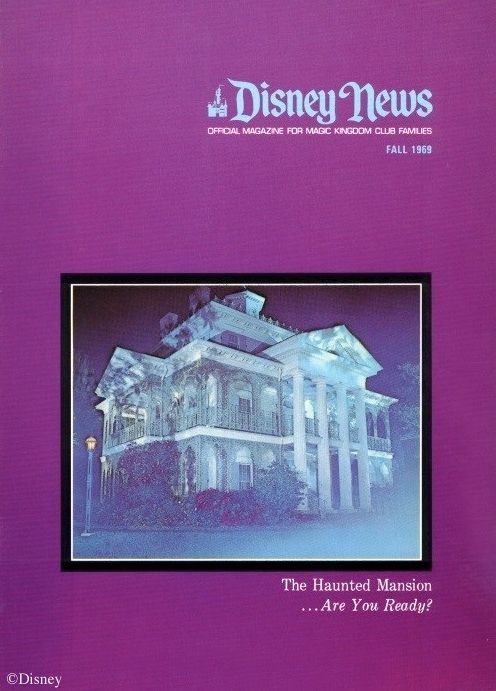

Are we ready???  This is a joke, right?

But what we expected was not what we got.

The Haunted Mansion was the first major new Disneyland attraction since forever that did
not represent ANY advance of ANY kind in either size or technological sophistication.  Zero.

Oh, there were a few fresh new tricks, notably the "Leota effect," but once you figured that one out (I swear, my brother and I figured her out after one day), it was obvious that it did not represent anything new in audio-animatronics.  The entire show was no bigger than Pirates—in fact, it was smaller—and the AA figures were no more sophisticated—in fact, they were less.  Not that the show wasn't amusing, it's just that we had come to expect . . . more.
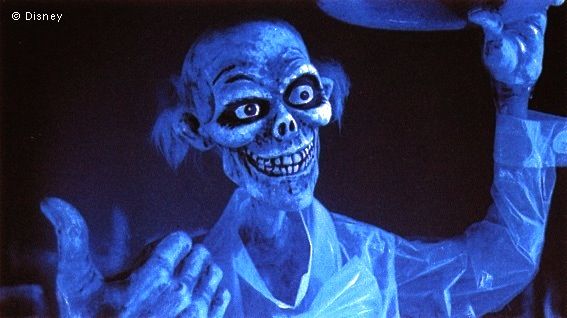

Now, you could make a case that this deviation from the script was a fluke.  The team at WED was indeed a little numb, almost in a state of shock, after Walt's passing, and the HM was the first attraction completed without Walt around to make the big gutsy decisions, adjudicating the debates over fundamental issues like show concept and design, which were still in a state of flux in 1966.  (Pirates was well past all of that when Walt died, and it could coast to the finish line.)  It would be tempting to conclude that with the HM they settled for a pale imitation of POTC, as if they were anxious to just finish the damn thing and clear the pipeline of Walt-era projects so that they could pause, regroup, reassess, and redefine themselves for a totally post-Walt world.

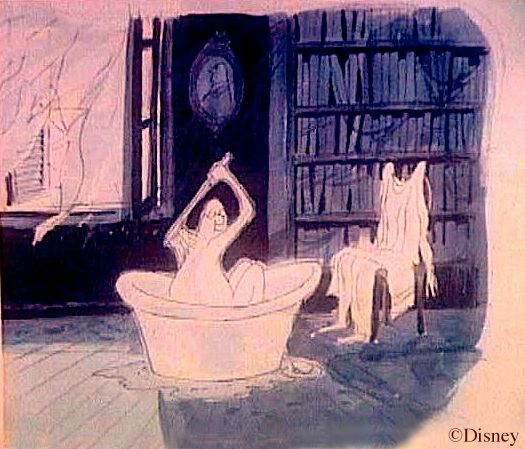
That's a tempting analysis, and there may be some truth to it, but on the whole I don't subscribe to it.  For one thing, there was still a relatively easy way to keep the carousel of progress spinning, and that was through scale.  Everyone knows that the HM façade was built in 1962 and just sat there for seven years, but did you know that the show building out back was not built until early in 1969?  They could have chosen to make the ride noticeably longer and bigger than POTC and satisfy public expectations that way.  Marc Davis had gags galore.  There were plenty of unused ideas.  Hey, how about a haunted kitchen?  a haunted bath?
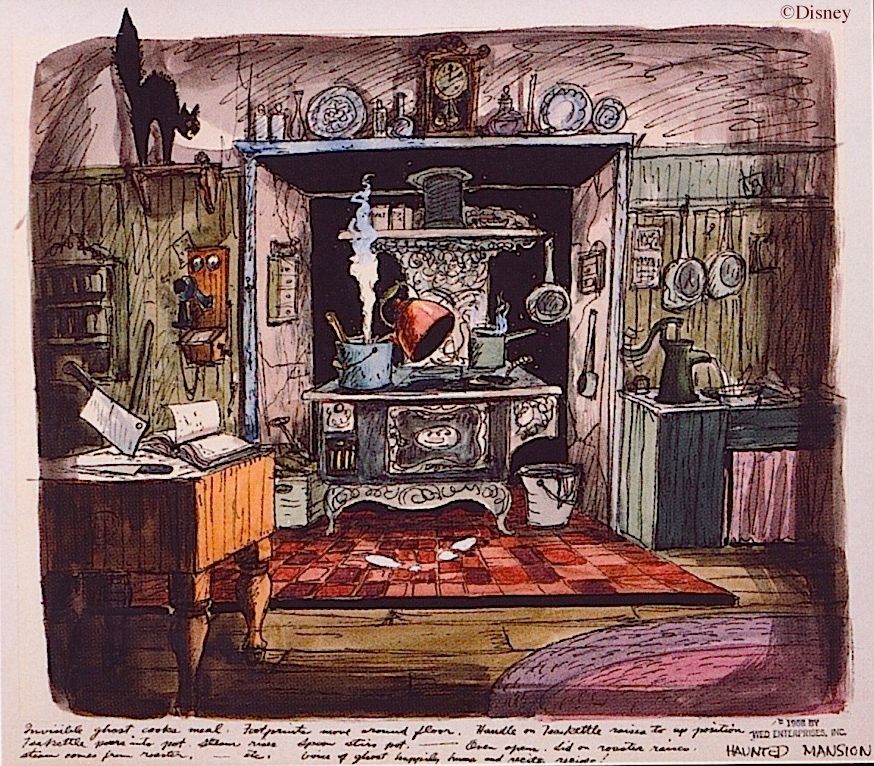


You could also argue that the HM was simply the point where they decided to end the charade.  Perhaps you can successfully top yourself with each new outing for awhile, but sooner or later it's going to defeat you.  No one can do that forever.  Better to commit yourself to variety and to quality, eliminating impossible forms of competition with your own past.  I think that this argument too has some merit.  Seen this way, the HM was the pivot point, the watershed that made possible '70's attractions like the Mickey Mouse Revue, Country Bears, and America Sings.  As I recall, no one felt pressured to compare those attractions with Pirates to see if they represented the next step upward on some kind of endless golden ladder.  Rather, people recognized intuitively that they were creative departures, utilizing AA technology to do something different.  "Hey look, we've had birds, people, dolls and dinosaurs, but this time they're bringing cartoon characters to life."  Thanks to the Mansion, each major new attraction would now stand or fall on its own terms, evaluated not as to whether it was bigger or technologically more sophisticated than the last one but as to whether it won over the audience with old-fashioned, well-crafted showmanship.  Did it create a believable world unto itself?  And did the things that transpired in that world connect with the human experience—that is, did the show have a heart?  (Of course this had always been the only essential question, but impossible expectations about presentation were now mercifully eliminated.)

You can stop a train by deliberately applying the brakes and coming to a graceful halt, or you can have a wreck.  That'll do it too, you know.  By the above analysis, the HM could have been a disaster, and it would still have served a useful purpose historically, bringing one era to an end and freeing up the options for the next.  But time marches on, and most younger guests today don't know or care which old ride came before which old ride.  Sorry, my peers, but the perception of 1960's Disneyland as one big shining crescendo of upward progress is a memory that belongs to us old fogeys.  As that mental picture has faded, it seems that the estimation of the HM as a top-tier, all-time classic seems to have grown, until we are where we are today.  Obviously, it didn't change the game by being a train wreck!  Therefore, an essentially negative evaluation of the HM, defining it in terms of what it was not, won't do.  What it was, positively, will be the subject of our next outing.


Friday, August 27, 2010

Two Taboos

.
You don't often run into discussions about what isn't in the Haunted Mansion, and when you do, it's usually to note that there isn't any grue, or there aren't any big scares.  Otherwise, it's what's there that gets the ink or the bandwidth.

There are, however, two omissions that create openings for some interesting observations (interesting, at least, to Long-Forgottenistas, or whatever it is we call ourselves).

Children Not Admitted

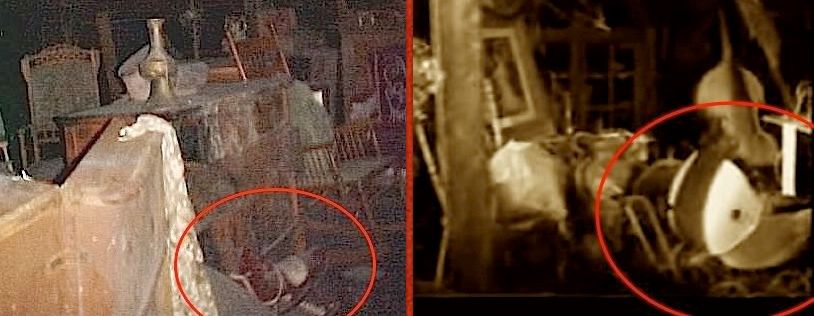
There are no ghosts of children anywhere among the 999.  Nada.  Zip.  Zilch.  The closest we come is a mute admission that children exist within the imaginative world of the Haunted Mansion.  Amidst the junk in the attic have been prams and hobby-horses at one point or another, perhaps an acknowledgment that some of the Mansion residents were once children.  Not exactly news that will make you spill your coffee.


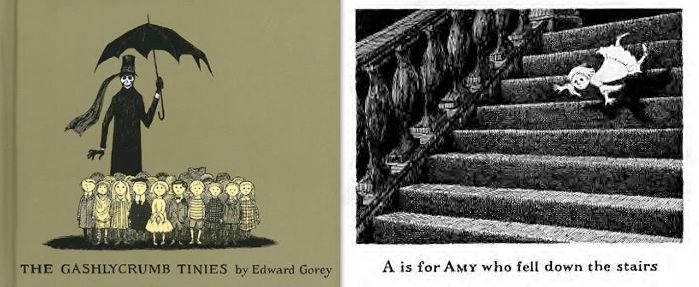
No child ghosts.  It's not as though anyone is pretending that no one under 18 ever dies, so...where are the kids?  At one point I argued that it isn't possible to make jokes about the death of a child.  Well, actually, you can, you know, if your name is Edward Gorey.


But that humor presupposes a very different world, and don't expect to work for Disney if that's your total bag.  Disney's offerings always have an upbeat ending.  They "celebrate the human spirit," to use a typical cliché, and to do so they imagine a cosmos that is essentially hospitable to humans and normally rewarding to anyone who dreams big and beautiful things.  If you hold a blacker, more bitter view of the cosmos, you can grin grimly at Gorey's perishing innocents and say with Gloucester:  "As flies to wanton boys, are we to th' gods, — they kill us for their sport."
If your view of things is not quite that bleak, then there are rules.  You can turn almost any adult's death into a jest, because by then we have all bitten the apple, we are all guilty creatures, and we all kind of know deep down that mortality is the fate we probably deserve.  You can even get away with a suicide joke.  But a child's death is Something Else entirely, and it's just never ha-ha funny to anyone who believes that there are—and should be—better things.

And No Crosses, Either

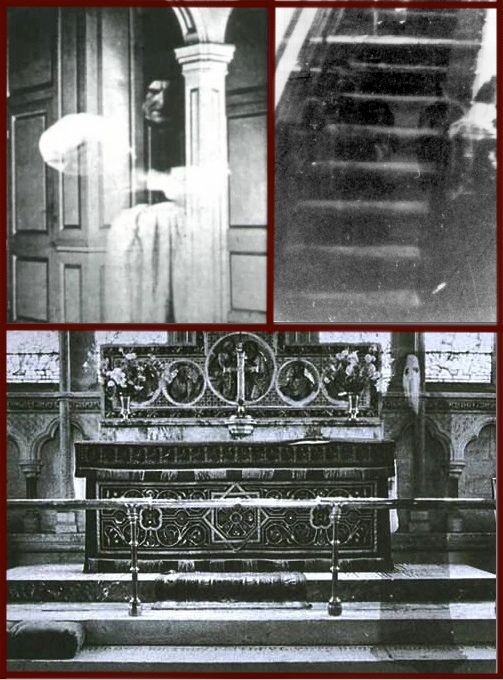
Considering how the Imagineers rifled though traditional material in search of ideas for the Haunted Mansion, it is striking that there are no nuns, no monks, no clergy of any kind.  It's not as if there is a gap in this area:  holy moly, ghost lore is chock full of nuns and monks, both "real" ghosts and literary ghosts.  Monks are especially prone to be caught by the camera, it seems.


Some literary ghosts have left the pages and almost taken on a life of their own (or afterlife, I guess), like the Bleeding Nun, from the 18th c. Gothic novel, The Monk.  Here she is on an early 19th c. magic lantern slide:


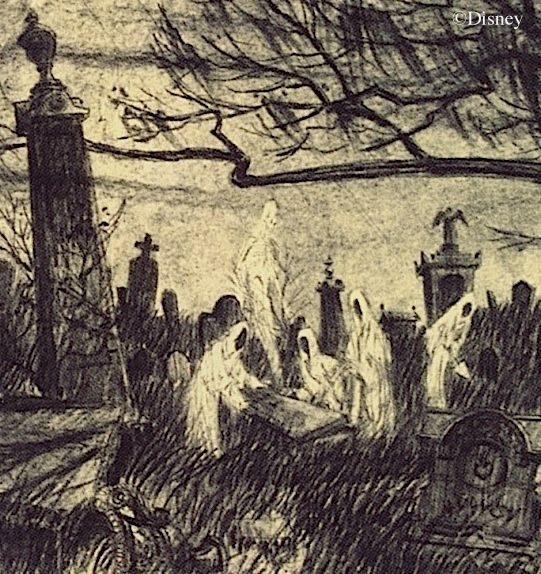
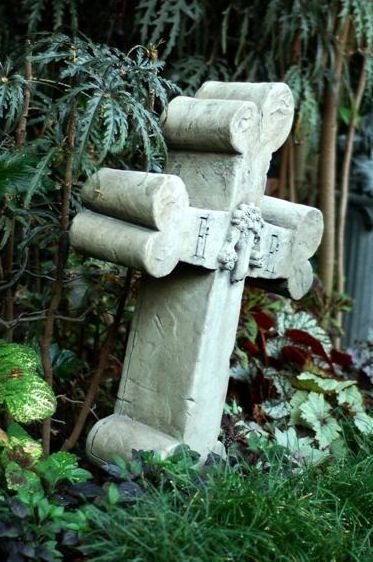
But the Mansion has steered clear of all of this.  It's part of a general taboo that includes any traces of Christian symbolism.  You will hunt in vain for a cross anywhere in the original HM cemeteries.  They aren't there.  It's pretty easy to figure out who was responsible for this, too:  Marc Davis.  Paintings and concept sketches by other HM Imagineers have an occasional cross, like Ken Anderson (Duane Alt)...


.                        . . . or Claude Coats . . .


. . . but Davis?  I've never seen a single cross in any of his concept work for the HM, despite the number of graveyard scenes he sketched.


In 2019 a massive new book on Davis was published: Mark Davis in His Own Words (around here known as MDIHOW), and it includes a number of never-before-seen sketches by Davis, including HM artwork with graveyards and such, and again, there are no crosses anywhere in the new/old artwork.

If you look at photos of the scale model of the graveyard, here again there's not a cross in sight.


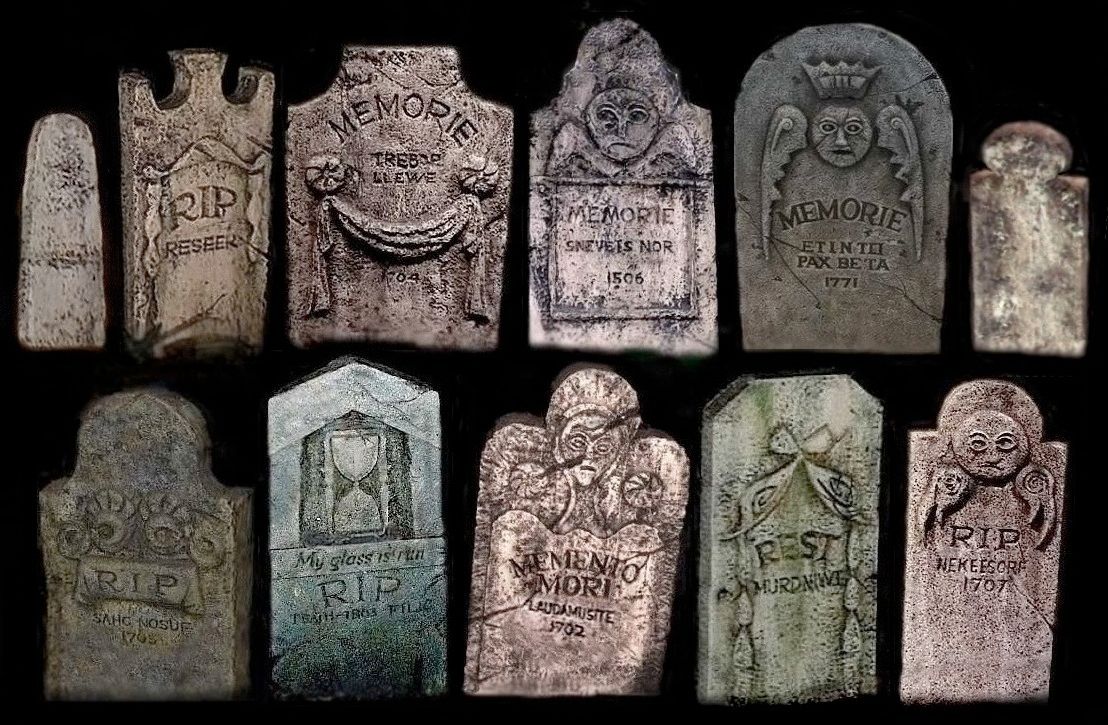
And the taboo is fully realized in the final attraction.  None of the headstones have a cruciform shape.  The winged head, frequently crowned, is extremely common on old New England headstones and represents the flight of the soul to heaven, but it's doubtful if many people know that, and few would consider it a Christian symbol per se since the idea it represents is scarcely unique to Christianity.


Davis was someone who had enough clout in this project to maintain a no-cross taboo all the way through, so all the evidence points to him.

But why this ban?  I rather doubt it was because Davis was so devout.  More likely it was because he was of the old school of thought that there was no reason to take any chance of offending religious sensibilities, especially Christian sensibilities, since that represents a mighty big chunk of the paying public.  I wouldn't be surprised if this was a dictum that came down to Marc from Walt himself.  Believe it or not, kids, in the early sixties it was still possible to worry that some people might think a haunted house was making fun of death, which might be okay so long as you didn't make it irreverent by bringing symbols of genuine, real-world faith into the mix.  It wouldn't be inconceivable at all that a Council of Bishops or a Sunday School association might write a letter of protest at the sight of serious Christian symbols being used as part of mere entertainment, especially with a subject as inherently serious as death.  Why stick your thumb in their eye when you don't need to?

Times change.  In an age in which deliberate and angry forms of literal blasphemy are common shock elements in art and in popular entertainment, it is hard to believe that someone might have worried about irreverence at a level this low (unless it's Islam we're talking about, but that's another story; don't get me started).  In fact, I would be surprised if anyone—including the Imagineers involved—even noticed that the first ever cruciform headstone at the Mansion made its debut in 1993.


If you're searching for the point where the 1969 Mansion comes closest to stepping over the line, I'm going to say it's the inscription on the MEMENTO MORI headstone, one of the nine main designs used in the graveyard scene:  "Laudamus Te" ("We glorify thee") occurs in the Latin Mass.  Ah, but on a headstone, the line can conceivably refer to the departed, so the sculptor gets off on a technicality.  ("If I had meant God, I would have used the equally common but less ambiguous 'Te Deum Laudamus.' ")

The lesson you draw from all of this is going to vary.  Some of you will breathe a sigh of relief that we've emerged from an oppressive cloud into an era of greater artistic freedom, while others will sigh too, but it will be a sigh of mourning over something valuable that has been lost.  Fifi's headstone is a tiny, eccentric milestone on some road or other.  We probably won't all know what kind of milestone until we're closer to the end of that road.
.

Saturday, June 19, 2010

The Mansion Gets Organized

.
Several major updates! May 14, 2014

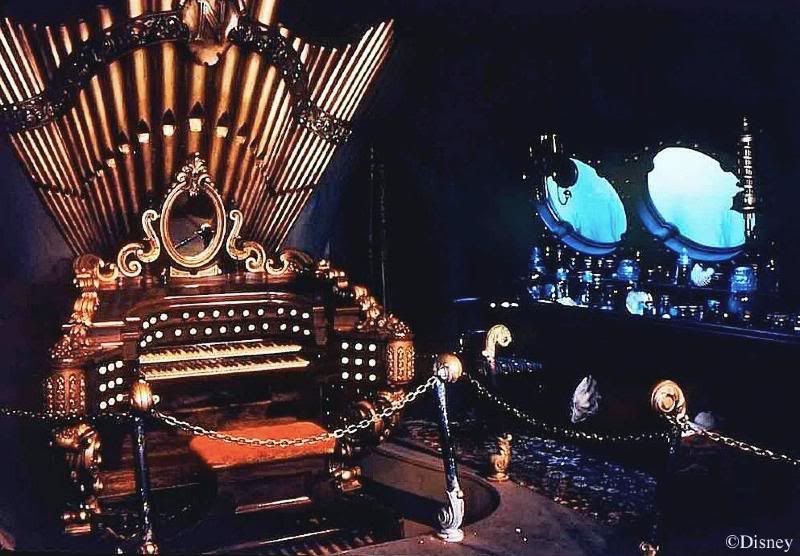
A couple of posts ago I mentioned the well-known fact that the organ in the Disneyland Haunted Mansion's ballroom is the same one used in 20,000 Leagues Under the Sea.  You can get that bit of trivia at any ol' blog; Long-Forgotten readers demand more.  More ye shall have, and yet with no more calories than with those regular Haunted Mansion blogs.  It's amazing.
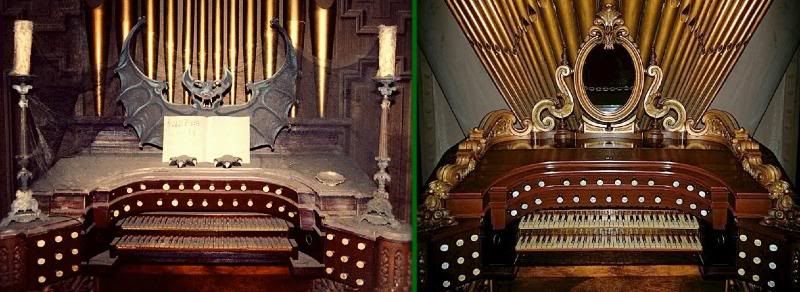
Harper Goff was a Disney genius of the first water.  It was he who designed the Nautilus and all of the sets for the classic 20K film.  One prop that gave him some trouble, however, was Captain Nemo's pipe organ.  The normal procedure was to go to the usual prop houses and arrange for an organ transplant to the 20K sets.  But he couldn't find anything suitable, so in desperation he began scouring the classified ads in the local papers.  He lucked out.  Some guy not too far away had an organ console in his garage that he was willing to unload for cheap.  When Goff saw the instrument he was delighted, because not only was it a handsome piece, but it had all the stop tabs and keys intact (a rare thing with old junked organs).  The owner was pretty tickled as well: that idiot from Disney paid him a cool $50 for an old organ console that didn't even work.

Decked out with a nice set of fake pipes (reportedly, plaster covered with gold leaf), the prop served its purpose, and when the 20K sets were put on display in a Disneyland Exhibit, the organ was a crowd pleaser, judging by the number of photographs around.


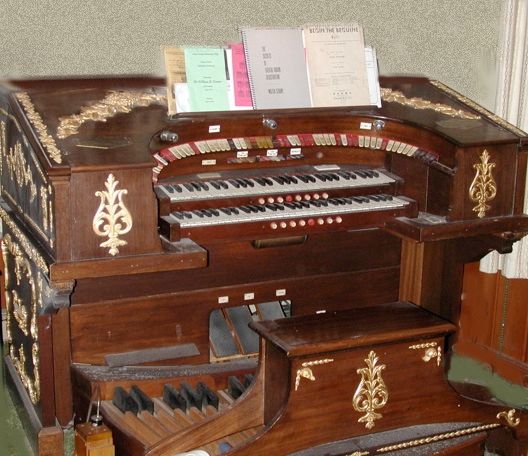
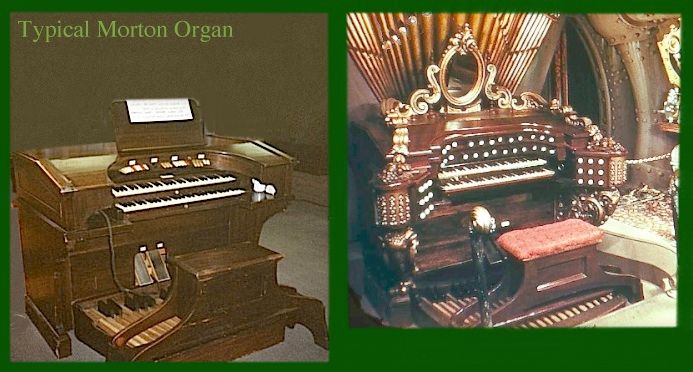
In May of 2014 reader Jonas Clark alerted us to several new details in the story of the 20K organ. It turns out that they did quite a bit more than just sticking a mirror and some pipes on the console. It was a Robert Morton electric theater organ, and like all such electric organs it did not have old-fashioned pull stops but color-coded tabs.

A typical Robert Morton console

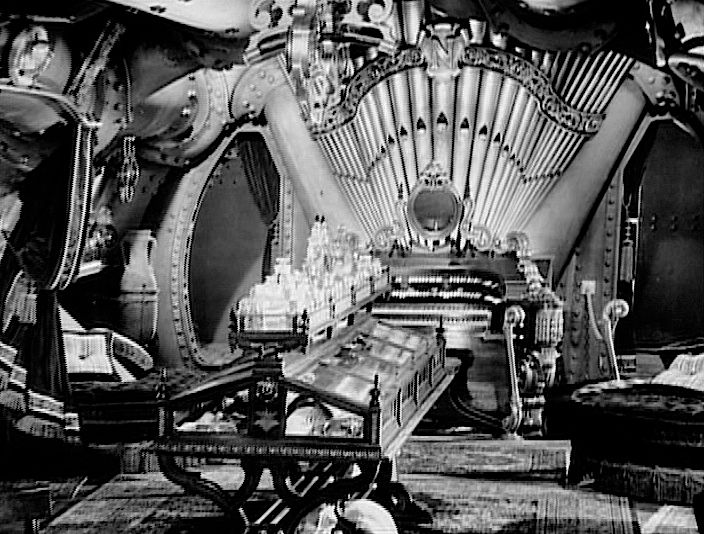
Apparently, the organ was already dolled up and on the 20K set before someone noticed that the
tabs were anachronistic.  In this rare, early production photo of the set you can see the tabs still there:


They pulled them out and covered the ugly holes with a wooden insert covered with dummy pull knobs. The
fix-it may already have been underway when the above photo was taken, as it appears that there are already
knobs on the two wings. Speaking of those wings, they project a little too far out for an authentic Robert Morton
2 manual organ and may themselves have been add-ons, including, one supposes, the ornate corbels beneath them.

In short, Goff's lucky find was modified much more than we have usually assumed before it was ready for the Nautilus.

On, now, to the Mansion.

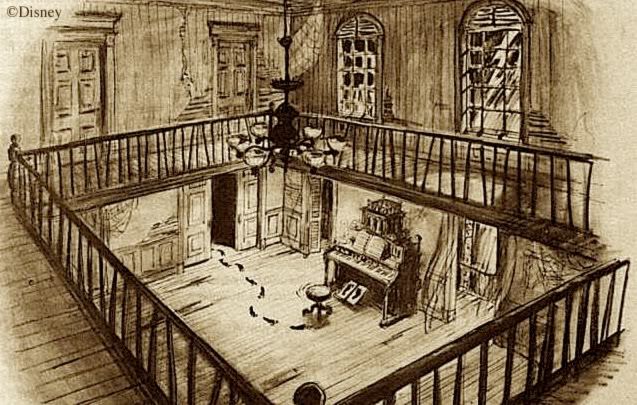
Three years after all this Ken Anderson was given the assignment of designing a Haunted House for Disneyland.  His plans always seem to have included a ballroom with an organ in it, played by an unseen organist, and viewed from a balcony.


For the organ itself, he was happy with an old-fashioned pump organ, a popular fixture in wealthy Victorian houses.


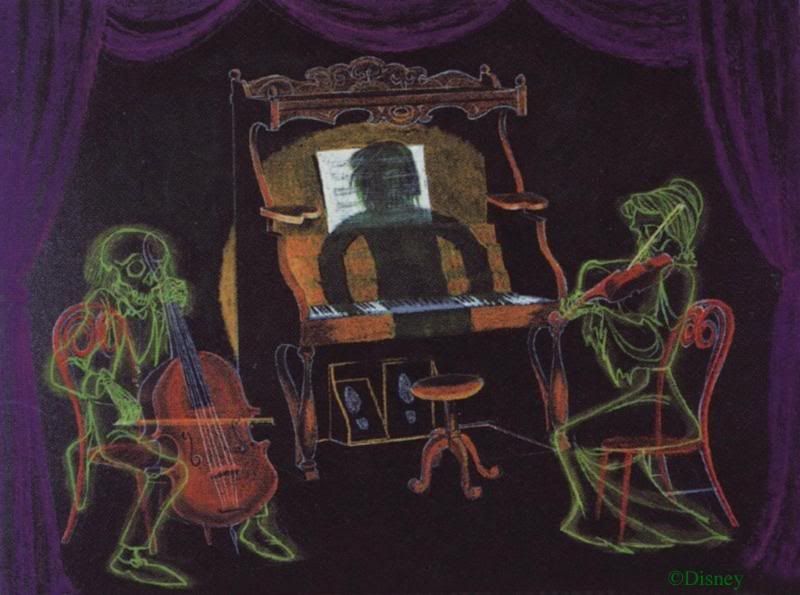
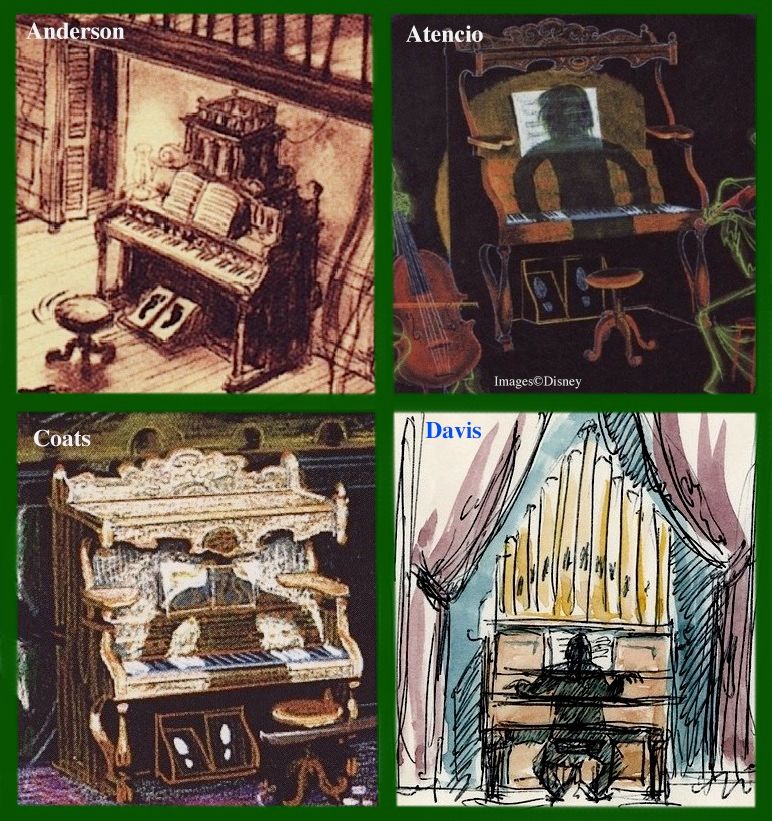
The Imagineers responsible for creating the actual Haunted Mansion gave numerous interviews over the years in a myriad of publications, especially Rolly Crump, X Atencio, and Marc Davis.  It is curious that in the published comments, rarely do they mention Ken Anderson and his pioneering labors in 1957 and 1958 on what would eventually be the Haunted Mansion (X does mention him at least once).  I have to think this is a fluke rather than a snub, perhaps the result of the questions asked and the material discarded in the editing process.  Whatever the reason, it took a long time for Anderson's contributions to be fully appreciated.  (There's a string of posts devoted to Anderson coming up, starting HERE.)  I'm pointing it out now because you will never find a clearer example of how later Imagineers made direct use of Anderson's ideas than this organ gag.  Although the sketch above doesn't show it, Anderson eventually conceived of a number of other instruments in use along with the organ, floating around the room.  That gag was used too, but it was transferred to the Séance circle.  Meanwhile, Anderson's pump organ with its ghostly musician leaving his footprints on the pedals was taken over wholesale by Claude Coats and by X Atencio, along with an ensemble of other musicians.
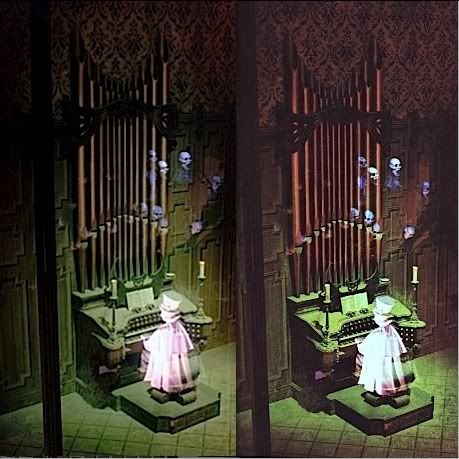


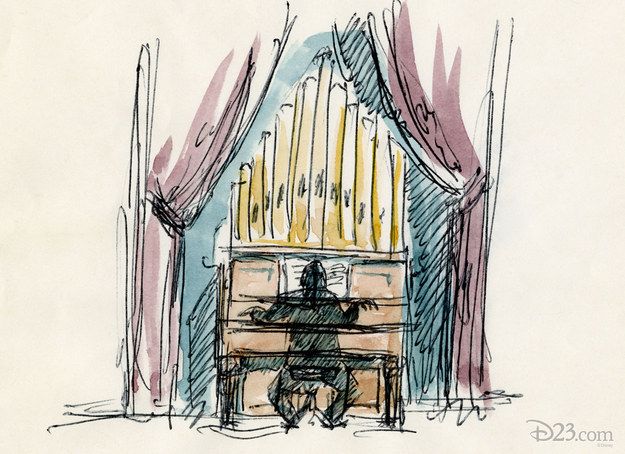
Marc Davis also played around with the idea:

D23/Disney

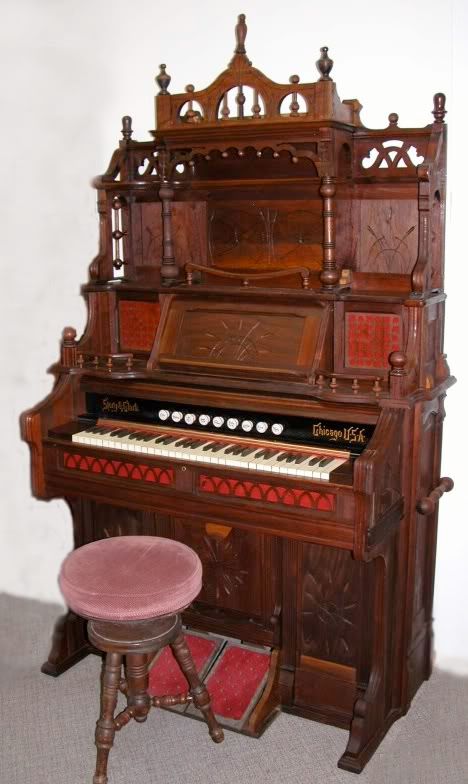
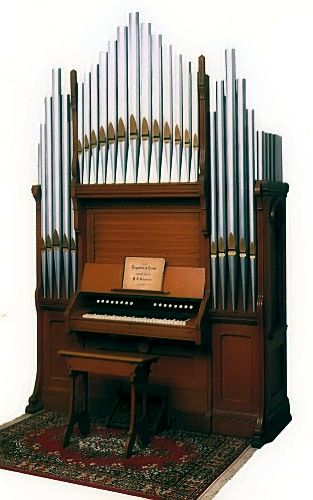
That Davis sketch was not published until May of 2014. In putting a set of pipes on
top, Davis was simply depicting a different style of pump organ, like this 1895 model:


Davis's sketch is a good illustration of the evolution of an idea. Notice how Marc borrows Anderson's original concept and borrows too the shadow organist innovation from Coats and/or Atencio, and then as his original contribution changes the organ style to one with the pipes prominently attached atop, taking the gag one step closer to what we see in the eventual ride.


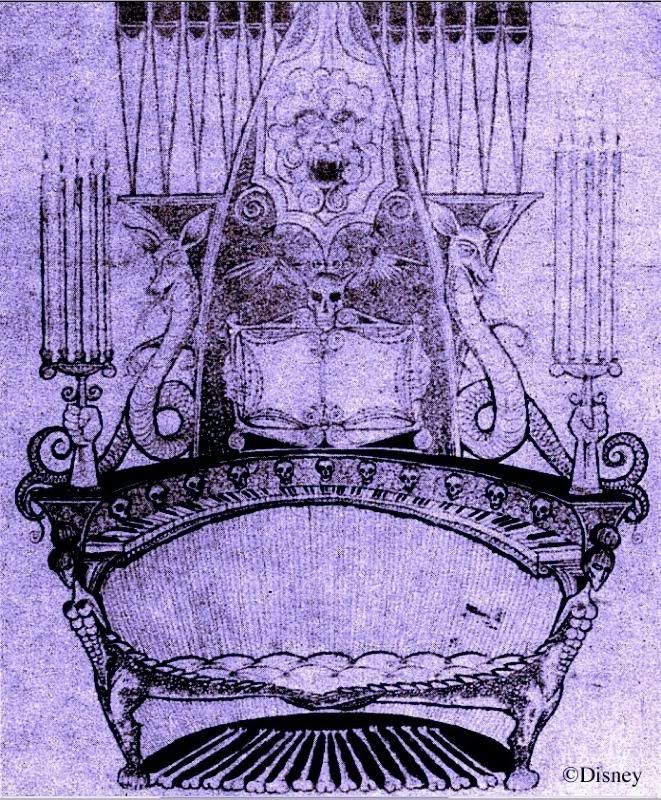
Meanwhile meanwhile, another Imagineer had ideas of his own.  Walt Disney personally recruited Rolly Crump to work on the Haunted House in 1959 because he recognized in Rolly a wild and original imagination with a penchant for the weird and fantastic.  That quaint old pump organ didn't really suit Rolly, who felt that it was important to present guests with things they had never seen before.  Rolly's organ console was, you might say, a little unorthodox.


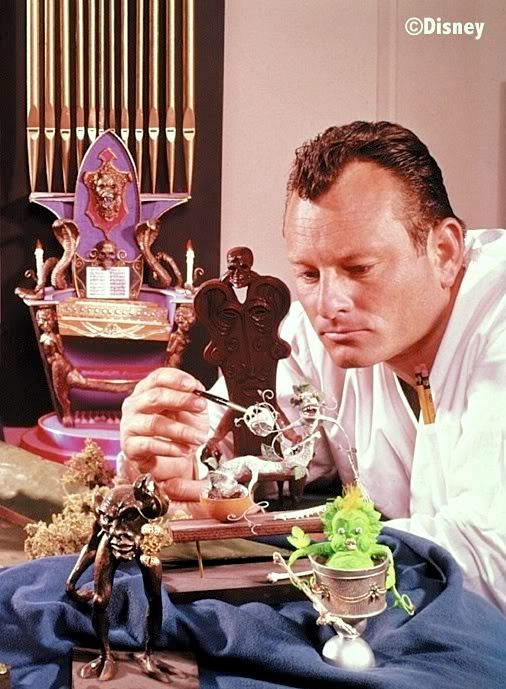
No matter how much the other Imagineers might balk at Rolly's ideas as "too weird," Rolly held a trump card:  Walt loved his stuff.  When Rolly built a small model of this organ, that was the one Walt used to demonstrate the Pepper's Ghost effect for viewers of the television program celebrating Disneyland's tenth anniversary in 1965.


Walt decided to put Rolly's surrealistic material into a "Museum of the Weird," separate from the Haunted Mansion proper.  But what about the ballroom organ?  What's it going to be guys, this crazy thing or the more staid Anderson-Coats-Atencio pump organ?  Or are there going to be two pipe organs in the attraction?  Walt's death in 1966 left questions like that without a supreme arbiter, but in this case, the question answered itself in that same year when the old 20,000 Leagues exhibit permanently shut down and work began on an all-new Tomorrowland.  Somebody realized that the Nemo organ was now available, and it was probably an easy decision to save a few dollars and some time by grabbing it for the Mansion.  So much for the pump organ.

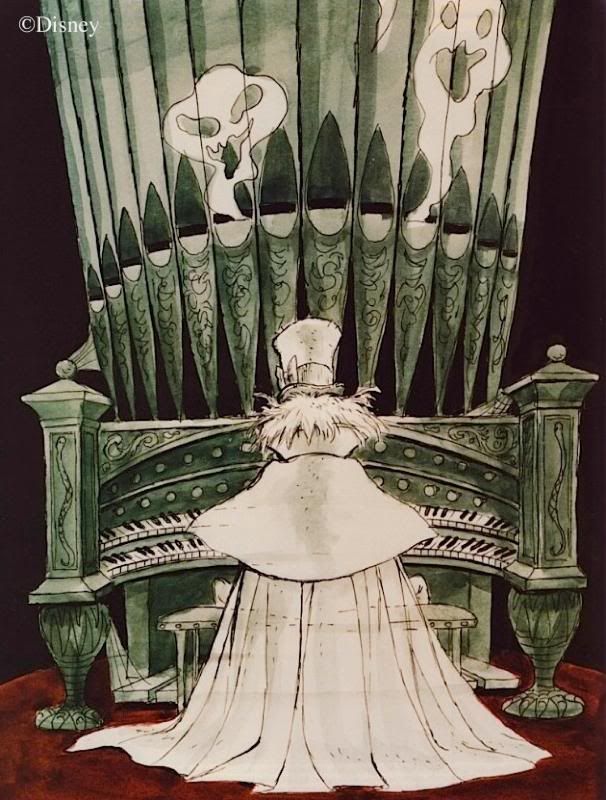
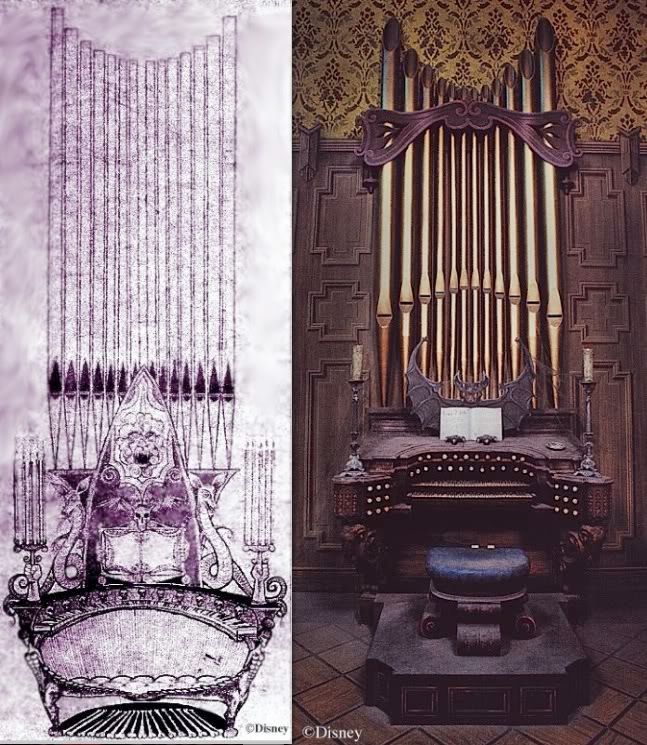
When Marc Davis sketched this concept for the organist, he seems to have had the Nemo organ in mind, judging by the fan-shaped organ pipes.


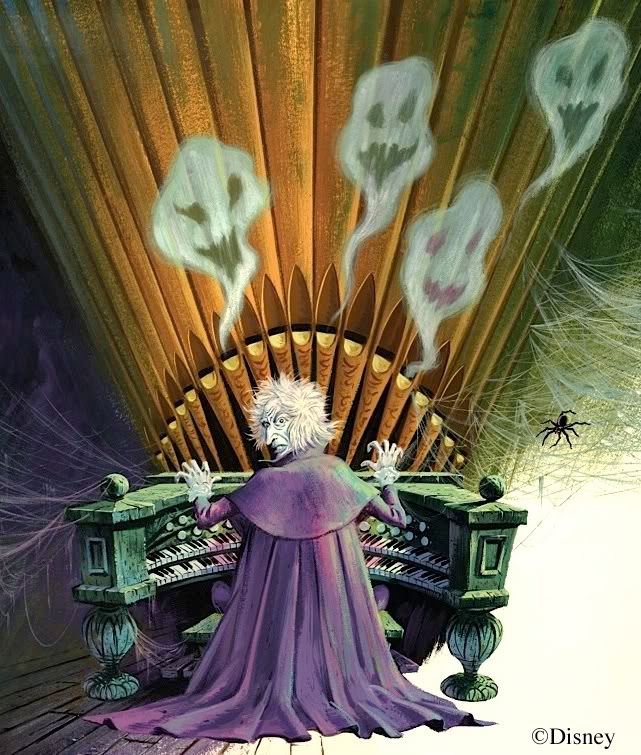
This is even more obvious in Collin Campbell's painting, based on Davis's sketch:


But the Nemo pipes were made of plaster, and the big "N" medallion wasn't something you could just snap off.  Besides, if they just plopped the same organ into the HM ballroom that had been on display in Tomorrowland for over ten years, plenty of guests would likely recognize it for the salvage job that it was.  The solution, of course, was to design a new set of pipes, and ta da, it was Rolly Crump's old design that came to the rescue.  That pipe set remains the single largest survivor from Crump's disused "Museum" designs to make it into the finished HM.


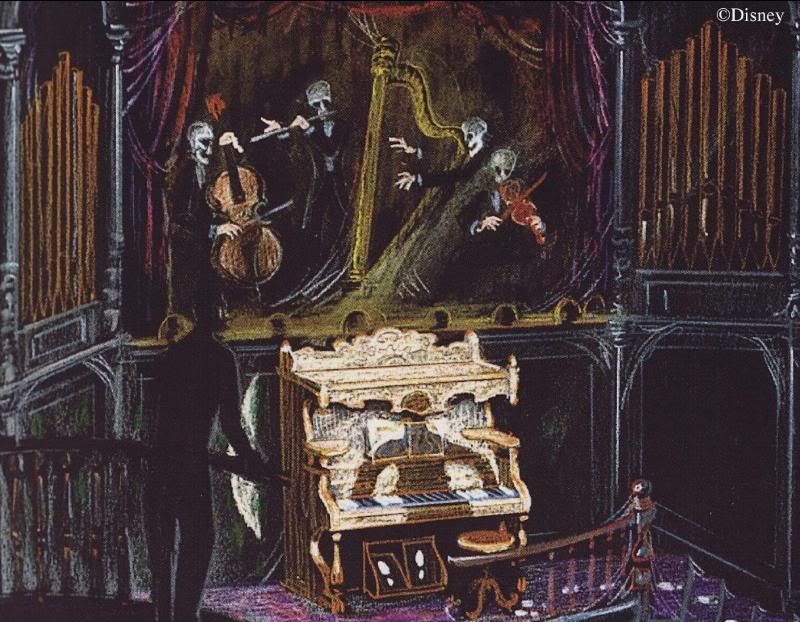
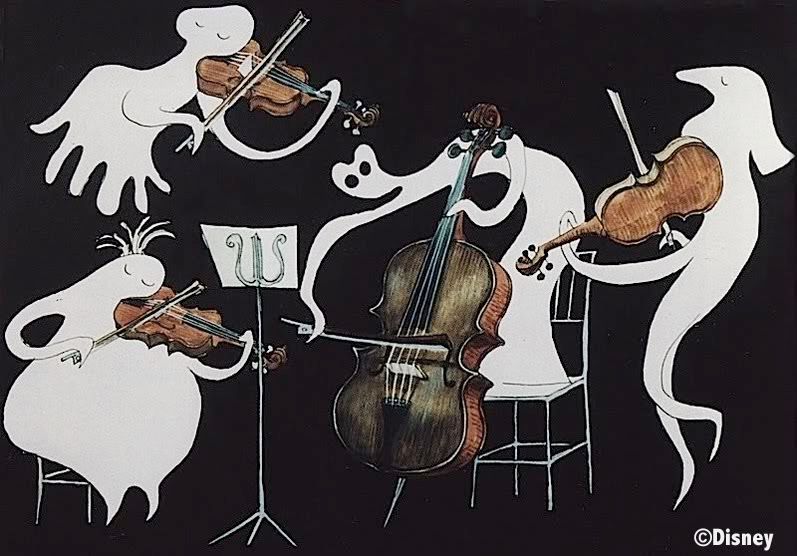
The rest is details.  What happened to the other musicians?  Marc Davis liked the idea of a ghostly musical ensemble, but he conceived of it as having its own tableau rather than as an adjunct to the ballroom organist.


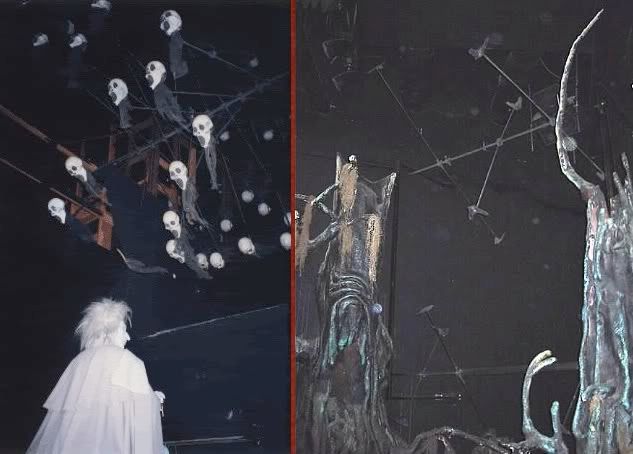
When this tableau was nixed, there went what once was going to be the organist's companions, and he became a solo artist.  Another Davis idea did survive, though: the banshees floating out of the organ pipes.  Very cool.  The cloudy spirits were solidified into skull-like heads, and the practical effect was simply a ferris-wheel device, reflected spookily in the glass.  This device may possibly have been inspired by the bats/eyes flying around in the forest scene in Snow White's Adventures, over in Fantasyland. That effect was part of a 1959 update, according to one source. If correct, this would not be the first nor the last borrowing from the park's original scary dark ride.


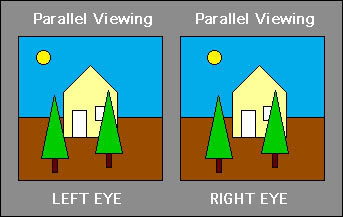
The end result is one of the Mansion's most memorable characters.  In glorious 3D for ya, once again.


Only the DL organ is "real."  The WDW and Tokyo organ consoles are simply plywood mockups, modeled on the original.  Between the 20,000 Leagues movie and the DL Haunted Mansion, that original instrument may be the most frequently viewed pipe organ console of all time.


I wonder what that guy did with his fifty bucks?

Sunday, April 25, 2010

But is it Art?


Nature is a haunted house; poetry is a house that tries to be haunted.   — Emily Dickenson


We had better tackle this issue right up front.  How can anyone take an amusement park ride so seriously that they end up writing reams of material about it, probing every nook and cranny and occasionally getting, you know, all philosophical and stuff?  Is this not evidence of arrested development, if not a disturbed personality?

Get.  A.  Grip.  It's.  A.  Ride.

...albeit a very good one.  Sure, it's a fine piece of entertainment that obviously took a lot of work and displays a lot of creative ingenuity, but c'mon, it's not art.  Or Art.  Or Awt.

The line between art and entertainment is, of course, a porous one.  Good art typically entertains, and good entertainment requires some sort of artistic skill.  In light of this overlap, it has been graciously decreed that if "mere" entertainment rises high enough, it may earn the designation, "popular" or "folk" art, but that's all the concession you rabble are going to get.  Now get the @#&*!! out of our museum, and next time wear a tie.

Unfortunately for the museum curator, the already porous line has become increasingly swisscheesified during the course of the last century, and the holes have been punched from both sides: you've got popular entertainers who expect to be respected as artists, and you've got "real" artists who see their role as essentially transgressive and so ridicule any received wisdom, even when that wisdom supposedly elevates their own work above common graphic design, or "commercial" art, or propaganda, or folk art, or entertainment.  Andy Warhol's Soup Cans make the point as well as anything.


Walt Disney was uncommonly shrewd about this issue.  I don't think he ever claimed that what his studio was producing was Art with a capital A.  No, what you got was a self-deprecating shrug and a claim to be nothing more than an entertainer.  Even his most blatant bid for artistic respect, Fantasia, bills itself only as "a new form of entertainment."  Of course he knew better.  It's not just the fact that his studio artists were capable of moonlighting as "real" artists, and did so from time to time; it's that they all knew darn well by the end of the 1920's that animation was a genuine art form, and that eventually the world would figure that out without them telling it so.  And of course, it did.  Same thing happened with jazz and with popular cinema.

So is the Haunted Mansion art?  If so, what would you call it?  Giant kinetic sculpture?  A form of puppetry?  Mechanical theater?  The genre does have a name:  dark ride.  That will have to do, and perhaps it's good enough.

Yes, it's art.  It passes the duck test.  It acts just like art.  It uses artistic media and was produced by people who were—many of them—accomplished artists by the most stringent definition, but it also passes a stricter test: the distinction between fine art and graphic design, or illustration.

This distinction was still in use when I was taking art courses, back in the middle ages.  Even if you don't buy it, it can still be articulated.  The difference between a painting of a tree that is Art and one that is merely Very Good Illustration, is that the wordless whammy, the wow factor that tells you that this is good stuff you're looking at, remains intact if it's Art even after you have come to fully understand the technique, but that quiet dazzle sorta evaporates if it's only Illustration.  Both of them have succeeded (at least a little) in their attempts to be a haunted house (like Nature is already, without even trying), but if we examine the painting closely and figure out what was in this painter's bag of tricks, the ghosts leave the "mere illustration" but not the "art," which continues to amaze us even more because the house somehow remains haunted even after you've seen the wires and trap doors.

This sort of analysis has fallen on hard times, not because it is incoherent but because it is so subjective.  We have been told that Toulouse-Lautrec's cabaret posters are fine art, while Norman Rockwell's magazine covers are merely good illustrations, and too many of us have begun to suspect that we are being snowed.


It doesn't really matter, because if the "Long-Forgotten" thread proves anything, it is that exhaustive attention to the techniques behind the Haunted Mansion does not seem to diminish the magic.  We've known since we were little kids that it's not really haunted, and we don't care, because...yes it is.

It's also art because if you pull on this particular thread, you find that the rest of the universe is attached to the other end.  It may be the oddest of oddball entry points, but this too can lead you into some pretty lively discussions with others (or with yourself, if you're prone to such things), the kind of pursuit that leaves you at the end of the day amazed once again at the puzzling wonder of being human.  No one is going to argue that the Haunted Mansion is on a par with King Lear or the Sistine Chapel, but in its own way it does what a good poem is supposed to do.

If you're still not convinced, then start making your way through the endless "Long-Forgotten" thread, or just hang around here for awhile.  The worst that can happen is that I prove to be a very foolish mortal indeed, but hey, there are a lot uglier ways to go about doing that than this.