Explorations of Disney's Haunted Mansion.
Ruminations and revelations concerning the history and artistry of the Disney parks' richest and most eccentric masterpiece.
Things You're Just Supposed to Know
Most of the time, Long-Forgotten assumes that readers are already familiar with basic facts
about the Haunted Mansion. If you wanna keep up with the big boys, I suggest you check out
first of all the website, Doombuggies.com. After that, the best place to go is Jason Surrell's book,
The Haunted Mansion: Imagineering a Disney Classic (NY: Disney Editions; 2015). That's the
re-named third edition of The Haunted Mansion: From the Magic Kingdom to the Movies (NY:
Disney Editions, 2003; 2nd ed. 2009). Also essential reading is Jeff Baham's The Unauthorized
Story of Walt Disney's Haunted Mansion (USA: Theme Park Press, 2014; 2nd ed. 2016).
This site is not affiliated in any way with any Walt Disney company. It is an independent
fan site dedicated to critical examination and historical review of the Haunted Mansions.
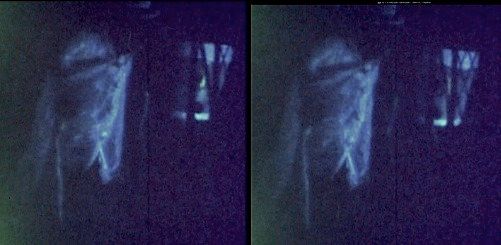
July 9 saw the appearance of some home movie footage from August of 1969, probably taken during the opening week of the Haunted Mansion, or not long after. There is a murky but important shot of the original attic bride, lasting about three seconds, and some much better film of the Hat Box Ghost, which is the real prize, of course.
This historic footage was discovered by Todd J. Pierce and posted at theDisney History Instituteblogsite. Being the anal old cuss that I am, I have a few quibbles with the narrative that accompanies the edited film. The photograph Todd mentions as appearing "40 years" after the Mansion first opened has actually been up at the Doombuggies.com site since October of 2001. To get really picky, the sign hanging at the entrance went up in January of 1965 and not 1963. But forget about those nit-picks. This is about as close to a Holy Grail for Mansionites as you're ever likely to see.
While we're on the subject of film, another video you just GOTTA see if you haven't already is the Martin/Warren ride-thru video of the WDW Mansion, filmed in 2009. It sets a new standard for this sort of thing, miles above anything else out there, including official Disney product. It's about an hour long, intending to give you every tasty detail of the ride. The sound quality is also excellent, so be sure to listen with headphones sometime.
For many Orlando fans, the three-and-a-half year interval between the major refurb of September 2007 and the disastrous new additions in April 2011 represents the gold standard, the best any Mansion has been since 1969 (notwithstanding the addition of Constance). It is our good fortune that the Martin/Warren video was made during this period.
Getting back to 7-11, as luck would have it, July 14 saw the publication of an October 1975 photo of the Disneyland attic bride, proving that the "Corpse Bride" variety was indeed used at Anaheim. That, plus the newly discovered HBG footage, led to the revamping of our early history of the attic bride. We can thank the Major at Gorillas Don't Blog for that one.
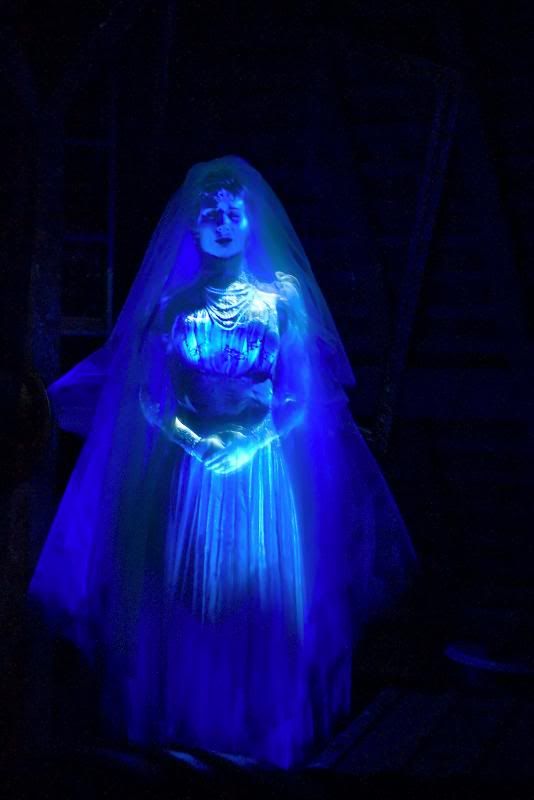
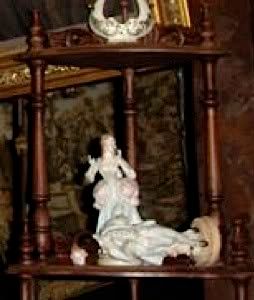
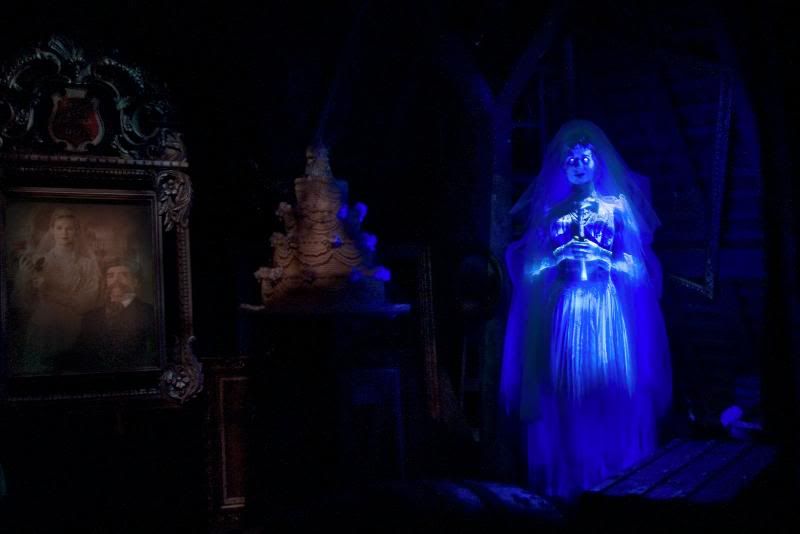
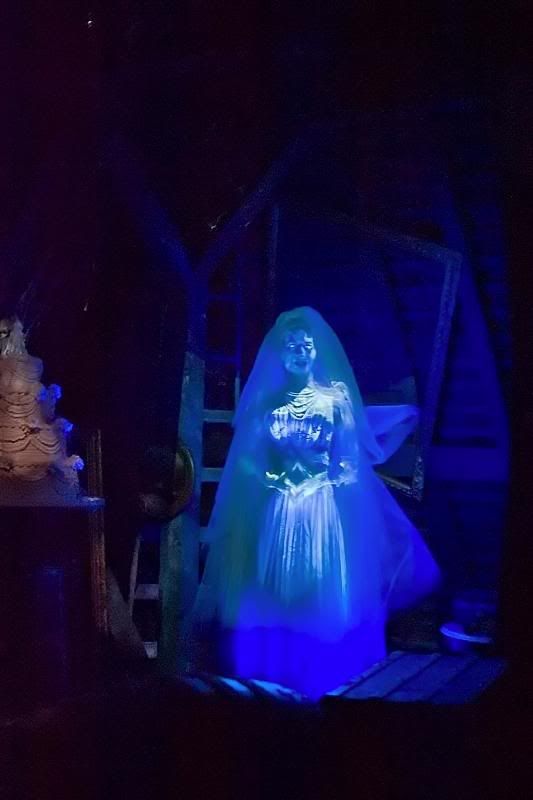
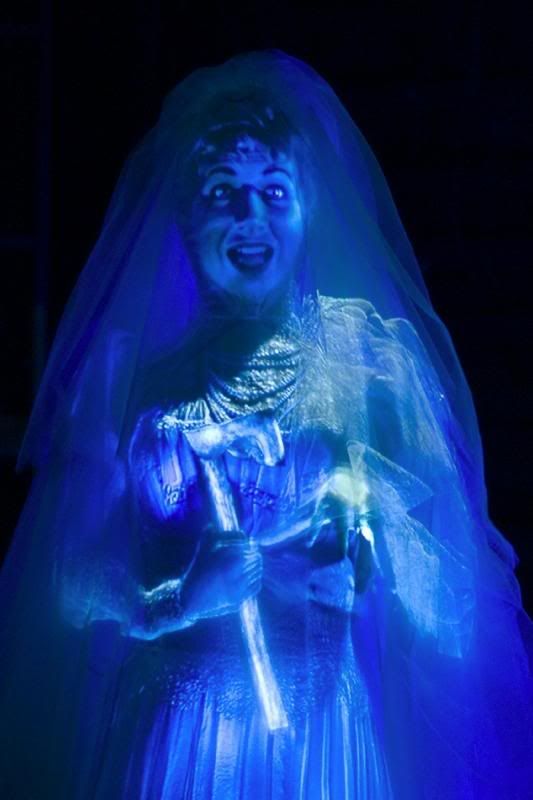
Like I said last time, the Constance addition is an ambitious attempt to expand the Mansion's backstory and solidify it. The attic bride now has a name (Constance Hatchaway) and a definite story. She's a "black widow" bride, marrying five men in succession (or at least five) and beheading each on their wedding night (Sigmund Freud, call your office). Each man is more wealthy than the last, and Connie's accumulating fortune is symbolized by the addition of a new string of pearls around her neck in each successive wedding portrait. Her junk now clogs the attic. Mostly wedding gifts. There are some cute items amidst the clutter, like this porcelain couple with the man fallen and with his head broken off.
"Oh my goodness!"
Here's the grim tally:
1869: Ambrose Harper
1872: Frank Banks
1874: The Marquis de Doom
1875: Reginald Caine
1877: George Hightower
There are official mini-bio's for each man (cf. Surrell 2nd ed., p. 84; 3rd ed., p. 109); the most interesting fact is that George is expressly said to be a former owner of the house, implying that Connie inherited it. Evidently, before it became a retirement home for ghosts, the Haunted Mansion was Connie's residence. As if to emphasize the point, the widow portrait in the stretching room is now officially recognized as a portrait of Constance. The resemblance between it and the last wedding portrait in the attic is obvious.
Objection, your honor: The Constance ghost is clearly still a young woman, while the stretch-room widow was just as clearly a senior citizen before she died. In addition, isn't the plot simply too far-fetched? You're saying there were five identical and sensational murders on Connie's successive wedding nights, and no one caught on? Were the latter suitors such dolts? And were the police brain dead? There are limits to our suspension of disbelief.
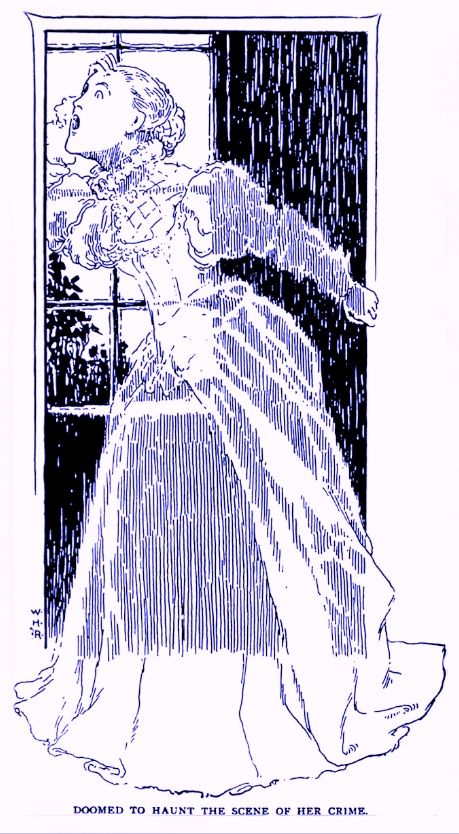
I'm no fan of the Connie thing, but I will say that these objections hold no water. The notion that ghosts appear as they appeared at the time of their death is not the only popular notion out there. There is also the idea that ghosts haunt because there is unfinished earthly business that must be resolved before they can "cross over," and perhaps they appear as they appeared at the time of that unfinished business, which may have occurred well before death. In Connie's case, it's an unavenged murder spree from her youth. That too is a concept not unknown to ghost lore:
From The Reader magazine, 1904 (hat tip Craig C.)
Interestingly enough, Ken Anderson invokes this ghost theory in one of his 1957 scripts:
"... our house had a tragic and bloody history of unlucky owners who died sudden and violent deaths, which resulted in their unhappy ghosts remaining behind to fulfill the uncompleted missions of their lives."
As for the preposterousness of the plot, it all becomes plausible when we throw money into the equation. Bribe the police, bribe the judges, remove any public record of the crime or its investigation, falsify death certificates, and presto: a clean slate for the next victim. Sure, she would have needed a good missing-and-presumed-dead story the first time (a teary-eyed Constance describes how Ambrose fell into the river on their honeymoon), and the second time would have demanded a cop or judge who could be bought pretty cheap (perhaps she used, er, other assets as well?), but after that she probably had enough wealth piling up to cover her tracks easily. As for how suitor #4 or #5 could be foolish enough to marry a widow whose previous husbands managed to disappear so quickly after the wedding, well...she's got a pretty face, see, and a certain wiggly-wag....
Objections overruled.
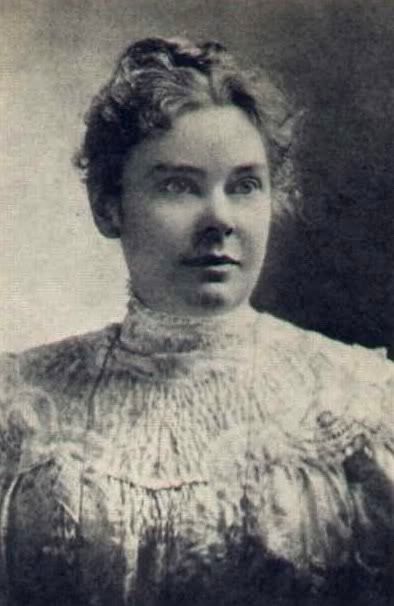
How did they cook up such an idea in the first place? Well, mad female ax murderers are nothing new on the radar screen of public cultural consciousness. Lizzie Borden and all that.
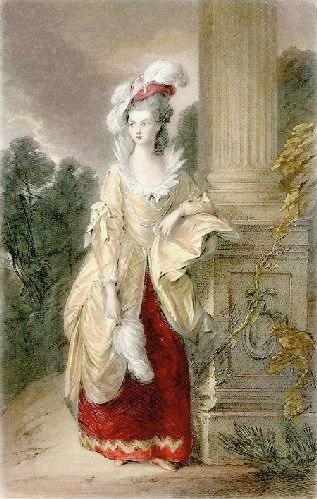
Closer to home, once again we find an interesting changing-portrait concept in the huge pile of unused material left behind by Marc Davis. He came up with a macabre version of a famous portrait by Thomas Gainsborough. So popular was "The Honourable Mrs. Graham" in its day that Gainsborough did several versions of it, including an etching:
It doesn't take much imagination to see inspiration for Constance in Davis's spoof:
Another inspiration for Constance hidden in the WDI vaults is the long-forgotten "Mr. Meaker," a character concept unknown until the discovery of a crude notebook sketch by Dick Irvine (VP of Design at WDI from '52—'73) . . .
. . . and this accompanying description: "Mr. Meaker was a very simple man who lost each of his five wives in a very tragic manner. They died in bed—apparently of natural causes. Mr. Meaker's only compensation was that his wives were all insured. He smothered them with affection." Here the tour guide throws a switch and the canopy of a nearby bed descends. The tour guide continues: "One night he was testing the mechanism while his cat was sleeping on the bed. When Mr. Meaker found out that he had killed his pet, he was heartbroken. He hanged himself."
It's not hard to see a male version of Constance in certain details of this outline. It's curious that he hanged himself, because if the HM's hanging man was already considered the Ghost Host at this point (and he probably was), then this backstory identifies the Ghost Host with Mr. Meaker. This opens up a can of interesting worms, but we'll tackle that one a little further down. (Actually, I've never tackled a worm and would decline any invitation so to do. The unfair weight advantage, for one thing, would take all the joy out of it for me.)
One of the most important factors shaping the creation of Constance, however, was inspiration drawn right from the existing ride. I have no doubt whatsoever that the Imagineers involved would respond to the criticism of Constance as an unwanted intrusion by pointing out that, on the contrary, they are zealous traditionalists with the highest possible respect for what the original Imagineers created. In expanding the backstory, they definitely wanted their addition to stay true to what was already there.
And they have a good case, so far as it goes.
First, Connie is a throwback to the original, scarier bride, skipping over and ignoring the forlorn 1995-2006 models in favor of their darker predecessors. On our own analysis, the original attic scene gave you just enough clues to conclude that the bride killed her groom via decapitation. The Hat Box Ghost goes topless to the tune of her lub dub, lub dub, remember?
Secondly, the Constance narrative seizes on the two items from the original HM that indicate a history prior to the "retirement home" story and it weaves the two together into a single story, so you could argue that the Connie story tidies things up a bit. I'm talking about (1) the Ghost Host's ambiguous tie to the house on the one hand (actually, it's his neck, but let that slide), and (2) the attic's tale of some kind of nuptial homicide on the other. Everything else in the HM is part of the three-act play taking place on the stage of "this ghostly retreat."
The Ghost Host connection is largely unspecified at this point, but there is every indication that it is waiting in the wings, ready to be rolled out as time and funds permit. That's right, people, there is another shoe waiting to drop. There are more chapters to the Constance saga up WDI's sleeve, so you had better get used to her. If her role is destined to change at all, it is only in order to expand it further. Do I have an inside line on this undisclosed sequel? Nope, but I can tell you that it will involve a character sometimes called the "Hatchet Man."
The Hatchet Man
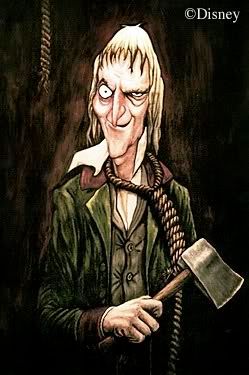
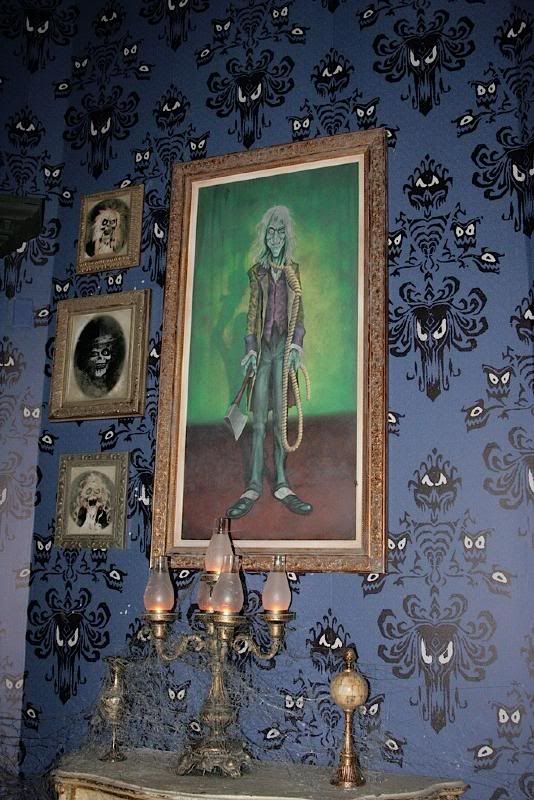
A creepy portrait of a man with a noose around his neck and a hatchet in his hand has been in the DL Corridor of Doors since the place opened.
Do not doubt the word of your blog administrator. Here is Hatch in a rare 1969 photo:
The Orlando HM has had Hatch since the day it opened, but as one of the "Sinister 11" portraits rather than in the Corridor of Doors:
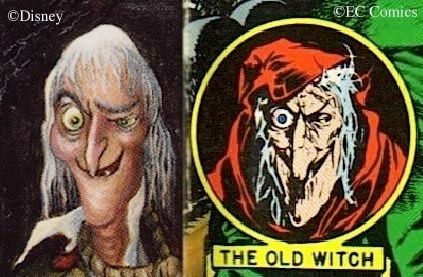
Incidentally, the Hatchet Man is one of those rare cases where you can point your finger directly at a piece of outside art that inspired it. Davis modeled him on "The Old Witch" from Tales From the Crypt comic books. Betcha didn't know that. Sheesh, Marc, this one isn't even subtle.
Anyway, Marc's original concept art for this character identifies
him explicitly as one possible way to visualize the Ghost Host:
MDIHOW 372
In addition, the hanging corpse in the stretching gallery is scrupulously dressed so as to match the Hatchet Man, and of course the hanging man is the GH ("there's always my way"). This is a good example of WDI overkill for the sake of "making it real," since guests can't possibly see this.
At one point there were even plans to make Hatchet Man/Ghost Host a fully dimensional figure
somewhere in the Mansion, as may be seen by a maquette they made of the character:
MDIHOW 372
There are at least three indications that WDI is currently preparing to raise the profile of this character considerably. First, his face is showing up elsewhere. Reportedly, when the Constance attic makeover took place at DL, plans included alterations to the Séance circle as well. The faces of Connie's husbands would be seen materializing around the perimeter, or something like that. It didn't happen. Either the report was false, or this part of the project was postponed for one reason or another (funding? technical feasibility? manpower? scheduling?). We did get a new effect in there, however, as the wandering Ectoplasm Ball began making faces at us. There were more than one, but one of them was Hatch:
Why him? Secondly, some guys from WDI just showed up one day and put a Hatchet Man portrait in the Corridor of Doors at the WDW Mansion. According to my sources, it was a complete surprise to the Florida folk. Bam. Now Orlando has a portrait similar to the one at DL. Hatch was already represented there as one of the "Sinister 11," so why this one as well? Not only that, but a dimension has been added to his character. Previously, you could say that his hatchet was simply the implement by which he cut his ties to the house. But now, he's wielding it as a frightening weapon—note the shadow.
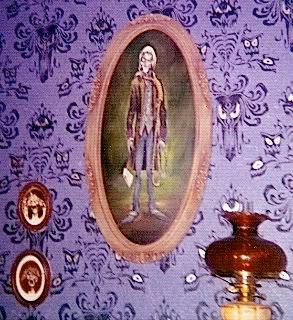
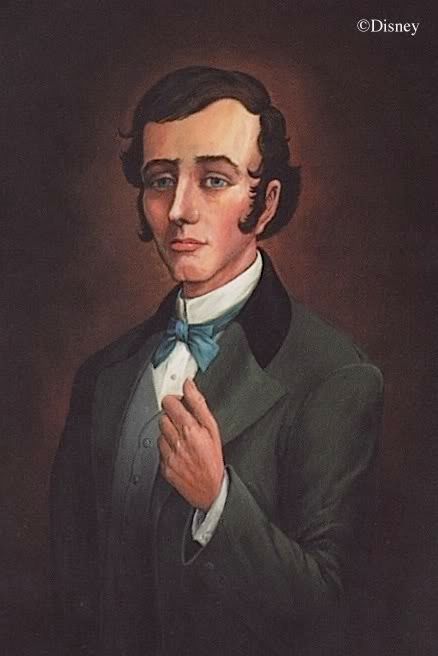
Thirdly—and this one is more subtle—WDI has apparently adopted a zero-tolerance policy toward any identification of the Ghost Host with any other character, specifically, a certain Master Gracey. Among Mansion fans there's a very popular belief that the character in the following painting is named "Master Gracey" and that he is the Ghost Host. Neither of these is official; it's purely fan-generated Mansion lore.
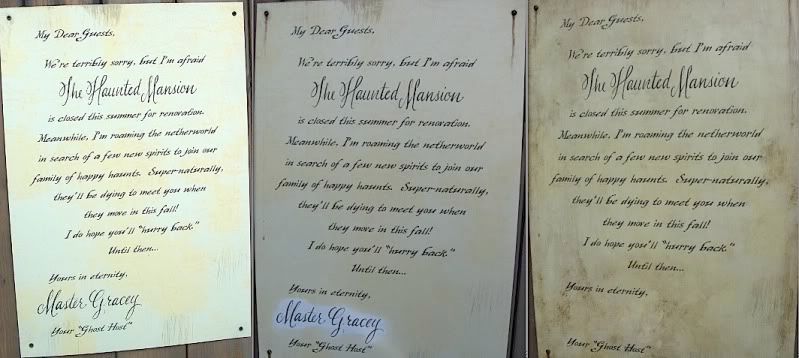
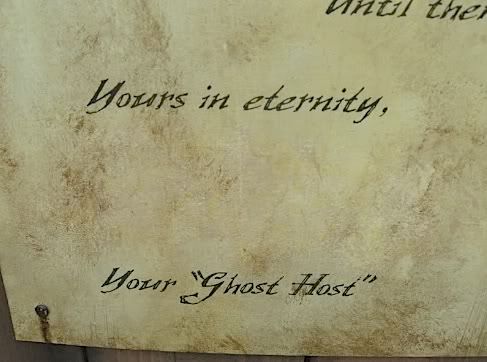
For years WDI has looked upon this with a certain bemused tolerance, and in fact the name "Master Gracey" has risen to the level of, I dunno, what you might call semi-official sanction. But any suggestion that he is the Ghost Host has been ruthlessly suppressed in recent years. When they put up a construction sign at the WDW Mansion during the massive refurb of 2007 that identified the Ghost Host as "Master Gracey"—dude, somebody got a stern email from On High, because they had to go to the trouble and expense of fixing the sign to eliminate this boo-boo. We're talking about a temporary construction sign here.
Now you see it...now you don't.
(photos by Pickwickgrl)
Sheesh, that's tight. "Who told them to change it?" "Top men." "Yes, but who?" "TOP. MEN."
And consider this dismaying observation. Jason Surrell had a loosey-goosey attitude about this whole business in his first edition (2003) of The Haunted Mansion: From the Magic Kingdom to the Movies. Speaking of the WDW Mansion, Surrell says:
"As guests enter the Foyer, their attention is drawn to a formal portrait of the master of the house hanging on the wall above the fireplace. The master is the Ghost Host himself, or Master Gracey, if you go by the name on one of the tombstones in the family plot, although that is not the official story."
But between that edition and the second edition (2009), some Top Men evidently had a little clarification session with Mr. S.
"As guests enter the Foyer, their attention is drawn to a formal portrait of the master of the house hanging on the wall above the fireplace. Contrary to another popular theory that has made the rounds over the years, the Ghost Host is not the master of the house—Gracey or otherwise—but merely one of 999 happy haunts."
And Jason—no fool he—gets to keep both kneecaps.
The most obvious reason for the crackdown is that the real Ghost Host is going to make a more formal entrance sometime in the future, and he's the sinister-looking Hatchet Man, not some dandy named "Master Gracey." How all this will tie into the Constance saga is unknown at this point, but they do make a charming couple with their mutual hatchet fetish, and I find it curious that a previous concept for the Ghost Host (Mr. Meaker) is in some ways a mirror-reflection of the future bride Constance, although I'm probably better advised to put that one down to coincidence.
One way or another, it appears that WDI is preparing to tie together the Ghost Host and the attic bride in a single backstory that tells the history of the HM before it became a ghostly retreat for wandering spirits from all over the world.
UPDATE (March 2015)
It's been several years now, and the second shoe has yet to drop. It may never. You see, the man I am sure was behind the implementation of this backstory is no longer in the position to do so. He's transferred to somewhere else in WDI now, and so far there is no evidence that the new boss is interested in developing the master plan of the old boss. Alas, the glowing face effect in the Séance Circle has fallen into neglect and disrepair, and merchandise identifying the Ghost Host with "Master Gracey" appeared on the shelves in conjunction with the Mansion's 45th anniversary. It's true that Merchandising tends to do its own thing and thumb its ignorant nose at WDI, but I'm pretty sure the previous guy would have put the kibosh on such heretical items.
UPDATE Again (January 2025)
With the debut of Connie 2.0 ("Connie Kicks Axe"), we can close the door permanently on any further developments in the original Constance saga. "When you come to the last page, close the book."
This post was written before the return of the Hatbox Ghost in 2015. An additional paragraph has been added to deal with that.
(Photo by Jeff Fillmore)
Warning label. We're going to get pretty heavy here before we get light, but you'll get no apologies from me. I happen to believe that people always and everywhere keep talking about the same old things, whether they're writing big, thick theology books or scripts for situation comedies. Stupid jokes or philosophical systems—it doesn't matter. We are all natural born theologians and moralists, and darn it, we just can't help ourselves; everything we discuss with each other echoes into and out from something vast and serious. No matter how trivial and superficial we think we are being, Deep calls to Deep (Ps 42:7). Connie will show up some paragraphs down, but if what goes first is not your cup of tea...well, no doubt there's a blog out there dedicated to hidden Mickeys in the Haunted Mansions. Google, and go in peace. Rest assured that there will be another installment of "Here Comes the Bride" to deal with some of the interesting inspirations for Constance and even some intimations of her future.
It's all good.
The current incarnation of the attic bride is a unique and ambitious attempt to swell the Mansion's cast of characters and expand and solidify its backstory. No longer is the HM simply a retirement home for ghosts from all over the world, brought here by invitation but getting stuck in the fabric of the house itself until Madame Leota fixes the snag so that they can materialize and start schmoozin' and boozin'. Until now, this basic plot has been the only backstory to the HM that could claim official sanction, and indeed it accords with what the Ghost Host tells you and accounts for most of what you see. But it has never completely covered the phenomena presented. For example, the Ghost Host has a further tie to the house. (The other end is tied to his neck.) What's with that? Was he an owner at one point? That would explain why the hosting duties fell to him, and perhaps the retirement home idea was his, but it suggests that the house had its own haunted history before that.
The other thing that suggests a previous history is the attic. Attics are places of concealment, of hidden horrible secrets. Moreover, the attic has always functioned as theasterisk on the big Marc Davis joke. The first thing to do is make it clear what that joke is, because that joke accounts for 90% of the HM. That joke is the broad, firm base from which other, smaller things may deviate.
As we saw in an earlier post, at first you think the ghosts are malevolent and out to get you, but it turns out that "they pretend to terrorize" and really don't care about you at all; they just want to get to a state of comfortable materialization so that they can enjoy themselves. Ha ha, the joke's on you: you thought they were hostile, and you were wrong.
The point of the joke, the moral of the story, the message of the Mansion, is that fear of death is overblown.
That's it in a nutshell. I mean, you really don't know if it's a chamber of horrors on the other side of the veil, do you? No one really knows, right? Perhaps the scary hauntings you hear about are just naughty pranks, perhaps all is forgiven and all is well and everyone's having a jolly good time over there. So long as you don't know which is the case, you might as well take the optimistic view. That's the vision presented to you by Mr. Davis. In his portrait of the afterlife, the executioner and the knight he dispatched are now best buds. There is no revenge, no bitterness, not even any residual hierarchy of power on the other side of the grave—kings and queens are playing like children! Yeah, there are those two duelists still going at it, but it's more a matter of both of them being humorously stuck in a cycle of irresolvable earthly business than a tragic vision of implacable hatred. You almost suspect that they're doing it as a game now. After all, what happens when a ghost shoots a ghost? Is he going to die or something? See? Joke! Ever'body laugh.
Without going even deeper than we need to, we might briefly note that there is a certain resonance between this joke and traditional Christian theology, wherein Death is defeated and rendered harmless ("where is thy sting?"), and ultimately the story of the universe is told as a comedy and not a tragedy. In this sense, the Haunted Mansion is simply expressing an optimistic hope firmly rooted in Western culture. "All shall be well."
Okay, now the asterisk, now the "yes, but." Equally part of the Western and Christian worldview is the notion that the afterlife is also the place where justice is finally served (it sure as hell ain't on this side of the veil, in case you hadn't noticed). Justice implies judgment, and judgment is bad news for the bad. That happy optimistic vision hopes that enough mitigating circumstances will ultimately be found so that everybody, or almost everybody, gets off, but if the wisdom of the ages is given any weight, there remains a residual pool of those who choose evil without any possible excuse for it and put themselves beyond the reach of even the most generous of post-mortem visions.
Disney traffics heavily in traditional fairy tales, correct? You'll note that the villains in fairy tales are often very villainous indeed. It might sometimes be possible to understand them, but you cannot excuse them. They have made their alliance with Death. You cannot redeem them; what you do is, you kill them. In truth, the world of traditional fairy tales is pretty stark and grim, and Disney has always faithfully represented this fact. Fairy tales are also a good place to check out the aforementioned wisdom of the ages. It's not surprising that Davis's warm bath of good feeling has a sober asterisk attached.
The HM is just complex enough to give a nodding acknowledgment to this darker truth while celebrating the rosier vision. This could have been accomplished in a number of ways, but the route the Imagineers chose (by intuition—don't ever think I'm claiming that they sat around and thought about all of this consciously), is the detective mystery. What is it that motivates the sleuth in all of those whodunnits? Bringing the criminal to justice. Making sure the guilty party doesn't get away with it. You don't associate Sherlock Holmes with forgiveness, do you? Now ordinarily, writers of detective fiction banish the supernatural from their pages. That's because the readers are supposed to be able to figure out who did it based on clues dropped along the way. If you throw angels and demons and ghosts in there, it spoils the whole thing. No one can reasonably be expected to anticipate a deux ex machina resolution to a mystery. But the reverse is not true: crime and detection are not absent from ghost lore. Too many ghosts busy themselves with revealing where the body is hidden, or where the knife was buried, or by terrorizing the guilty into confessing their crime. These ghosts, at any rate, are not in a forgiving mood. They want justice.
In our discussion of the Hat Box Ghost, we showed that the whole attic scene originally was held together by the head-in-a-hatbox symbol, which hails from the world of crime mystery. You're in the attic, which is one of the two places in an old house where horrible secrets and crimes are hidden (the other is the cellar, of course). You see that hatbox, and you have a dreadful suspicion that there's a severed head in it, and when your suspicion is confirmed, you realize you're looking at a murder, and you wonder what happened and who did it. Like a good murder mystery, the attic gives you just enough clues to conclude that the bride is the guilty party, as we saw. What's the Hat Box Ghost up to, anyway? He'sshowing you what happened. Got his noggin whacked off and hidden in a hatbox. The murderer evidently got away with it, but now the victim's ghost has come back to reveal the awful truth to the world. The crime is illustrated before your eyes and it is linked to the bride via the synchronized heartbeat. Very efficient storytelling—this all takes about a second and a half. These guys are GOOD.
Note that the question of justice enters in here—you wonder who committed the crime—whereas when you see the knight in the graveyard, who is just as beheaded as the HBG is, you don't ask any such questions. The perp is right there, after all, and neither of them care any more, and you don't even know which was in the right and which was in the wrong. And you don't care either. You regard the two beheading victims in completely different ways. Creepy atmosphere + a hatbox in the attic = bingo, you're in murder mystery land.
Oh, all right, I hear those fingers drumming on the tabletop. You've been good, so here. Here's a few more Connie shots by Jeff Fillmore (aka ~Life by the Drop~ at flickr). She's miserably hard to photograph, and I don't know how he does it, but IMO Mr. F. has got the best Connie shots on the Web.
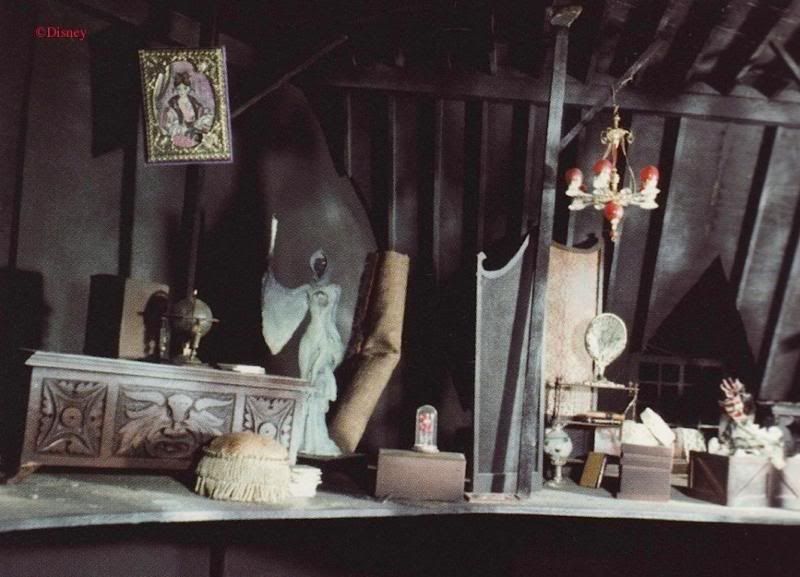
From beginning to end, the attic scene has never been free of the grisly-hatbox symbol. It is just as fundamental as the bride herself. We noted how the two blast-up ghosts were skullish heads popping from hatboxes. They were there from 1969 until 2006. You can go back earlier. Here again is a shot of the scale model, which we've seen before:
Let's pan to the right and see what got cropped out. Well looky there. I see two hatboxes, and one of them is suspiciously isolated. You look inside, I just had dinner.
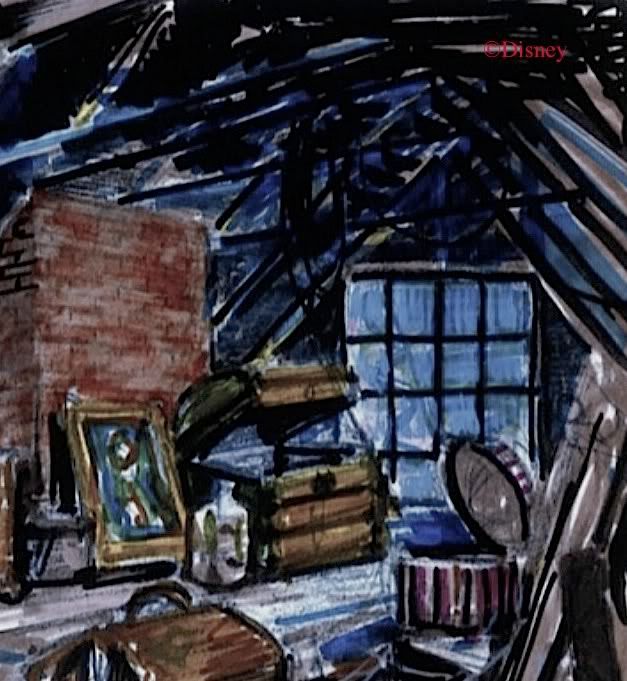
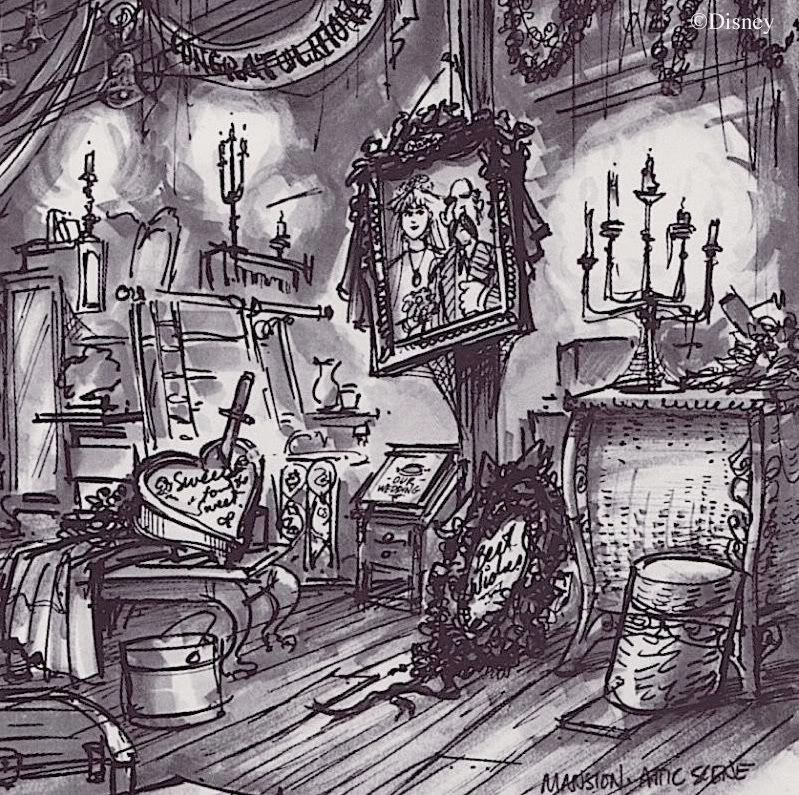
Next up, some Claude Coats concept art for the attic:
Well, I'm not so sure that it isn't an innocent hatbox in this case. But this is an attic. No doubt something horrid is hidden there. Any guesses where the body is? Possibly the trunk, but if you didn't think, "Maybe walled up in the brickwork of that chimney," you really need to read more books and see more movies. See how it works? They know that you just know these things.
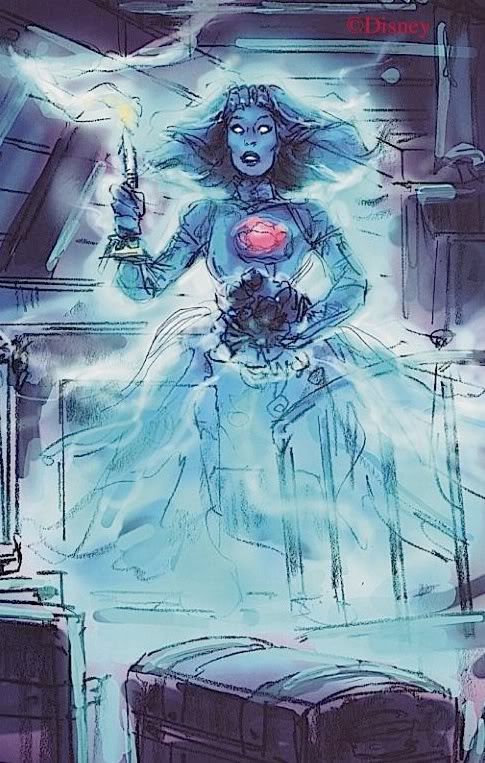
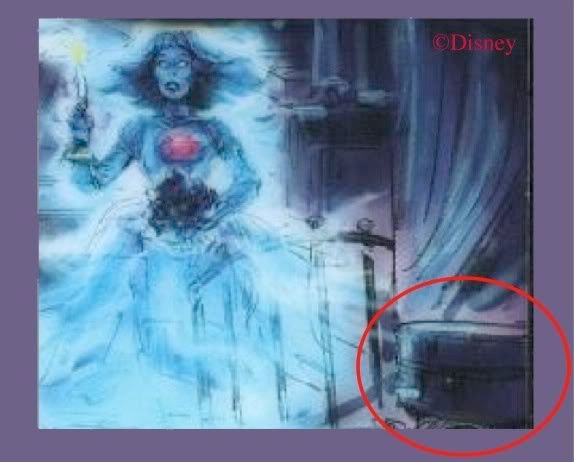
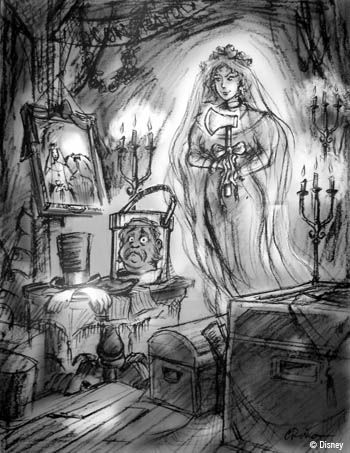
When they were kicking around ideas for a New Bride in the mid-2000's, there was a range of ideas put out there for consideration. One widely-reproduced sketch that passes as "concept art for Constance" actually stayed very close to the then-current bride. Still has the candle, still has the beating heart, still has the bouquet, and still has the blank white eyes. Just a coked-up version of the previous, "blue-faced" bride, really.
Oh, and if you come across a less-severely cropped version...well whaddya know:
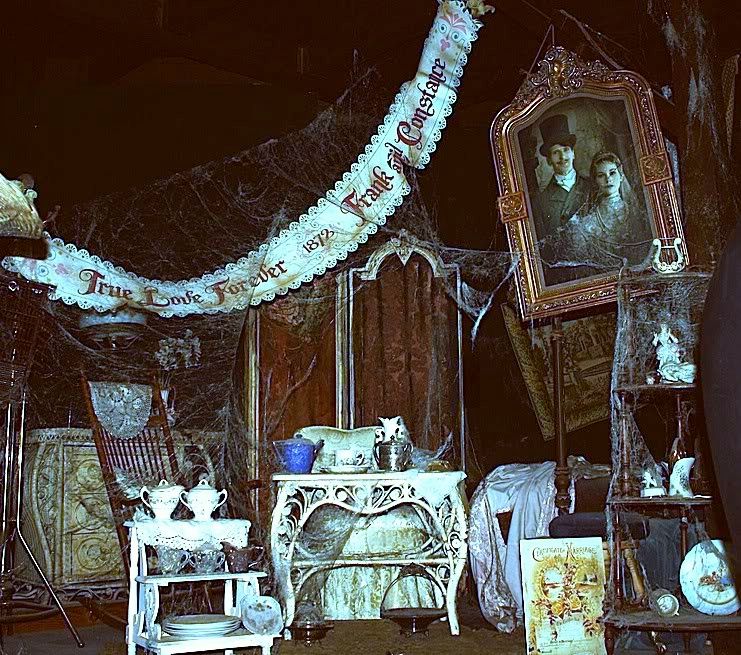
Here's the Frank tableau in the finished make-over at Disneyland:
Nice. And here's a piece of concept art for it. (Nudge nudge: lower left, atbox-hay on the oor-flay).
Just in case you think I'm imagining things, some concept art for Constance throws subtlety to the wind and takes us directly back to Hat Box Ghost territory. Oh, and notice how close this Connie is to the finished character:
Ewww. That'll put you off your Eggs Benedict.
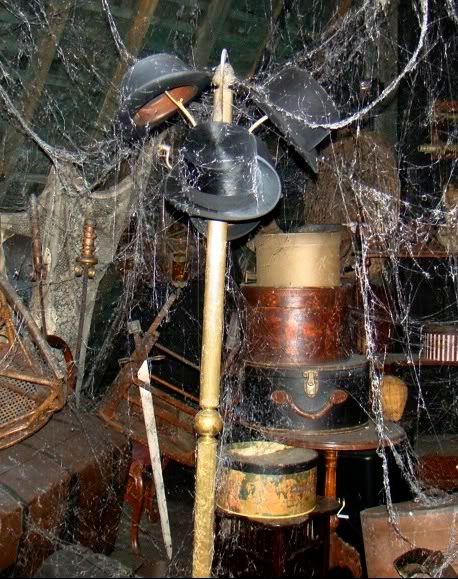
Reportedly, there were plans to put a stack of five hatboxes across from Constance in the HBG's old spot, with the names of her five husbands on them. Hatbox city. One report even suggested that they would light up and glow from within. That didn't happen, but they did put a hat-rack there, with hats on it matching Connie's hubbies in the portraits. Heh heh. When they put Constance into the WDW attic in 2007, they too got a hat-rack, but they also got the stack of hatboxes. No name tags or lights though.
Wouldn't want to be in there on a warm day. Notice the swords laying around. You don't suppose that means anything, do you?
With the grisly-hatbox symbol, you've got CRIME looking for PUNISHMENT. You've uncovered something deliberately hidden. There's a murderer out there somewhere, a score to settle, a vengeance yet denied. Question: How has the attic bride always been different from most of the other ghosts you see? Answer: She's not happy. No socializing for her. Even Constance is only experiencing the lunatic glee of the criminally insane. If you insist on calling it "happy," then it's kind of a Charles Manson happy, you know? I wouldn't say she's happy. She's not forgiven or forgiving, not within the embrace of any resolution. But is justice being served? Well, if she wasn't so utterly wacked-out, she'd realize that she's exposing herself and being exposed. Hattie with his damning heart-beat box is gone, but now we've got five haunted wedding portraits with the husbands' heads disappearing. Those portraits are five ghostly fingers from beyond the grave laying accusation. And yet, those guys aren't happy either, and they don't even get the relief of being too crazy to care. You don't see forgiveness, but you don't see just deserts either. The ghostly revelations inspire no remorse in Connie, and she's suffering no reprisal. Her madness has taken her to a place without punishment, but also without love.
This is a very sour note in the HM, and it may well be a thematic blunder. The Connie addition is seriously flawed. Unlike the knight and executioner, there has not been any post-mortem reconciliation in this case. They're grim ghosts without the grinning part. If there were a way to show the husbands yukking it up with Connie, all of them laughing at the silly fuss their earthly crime drama stirred up, then they'd be part of the Marc Davis all-is-now-well joke. Or, alternately, if the hubbies were allowed to show some sense of satisfaction that at last the murderer has been caught out, putting their spirits to rest, avenging them, giving them something to grin about like the old Hat Box Ghost, then they would fit into the traditional role of the attic as the "justice must be satisfied" asterisk added to the otherwise merry universalism of the Haunted Mansion. As things stand, the message of the attic is, "the Devil wins," however lightly and humorously expressed. Yes, you will survive death and live forever; but no, there is no guarantee that you will find either justice or forgiveness on the other side. That's a common enough stance in modern horror, of course, but it is utterly foreign to the Mansions. Or it was, until May 2006.
***************
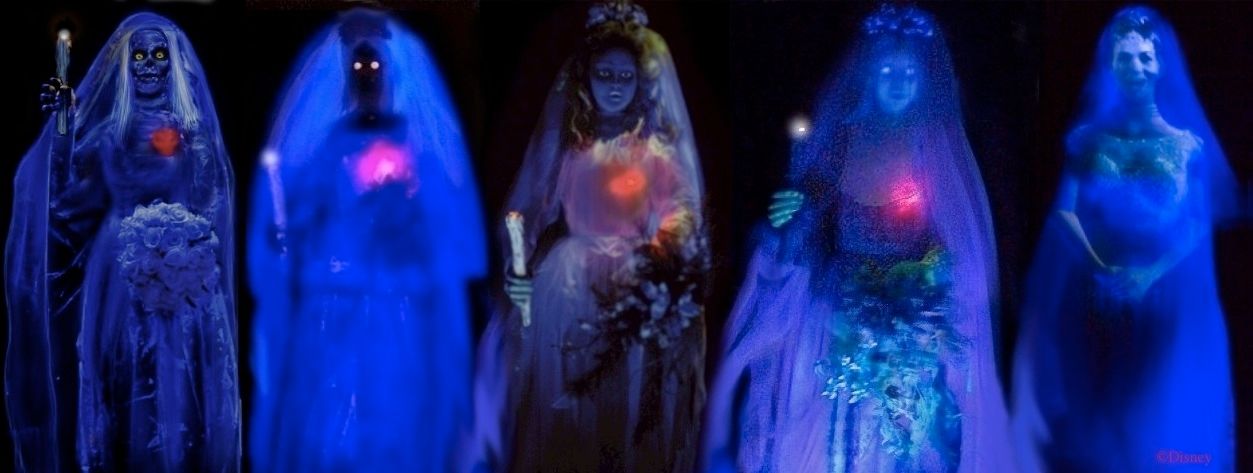
Now that we've arrived at the current incarnation of the attic bride, here would be
the place to place two handy murals, showing the character down through the years.
At Disneyland, the Corpse Bride version of Beating Heart was the original, lasting from Aug 1969 until the late 70's. Black-faced Beating Heart replaced her and lasted until 1995. Then it's the blue-faced bride, unveiled or veiled (1995—May 2006), and Constance (May 2006—Jan 2025).
UPDATE: And now, of course, we can add a sixth bride to the lineup: the new Connie, who debuted Jan 18, 2025.
Mike Kindrich
At WDW, we started out with a somewhat milder version of the Corpse Bride (Oct 1971—1973), followed by a black faced version until 1997. Blue face, with wild hair, lasted from 1997 to 2007. Constance debuted in the fall of 2007.
October 2019 Addendum.
Now that the Hatbox Ghost has returned, what are we to make of the attic? Not only did he return, but oodles of hatboxes came with him. He's got three stacked on his left and five on his right. Not only that, but one conspicuous hatbox has been added to each of the five tableaux featuring the husband portraits. Obviously the latter detail is supposed to raise the horrifying suspicion that Connie has kept each head as a souvenir. But I don't know what to make of the piles of extra hatboxes that came with HBG2. Egads, are we to think they too contain heads? Or if that seems improbable, are they there perhaps to tease us? to tell us, "You know, sometimes a hatbox is just a hatbox" and cast doubt on our suspicions? I don't know.
(animated gif by Boogafrito)
I'm interrupting our bride series because I'm hoping to get permission to use some very fine photos. Seems like as good a time as any to turn to the attic's other famous resident, her groom. (Please note that this post was written several years before the return of the Hat Box Ghost in May of 2015. That event is discussed HERE.)
The Hat Box Ghost: Fact and Fiction
If this were the mid-1990s, an article on the Hat Box Ghost would have to spend a lot of space (1) explaining what the heck the "Hat Box Ghost" is, and (2) arguing that such a figure once existed. It was a classic case of a "Long-Forgotten Haunted Mansion Effect."
What a difference 15 years makes—especially if a little thing that starts with "www" explodes during those 15 years. Now the problem with writing about the Hat Box Ghost is how to say something that hasn't already been said umpteen times, and how not to alienate readers who are tired of hearing about him. In some ways I can't blame them. When the merchandizing arm of Disney began planning how best to celebrate the Haunted Mansion's 40th anniversary (and how best to soak the fans for every spare nickel), they decided to make the HBG their main mascot and plastered his visage all over the place: HBG on posters, HBG on online announcements, HBG pins, computer-animated HBG hosting the Haunted Holidays website—you couldn't escape the HBG's evil grin if you paid any attention to the HM 40th at all. Frankly, I couldn't wait for it to be over and gone.
For readers who still need the basic facts about the HBG, there are good treatments here, here and here. (If some of what follows sounds suspiciously similar to what you find at those links, it's not because I'm ripping them off; it's because I had a hand in their composition.) Most of the known photographs of the HBG can be seen at those links as well. They've been posted and re-posted ad infinitum (some would say ad nauseum). Nowadays, you can even feast your eyes on schematic and electrical diagrams for the figure. Among the photos, one stands out. It's unique, and it's regarded by many aficionados as the most precious photographic relic of all time from the Mansion's entire history:
This photo simultaneously explodes two myths. It proves that he did exist and was installed in the ride, and it proves that the general public did see him. This shot is taken from a doombuggy. It is highly unlikely that Cast Members were allowed to take flash photos during their pre-opening preview (the "soft opening") or that one of them would have foolishly risked his/her job by trying to take one on the sly. This is not a professional photo either. Just about the only thing it can be is a tourist snapshot. Any remaining doubt, however, was obliterated forever in July of 2011, when some amazing home movie footage was posted atDisney History InstituteIt includes actual film of the Hat Box Ghost taken in August 1969.
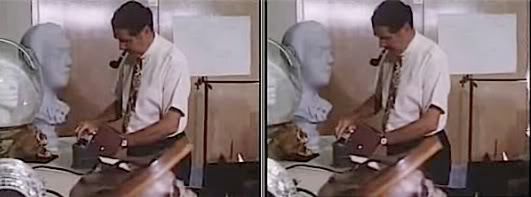
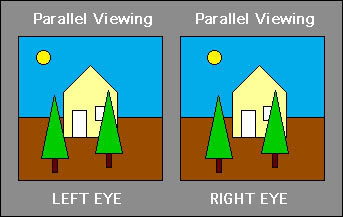
That's exactly the sort of horizontal sweep that allows one to construct a 3D "magic eye" photo:
I'll be danged. The original Hatbox Ghost in 3D. Who'da thought we'd ever see that?
Well, what can I say here that hasn't been said everywhere else? How about a couple of eyewitness testimonies? Here's my lovely little tale, something I've recounted many times. If you've heard this one before, let it scroll, baby, scroll. Our family had our usual annual DL trip during the first week of August, 1969. On the Jungle Cruise, between Trader Sam and the dock, the skipper asked us if anyone knew what was happening this weekend. Nope. In a basso profundo, he told us that the Haunted Mansion was opening, wisecracking that as usual Disney only took ten years to build a ride. My brother and I went from ecstasy to despair in the course of about three seconds. We had been waiting it seemed like forever for that old house to open its gates. Now we had barely missed it and would have to wait a whole year to see it. Reasonably enough, we concluded that life stank.
Well, a week or so later, some business or other required us all to ride through Anaheim, and as we passed within eyesight of the park, my Dad suddenly asked my brother and me if we'd like to go in for a couple of hours (it was already late in the day). This was unheard of. Once or twice a year was about it for our family DL trips, and the visits were never close together. He knew how badly we wanted to see the haunted house, and—bless 'im—he just decided to indulge us this once.
Ka-chow. Speed, I am speed. I'm racing down Main Street, swinging through Adventureland, knocking over old ladies (kidding, just kidding), and getting into the looooooooong line. I've got some great memories from that day. I've told you about the hitchhiking ghosts in the mirror. But in retrospect the most valuable has turned out to be my memory of seeing the Hat Box Ghost. This was August 14th, Thursday of opening week.
As our doombuggy turned to scoot into the attic, the first blast-up ghost caught me just perfectly, just exactly as designed. It's one of those things that can only really surprise you once, and luckily for me the timing was exquisite. There were the other pop-up ghosts too, of course. The methodical screams and squeals every few seconds pretty much advertised their presence. Coming up soon on the left was this murky, bridal figure, back among the rafters and debris. The first time through I don't think either of us even recognized that she was a bride. And at the end of the attic scene there was this well-illuminated, creepy little old man in the corner on the right, wearing a cloak and top hat, and holding a...I guess that's a hat box?, with his hand quavering on top of his cane, as if he was a very old man. Very creepy, and unlike anything else in the attic. It is my recollection that in the course of what must have been two or three or four rides that day I noticed that the hat box would slowly light up and had a head inside. I noticed nothing unusual about the other head. It wasn't disappearing and reappearing, like we learned later it was supposed to. You know, like this:
(animated gif by maddartist Larry Higbee)
And that was it. On our next visit several weeks later (with a church youth group—we really got lucky with DL visits that year), the weird little old man was gone, and the bride was in his spot. I figured this was a temporary situation, that something was wrong with the little guy. Even at the age of 14, I knew that figures disappeared from rides now and then for repairs, but they always came back. For a long, long time—far longer than seems rational—I always looked for him whenever we visited DL, thinking he might be back. Not until 2002 and the discovery of Doombuggies.com did I learn enough about what had come to be called "The Hat Box Ghost" to know that he had never really come back.
In conversation with the one other trustworthy eyewitness that I've found (a guy who went on to work with Marc Davis for some 14 years, incidentally), more details emerged. He visited the park often in those early days. He tells me that the first time he saw the HBG his face did indeed disappear and flash into the hat box, but the next time the effect didn't work right: the face was continually lit, but the hatbox face continued to flash on and off. (This is what I remember.) Another time the face was completely blackened while the hatbox continued to flash away. He says that later on, at least once, they moved the bride out of his spot and tried the figure yet again.
Now, these are the recollections of one person from when he was 11 years old, so the usual precautions about the deceptiveness of memory apply, but the account is inherently plausible, and together with other testimonies, a tentative history can be patched together.
The HBG was definitely there for the "soft opening" and seen by Cast Members August 7—8. It was noticed immediately that the effect didn't work very well (catching problems is one of the reasons they have CM "soft openings," after all). They pulled him out before the HM opened to the public the next day, Saturday the 9th, but he was already re-installed by the 10th. Thanks to maintenance records discovered by Tony Baxter in 2013, we know that the figure was certainly in use for at least a couple of weeks. They tried to get the effect to work. After removing and reinstalling the figure—perhaps several times—they finally gave up and permanently removed him. This explains why some early riders, even opening-day riders, have no recollection of the figure, and the false notion that he was never seen by the public became such common currency that it wound up in the first edition of Jason Surrell's generally reliable book, The Haunted Mansion: From the Magic Kingdom to the Movies (2003). Significantly, in the second edition (2009), this denial has been watered down to an admission that maybe the public saw him.
What was the problem? Various reasons have been given, but the most likely explanation is that the effect didn't work. The face was painted with fluorescent paint that glows under a black light. It was supposed to disappear when the focused black light spotlight on it was turned off. The problem was that there was too much ambient light in the attic for the face to fully disappear on a figure so close to the track, and the illusion was unconvincing. After he was removed, the bride was shifted to his spot so that the attic would still have a climax of sorts, and that was that.
The Hat Box Ghost: Becoming a Legend
So.... how did this failed character become such a legend, almost a cult hero? Well, you can credit (or blame) the souvenir record albums, first and foremost. Both the "Story and Song" LP, intended for older kids and young teens, and the children's record describe him in some detail and feature him prominently in their artwork. These records were popular and were sold at the parks for years. This means that an entire generation of HM fans grew up hearing about the ghost and seeing his image. He is described in connection with the bride in the attic. Well, here's the attic, and there's the bride. This is where that ghost with the hat box is supposed to be. So where is he? The records ensured that he was never going to be completely forgotten. In short, you can credit a lot of the Hat Box mystique to these words...
The Hat Box Ghost on the Children's Record
The Hat Box Ghost on the "Story and Song" album
...and to these images:
Note that the "Story and Song" LP cover puts him smack dab in the middle, like he owns the place:
He also gets his own page in the 11-page booklet included with the album:
The other thing that kept the HBG flame lit was Disney's use and reuse of publicity shots for the HM featuring the HBG. It seems that sometime in the latter part of 1968 Disney decided they would need some eye-catching promotional photos to include with press releases about the soon-to-be-opened Haunted Mansion. Special effects whiz Yale Gracey was recruited, and he struck a series of whimsical poses with HM ghosts, most of them reflected cleverly in a sheet of glass (the old "Pepper's Ghost" trick) or double-exposed. There were a lot of these, giving newspapers a wide assortment from which to choose.
Not only that, but numerous poses from the same photo session were usually released, giving the papers even more choices within choices. As it turned out, the most popular shot was Yale posing with a HBG prototype (not the actual figure).
At least eight different pictures from that particular photo shoot found their way into various publications.
(The prototype head had much more detail than the final production figure [see both below],
but they are the same head. The difference between the two is paint and nothing more.)
Disney used these photos in their own publications, naturally.
The significant thing is that Disney continued to recycle these, even after the HM had opened. The shot below appeared in a popular souvenir history book, Disneyland: The First Quarter Century, published in 1979, as well as in subsequent incarnations of the book (...The First 30 Years; ...The first 35 Years). In the book's treatment of the HM, the HBG was the only ghost shown, since this was the only "interior" HM photo in the spread:
Naturally, anyone familiar with the record albums recognized the HBG immediately and was set to wondering whether it had, in fact, existed. Look Fred! There it is in a photo! Thanks to this misleading photo, and perhaps others in the series, some people (including Tony Baxter at one point) concluded that the HBG effect was accomplished through the use of a Pepper's Ghost illusion.
So you've got the souvenir record albums and you've got the Yale and HBG photos. Last but not least, there was a groundbreaking article about the HBG in E-Ticket magazine #32 (Fall 1999), including never-before-seen photos of the actual figure. Imagineer Chris Merritt, a long-time HBG aficionado, can be credited with exhuming most of this new material from long-forgotten files in the WED/WDI archives. In turn, Jeff Baham and Doombuggies.com gave the Merritt/E-Ticket material wide exposure, recapping it for the Internet-savvy HM fan and adding a few new tidbits as well.
You often hear another detail that is supposed to deepen the mystery: All the original molds for the figure have disappeared without a trace! This claim may have been true when Tony Baxter first made it, but it's been false now for years. The original mold for the head was located and used in the creation of the new Hatbox Ghost (May 2015), and the mold is labeled "hatbox figure." Other than the head, there were never any exclusive molds to be lost. His hands are identical to the hands on the guy trying to open his coffin. His hat is the same thing the coachman and the picnic guy in the graveyard scene originally wore. There are no other molded parts to the figure, just aluminum tubing, wire, costuming, and wads of plastic wrap.
Put it all together, friends, and it's no mystery why a sort of Hat Box mystique began to develop. He was the ghost of a ghost, leaving an ongoing sense of his absence in the attic. He was a palpable presence there, made real only by memory. A mystery. An enigma. The perfect place for a ghost, living his unlife somewhere between your imagination and the solid walls of the Mansion. Best ghost in the house, some would say, because he's there but you never see him. Hey, who am I to disagree?
I came up with a photoshop to try to give some inkling of what he looked like, and now even that stupid picture has been sucked into the vortex of HBG misinformation. It has been taken as genuine by many people—including Disney, who used it at their Haunted Holidays website!
This thing was even included in a display at the Disney Gallery on Main Street in Disneyland, in July 2014!
It's a photoshop, people. It's. Not. Real. I even made some "magic eye" 3Ds out of it:
The Hat Box Ghost: The Background
Oboy, this is the good part. Shut up, it is too.
We have already remarked in earlier posts how the HM gags had to be instantly recognizable, jokes you could "get" in a split second. We saw how the Mummy tableau in the graveyard represented a rare failure in this regard. What about the HBG? What's the background there?
Dude, this one works. Let's say you're (1) watching a scary movie, and (2) the "OMG-something-horrible's-about-to-happen" music starts up, and (3) the camera directs your attention to a round hatbox sitting there by itself. What do you think is in it? Oh come on, this is an easy one. There's a severed head in there. Gotta be. This is a no-brainer (um, okay, that's probably not the best choice of words). Why is it that when you look at a round hatbox in anything like an ominous atmosphere, you CAN'T avoid the dreadful suspicion that there's a severed head in it? Well, for one thing, the motif is a Hollywood cliché, being used in a number of films. For example:
Night Must Fall (1937) remake: 1964
Rear Window (1954)
The Thing That Couldn't Die (1958)
Crazy in Alabama (1999)
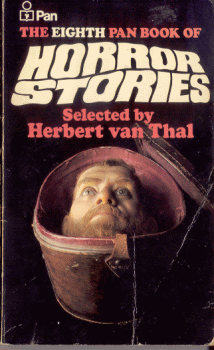
For another, the motif is also found in pop-culture print media. Here's a 1968 paperback for your viewing pleasure (you sicko):
[Further examples of the same motif have been brought to our attention by readers in the Comments: "The Screaming Skull" (story) and Frankenstein Must Be Destroyed (film).]
The main contributer among all these is probably Night Must Fall, which was first a play, then a film, then a radio adaptation, then a film remake. The stage version is still performed, and the films were international hits.
Still, I have to wonder how those relatively modest sources created such a universally recognized symbol. I almost want to go rummaging around in Freudian or Jungian categories, but I won't. Let's go back into the attic; that's creepy enough.
The original attic in DL's Haunted Mansion was a LOT more coherent and thematically sophisticated than it is given credit for. It's not uncommon for fans to point to the two major overhauls of the room as proof that the Imagineers were never satisfied with it, that it was the weakest room in the HM, etc., etc.
Bull-only. Back in the day, what was the first ghost you saw when you went into the attic? A skull-like head leaping out of a round hatbox, that's what. Here he is in glorious 3D, and if you think that's cool, check out the same thing animated. (Boogafrito, you rock.)
You go a little further, and just in case you missed it the first time, there it is again, this time on the left: a skull-like head jumping out of a round hatbox.
Practically right behind that second blast-up stands the original bride in her original spot. (That standing screen wasn't there in the old days.) Her heartbeat fills the room, so her presence fills the room. Is she dangerous or just sort of sad? The attic also has three regular ol' head-on-a-stick pop-ups. They're probably a tribute to traditional spook houses, like everyone says, but they also add a touch of...I don't know...menace...to the atmosphere. Finally, you see the climax of the scene: the Hat Box Ghost. Holy crap, now you know what was being foreshadowed. It's the groom! Apparently, the Imagineers assumed from the beginning that you would assume—and correctly so—that this is the groom to the bride. How did he get beheaded, and how came his head to be hidden in a hatbox? The ride only gives you one real suspect to contemplate, and of course that's the bride. Remember, her presence fills the room, and the hat box head is hideously-mockingly flipping back and forth in synch with her heartbeat. You leave the attic full of dark suspicions. A grisly crime, a shadowy suspect, a perverse nuptial. Clues to something, but only clues.
The severed-head-in-a-hatbox motif dominated the original attic, and it worked because it is an instantly recognizable visual cliché drawn from the vast pop-cultural milieu of horror, crime, and mystery. Removing the Hat Box Ghost removed the linchpin of the entire presentation, taking away the unifying climax. It left the bride without any connection to the blast-up ghosts, and it left the blast-up ghosts without anything to distinguish them from the other pop-ups. The overhauls of 1995 and 2006 were essentially attempts to repair the artistic damage that was done mere weeks after the Mansion opened in 1969.
Just to clinch the fact that the blast-up ghosts are indeed foreshadowing the Hat Box Ghost, it may be noted that Yale Gracey originally intended them to be much more explicitly skulls. Compare his early sketch with the actual schematic for the effect:
He even built one like that. You can barely see the top of it in this photo of Yale in his workshop. It's at the bottom in the extreme foreground. If you can "magic eye" it, it's much easier to see. (I'm telling you kids, it's a skill worth acquiring). If that isn't a "rocket skull" in a leather hatbox, then it has something to do with the Hat Box Ghost himself, I'll bet.
Speaking of leather hatboxes, that one in the Yale photo looks like it could be the actual one used in the ride, which is curious because...
I suppose I could take that further, but I'll quit while I'm a head.
If you're paying attention, you might have noticed how little the attic of today has departed from the original, thematically. Next up, when we start taking a look at Constance, we'll see how closely related the old and the new attics are.
By day a Doctor of Biblical Studies and specialist in The Book of Enoch; by night a tireless investigator of Disney's Haunted Mansion. Don't ask me to explain how that happened.