Things You're Just Supposed to Know

Most of the time, Long-Forgotten assumes that readers are already familiar with basic facts
about the Haunted Mansion. If you wanna keep up with the big boys, I suggest you check out
first of all the website, Doombuggies.com. After that, the best place to go is Jason Surrell's book,
The Haunted Mansion: Imagineering a Disney Classic (NY: Disney Editions; 2015). That's the
re-named third edition of The Haunted Mansion: From the Magic Kingdom to the Movies (NY:
Disney Editions, 2003; 2nd ed. 2009). Also essential reading is Jeff Baham's The Unauthorized
Story of Walt Disney's Haunted Mansion (USA: Theme Park Press, 2014; 2nd ed. 2016).

This site is not affiliated in any way with any Walt Disney company. It is an independent
fan site dedicated to critical examination and historical review of the Haunted Mansions.
All images that are © Disney are posted under commonly understood guidelines of Fair Use.

________
.
Showing posts with label Pepper's Ghost. Show all posts

Friday, January 31, 2025

Here Comes the Bride, Part Six: Connie Loses Her Axe

 .UPDATES ADDED 2-28-25 

Los Angeles Times

Kid you not, within days of the debut of the New Constance (Jan 18, 2025), I began getting inquiries as to why I hadn't said anything yet. "Well? Where's the post??"  *sigh* That's how things go these days. Everyone wants instant analysis. But I say it's better to let the first wave of excitement/outrage run its course before taking to the keyboard. Otherwise, you end up saying things that look embarrassingly knee-jerky and outdated within a very short time.

We'll deal with all the other new stuff—the stuff outside the attic—in the next post. That will include not only the new queue and the execrable Somewhere Beyond, but all the other items as well. There are quite a lot of them, actually. Some are good, some are bad. You'll see.


What's New?

We had better begin with what was actually done and who did it. According to my sources, the new attic and all the rest of the new changes to the Mansion were done locally, at Anaheim, rather than by Walt Disney Imagineering. If so, don't blame WDI (at least not directly) if there's anything there you don't like, or praise WDI if there are things you do. I'm told this was done by Disneyland, and for good or ill, responsibility for the whole thing goes ultimately to DL's art director, Kim Irvine.

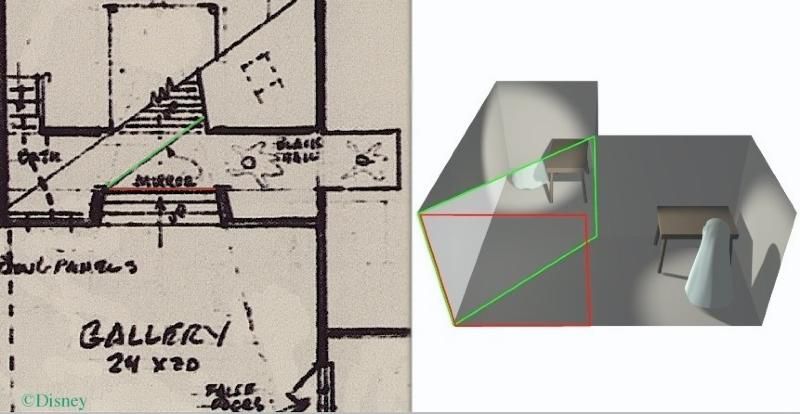
The New Connie is an odd combination of Pepper's Ghost and mapped projection onto a blank white mannequin. If the latter sounds a lot like the old Connie, you hear correctly. They put in a huge piece of glass at a 45º angle, tilting toward you. The reflected image in it is projected from a very shallow hollow in the floor. They evidently wanted a blowing fabric effect for the dress, which wouldn't have been very easy to accomplish if the reflected image were laying horizontally, so we've got this mannequin along with Pepper, which is strange, because it seems to defeat the whole genius and raison d'être of Pepper's Ghost: its magical transparency. The face is totally Pepper's, so there's no real reason why it couldn't be animated to some degree, and perhaps it will be in future.

 You can see the new diagonal beams on either side of her, put there to support and hide the edges of the sheet of glass, which is well-done, but in some videos, you can glimpse part of the figure in the floor.


One problem with Pepper's is that the large sheet of glass in use can inadvertently pick up reflections of irrelevant objects that happen to be in the wrong spot and are too brightly lit. Ever since Connie debuted in 2006, this has been an irritant, because the Ambrose portrait and other items in that attic tableau can be seen reflected in the ballroom glass as you scoot along. Alas, the same issue is found here, as a pile of brightly lit packages and dishware on the floor next to the Connie & George portrait can be seen floating upside down in the air near the attic ceiling while you're looking at the new bride.

VicariousCorpse

You've heard of the mystery of the haunted wedding gifts, haven't you? Some say they float along the ceiling upside down. Others say it's only a trick of the light.

Maybe they'll fix that. I'm told that they were still tweaking the thing until the last minute, and it shows. The bride's nose is all wonky in the early photography. (See the pic they released to the LA Times at the top.) Hopefully they will fix it.* Of course, I kept saying that about the old Constance too. I'm also struck by the fact that the new figure is totally static. The older brides swayed back and forth and moved their candle arm. This one just stands there, stock-still.

*UPDATE 2-12-25: Looks like they did.

Steven Lewis

They haven't changed the bride's name. "Constance" is still attested numerous places in the hubby-portrait tableaux, so we haven't got a new bride so much as a complete overhaul and reinvention of the old one.


One has to wonder whether "Hatchaway" is still supposed to be her maiden name, since the pun is now inappropriate. It has been canonical these last 20 years, since it's on the marriage certificates that have been on public display in the attic (albeit a little irregularly), even though riders can't possibly read them.


But if those are gone now (yet to be confirmed as of this writing), "Hatchaway" may be considered gone as well.

So . . . why the change?


Technological Advances? 

If you check out the Tom Martens article about the new bride in the LA Times, you will be told that it involved, among other things, an updating of the technology.

According to the Times, the new bride utilizes "the latest in projection technology," and you're looking at a technological "advance." He got this rubbish from Kim Irvine, who told him the "projection technology on the prior figure had become so outdated as to necessitate regular maintenance," which is an odd thing to say since everything needs "regular maintenance."

What I'm told is that the projector in the floor is exactly the same projector used for the old Constance. So much for technological advance. Someone might point out here the gee-whiz magical effects that come with the new bride, those ghostly little orbs floating around her in three-dimensional space. Whatever else you might say, no one can deny that the effect looks very cool . . . 


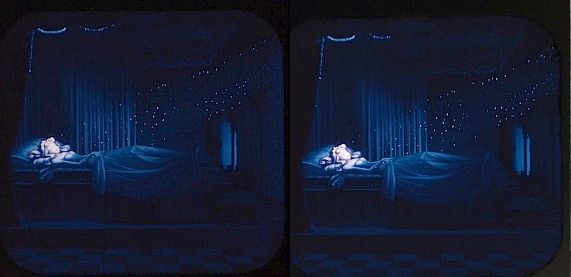
. . . just like it did in 1957:


Matter of fact, if you check out the current incarnation of the Sleeping Beauty walk-thru, you'll see an array of impressive Pepper's effects beyond which the new Connie advances not a single millimeter.


Sensitivity Issues?

Kim sez: "The bride that used to be in there was an ax murderer, and in this day and age we have to be really careful about the sensitivities of people. We were celebrating someone chopping off her husband's heads, and it was a weird story." Not surprisingly, these kinds of comments have sparked a lot of mockery and indignation, but at the same time there's a kernel of truth in all that. As I argued years ago, the Connie story doesn't jibe well with the artistic statements of the HM, which are two: (1) the afterlife may be joyful rather than horrifying. However, (2) justice must be served. It was the attic's job to temper the Mansion's otherwise universal message by adding a detective story, brilliantly told in about one minute of actual time. The essence of all detective stories is that evil exists and the demands of justice must be met. That stern claim cannot simply be wished away. (It may be washed away by an act of atonement, but at that point we're talking about Christianity.) Anyway, as I pointed out, the Constance story does not fit either message: it was a story in which the devil wins, which is a common horror theme but foreign to the Mansion until 2006. So yes, however much wicked fun people got out of her, there was always something out of place with the Constance saga. Talking about "sensitivity" may not be the best approach to the problem, but it does recognize that something smelt funny about her.


The Boring Truth?

It's possible I'm wrong about this, but if I am, there's an extraordinary coincidence that wants explaining. The original Constance character was brought to (after)life by two talented ladies, Kat Kressida and Julia Lee.


Kat provided the voice and Julia the look (although it's never been absolutely clear whether Kat as well as Julia contributed something to the heavily-doctored and digitized visual projection of Connie). Anyway, Connie debuted in May of 2006, so these gals most likely contracted with Disney in 2005.

Shortly after Connie's debut, Julia added a credit to her now-defunct website:
 

That "next twenty years" business is VERY strange. Disney normally owns outright the performances for which they contract, and yet it's hard to account for these comments unless they represent something or other in the contract. Can you think of any other way to explain them? Okay, well, do the math, people. 2025 is 20 years after the original contract with Julia (and presumably Kat?). Of course, Julia's visage still appears in the hubby portraits, but perhaps this "twenty years" business pertains only to the video imagery. Whatever. Until I learn otherwise, this will be my answer to the "why" question: Expiration date reached.

These are from one of the Julia Lee photoshoots:


Why the Why? What About the What?

Yes, let's do the real Long-Forgotten stuff. What is supposed to be going on with the new bride? Irvine has given out some blather about bringing back the sorrowful figure that the original Imagineers imagined, a bewildered bride searching for her lost husbands. A story of lost love. So sad.

Ugh. You can read the whole "Here Comes the Bride" series here at LF if you want to know what the original Imagineers were up to. It's true that in many ways the new Connie is a throwback to the old Beating Heart bride, but the original figure was the Corpse Bride, and she was scary.


Not only that, but the Hatbox Ghost made it pretty clear that she was a murderer who beheaded her victim. It's true that after Hattie was gone and Beating Heart continued to evolve (the Black-Faced bride, the Blue-faced bride), she became more ambiguous. I myself used the word forlorn in those discussions, so if Kim wants to claim that bride was sad, I can't say she's crazy to think so. Once the Hatbox Ghost was gone, the murder mystery was destroyed anyway, and people were free to read the bride in multiple ways.


However, Connie 2.0 is not the only new character in the attic. There is also a black cat at her side.

You'd look grumpy too if someone stuck a candy corn in your eye (pic: Mike Kindrich)
 

Is She a Witch?

As everyone knows, this feline friend of Connie's is a tribute to the unused X. Atencio concept, the One-Eyed Black Cat, and this, dear friends, is how tributes should be done: a subtlety found in something organically connected with the story, not a gratuitous addition put there just for the sake of having a "tribute." So kudos to Kim and Co. for that. But with that black cat there, the message I immediately receive is, "The bride was a witch." I've been told that the team responsible for the new attic weren't aiming for that. Irvine has explained the bride as something quite different, a sympathetic character. It is supposed that the black cat is adequately accounted for as a tribute to X and nothing more should be read into it.

But artistic intention only counts for so much if you're trafficking in cultural symbols and stereotypes. "Spooky woman with a black cat at her side" = she's a witch. I feel a little stupid defending that reading, because we are talking here about a pretty firmly embedded symbol in the collective (sub)consciousness of our culture, many centuries old. And besides, what was that One-Eyed Black Cat, anyway? The Atencio character was unambiguously a demonic figure who only appears as a cat. Look up "witch's familiar" if you really need help here.

Some have argued that since she doesn't LOOK like a witch (pointy hat, broom, etc), the assumption is shaky. A ghost with a black cat is not automatically witchy. Neither is a bride with a black cat. So I guess it's every interpreter to their keyboard, and we still have ourselves an open mystery. Fair enough. WITCHever you decide, one must allow that there is BROOM for more than one view. What the HEX, I don't need to SPELL it out any further.

By the witchy reading, though, the interpretation of the new attic is fairly straightforward. The successive husbands of this woman, all of whom mysteriously disappeared, did so because she was an evil witch who probably did them in. That also neatly explains why husbands two through five were increasingly imbecilic in that they did not suspect anything was wrong. It's simple: they were bewitched! Of course, if Connie 2.0 is still a baddie, it means that the attic still gives us an anomaly, a yet-unpunished and yet-unredeemed villain, that all they've done is replace an axe with a hex. (Hmm . . . no wonder they thought a tribute to X fit here.) Finally, I will point out that a sinister interpretation is encouraged by retaining the name "Constance" and her hubby portraits, in continuity with the previous 20 years of history, which unavoidably bring with them certain expectations about her that will continue to hang over the whole place. We have not been given a clean break. (This will be taken up further in the next post, so stay tuned.)


The Hatbox Ghost Disappears Again

The worst thing about this addition, in my admittedly subjective opinion? With the total expunging of the beheading theme, there is no longer any organic connection between the Hatbox Ghost and the attic. He's been standing outside the attic proper for ten years anyway, but now he really is outside; that is, he can no longer be considered an "attic character." I suppose he's become so famous that he's no longer seen as requiring some particular reason for fitting him into the Mansion, no more than, say, the Opera singers or the Royals. But the fact that henceforth he does not tie in with any known narrative with regard to the Mansion's imaginative history feels to me like the unkindest cut of all.


The Candelabra Floats

I don't mind in principle their attempt to expand the character's presence in the Mansion by matching her candelabra not only to the one in the Endless Hallway but also to a new candelabra in the graveyard, which replaces the purplish wraith in the crypt by the Opera Pair.


Like others, I think the ghost was much more interesting than the new candelabra, and I always hate it when a 1969 original effect is scrapped. But the idea itself is agreeable in that it deliberately raises questions which it doesn't answer, like any good haunted house should.


Influences

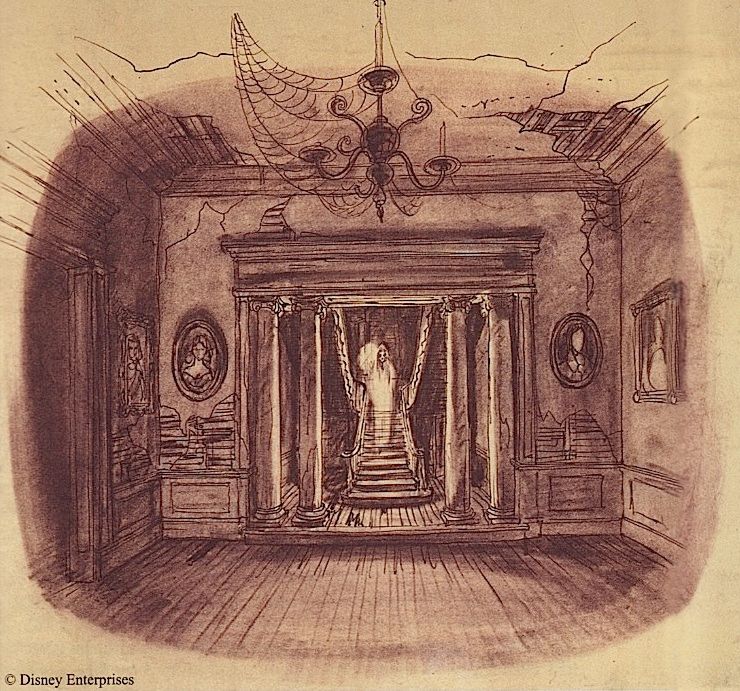
Since we're in the awkward position of denying what the Imagineering team claims they intended to do, there is no point in pulling up examples of stuff that may have influenced the new figure as a concept, but we can at least say a few things about visual influence. First of all, the new Connie looks a lot like some of the concept art for the old Connie:

The eerie flowing effect on her gown reminds me a little of the Falls of the Bride in Peru. It's possibly an influence, but I wouldn't press it. Otherwise, see the previous brides for visual influences.

Something Wicker This Way Comes

It took a long time for photos to finally appear, but as was reported earlier there is a wicker coffin in the corner of the attic where the HBG originally stood and where the Beating Heart bride stood from late 1969 until the spring of 2006.

yensidtlaw

Wicker coffins were popular during the Civil War period because they were cheaper to make, and they continued to be popular for various reasons through Victorian times and beyond (i.e., for transport, for displaying the body at funerals, for temporary use until a doctor could examine the corpse, etc.). Here's an authentic Victorian example:


 Also new is a pig-shaped picnic basket in the Ambrose tableau:

 yensidtlaw
 

Again, nothing original about these:

The grapes and bread are somehow still fresh, but then, so is the wedding cake, so . . . supernatural preservation, I guess.

I don't see any need to tie these new props together within some sort of new, united backstory. More likely, one or another of the Imagineers involved came across these antique wicker items online or in a shop somewhere and thought they looked kinda Mansiony.


Conclusions

The consensus to date is that the new Connie is visually an improvement over the old Connie, but that's a pretty low bar. The amount of money and effort that went into this new version hasn't produced anything like the hoped-for results. "Underwhelmed" is a word that keeps appearing, and I've encountered exactly that same reaction from die-hard Mansion freaks and casual park goers alike. Overall, an improvement, but it feels like a missed opportunity. Maybe more is coming?


**************

Tuesday, October 29, 2019

The "Boy Mechanic" Myth (OR IS IT? UPDATED!)

.
Edit: November, 2020. I've been in communication with a source that potentially calls into question the whole premise of this post, or most of it. But first, go ahead and read the original blogging below, and then take note of the update that immediately follows it.

Kind of a downer post, folks. Sorry about that. But it's time for someone to turn a KNOW into a NO.

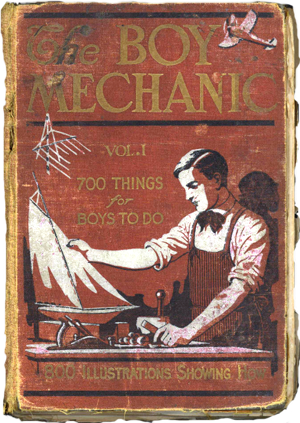
If you're any kind of Mansion history nerd, one thing you know (or think you know) is that special effects whiz Yale Gracey was heavily influenced by a book called The Boy Mechanic, which came out in 1913 and gave him all kinds of neat-o mosquito, tough torpedo ideas he would later use to cook up illusions for the Haunted Mansion.


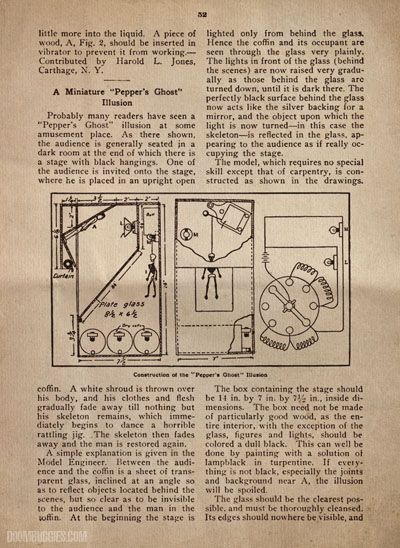
The example everyone points to is the "Pepper's Ghost" illusion on pages 52-53:


I'm sorry to report that Rolly Crump is the man chiefly responsible for promoting the Boy Mechanic myth. It was he who first pointed out the Pepper's Ghost chapter, implying that this is where Yale got the idea for this most convincing of all Haunted Mansion illusions.

I don't doubt Rolly's sincerity, but the simple fact is that there is virtually nothing in the book that looks to me like it might have served as inspiration for anything in the Mansion. Yes, I've read it. Nothing there. It's a compendium of projects contributed by a host of readers of Popular Mechanics magazine, with all sorts of "how to make this" and "how to do that" instruction, some of it extremely rudimentary and some of it remarkably sophisticated. It is true that there are lots of magic tricks in it, but they are mostly the kind of things you found in that first ever "magic set" you got as a kid. Coin, card, and handkerchief tricks. Think of the beloved Magic From the Haunted Mansion 1970 souvenir booklet. That level. Oddly enough, however, and at the other extreme, The Boy Mechanic also includes explanations of how some very professional stage tricks are done, and these go well beyond the scope of DYI at home even by adults, let alone boys. There's the levitating lady with hoops passed over her, and very sophisticated black boxes that require trained assistants and special lighting. You wonder why they're in there, except as spoilers. Nevertheless, I didn't find anything even among those that I could connect with something in the Mansion. (By the way, the books have thorough indices, making it easy to find all the "tricks," "magic," and "illusions.")

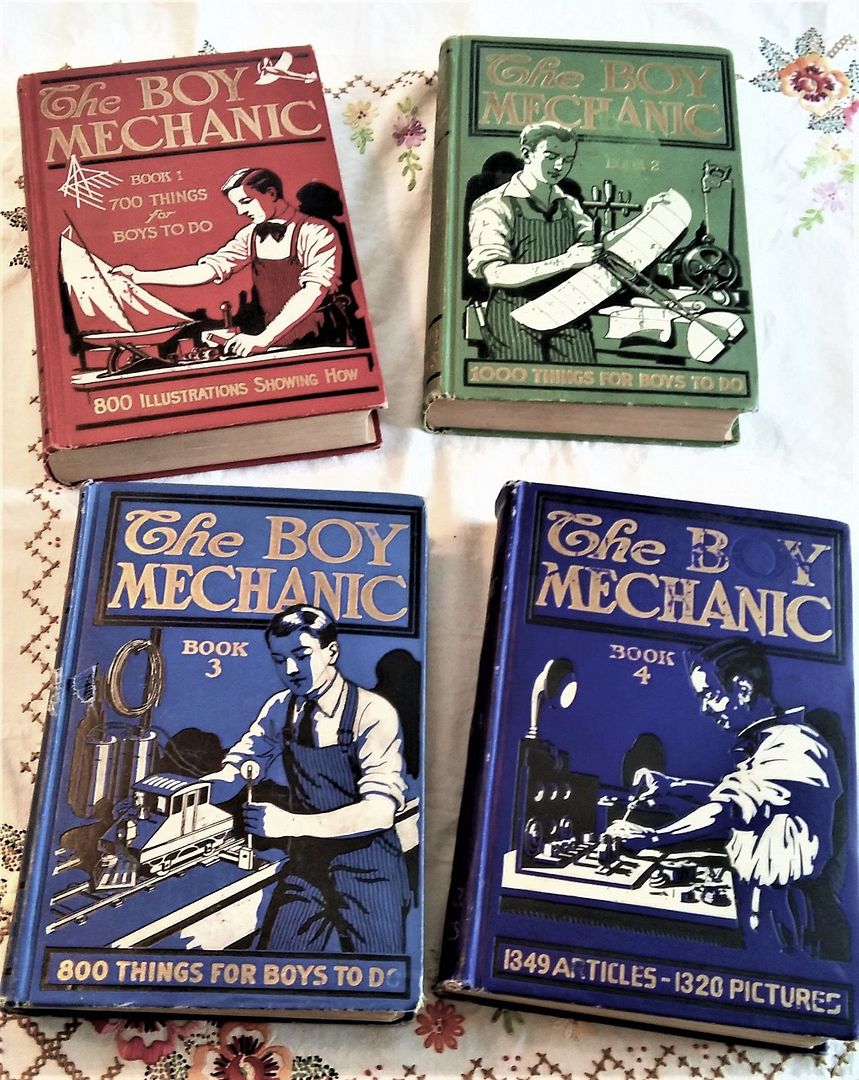
Did I say "books"? Yep, there are actually four volumes in the series, not just the one.


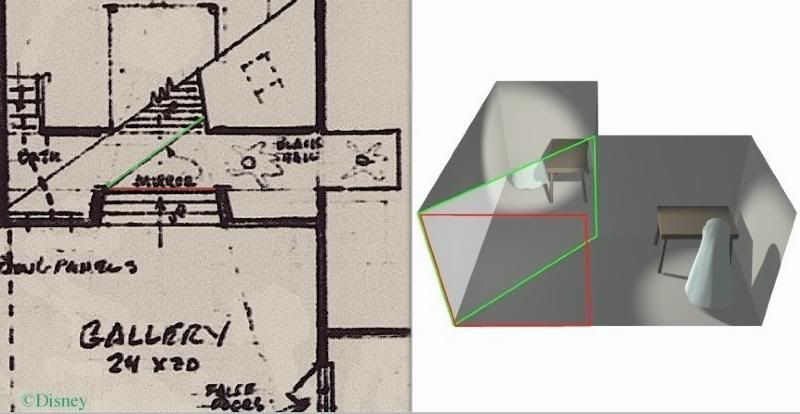
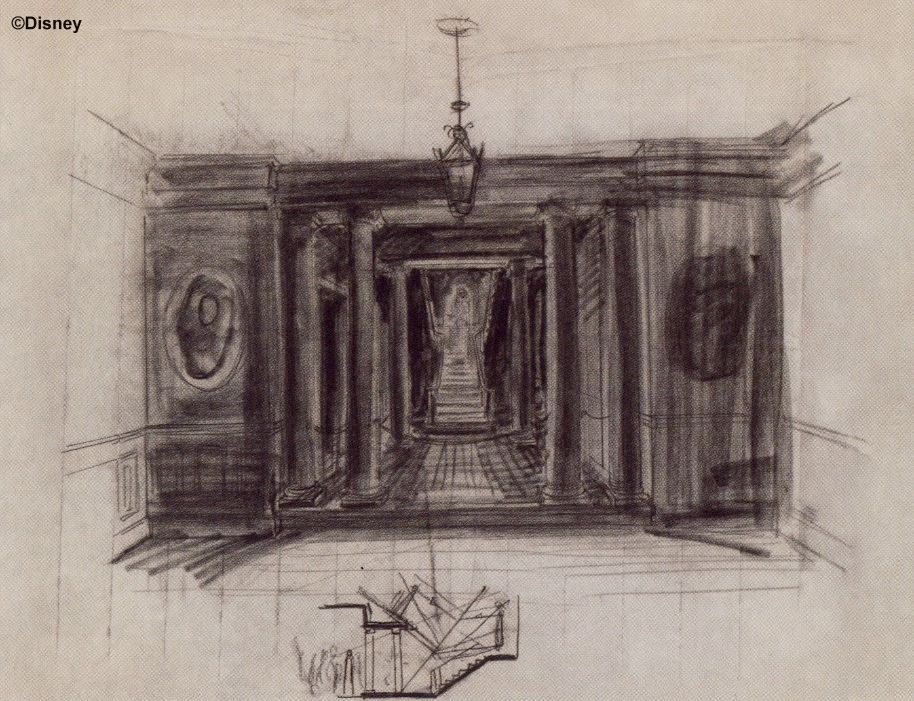
But what about that Pepper's Ghost chapter? Well, we've covered this ground before (HERE, and HERE), but to recap, Ken Anderson's plans for the Disneyland Haunted House featured several applications of Pepper's Ghost. You will remember that those plans date from 1957-58, and Yale's involvement in the project began in 1959, so it's not as if Ken's plans were lost in a file somewhere and forgotten over time.


But there's even more Pepper there than we knew. We've seen this Anderson sketch before:


What we didn't know until it was published recently is that Anderson did a second sketch of this scene,
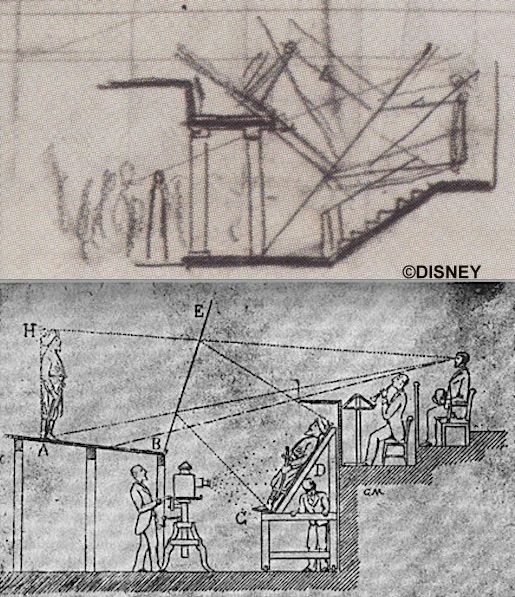
this time included a diagram of how the illusion would be achieved, using classic Pepper's Ghost:

MDIHOW 337

Ken's diagram is crystal clear and reminds me of 19th century specimens:


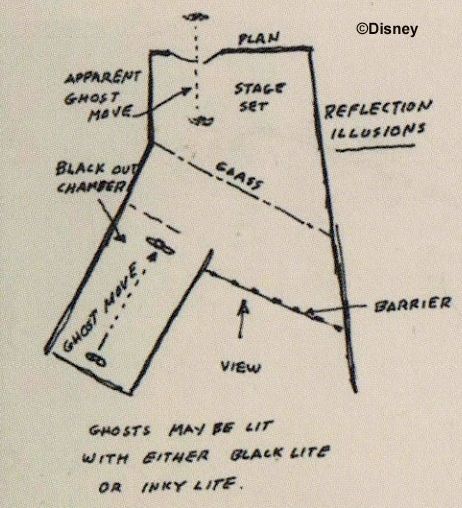
Turning to Yale, more complete and better quality copies of pages from Yale's notebooks have also been published recently, in
MDIHOW (421) and at Doombuggies . com. They provide good examples of how Yale would have used Pepper in the attraction:


Looks to me a heck of a lot more like Ken Anderson than Boy Mechanic.

And then there's the fact that the original '57 Sleeping Beauty walk-thru was absolutely loaded with extremely sophisticated examples of Pepper's Ghost, thanks to Anderson. Perhaps the best way to appreciate this is to get ahold of the Sleeping Beauty 50th Anniversary Platinum Edition DVD. In the Special Features is a fascinating history of the original walk-thru attraction (hosted by Tony Baxter and Chris Merritt). Everyone talks about what a special effects genius Yale Gracey was, but I'm telling ya, our boy Ken was not far behind.


It's perfectly possible that Ken's work stirred memories in Yale of seeing such an illusion in an old book he had
read as a kid, and perhaps he made some remarks to Rolly about it, and the whole thing grew out of that. Whatevv.

*****************

And now for the update. My source is a former WDI Imagineer who once worked with a couple of WDI guys who worked with Yale in earlier years. One of them was in fact Yale's assistant not long before Yale's retirement and took over the department as it moved into the EPCOT years. Anyway, according to my source, both of those guys told him that Yale worked on the Sleeping Beauty walk-thru, heavily implying that the sophisticated Peppers Ghost effects (and other effects) in the diorama were in fact the work of Yale Gracey, not Ken Anderson. The problem is that there is currently no hard evidence for his involvement, like his name on a project document. But as second-hand hearsay goes, this is much more solid evidence than usual, and it comes from excellent sources. If it's true, then we can imagine a scenario in which Yale first learned about Peppers from those famous pages in the original Boy Mechanic volume and was directly responsible for introducing that effect at WED, to Ken, Rolly, and others. It's still true that there is nothing else in the books that looks remotely like anything seen in the Mansion or elsewhere, so that part of the myth is indeed mythical, but the notion that it was the original source for the Peppers Ghost effect could well be true after all.


Tuesday, August 24, 2010

Death is a Cabaret, Old Chum...

.

Time to get our noses out of the Ancient Near East and back into the Victorian era, where we find more direct sources of inspiration for the Haunted Mansion.  Back HERE I discussed briefly the Cabaret du Néant, with a link HERE to Cory's treatment of the subject, which is largely given over to quoting a lengthy passage from Bohemian Paris of To-day (J.B. Lippincott, 1900).  It was written by W. C. Morrow from notes by Edouard Cucuel (the book also includes Cucuel's sketches).  It's very good, very interesting, and a valuable source, but buyer beware; it's a second-hand account, and in places it's inaccurate.  However, there are descriptions of the C du N published in other sources too, plus a lot of photos.

There is little doubt in my mind that the Cabaret du Néant was a direct source of inspiration for the Haunted Mansion.  My reasons for thinking so will emerge with a fresh description of the Néant experience, drawn from several sources, as well as a closer look at the special effects used in the Néant show.  I do not think these tricks have ever been explained accurately, so if you think you know the Cabaret well enough already—think again.

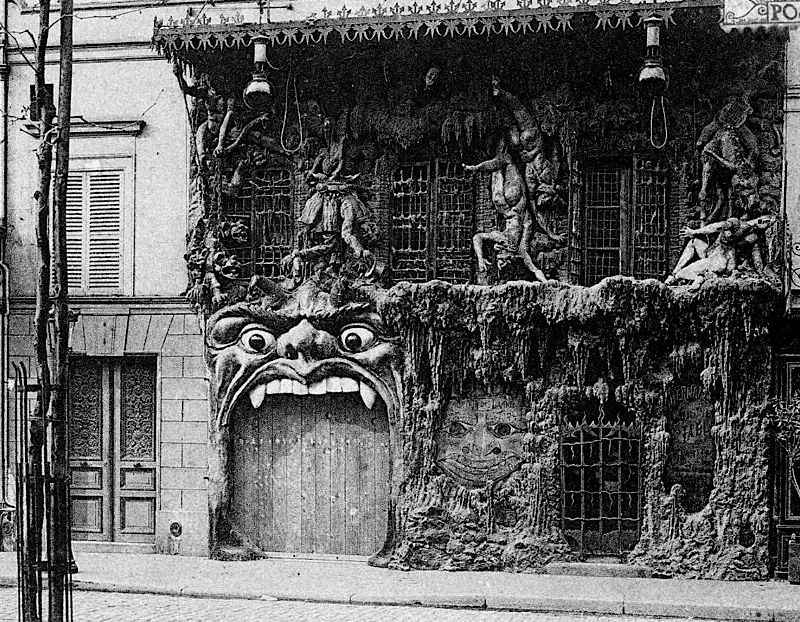
A bit of background.  The pub originally opened in Brussels in 1892 as the "Cabaret de la Mort" (i.e. the Cabaret of Death), but it soon moved to the Montmartre district of Paris, where it was renamed the "Cabaret du Néant" ("néant" = nonexistence, obliteration, nothingness, death).  The Montmartre district was THE place to be if you were an artiste in the second half of the 19th c.  It seems like all of the important Impressionist painters lived there or hung out there.  In the 1890's, it was bursting at the seams with cabarets and theaters, including fully-themed nightclubs.  Practically across the street from the Cabaret du Néant, for example, were the "Cabaret of Heaven" and the "Cabaret of Hell," side by side.  The waiters dressed as angels in the former and devils in the latter.  Guess which one this is:


The famous Moulin Rouge cabaret is still there, but otherwise these pubs and theaters are all gone.

. . . Come to the Cabaret.

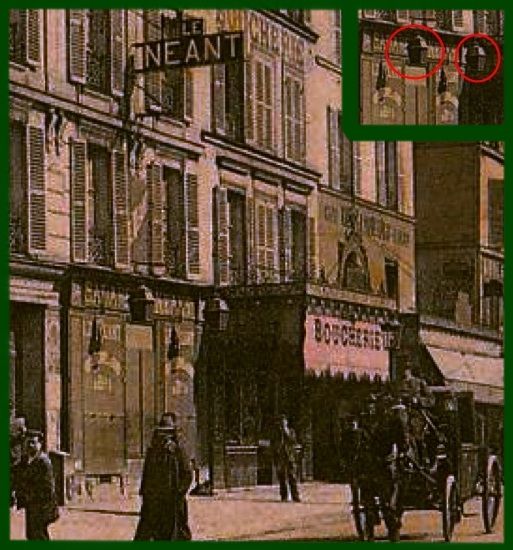
Shall we pay a visit?  Oh, do let's.  The street façade of the CdN is like a house dressed for mourning in traditional French fashion, with austere black and white coverings, although there is a skull and crossbones on the front door.  There are two large, iron, torch-like lamps throwing yellowish-green light down on all who pass by.  That kind of colored light makes people look shockingly sick and corpse-like, so we're already getting in the mood.


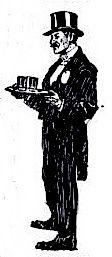
The unsmiling doorman is dressed exactly like a croquet-mort; that is, a professional
pall-bearer or undertaker's assistant.  The same is true for the waiters inside.


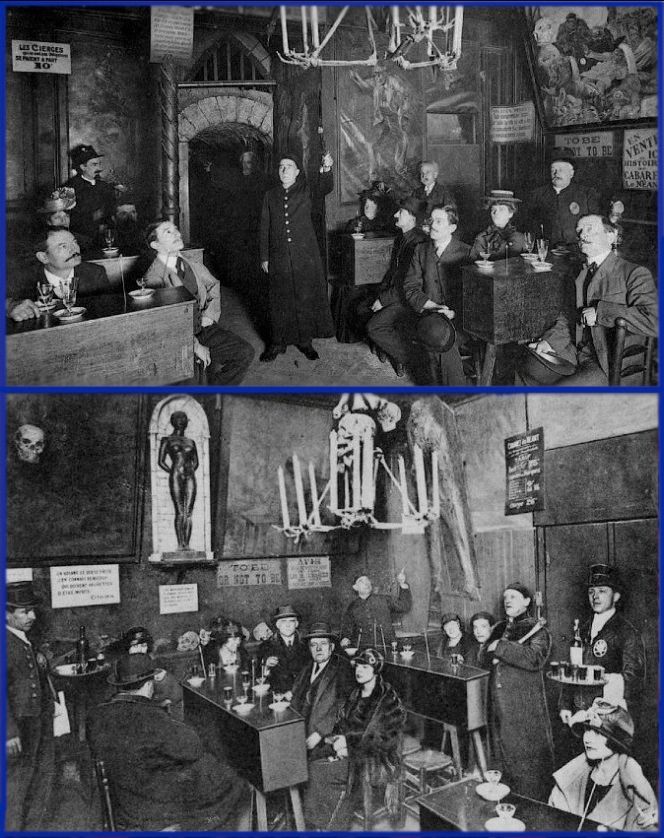
The doorman leads you through the low, narrow front door and down a short, dark corridor.  He opens some black drapes, allowing you to enter the first room.  It's dark, lit only by candles.  A chandelier in the center of the room is constructed of (real) human bones and nicknamed "Robert Macaire's chandelier," Macaire being a sort of all-purpose villain and bogeyman in France.  Upturned coffins serve as tables, with small thin candles available for illumination.

.                         


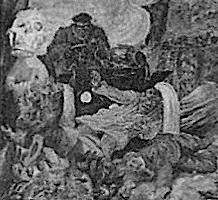
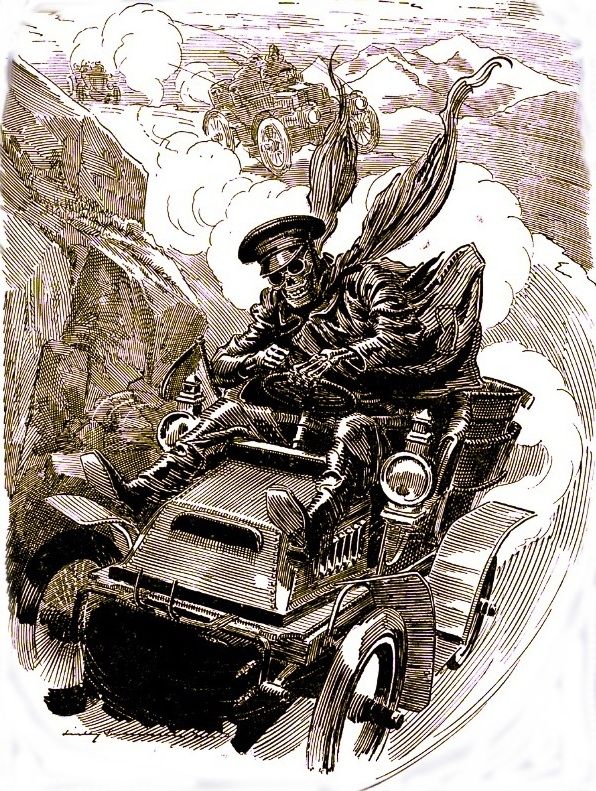
The walls are decorated with skulls (which serve as dim lamps), sculpture, and posters with grim slogans such as "Life is a folly which Death corrects," "To be or not to be," and "Requiescat in Pace," as well as No Smoking signs, price lists, and notices that candles are available for 10 cents.  More importantly, there are paintings all over the walls depicting death and carnage.  Battle scenes, a guillotine in action, and in later times, a painting of an automobile with a demonic driver, running people down—at least I think that's what this is:


It's similar to a cartoon that appeared in Punch, in 1903:

(hat tip to Craig Conley)

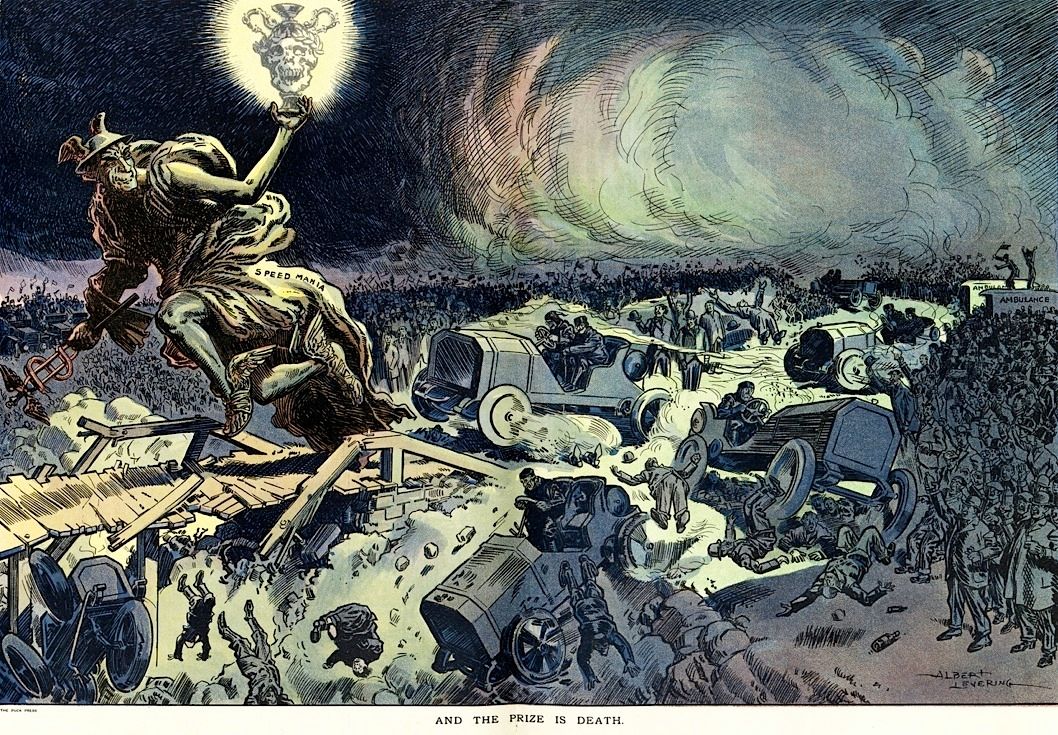
By the way, this was actually a common theme among cynics and satirists in those days. These new-fangled automobiles were extremely dangerous, to the point that they betrayed a contemptible indifference to human (and other) life. They were depicted as instruments of death, glamorous only to the foolish and the callous. Here's a wonderful example from Puck. Behold the demon, "Speed Mania":

Puck 68/1756, Oct 26, 1910

Anyway, back to the Cabaret. Upon entering the room, you are met with "Welcome, moribunds," or "Welcome, weary wanderer, to the kingdom of Death," or "Enter, mortals of this sinful world, enter into the mists and shadows of eternity," or some other greeting striking the same tone as "Welcome, foolish mortals."   Better get used to it.  You and your friends will be continually addressed as "mortals," "coffin worms" (asticots de cercueil), and "Maccabees," the latter term being a slang expression for anonymous cadavers found floating in the river.  In an account from 1931, it says that the staff at that time received guests by chanting a mass for the dead.  The staff are all instructed not to smile or do anything else to break the solemn atmosphere, much like HM butlers and maids.  That includes the waiter, who seems to mean it when he says "Name your poison."  The mixed drinks and the beer are all renamed after deadly microbes and bacteria of various diseases.  The waiter will plop them down before you, saying something like, "Drink, coffin worms.  Drink these loathsome poisons filled with the deadliest germs."

A man in clerical garb eventually enters and gives a lengthy speech in morbid detail about the horrors of death, progressing from the variety of gruesome and agonizing ends awaiting individuals to the miserable fates of mankind in general.

Here the place gets interesting.

As he commences this portion of the lecture, the speaker points to a painting depicting a battle scene.  According to Morrow, it begins to glow, making its details clear (remember, it's pretty dark in there).  Then the glow fades away, and the painting has changed.  The human figures in it are now all skeletons.  The same thing happens with a painting of a guillotine chopping away.  When the glow fades, the figures are now skeletons.  Another painting shows a festive ball.  Glow and fade.  Now the dancers are all skeletons.

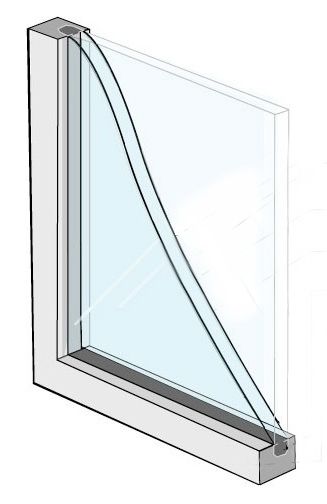
In my earlier treatment I quoted without objection Albert Hopkins' explanation of this effect (written in 1901).  He suggests that the paintings are transparencies with one scene painted on one side and another on the other, the second one becoming visible when illumined from the rear.  I now think that explanation is inadequate.  It doesn't really account for the effect as described by Morrow.  The paintings light up and then fade back down, revealing a skeletonized version of the same scene.  How would you do that with a single, two-sided cloth?  The effect could be produced, however, by having two paintings layered very close to each other, much like the panes in a double-pane window.

The skeleton one is in front, painted on a thin cloth or on theatrical scrim.  The "normal" one is in back.  The paintings are already moderately illumined from the back when folks come in, showing the back painting through the transparent front one.  The lighting is further turned up during the lecture, at the appropriate time, and then faded down and extinguished, leaving the front painting visible for the first time.  This would be perfectly do-able in the 1890's (the CdN was fully electrified).

In that earlier post, I drew a parallel between the CdN changing-painting effect and the attic wedding pictures and portrait hall paintings of the HM.  If the above explanation is acceptable as a more satisfactory accounting for the effect as described, then the parallel between the Cabaret du Néant and the current Disney versions is extremely close indeed.

If you bought a drink while in the first room, you got a ticket entitling you to enter the Chambre de la Mort.  You now take your puny candle and follow a man in Capuchin monk's garb single file through an arched doorway (painted to look like stone), down a narrow flight of steps, with green and yellow lighting once again, making everyone look cadaverous.


At the end of the steps is an antechamber where you wait your turn.  The show repeats about every half hour, and only 15 or 20 are admitted at a time.  To amuse yourself while you wait, you can look through holes or niches in the brickwork at gruesome tableaux, "studies of cholera patients, of persons buried alive, and similar cheerful subjects" (NYT Apr 9, 1894).  Morrow (Cucuel) speaks of "bones, skulls, and fragments of human bodies."  At last a cowled figure with only his eyes visible comes in and produces a large iron key, unlocking the spiked iron gate at one end of the room and opening it with a harsh grating sound.  The monks mournfully announce that you have arrived at the Gates of Death, and in you go.  There is an item inside, near the entrance:  "By a clever arrangement of mirrors one sees one's self on entering reflected lying in a coffin" (NYT '94), which seems like a good idea since you can then see for the first time what you yourself look like under greenish-yellow lighting.

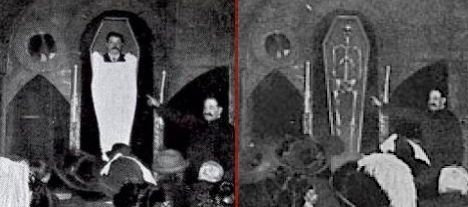
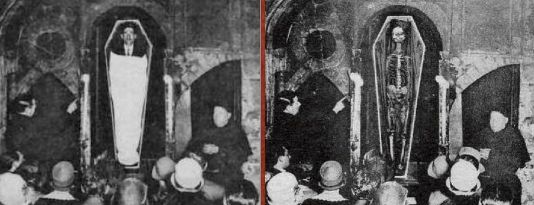
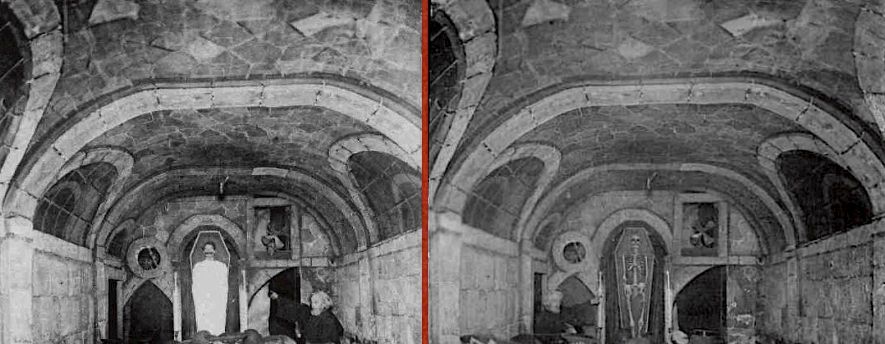
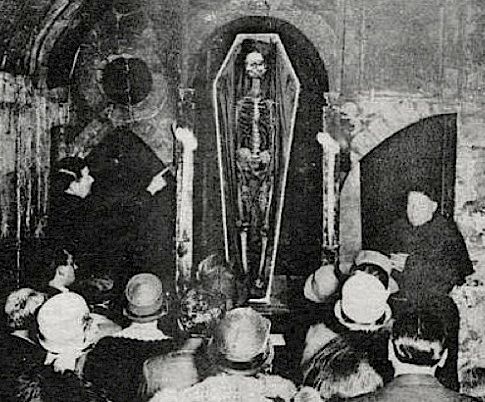
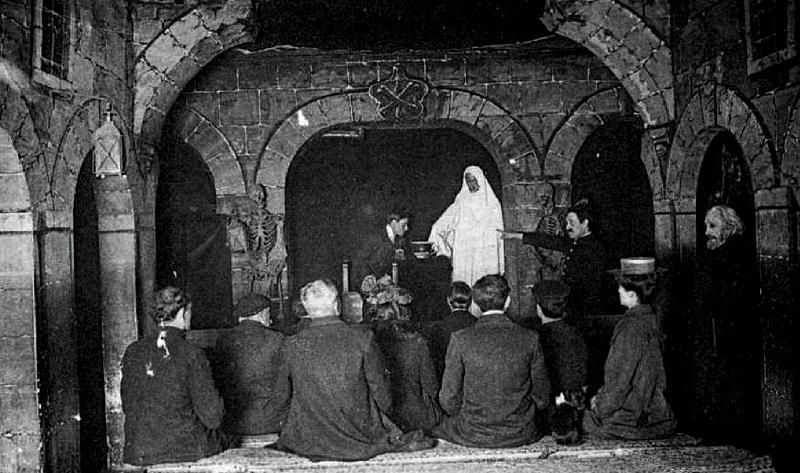
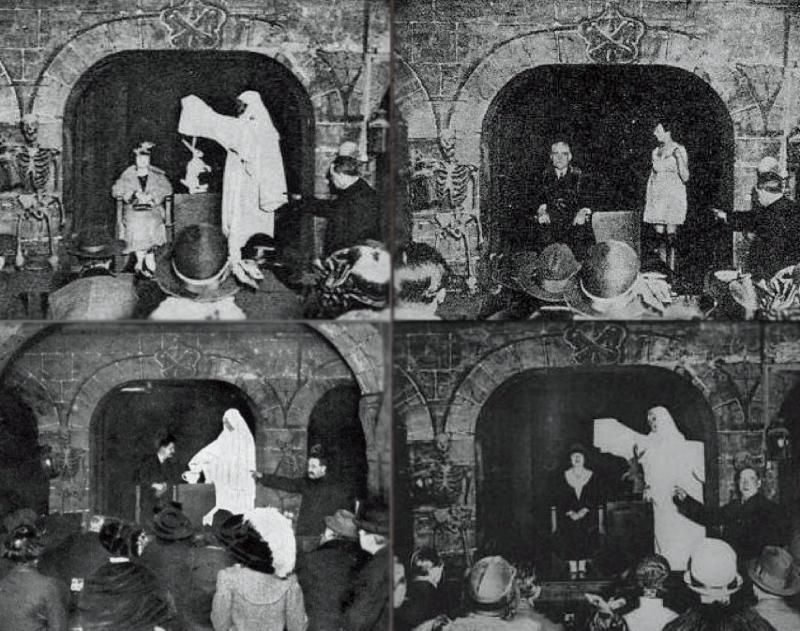
This part of the Cabaret du Néant show is justly famous.  An upright coffin is visible in a narrow doorway at the far end of the room, which was hung in black in early years but later on left exposed, having been painted to look like stone vaulting.  Also in early years, a pretty young lady was already in the upright coffin when you came in. She would smile and wink and then grow silent.  While the monk guide kept up his groaning soliloquy about death and decay, she turned into a decaying corpse and finally a skeleton, right before your eyes.  The process was then reversed, but instead of the young lady a fat old man returned.  He would leave the coffin, and the monks would ask for a volunteer from the audience who would like to experience death.  In later times they went straight to this phase and skipped the earlier stunt.  Not missing a single detail, the Cabaret folks have a harmonium and an iron bell offstage somewhere, providing dirge music and solemn tolls at appropriate times.

There are a lot of pictures of this trick.


I especially like this last set because it really shows the excellent trompe l'oeil work in this chamber, transforming blank wall into convincing arches and stonework through skillful use of the paintbrush.


The trick is done, of course, using the Pepper's Ghost illusion, which requires only a big sheet of glass and careful manipulation of the lighting.  But here again, I think Albert Hopkins' explanation is inadequate.  He's got a simple two-chamber set up, turning the coffin occupant into a skeleton and back again.  With this arrangement, the sense of gradual transformation would be enhanced through the use of colored light.  The light on the volunteer goes from normal to greenish-yellow before fading down, while the skeleton is gradually lit up.

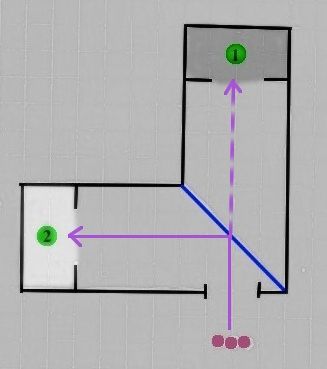
Below is a simplified pair of diagrams.  When the coffin-with-occupant (#1) is illumined and the coffin-with-skeleton (#2) is dark, the audience sees only the first.  When coffin 1 goes dark and coffin 2 is lit up, you see only the second, but it looks like it's in the place of the first.  This is simple, rudimentary Pepper's Ghost illusioneering.


The problem with the Hopkins arrangement is that it does not account for the descriptions of the effect.  Morrow describes a slow dissolving of the face into a corrupt state of decomposition before finally becoming a dried skull:

Her face slowly became white and rigid; her eyes sank; her lips tightened across her teeth; her cheeks took on the hollowness of death,—she was dead.  But it did not end with that.  From white the face slowly grew livid...then purplish black.... The eyes visibly shrank into their greenish-yellow sockets. ...Slowly the hair fell away....The nose melted away into a purple putrid spot.  The whole face became a semi-liquid mass of corruption.  Presently all this had disappeared, and a gleaming skull shone where so recently had been the handsome face of a woman.

Well, Morrow is giving a flowery, second-hand description based on Cucuel's notes, so maybe this is all exaggerated.  But the 1894 New York Times account also describes a three-stage process, although the stages are different: man, skeleton, vacant.  The shroud on the volunteer "by some trick gradually melted away, so did the flesh, or rather the man in the coffin, and a skeleton appeared in his stead.  There remained another experiment to be witnessed, namely, the crumbling away to dust of the bones."

There may even be a photograph of the intermediate, rotted-corpse stage as described by Morrow:


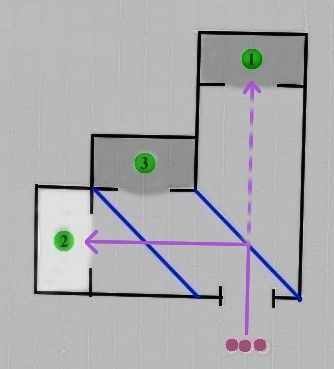
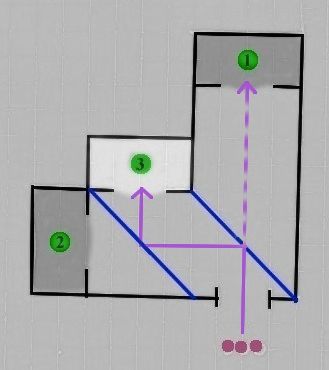
The CdN gang may have had a much more sophisticated set-up than Hopkins describes. One possible
way to add a step to the transformation is with two sheets of glass and a third, intermediate coffin.

.                      


.                      


.                      

For an alternate method, still using only a single glass, see the remarks by "John b" in the Comments (Aug 4, 2013). It involves rotating, back-to-back coffins. The only problem I see with it is that it would be hard to use genuine audience volunteers that way. You'd probably need stooges.

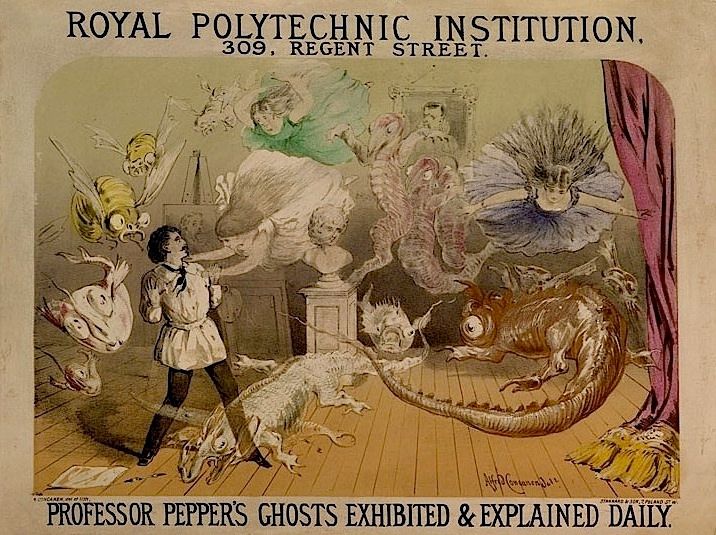
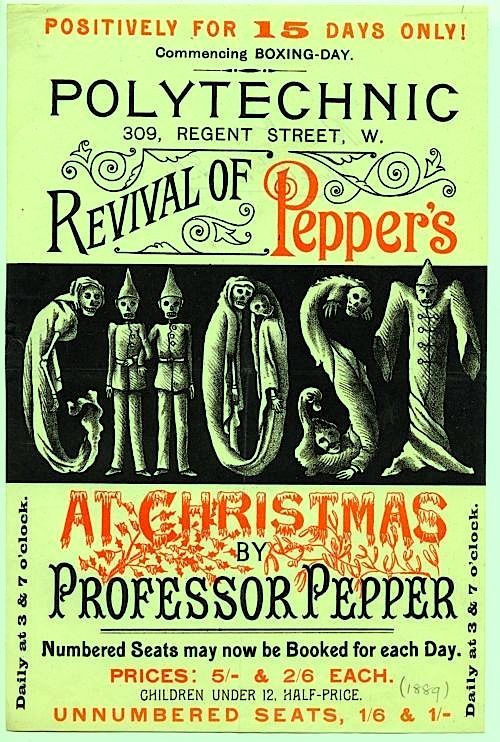
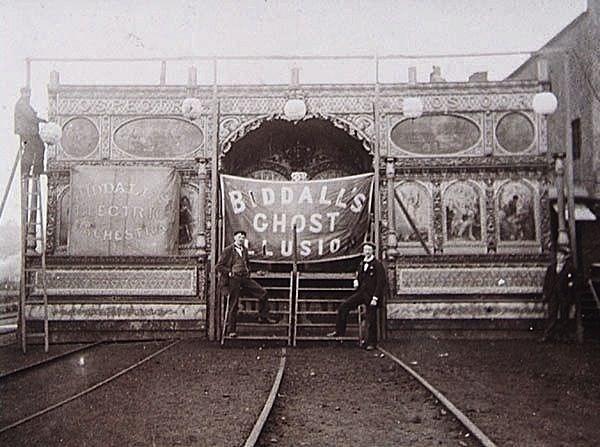
Why so fancy?  By the 1890's, Pepper's Ghost trickery had been in use for thirty years.  The Cabarets of Heaven and Hell, across the street from the CdN, used it in their floor shows.  Various traveling ghost show exhibits and theaters made heavy use of it, and Professor Pepper himself kept flogging it at the Royal Polytechnic Institute where he worked.


.                  


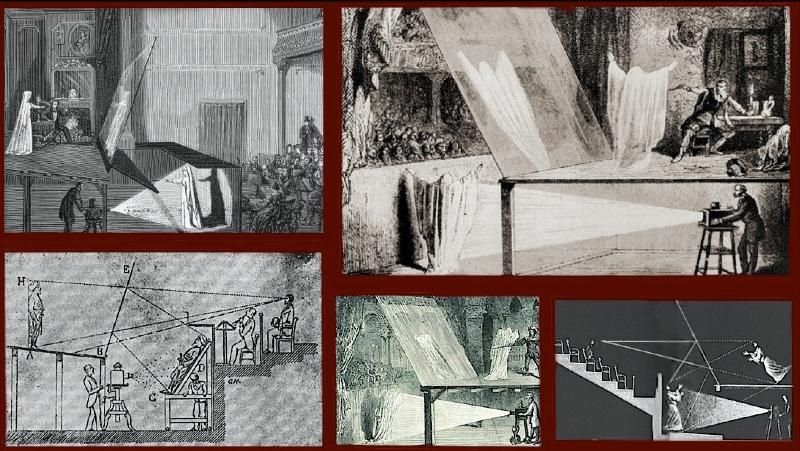
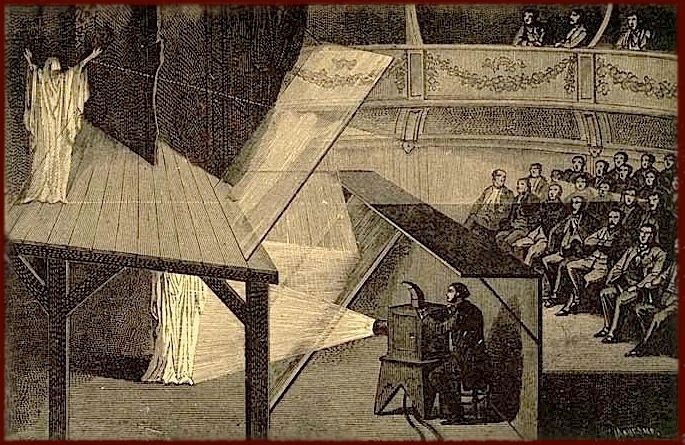
Furthermore, there was no shortage of Victorian spoil-sports eager to inform the public how the illusion was done:


It stands to reason that showmen would be searching for clever new ways to use what was now an old-hat illusion, something to bring back the "how do they do that?" element.  The CdN boys seem just the kind who would tackle such a problem.  Besides, two-sheet Pepper's Ghost illusions were known, even if this illustration doesn't show them making any particularly good use of it.


Originally, the coffin gag was the end of the show at the CdN, but in 1900 or 1901 they added a whole third room, set up like a small theater, with another Pepper's Ghost illusion onstage.


This one was played strictly for farce, to judge by descriptions and photos.  The poor volunteer could not see what the audience saw:  ghosts moving around, mocking, doing stupid bunny tricks, acting in a lewd and lascivious manner (this is Paris, after all).  "[T]he solemnity which the lecturers invoke is of a most mock sort, and the audiences are continuously convulsed with laughter" (NYT 1896).  Time to go.


Rolly Crump and Yale Gracey were professional magicians, as noted in an earlier post, and they did research into things like the history of Pepper's Ghost.  There can hardly be any doubt that they knew about the Cabaret du Néant, which is mentioned in any decent survey of Pepper's.  Earlier, Ken Anderson had incorporated a Pepper's Ghost illusion in his proposed haunted house walk-thru, using a 45º angled glass pane, much like CdN:


Eventually, this horizontal version of Pepper's would be used in Phantom Manor to make Melanie appear in the Endless Hallway.  By the way, the CdN coffin gag was reproduced very closely, except it wasn't at Disneyland but at Knotts Berry Farm:


Besides the technical gimmicks, the CdN used a winning recipe of horror + stage magic + laughs, essentially the formula used for the Haunted Mansion.

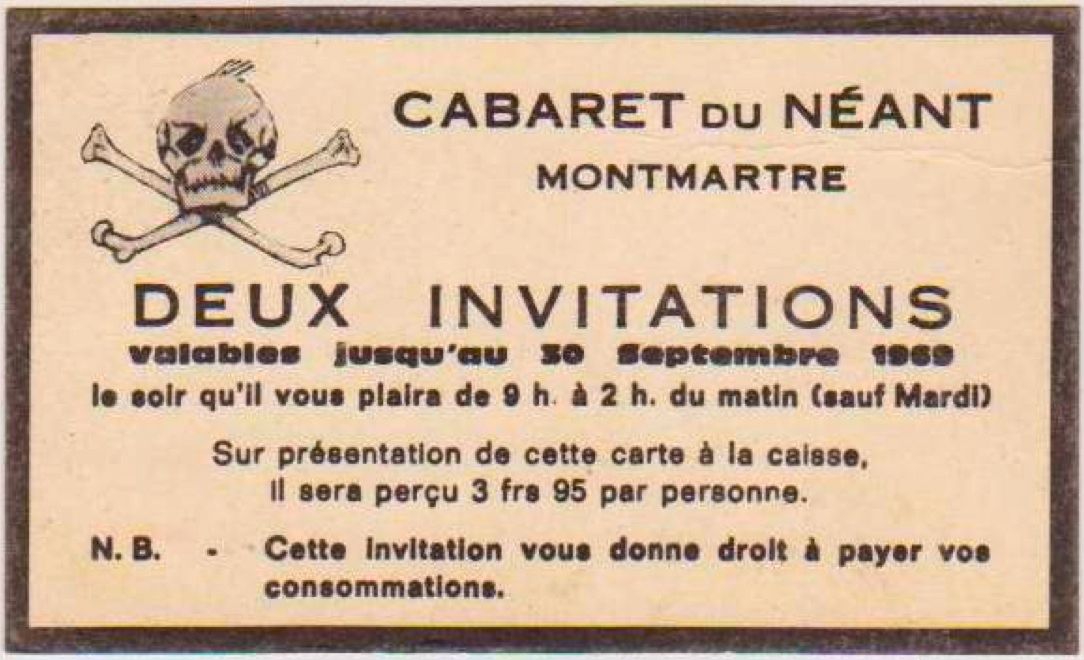
Some time in the 1930s the Cabaret moved to a different location on the same street (#64 instead of #34) and continued to operate there for a long time. In November of 2012 we made a major discovery: The Cabaret du Néant was still open in September of 1969, in other words, still operating when the Haunted Mansion opened.


As a postscript, I should mention the apparent discrepancy between the photos of the coffin gag, in which the coffin looks like it's standing right in the doorway, and the actual set-up, which had it much further back.  It's simple:  these are staged photos, intended for post cards and publicity.  They moved the coffins up for the photo shoots.
.